The Curious Cat Investing, Economics and Personal Finance carnival is published monthly with links to new, related, interesting content online.
- We Need a Warby Parker for Mattresses by Rohin Dhar – “Like eyeglasses, mattress technology is fairly stable. Yet, publicly traded mattress wholesalers have gross margins of 41-64% (TPX, ZZ, SCSS). Across the industry, the retailers then mark up the mattresses another 96% on average (calculated from here). By the time a customer buys a mattress, it costs them ~74% more than the production cost of the product. An 74% gross margin is a lot of room for a startup to figure out how to acquire customers!”
- Manufacturing Output as Percent of GDP from 1980 to 2010 by Country by John Hunter – “For the 10 largest manufacturing countries in 2010, the overall manufacturing GDP percentage was 24.9% of GDP in 1980 and dropped to 17.7% in 2010.”
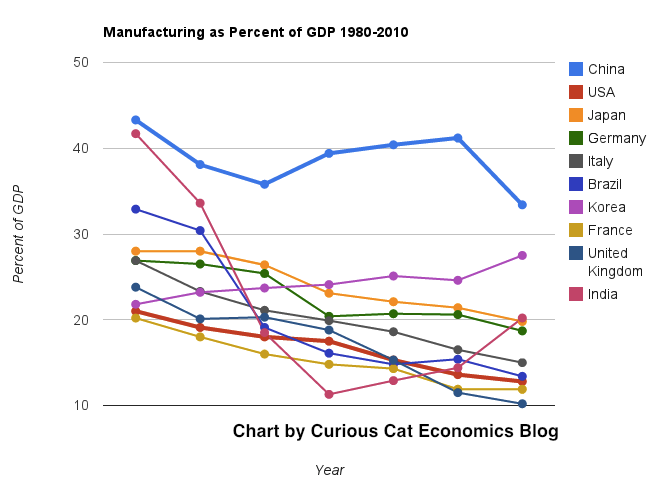
This chart shows manufacturing output, as percent of GDP, by country and was created by the Curious Cat Economics Blog based on UN data. You may use the chart with attribution. - Wall Street doesn’t know what business it is in by Mark Cuban – “Regulators have got to start to recognize that traders are not investors and vice versa and treat them differently. Different regulations. Different tax structure. Different oversight. Individual investors and the funds that just invest in stocks and bonds are not going to crash the market. Big traders who are always leveraging up and maximizing the number of trades/hacks they make will always put the system at risk…
There is absolutely NO VALUE to High Frequency Trading. None.” - Who is speaking for the poor? by Felix Salmon – “the smarter you are (as measured by IQ), the more likely you are to be invested in the stock market. And this distribution is independent of wealth… Most impressively, check out this paper from 2007. It asked just three “simple mathematical questions” of couples to judge the numeracy of each one. If neither got any questions right, the total wealth of the couple, on average, was $202,000. If they both got one question right, it was $505,000. If they both got two questions right, it was $853,000. And if they both got all three questions right, their average wealth on average was a whopping $1.7 million. (If they got different scores from each other, the wealth ended up somewhere in between.)”
- Too Big to Fail and Too Risky to Exist by William Quirk – “In 1989, the CEOs of our seven largest banks earned an average of $2.6 million. In 2007, the average CEO income had risen to $26 million… In 2011, Phil Angelides, chairman of the U.S. Financial Crisis Inquiry Commission, summarized the problem: ‘These banks are too big to fail. They’re too big to manage. They’re too big to regulate. They’re too complex to understand and they’re too risky to exist. And the bottom line is they offer very little benefit.’ (as you can imagine CEO’s taking $26 million [and all the other well paid minions] want to continue doing whatever allows that and they pay the politicians enough to avoid and actual fixes being implemented – John).
- Europe’s crisis will be followed by a more devastating one, likely beginning in Japan – “About half of the Japanese government’s annual budget now goes to pensions and interest payments. As the government has spent more and more to support its growing elderly population, Japanese savers have willingly financed ever-increasing public-sector debts… Japanese savers are essentially tendering their savings in return for newly issued government debt, which is not backed by hard assets. It is backed only by an aging, shrinking population of taxpayers.”
- The Rise of Market Correlations – “…formed the bases of Nobel Laureate Harry Markowitz’s Modern Portfolio Theory (MPT). The correlations between individual assets and their impact on the overall portfolio return/risk profile are crucial elements of this theory. MPT has received many recent criticisms; however, the contributions to managing risk through uncorrelated investments are invaluable to the long-term success of individual investors.”
- Surprise! There Are 386,000 More Jobs Than We Thought – “We thought the U.S. economy added just under 2 million jobs between March, 2011 and March, 2012. Turns out, the actual number was more like 2.4 million — a big difference!”
Leave a Reply