Author: John Hunter

  • Iskandar Malaysia Economic Development Zone

    Based on my thoughts on killing the Goose laying golden eggs in Iskandar Malaysia posted on a discussion forum. The government has instituted several several policies to counteract a bubble in luxury real estate prices in the region (new taxes on short term capital gains in real estate [declining amounts through year 6]), increasing limits on purchases by foreigners, new transaction fees (2% of purchase price?) for real estate transactions, requirements for larger down-payments from purchasers…

    Iskandar is 5 times the size of Singapore and is in the state of Johor in Malaysia. Johor Bahru is the city which makes up much of Iskandar but as borders are currently drawn Iskandar extends beyond the borders of Johor Bahru.

    The prospects for economic growth in Iskandar Malaysia in the next 5, 10 and 15 years remain very strong. They are stronger than they were 5 years ago: investments that produce economic activity (theme parks, factories, hospitals, hotels, retail, film studio…) have come online and more on being built right now.

    Cooperation with Singapore is the main advantage Iskandar has (Iskandar is next to the island of Singapore similar to those areas surrounding Manhattan). It provides Iskandar world class advantages that few other locations have (it is the same advantages offered by lower cost areas extremely close to world class cities – NYC, Hong Kong, London, San Francisco etc.). Transportation connections to Singapore are critical and have not been managed as well as they should have been (only 2 bridges exist now and massive delays are common). A 3rd link should be in place today (they haven’t even approved the location yet).

    A MRT connection to Singapore (Singapore’s subway system) should be a top priority of anyone with power interested in the future economic well being of Iskandar and Johor. Johor Bahru doesn’t have a light rail system yet this would be the start of it. It has been “announced” as planned for 2018 but not officially designated or funded yet.

    (more…)

  • Lazy Golfer Portfolio Allocation

    There are many asset allocation strategies; which often are pretty similar. In general they oversimplify the situation (so an investor needs to study and adjust them to their situation – though most don’t do this, which is a problem). In general, I think asset allocation suggestions are too heavily weighted on bonds, and that is even more true today in the current environment – of could that is just my opinion.

    I ran across this suggested allocation in Eyewitness to a Wall Street mugging which I think has several good values.

    • It focuses on low fee, market index funds. Fees are incredibly important in determining long term investment success
    • It has lower bond allocation than normal
    • It has more international exposure than many – which I think is wise (this suggested portfolio is for those in the USA, USA portion should be lowered for others)
    • It includes real estate (some suggested allocations miss this entirely)

    In my opinion this allocation should be adjusted as you get closer to retirement (put a bit more into more stable, income producing investments).

    My personal preference is to use high quality dividend stocks in the current interest rate environment. I would buy them myself which does require a bit more work than once a year rebalancing that the lazy golfer portfolio allows.

    I would also include 10% for Vanguard emerging markets fund (VWO) (for sake of a rule of thumb reduce Inflation Protected Securities Fund to 10% if you are more than 10 years from retirement, when between 10 and 1 year from retirement put Inflation Protected Securities Fund at 15% and Total Stock Market Index Fund at 35%, when 1 year from retirement or retired lower emerging market to 5% and put 5% in money market.

    Depending on your other assets this portfolio should be adjusted (large real estate holdings [large net value on personal home, investment real estate…] can mean less real estate in this portfolio, 401k holdings may mean you want to tweak this [TIAA CREF has a very good real estate fund, if you have access to it you might make real estate a high value in your 401k and then adjust your lazy portfolio], large pension means you can lower income producing assets, how close you are to retirement, etc.).

    The Lazy Golfer Portfolio (Annually rebalance the fund on your birthday and ignore Wall Street for the remaining 364 days of the year) contains 5 Vanguard index funds

    • 40% Total Stock Market Index Fund (VTSMX)
    • 20% Total International Stock Index Fund (VGTSX)
    • 20% Inflation Protected Securities Fund (VIPSX)
    • 10% Total Bond Market Index Fund (VBMFX)
    • 10% REIT Index Fund (VGSIX)

    Related: Retirement Planning, Looking at Asset AllocationLazy Portfolio ResultsInvestment Risk Matters Most as Part of a Portfolio, Rather than in IsolationStarting Retirement Account Allocations for Someone Under 40Taking a Look at Some Dividend Aristocrats

  • Global Workplace

    The world has become very interconnected. This is no surprise, the evidence is all around us and continues to increase. What this actually means though is more complex than it appears.

    One area this impacts greatly is the workplace. More and more people are working internationally. This continues to largely be either through large multinationals or cheap labor that is imported to do largely unskilled or minimally skilled labor.

    There is also a continuing increase in skilled and educated labor working overseas for other than huge multi-nationals. The infrastructure to support this is often not in place. The current structure (visas etc.) support the two modes mentioned above.

    But I see an increasing number of opportunities for countries that encourage entrepreneurship and high skill jobs. I relocated to Malaysia and in doing so did a bit of research. It is difficult to get a long term visa in most countries without a full time job (and given the complexity of hiring foreign workers this often means dealing with companies that do a lot of it – in the 2 categories mentioned above).

    Career prospects are enhanced with international experience. One way to get a jump start on your career is international education. This has been popular for a long time but is becoming more and more popular. Students studying in London can get the benefits of international experience (unless they are from England, obviously) and enjoy the great city of London and accessible travel to Europe.

    The importance is to truly gain an international perspective. Those in the USA have the greatest problem as knowledge workers in most other countries are much more aware of the global economy. Europe is an easy way to get started and is packed with lot of great schools and processes in place to make it easy to become a student.

    As I mentioned in a previous post, I believe the most important factor for a career is finding something you love to do, but within those possibilities it is nice to know the payoff of different college degrees.

    Those that see Asia as the economic engine for the next 50 years might well be tempted to look at attending school there. There are plenty of options though it may take a bit more work on your part to make it happen. I think attending at least some portion of college internationally is a great idea as is getting international work experience early in your career.

    Related: How to Balance the Benefits of Foreign Workers and the Potential Damage to Citizen’s Job ProspectsLeading Economic Freedom: Hong Kong, Singapore, New Zealand, Switzerland

  • Phased Retirement

    I have long thought the binary retirement system we have primarily used is less than ideal. It would be better to transition from full time work to part time work to retirement as people move into retirement. According to this study, from the University of Michigan Retirement Research Center, the phased retirement option is becoming more common.

    Macroeconomic Determinants of Retirement Timing

    partial retirement has been on the rise across all age and income groups. While partial retirement was virtually non-existent for 60-62 years olds in 1960, over the past 20 years more than 15 percent of workers in this age group are categorized as partially retired. For 65-67 year olds, the recent partial retirement rate is over 20 percent, up from 5-10 percent in 1960.

    The paper doesn’t really focus much on what I would find interesting about the details of how we are (or mainly, how we are not) adjusting to make partial retirement fit better in our organization (the paper is focused on a different topic). The paper does provide some interesting details about the changes with retirement currently.

    Related: Career Flexibility67 Is The New 55Retirement Delayed, Working Longer

  • USA Congress Further Aids Those Giving Them Cash – Risks Economic Calamity Again

    It is no surprise those we elect that have shown there primary concern is providing favors to those giving them lots of cash have given the wall street crowd that showers them in cash what they want yet again. As long as we keep electing these people they will keep providing benefits to those giving lots of cash that the rest of society is stuck paying for.

    Read more about this huge fiasco: Congress Sells Out To Wall Street, Again!

    Even ill-informed politicians now can’t pretend they don’t know the risks they run by providing these favors. But they figure they won’t have to be accountable – they haven’t been held accountable so far. So they are probably right that they won’t be held accountable when the taxpayers suffer huge losses and the taxpayers have to again bail out the too big to fail institutions and savers have to again bail out the too big to fail banks and…

    As bad as the economy has been since the to-big-too-fail crowd created economic calamity it is amazing it hasn’t been much worse. The extraordinary efforts of the Fed have been amazingly successful. I worry they have put us in an extraordinarily risky place but so far the results have been remarkable. Hoping such slights of hand (plus huge transfers of wealth from middle class savers to to-big-too-fail speculators – in the tune of hundreds of billions of dollars – so it isn’t like there are not huge suffering by millions of people – even those that were not thrown out of work) will allow continued reckless giveaways to those paying politicians is a very bad idea.

    But it is no surprise those we elect have chosen that course of action. It seems we are very unlikely to learn without a real depression being forced by decades of extremely foolish behavior by our elected officials in Washington DC.

    Related: Continuing to Nurture the Too-Big-To-Fail Eco-systemThe Risks of Too Big to Fail Financial Institutions Have Only Gotten WorseAdding More Banker and Politician Bailouts is not the AnswerFailure to Regulate Financial Markets Leads to Predictable Consequences (as does letting big contributors create “regulations” that are nothing more than government granted favors to huge organizations)Congress Eases Bank Laws, 1999, while risks were stated by those not willing to lie down for Wall Street Lobbyists (few though they were)

  • Global Stock Market Capitalization from 2000 to 2012

    Looking at stock market capitalization by country gives some insight into how countries, and stocks, are doing. Looking at the total market capitalization by country doesn’t equate to the stock holdings by individuals in a country or the value of companies doing work in a specific country. Some countries (UK and Hong Kong, for example) have more capitalization based there than would be indicated by the size of their economy.

    It is important to keep in mind the data is in current USA dollars, so big swings in exchange rates can have a big impact (and can cause swings to be exacerbated when they move in tandem with stock market movements – if for example the market declines by 15% and the currency declines by 10% against the US dollar those factors combine to move the result down).

    Chart of stock market capitalization from 2000 to 2012 for USA, China, Japan, UK and world
    The chart shows the top four countries based on stock market capitalization, with data from 200 to 2012. The chart created by Curious Cat Investing and Economics Blog may be used with attribution. Data from the World Bank.

    As with so much recent economic data China’s performance here is remarkable. China grew from 1.8% of world capitalization in 2000 to 6.9% in 2012. And Hong Kong’s data is reported separately, as it normally is with global data sets. Adding Hong Kong to China’s totals would give 3.7% in 2000 with growth to to 8.9% in 2012 (Hong Kong stayed very stable – 1.9% in 2000, 2% in 2012). China alone (without HK) is very slightly ahead of Japan.

    The first chart shows the largest 4 market capitalizations (2012: USA $18.6 trillion, China and Japan at $3.7 trillion and UK at $3 trillion). Obviously the dominance of the USA in this metric is quite impressive the next 7 countries added together don’t quite reach the USA’s stock market capitalization. I also including the data showing the global stock market capitalization divided by 3 (I just divide it by three to have the chart be more usable – it lets us see the overall global fluctuations but doesn’t cram all the other data in the lower third of the chart).

    Canada is the 5th country by market capitalization (shown on the next chart) with $2 trillion. From 2000 to 2012 China’s market capitalization increased by $3.1 trillion. The USA increased by $3.6 trillion from a much larger starting point. China increased by 536% while the USA was up 23.5%. The world stock market capitalization increased 65% from 2000 to 2012.

    Related: Stock Market Capitalization by Country from 1990 to 2010Government Debt as Percent of GDP 1998-2010Manufacturing Output by Country 1999-2011: China, USA, Japan, Germany

    (more…)

  • Continuing to Nurture the Too-Big-To-Fail Eco-system

    Fed Continues Adding to Massive Quantitative Easing

    In fact, while the Fed has pumped about $2.8 trillion into the financial system through nearly five years of asset buying.

    Bank excess reserves deposited with the New York Fed have mushroomed from less than $2 billion before the financial crisis to $2.17 trillion today. In essence, roughly two-thirds of the money the Fed pumped into the banking system never left the building.

    The Fed now pays banks for their deposits. These payment reduce the Fed’s profits (the Fed send profits to the treasury) by paying those profits to banks so they can lavish funds on extremely overpaid executives that when things go wrong explain that they really have no clue what their organization does. It seems very lame to transfer money from taxpayers to too-big-to-fail executives but that is what we are doing.

    Quantitative easing is an extraordinary measure, made necessary to bailout the too-big-to-fail institutions and the economies they threatened to destroy if they were not bailed out. It is a huge transfer payment from society to banks. It also end up benefiting anyone taking out huge amounts of new loads at massively reduced rates. And it massively penalizes those with savings that are making loans (so retirees etc. planing on living on the income from their savings). It encourages massively speculation (with super cheap money) and is creating big speculative bubbles globally.

    This massive intervention is a very bad policy. The bought and paid for executive and legislative branches that created, supported and continue to nurture the too-big-to-fail eco-system may have made the choice – ruin the economy for a decade (or who knows how long) or bail out those that caused the too-big-to-fail situation (though only massively bought and paid for executive branch could decline to prosecute those that committed such criminally economically catastrophic acts).

    The government is saving tens of billions a year (maybe even hundred of billions) due to artificially low interest rates. To the extent the government is paying artificially low rates to foreign holders of debt the USA makes out very well. To the extent they are robbing retirees of market returns it is just a transfer from savers to debtors, the too-big-to-fail banks and the federal government. It is a very bad policy that should have been eliminated as soon as the too-big-to-fail caused threat to the economy was over. Or if it was obvious the bought and paid for leadership was just going to continue to nurture the too-big-to-fail structure in order to get more cash from the too-big-to-fail donors it should have been stopped as enabling critically damaging behavior.

    It has created a wild west investing climate where those that create economic calamity type risks are likely to continue to be rewarded. And average investors have very challenging investing options to consider. I really think the best option for someone that has knowledge, risk tolerance and capital is to jump into the bubble created markets and try to build up cash reserves for the likely very bad future economic conditions. This is tricky, risky and not an option for most everyone. But those that can do it can get huge Fed created bubble returns that if there are smart and lucky enough to pull off the table at the right time can be used to survive the popping of the bubble.

    Maybe I will be proved wrong but it seems they are leaning so far into bubble inflation policies that the only way to get competitive returns is to accept the bubble nature of the economic structure and attempt to ride that wave. It is risky but the supposedly “safe” options have been turned dangerous by too-big-to-fail accommodations.

    Berkshire’s Munger Says ‘Venal’ Banks May Evade Needed Reform (2009)

    Munger said the financial companies spent $500 million on political contributions and lobbying efforts over the last decade. They have a “vested interest” in protecting the system as it exists because of the high levels of pay they were earning, he said. The five biggest U.S. securities firms, only two of which still exist as independent companies, paid their employees about $39 billion in bonuses in 2007.

    Related: The Risks of Too Big to Fail Financial Institutions Have Only Gotten WorseIs Adding More Banker and Politician Bailouts the Answer?Anti-Market Policies from Our Talking Head and Political Class

  • Too-Big-to-Fail Bank Created Great Recession Cost Average USA Households $50,000 to $120,000

    A report by the Dallas Federal Reserve Bank, Assessing the Costs and Consequences of the 2007–09 Financial Crisis and Its Aftermath, puts the costs to the average household of the great recession at $50,000 to $120,000.

    A confluence of factors produced the December 2007–June 2009 Great Recession—bad bank loans, improper credit ratings, lax regulatory policies and misguided government incentives that encouraged reckless borrowing and lending.

    The worst downturn in the United States since the 1930s was distinctive. Easy credit standards and abundant financing fueled a boom-period expansion that was followed by an epic bust with enormous negative economic spillover.

    Our bottom-line estimate of the cost of the crisis, assuming output eventually returns to its pre-crisis trend path, is an output loss of $6 trillion to $14 trillion. This amounts to $50,000 to $120,000 for every U.S. household, or the equivalent of 40 to 90 percent of one year’s economic output.

    They say “misguided government incentives” much of which are due to payments to politicians by too-big-to-fail institution to get exactly the government incentives they wanted. There is a small bit of the entire problem that is likely due to the desire to have homeownership levels above that which was realistic (beyond that driven by too-big-to-fail lobbyists).

    “Were safer” says a recent economist. Which I guess is true in that it isn’t quite as risky as when the too-big-to-fail-banks nearly brought down the entire globally economy and required mass government bailouts that were of a different quality than all other bailouts of failed organizations in the past (not just a different quantity). The changes have been minor. The CEOs and executives that took tens and hundreds of millions out of bank treasures into their own pockets then testified they didn’t understand the organization they paid themselves tens and hundreds of a millions to “run.”

    We left those organizations intact. We bailed out their executives. We allowed them to pay our politicians in order to get the politicians to allow the continued too-big-to-fail ponzie scheme to continue. The too-big-to-fail executives take the handouts from those they pay to give them the handouts and we vote in those that continue to let the too-big-to-fail executives to take millions from their companies treasuries and continue spin financial schemes that will either work out in which case they will take tens and hundreds of millions into their person bank accounts. Or they won’t in which case they will take tens of millions into their personal bank accounts while the citizens again bail out those that pay our representatives to allow this ludicrous system to continue.

    (more…)

  • Goldman Sachs, Visa and Nike Added to Dow Jones Industrial Index: HP, Alcoa and Bank of America Out

    At the close of business this Friday Goldman Sachs, Visa and Nike will be added to Dow Jones Industrial Average (DJIA) and HP, Alcoa and Bank of America will be dropped. The DJIA is a not something that deserves attention in my opinion, but it gets it. The index of 30 large stocks is less useful than say the S & P 500 Index with I prefer.

    The “industrial” heritage (represented by the name) is still visible but as the economy has changed the makeup of stocks has moved to reflect the growing importance of services.

    The 30 stocks in the DJIA will be:

    • American Express Company – AXP
    • AT&T – T
    • Boeing – BA
    • Caterpillar – CAT
    • Chevron – CVX
    • Citigroup – C
    • Coca-Cola – KO
    • Du Pont – DD
    • Exxon Mobil – XOM
    • General Electric Company – GE
    • General Motors – GM
    • Goldman Sachs – GS
    • Home Depot – HD
    • Intel – INTC
    • International Business Machines – IBM
    • Johnson & Johnson – JNJ
    • J. P. Morgan Chase – JPM
    • Kraft Foods – KFT
    • McDonald’s – MCD
    • Merck – MRK
    • Microsoft – MSFT
    • Minnesota Mining & Manufacturing – MMM
    • Nike – NIKE
    • Pfizer – PFE
    • Procter & Gamble – PG
    • United Technologies – UTX
    • Verizon Communications – VZ
    • Visa – V
    • Wal-Mart Stores – WMT
    • Walt Disney – DIS
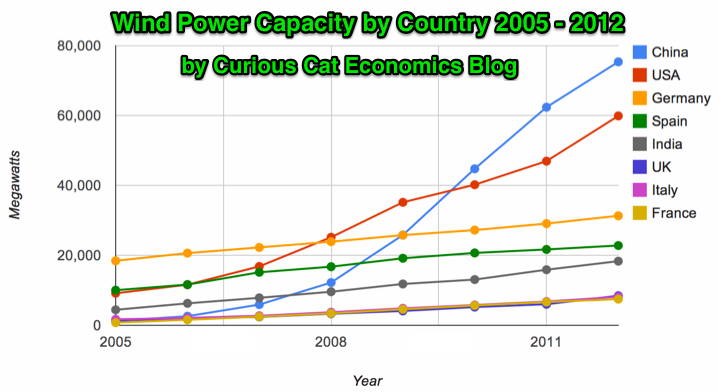
  • Chart of Global Wind Energy Capacity by Country 2005 to 2012

    Global wind power capacity has increased 391% from 2005 to 2012. The capacity has grown to over 3% of global electricity needs.

    chart of global wind power capacity by country from 2005 to 2012
    Chart by Curious Cat Economics Blog using data from the Wind Energy Association. Chart may be used with attribution as specified here.

    The 8 countries shown on the chart account for 82% of total wind energy capacity globally. From 2005 to 2012 those 8 countries have accounted for between 79 and 82% of total capacity – which is amazingly consistent.

    Japan and Brazil are 13th and 15th in wind energy capacity in 2012 (both with just over one third of France’s capacity). Japan has increased capacity only 97% from 2005 to 2012 and just 13% from 2010 to 2012. Globally wind energy capacity increased 41% from 2010 to 2012. The leading 8 countries increased by 43% collectively lead by China increasing by 68% and the USA up by 49%. Germany added only 15% from 2010 through 2012 and Spain just 10%.

    Brazil has been adding capacity quickly – up 170% from 2010 through 2012, by far the largest increase for a county with significant wind energy capacity. Mexico, 24th in 2012, is another country I would expect to grow above the global rate in the next 10 years (I also expect Brazil, India and Japan to do so).

    In 2005 China accounted for 2% of wind energy capacity globally they accounted for 30% in 2012. The USA went from 15% to 24%, Germany from 31% to 12%, Spain from 17% to 9% and India from 8% to 7%.

    Related: Global Wind Energy Capacity Exceeds 2.5% of Global Electricity Needs (2011)Nuclear Power Generation by Country from 1985-2010Chart of Wind Power Generation Capacity Globally 2005 to 2012 (through June)