Author: John Hunter

  • Health Care Costs Continue to Grow Including Costs Missed in Economic Data

    A recent report by Deloitte, The Hidden Costs of U.S. Health Care: Consumer Discretionary Health Care Spending provides some interesting data.

    Between 2006 and 2010 USA health care expenditures increased by 19%. Government spending accounted for 40% of costs (remember that figure is lowered due to Deloitte’s including inputed value for care of relatives). Those 65 and older account for 61% of the inputed cost care that is provided.

    chart of USA health care spending by age group
    Seniors and baby boomers account for 64% of health care costs, but comprise only 40% of the USA population. The imputed cost of supervisory care and hospital care are far higher proportions of health care expenditures of seniors (65 and older).
    An additional $621 billion in direct and indirect costs was estimated for goods and services above what is captured in NHEA accounting. Of this additional amount, $492 billion (79 percent) is the imputed value of unpaid supervisory care given to individuals by family or friends.

    I find this imputed value largely not worth considering. There are problems with the way we count GDP and economic activity (that affect health care and lots of other things). It is fine to be aware that they think $492 billion of extra care is given by family members but using that figure in any sensible way (other than saying hey there is a huge cost in people’s time to dealing with our health care system and sick people that isn’t counted in economic data) is questionable.

    It is useful in looking at the increasingly old population we will see in the future and judging their is a large need for supervisory care that is not captured in just looking at the costs included in economic data currently. Not only will our grandkids have to pay for our living beyond our means today they will have to do so while providing unpaid care to their parents and grandparents.

    The burden of long term supervisor care (that which can be provided by a non-health care professional) is one reason a resurgence in multi-generation housing options make sense to me. There are other good reasons also (child care, socialization, financial support to the young…). There are some real advantages and real disadvantages to such options. But I think economic advantages are going to encourage more of this going forward.

    Related: Personal Finance Basics: Long-term Care InsuranceHealth Care in the USA Cost 17.9% of GDP, $2.6 Trillion, $8,402 per person in 2010Resources for Improving Health Care System Performance

  • Lavishing Tax Cuts on Ourselves That Our Grandkids Have to Pay For is Bad Policy

    Those that want to continue the policies of the last few decades of policies that tax our grandkids to pay for us living beyond our means seem to have won the day again. Not a surprise; very sad though.

    In my reading stories on the wonderful success of “avoiding the fiscal cliff” seems to amount to passing the George Bush tax cuts again (except this time when in a much much worse budgetary position) and modifying the extent to which the absolute richest benefit from those cuts (so the richest don’t get quite as step cuts as they had been getting but still are getting big cuts from before the Bush tax cuts were made. And the recent trend of treating trust fund babies as the absolute most favored taxpayers was continued (though a few of the absolute richest trust fund babies will have to have some taxes withheld from their windfalls).

    I haven’t read anything about them getting rid of the “hedge fund manager” tax favors. Did they? Did they even bother to change the law so retired managers don’t get the super huge tax favors too?

    On the spending beyond our means issue they seem to have just decided that having the grandkids continue to fund our spending is wonderful.

    If it were up to me I would have continued some of the Bush tax cuts (certainly not for those making more than $200,000 – unless we can cut spending way more than I would guess in which case I would be fine having taxes even for the richest few lowered). I would have continued treatment that reduced taxes owed on dividends and capital gains, though perhaps a bit less than they did. I would cap mortgage deductions (at say $50,000 a year or something).

    I certainly would not have supported such massive Bush tax cuts without large spending cuts. If this level of spending is what we intent to do, we need to pay for it and not just bury our kids and grandkids with huge bills. Without spending cuts I would not have voted again for the Bush tax cuts, which seems to be the main extent of their “solution” (taking a bit of the tax cuts for the wealthiest off the plate but pretty much just passing Bush’s tax cut again).

    (more…)

  • Curious Cat Investing, Economics and Personal Finance Carnival #40

    The Curious Cat Investing, Economics and Personal Finance carnival is published monthly with links to new, related, interesting content online.

    • Health-care bill in retirement: $240,000 by Elizabeth O’Brien – “Here’s a breakdown of where their $240,000 goes: 32% goes to premiums for Medicare Parts B & D, which cover doctor visits and drugs, respectively; 23% goes to prescription drugs expenses not covered by Medicare Part D; and 45% goes toward Medicare cost-sharing provisions, including copayments, deductibles, other services not covered by Medicare, and any optional Medigap policies purchased.

      For all their detail, Fidelity and EBRI’s retirement health-care estimates have a whopping exclusion: the cost of long-term care, which could be provided at home or in an assisted living or nursing facility.”

    • We’re Headed For A Disaster Of Biblical Proportions by Henry Blodget – “The rise in population, the ten-fold increase in wealth in developed countries, and the current explosive growth in developing countries have eaten rapidly into our finite resources of hydrocarbons and metals, fertilizer, available land, and water.”
    • photo of street art of spaceman in space
      Street art, Yogyakarta, Indonesia by John Hunter
    • Save What You Can, Increase Monthly Savings as You Can Do So by John Hunter – “My favorite tips along these lines are: spend less than you make, save some of every raise you get…”
    • A Better Way to Deliver Aid by Dr. William Brindley and Douglas Sabo – “To increase the speed of delivery and put decision-making power into the hands of beneficiaries, the international aid community has made a concerted effort over the last decade to transition away from the distribution of in-kind goods to the direct transfer of cash payments to assist those in need”
    • (more…)

  • USA Fiscal Cliff – Better Than Past Behavior

    I am glad we have a “fiscal cliff” to finally get some reduction in the future taxes both parties have been piling on with abandon the last few decades. When you have enormous spending beyond your income, as the USA has had the last few decades, cutting current taxes is just raising taxes on your grandchildren to pay for your spending. Shifting taxes to your grand children is not cutting taxes it is shifting them to future generations.

    If you want to really cut taxes you must cut taxes and not pass on paying for your cuts to your kids. It seems pretty obvious those that advocating cutting current taxes the last few decades were only interested in living beyond their means today and foisting the responsibility to pay to their grandchildren. That is despicable behavior.

    The fiscal cliff is an opportunity to return to a budget that has the generation doing the spending paying the taxes (last seen in the Clinton administration). The fiscal cliff outcome is going to be far from perfect. But the result will be a much more honorable outcome than foisting ever increasing taxes on future generations to pay for our current spending.

    Obviously, if you reducing how much you are adding to your credit card balance each month and start paying your bills that means you don’t get to live off your future earnings today. So you will suffer today compared to continuing to tax the future to pay for your spending.

    I hope the compromise results in spending cuts and an elimination of the Bush generation shifting taxes (cutting taxes on the the current wealthy without spending cuts – so just taxing the future to pay for tax cuts today). It is unlikely the fiscal cliff results in us actually paying for our spending (the best possible result is not an elimination of adding to the taxes future generations must pay but just a reduction in the level of tax increases we are imposing on the future every year).

    Lots of little things should be done to save a few billion (maybe it could add up to $50 billion a year if we are very lucky). But the serious spending cuts have to come from reductions in military spending, reducing waste in the health care system and making social security more actuarially sensible (social security is not part of the fiscal cliff discussions though). Reducing tax breaks also has to happen, unless absolutely huge spending cuts can be found which is not at all likely.

    (more…)

  • Save What You Can, Increase Savings as You Can Do So

    Building your saving is largely about not very sexy actions. The point where most people fail is just not saving. It isn’t really about learning some tricky secret.

    You can find yourself with pile of money without saving; if you win the lottery or inherit a few million from your rich relative via some tax dodge scheme like generation skipping trusts or charitable remainder trusts.

    But the rest of us just have to do a pretty simple thing: save money. Then, keep saving money and invest that money sensibly. The key is saving money. The next key is not taking foolish risks. Getting fantastic returns is exciting but is not likely and the focus should be on lowering risk until you have enough savings to take risks with a portion of the portfolio.

    My favorite tips along these lines are:

    Spending less than you make and building up your long term savings puts you in the strongest personal finance position. These things matter much more than making a huge salary or getting fantastic investing returns some year. Avoiding risky investments is wise, and sure making great returns helps a great deal, but really just saving and investing in a boring manner puts you in great shape in the long run. Many of those making huge salaries are in atrocious personal financial shape.

    Another way you can boost savings is to do so when you pay off a monthly bill. So when I paid off my car loan I just kept saving the old payment. Then I was able to buy my new car with the cash I saved in advance when I was ready for a new car.

    (more…)

  • Curious Cat Investing, Economics and Personal Finance Carnival #39

    The Curious Cat Investing, Economics and Personal Finance Carnival is published monthly with links to new, related, interesting content online. Also see related books and articles.

    • QE3 is Ben Bernanke’s masterstroke of market manipulation by Matt Phillips – “it’s way more profitable to make mortgages now than it was during the peak of the housing frenzy. This is because at that time banks were competing like crazy to make new mortgages, driving profit margins way down.”
    • Long Term View of Manufacturing Employment in the USA by John Hunter – “In 1980 manufacturing jobs accounted for over 22% of USA jobs; by 1990 that fell to 17%, by 2000 to 14% and by 2010 to 10%.” During this period jobs fell from 18 million to 12 million while manufacturing output increased.
    • photo of fruit for sale at open market
      Fruit at outdoor market in Phnom Penh, Cambodia by John Hunter.
    • Let’s Increase America’s Savings Rate in November! by Jim Blankenship – “Recent figures have shown that we Americans are doing a little bit better of late, at a 5% savings rate versus around 1% back in 2005 – but this is a dismal figure when you consider how most folks are coming up short when they want to retire.”
    • The Importance Of Elizabeth Warren by Simon Johnson – “We should confront excessive market power, irrespective of the form that it takes. We need a new trust-busting moment. And this requires elected officials willing and able to stand up to concentrated and powerful corporate interests. Empower the consumer – and figure out how this can get you elected.”
    • (more…)

  • USA Adds Another 255,000 Jobs. Unemployment Rate To 7.9%

    Total nonfarm payroll employment increased by 171,000 in October, and the unemployment rate increased at 7.9%, the U.S. Bureau of Labor Statistics reported today. Employment rose in professional and business services, health care, and retail trade. The change in total nonfarm payroll employment for August was revised from +142,000 to +192,000, and the change for September was revised from +114,000 to +148,000.

    So with this report another 255,000 (171 + 50 + 34) were added, quite a good number. If we could see 250,000 jobs added for 12 more months that would be quite nice – though still will not have recovered all the jobs cost by the too-big-too-fail credit crisis.

    Employment growth has averaged 157,000 per month thus far in 2012, about the same as the average monthly gain of 153,000 in 2011.

    Hurricane Sandy had no discernable effect on the employment and unemployment data for October. Household survey data collection was completed before the storm, and establishment survey data collection rates were within normal ranges nationally and for the affected areas.

    Long-term unemployment remains a problem, in October, the number of long-term unemployed (those jobless for 27 weeks or more) was little changed at 5.0 million. These individuals accounted for 40.6% of the unemployed (a higher percentage than normal – as it has been for the duration of the too-big-too-fail job recession.

    The civilian labor force rose by 578,000 to 155.6 million in October, and the labor force participation rate edged up to 63.8%. Total employment rose by 410,000 over the month (I am guessing this is not seasonally adjusted – the highlighted figures normally quotes are seasonally adjusted figures). The employment-population ratio was essentially unchanged at 58.8%, following an increase of 40 basis points in September.

    Related: Unemployment Rate Reached 10.2% (Oct 2009)USA Economy Adds 151,000 Jobs in October and Revisions Add 110,000 More (Oct 2010, unemployment rate at 9.6%)USA Unemployment Rate Drops to 8.6% (Nov 2011)USA Lost Over 500,000 Jobs in November, 2008

    (more…)

  • Long Term View of Manufacturing Employment in the USA

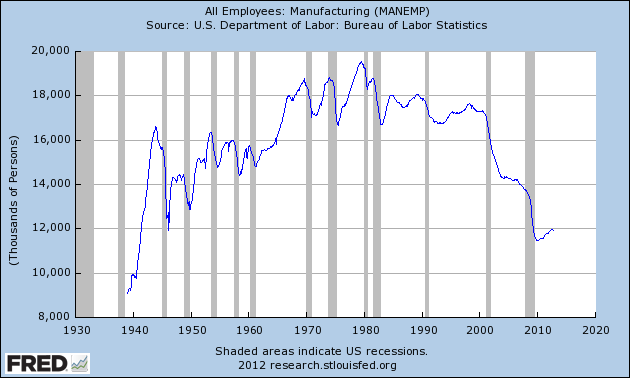
    Manufacturing employment is on a long term decline, in the USA and the world. The massive increases in productivity allow fewer and fewer people to produce more and more good. This is a good thing as it allows us to afford more good with less cost. But it does mean fewer manufacturing jobs, which are very good jobs, exist. This is a shame but something we shouldn’t anticipate changing. Believing we will globally, or in the USA, return to the huge number of manufacturing that were available previously jobs is not a wise conclusion to reach. Certainly there can be short term fluctuations that lead to increased jobs – that has happened in the last year for example.

    graph of Manufacturing_employment jobs in the USA (1940 - 2012)

    The most surprising thing to me about this graph is how stable employment was through 2000. From 1980 to 2000 the most common idea was the USA no longer manufactured anything. This idea was wrong, as I have written about previously: Chart of top 15 countries manufacturing output over time (2009)Top 10 manufacturing countries in 2006. But I did think employment declined more from 1970 to 2000.

    One factor in this perception is that the number of employed people in the USA has continued to grow. So even remaining somewhat stable from 1970 to 2000, as a percentage of the labor force the jobs kept shrinking. The more important factor that played on people emotionally is factories being shut down got much more attention in the news than new jobs being added. So the perception was tons of jobs were being lost and none were being gained.

    (more…)

  • Withdrawing Huge Amounts of Cash From Companies You Saddle with Debt is Despicable Behavior

    Bain Capital is a product of the Great Deformation by David Stockman

    Bain’s billions of profits were not rewards for capitalist creation; they were mainly windfalls collected from gambling in markets that were rigged to rise.

    Except Mitt Romney was not a businessman; he was a master financial speculator who bought, sold, flipped, and stripped businesses. He did not build enterprises the old-fashioned way—out of inspiration, perspiration, and a long slog in the free market fostering a new product, service, or process of production. Instead, he spent his 15 years raising debt in prodigious amounts on Wall Street so that Bain could purchase the pots and pans and castoffs of corporate America, leverage them to the hilt, gussy them up as reborn “roll-ups,” and then deliver them back to Wall Street for resale—the faster the better.

    That is the modus operandi of the leveraged-buyout business, and in an honest free-market economy, there wouldn’t be much scope for it because it creates little of economic value. But we have a rigged system—a regime of crony capitalism—where the tax code heavily favors debt and capital gains, and the central bank purposefully enables rampant speculation by propping up the price of financial assets and battering down the cost of leveraged finance.

    So the vast outpouring of LBOs in recent decades has been the consequence of bad policy, not the product of capitalist enterprise.

    I abhor the subsidies provided to those that saddle corporations (that build up value through decades of hard work by employees) with huge debt. The actions of leveraged by out firms are atrocious. They seek to pretend that business is once again the land of the amoral behavior, as the robber barron’s sought to convince society of long ago. Those that saddle corporations (that have an obligation to those that built them up) with huge debt are despicable.

    Those same despicable people then take huge amounts of cash (for themselves) from the debt they saddled the corporation with.

    Quite a few smart people have figured out how to pay congress to allow those smart people to take huge profits out of businesses. By being smart enough to have congress create laws to allow their behavior they can say it was just doing what the law allowed. When you conspire with the authorities to create a system to drain cash from legitimate businesses into your pocket you can claim you are acting legally (if you do so by having them change the law, instead of having them just ignore the existing laws). But what is being done (for decades by both parties) by those we continue to elect to allow this behavior shows just how corrupt the system is.

    It is sad we allow those politicians who payoff those that give them large amount of cash, at the expense of our society, to remain in office. But we don’t even discuss the issues in any significant sense. Those using this cronyism and corruption know they are continuing to be given the open door to continue their very destructive ways. These are smart people. They know how to use public apathy and rhetoric to keep from discussing the important issues. It is going to take us to stop the corrupting cronyism that has taken over our political parties.

    Related: Too Much Leverage Killed MervynsFailed Executives Use Leverage to Increase Their Pay, Let Others Bailouts LaterExecutives Treating Corporate Treasuries as Their Money, A Sad State of AffairsCEOs Plundering Corporate CoffersLeverage, Complex Deals and ManiaLooting: Bankruptcy for Profit

  • Curious Cat Investing, Economics and Personal Finance Carnival #38

    The Curious Cat Investing, Economics and Personal Finance carnival is published monthly with links to new, related, interesting content online.

    • We Need a Warby Parker for Mattresses by Rohin Dhar – “Like eyeglasses, mattress technology is fairly stable. Yet, publicly traded mattress wholesalers have gross margins of 41-64% (TPX, ZZ, SCSS). Across the industry, the retailers then mark up the mattresses another 96% on average (calculated from here). By the time a customer buys a mattress, it costs them ~74% more than the production cost of the product. An 74% gross margin is a lot of room for a startup to figure out how to acquire customers!”
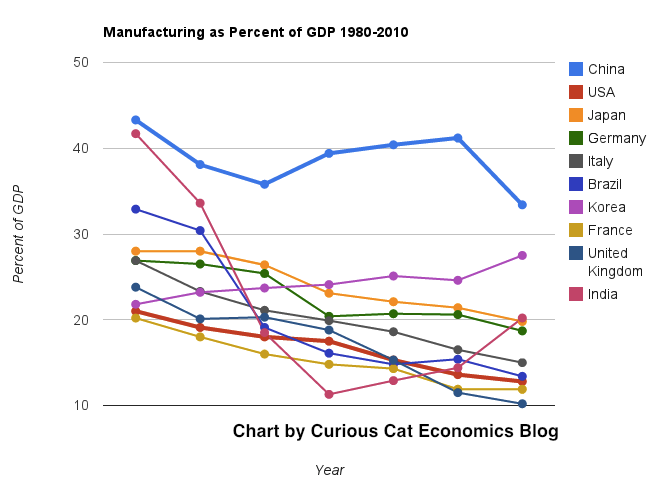
    • Manufacturing Output as Percent of GDP from 1980 to 2010 by Country by John Hunter – “For the 10 largest manufacturing countries in 2010, the overall manufacturing GDP percentage was 24.9% of GDP in 1980 and dropped to 17.7% in 2010.”

      chart of manufacturing output as percent of GDP by country from 1980 to 2010
      This chart shows manufacturing output, as percent of GDP, by country and was created by the Curious Cat Economics Blog based on UN data. You may use the chart with attribution.
    • Wall Street doesn’t know what business it is in by Mark Cuban – “Regulators have got to start to recognize that traders are not investors and vice versa and treat them differently. Different regulations. Different tax structure. Different oversight. Individual investors and the funds that just invest in stocks and bonds are not going to crash the market. Big traders who are always leveraging up and maximizing the number of trades/hacks they make will always put the system at risk…
      There is absolutely NO VALUE to High Frequency Trading. None.”
    • (more…)