Author: John Hunter

  • 12 Stocks for 10 Years – October 2012 Update

    The 12 stock for 10 years portfolio consists of stocks I would be comfortable putting into an IRA for 10 years. The main criteria is for companies with a history of large positive cash flow, that seemed likely to continue that trend.

    Since April of 2005 the portfolio Marketocracy* calculated annualized rate or return (which excludes Tesco) is 7.1% (the S&P 500 annualized return for the period is 5.4%).

    Marketocracy subtracts the equivalent of 2% of assets annually to simulate management fees – as though the portfolio were a mutual fund – so without that (it is not like this portfolio takes much management), the return beats the S&P 500 annual return by about 370 basis points annually (9.1% – 5.4%). And I think the 370 basis point “beat” of the S&P rate is really under-counting as the 200 basis point “deduction” removes what would be assets that would be increasing (so the gains that would have been made on the non-existing deductions in the real world – are missing). Tesco reduces the return, still I believe the rate would stay above a 300 basis point advantage.

    The current stocks, in order of return:

    Stock Current Return % of sleep well portfolio now % of the portfolio if I were buying today
    Amazon – AMZN 473% 11% 8%
    Google – GOOG 252% 18% 15%
    PetroChina – PTR 104% 6% 6%
    Apple – AAPL 94% 15% 13%
    Templeton Dragon Fund – TDF 84% 6% 4%
    Danaher – DHR 60% 10% 10%
    Templeton Emerging Market Fund – EMF 43% 5% 8%
    Pfizer – PFE 6% 6% 7%
    Toyota – TM 5% 7% 12%
    Intel – INTC 1% 5% 7%
    Cisco – CSCO -3% 3% 4%
    Cash 8%* 4%
    Tesco – TSCDY -18%** 0%* 5%

    The current marketocracy results can be seen on the Sleep Well marketocracy portfolio (the site broke the link, so I removed the link).

    Related: 12 Stocks for 10 Years: Jan 2012 Update12 Stocks for 10 Years, July 2011 Update12 Stocks for 10 Years, July 2009 Updatehand picked articles on investing
    (more…)
  • USA Unemployment Rate Drops to 7.8%, 200,000 Jobs Added

    The unemployment rate decreased to 7.8%, and total nonfarm payroll employment rose by 114,000 in September, the U.S. Bureau of Labor Statistics reported today. The change in total nonfarm payroll employment for July was revised from +141,000 to +181,000, and the change for August was revised from +96,000 to +142,000. Thus, with this report 200,000 new jobs were added (114,000 + 40,000 + 46,000).

    The unemployment rate declined from 8.1% in August to 7.8% in September. For the first 8 months of the year, the rate held within a narrow range of 8.1 and 8.3%. The number of unemployed persons, at 12.1 million, decreased by 456,000 in September.

    The number of long-term unemployed (those jobless for 27 weeks or more) was little changed at 4.8 million and accounted for 40.1% of the unemployed. This remains one of the most serious problems – along with the less that strong job creation numbers (since the too-big-too-fail financial crisis kicked off the great recession). In 2012, employment growth has averaged 146,000 per month, compared with an average monthly gain of 153,000 in 2011. 150,000 is decent but because of the huge job losses in the 4 years prior to 2011 there is a big recovery needed. Adding above 225,000 jobs a month, for years, would be a good result and put the economy on much firmer ground.

    Health care added 44,000 jobs in September. Job gains continued in ambulatory health care services (+30,000) and hospitals (+8,000). Over the past year, employment in health care has risen by 295,000.

    The average workweek for all employees on private nonfarm payrolls edged up by 0.1 hour to 34.5 hours in September. The manufacturing workweek edged up by 0.1 hour to 40.6 hours, and factory overtime was unchanged at 3.2 hours. The average workweek for production and nonsupervisory employees on private nonfarm payrolls was unchanged at 33.7 hours.

    In September, average hourly earnings for all employees on private nonfarm payrolls rose by 7 cents to $23.58. Over the past 12 months, average hourly earnings have risen by 1.8 percent. In September, average hourly earnings of private-sector production and nonsupervisory employees increased by 5 cents to $19.81.

    Related: Bad Jobs News in the USA, Unemployment Remains at 9.1% (Sep 2011)USA Unemployment Rate at 9.6% (Sep 2010)Unemployment Rate Increases to 9.7% (Sep 2009)Over 500,000 Jobs Disappeared in November 2008

  • Manufacturing Output as Percent of GDP from 1980 to 2010 by Country

    The largest manufacturing countries are China, USA, Japan and then Germany. These 4 are far in the lead, and very firmly in their positions. Only the USA and China are close, and the momentum of China is likely moving it quickly ahead – even with their current struggles.

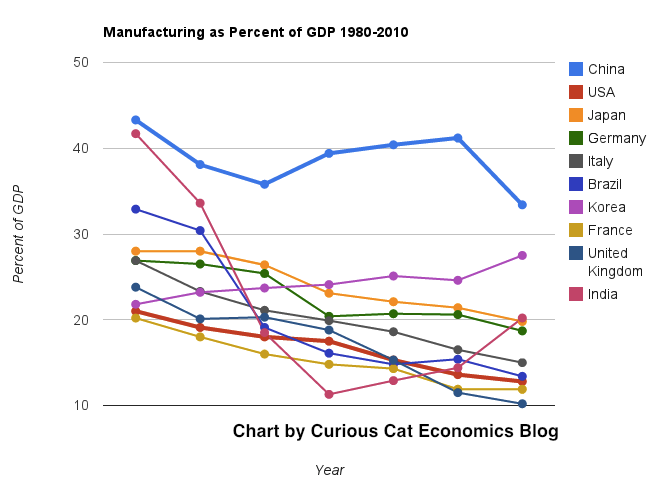
    The chart below shows manufacturing production by country as a percent of GDP of the 10 countries that manufacture the most. China has over 30% of the GDP from manufacturing, though the GDP share fell dramatically from 2005 and is solidly in the lead.

    Nearly every country is decreasing the percentage of their economic output from manufacturing. Korea is the only exception, in this group. I would expect Korea to start following the general trend. Also China has reduced less than others, I expect China will also move toward the trend shown by the others (from 2005 to 2010 they certainly did).

    For the 10 largest manufacturing countries in 2010, the overall manufacturing GDP percentage was 24.9% of GDP in 1980 and dropped to 17.7% in 2010. The point often missed by those looking at their country is most of these countries are growing manufacturing, they are just growing the rest of their economy more rapidly. It isn’t accurate to see this as a decline of manufacturing. It is manufacturing growing more slowly than (information technology, health care, etc.).

    chart of manufacturing output as percent of GDP by country from 1980 to 2010
    This chart shows manufacturing output, as percent of GDP, by country and was created by the Curious Cat Economics Blog based on UN data. You may use the chart with attribution.

    The manufacturing share of the USA economy dropped from 21% in 1980 to 18% in 1990, 15% in 2000 and 13% in 2010. Still, as previous posts show, the USA manufacturing output has grown substantially: over 300% since 1980, and 175% since 1990. The proportion of manufacturing output by the USA (for the top 10 manufacturers) has declined from 33% in 1980, 32% in 1990, 35% in 2000 to 26% in 2010. If you exclude China, the USA was 36% of the manufacturing output of these 10 countries in 1980 and 36% in 2010. China’s share grew from 7.5% to 27% during that period.

    The United Kingdom has seen manufacturing fall all the way to 10% of GDP, manufacturing little more than they did 15 years ago. Japan is the only other country growing manufacturing so slowly (but Japan has one of the highest proportion of GDP from manufacturing – at 20%). Japan manufactures very well actually, the costs are very high and so they have challenges but they have continued to manufacture quite a bit, even if they are not growing output much.

    (more…)

  • Leading Economic Freedom: Hong Kong, Singapore, New Zealand, Switzerland

    Hong Kong again topped the rankings, followed by Singapore, New Zealand, and Switzerland. Australia and Canada tied for fifth, of the 144 countries and territories in the Fraiser Institute’s 2012 Economic Freedom of the World Report.

    “The United States, like many nations, embraced heavy-handed regulation and extensive over-spending in response to the global recession and debt crises. Consequently, its level of economic freedom has dropped,” said Fred McMahon, Fraser Institute vice-president of international policy research.

    The annual Economic Freedom of the World report uses 42 distinct variables to create an index ranking countries around the world based on policies that encourage economic freedom. The cornerstones of economic freedom are personal choice, voluntary exchange, freedom to compete, and security of private property. Economic freedom is measured in five different areas: (1) size of government, (2) legal structure and security of property rights, (3) access to sound money, (4) freedom to trade internationally, and (5) regulation of credit, labor, and business.

    Hong Kong offers the highest level of economic freedom worldwide, with a score of 8.90 out of 10, followed by Singapore (8.69), New Zealand (8.36), Switzerland (8.24), Australia and Canada (each 7.97), Bahrain (7.94), Mauritius (7.90), Finland (7.88), Chile (7.84).

    The rankings and scores of other large economies include: United States (18th), Japan (20th), Germany (31st), South Korea (37th), France (47th), Italy (83rd), Mexico (91st), Russia (95th), Brazil (105th), China (107th), and India (111th).

    When looking at the changes over the past decade, some African and formerly Communist nations have shown the largest increases in economic freedom worldwide: Rwanda (44th this year, compared to 106th in 2000), Ghana (53rd, up from 101st), Romania (42nd, up from 110th), Bulgaria (47th, up from 108th), and Albania (32nd, up from 77th). During that same period the USA has dropped from 2nd to 19th.

    The rankings are similar to the World Bank Rankings of easiest countries in which to do business. But they are not identical, the USA is still hanging in the top 5 in that ranking. The BRICs (Brazil, Russia, India and China) do just as poorly in both. The ranking due show the real situation of economies that are far from working well in those countries. China and Brazil, especially, have made some great strides when you look at increasing GDP and growing the economy. But there are substantial structural changes needed. India is suffering greatly from serious failures to improve basic economic fundamentals (infrastructure, universal education, eliminating petty corruption [China has serious problems with this also]…).

    (more…)

  • Ethical Failing of Finance Company Boards and Executives Continue

    As I have said, the behavior (driven by the poor ethical standards of the “leaders” of our financial institution) of our financial institutions means, as a a customer, you have to be on guard for their tactics to trick you out of your money. Essentially you have to expect them to behave like a pickpockets and be on guard against them at all times. This is an extremely sad state of affairs: that the ethical failings of such critically important players in our economy are so widespread, long-lasting and accepted. However, as we have seen, they profit from this behavior and their long track record of such behavior provides evidence they will continue acting in this way.

    Discover to refund $200 million to credit card customers

    More than 3.5 million Discover credit card customers will share $200 million in refunds in the wake of a federal investigation that determined the bank tricked people into signing up for payment protection plans and other add-on services.

    The Consumer Financial Protection Bureau and Federal Deposit Insurance Corp. found that Discover Financial Services telemarketers often talked faster when explaining fees and terms as they pitched the services, leading customers to think there was no additional fee, the regulators said Monday.

    It is very good to see the Consumer Financial Protection Bureau taking action to protect the consumers from the financial institutions continued efforts to evade the law and take a little bit from millions of consumers. This type of behavior has been tolerated previously, and should never have been. The financial institutions strategy to take small amounts from millions of people was a wise way of dealing with the tendency of law enforcement to ignore such “small infractions” – they didn’t seem to bother seeing that taking small amounts from millions of people results in hundreds of millions of dollars in ill gotten gains.

    Far too much of the bad practices are continuing. And when they are caught the consequences are far too small (which is why they keep behaving unethically). Discover is only being charged $14 million in civil penalties for their lapses (and has to return $200 million it took unfairly).

    It is good to have police to try and catch literal pickpockets. And it is good to have the Consumer Financial Protection Bureau to catch financial institutions that take far more than pickpockets can dream of away from the wallets of consumers.

    Related: Capital One Bank Agrees to Refund $150 Million to 2 Million Customers and Pay $60 Million in FinesVery Bad Customer Service from Discover CardCredit Card Regulation Has Reduced Abuse By BanksContinued Credit Card Company Customer Dis-ServiceI Strongly Support the Consumer Financial Protection Bureau

    (more…)

  • Easiest Countries in Which to Operate a Businesses (2011)

    Singapore is again ranked first for Ease of Doing Business by the World Bank.

    Country 2011 2008 2005
    Singapore 1 1 2
    Hong Kong 2 4 6
    New Zealand 3 2 1
    United States 4 3 3
    Denmark 5 5 7
    other countries of interest
    United Kingdom 7 6 5
    Korea 8 23 23
    Canada 13 8 4
    Malaysia 18
    Germany 19 25 21
    Japan 20 12 12
    France 29 31 47
    Mexico 53 56 62
    Ghana 63
    China 91 83 108
    India 132 122 138
    Brazil 126 122 122

    The rankings include ranking of various aspects of running a business. Some rankings for 2011: starting a business (New Zealand 1st, Singapore 4th, USA 13th, Japan 107th), Dealing with Construction Permits (Hong Kong 1st, New Zealand 2nd, Singapore 3rd, USA 17th, China 179th), protecting investors (New Zealand 1st, Singapore 2nd, Hong Kong 3rd, Malaysia 4th, USA 5th), enforcing contracts (Luxemburg 1, Korea 2, Iceland 3, Hong Kong 5, USA 7, Singapore 12, China 16, India 182), paying taxes (Maldives 1, Hong Kong 3, Singapore 4, USA 72, Japan 120, China 122, India 147).

    These rankings are not the final word on exactly where each country truly ranks but they do provide a valuable source of information. With this type of data there is plenty of room for judgment and issues with the data.

    Related: Easiest Countries from Which to Operate Businesses 2008Stock Market Capitalization by Country from 1990 to 2010Looking at GDP Growth Per Capita for Selected Countries from 1970 to 2010Top Manufacturing Countries (2000 to 2010)Country Rank for Scientific PublicationsInternational Health Care System PerformanceBest Research University Rankings (2008)

  • USA Housing Rents Increased 5.4% in the Last Year

    US Zillow Rent Index

    The USA economy is still in very fragile ground. The continued problems created by policies focused on aiding too big too fail institutions and continued huge federal budge deficits are dangerous. And the continued problems in Europe and mounting problems in China are not helping. Still, rental prices continue to rise across the USA.

    The graph above shows housing rents (as shown by the Zillow rent index) have increased 5.4% in the last year (through July) across the USA. In Boston the increase was 4.5%; Grand Junction, Colorado -4.9%; San Francisco up 8.8%; Washington DC up 7.3%; Raleigh, NC up 1.8% (though the last one couldn’t be added to the graph for some reason). I just picked some cities I found interesting – with some diversity.

    Housing prices are up 1.2% in the same period, according to the Zillow price index.

    When looking at data on rental prices and home prices you will notice different sources give different readings. Judging these changes across the nation is very difficult and requires making judgements. Even at the local level the measures are imprecise so the figures you see will vary. Taking a look at several different measures, from reputable sources, is often wise.

    Related: USA Apartment Market in 2011Top USA Markets for Buying Rental PropertyApartment Vacancies Fall to Lowest in 3 Years in the USA (April 2011)Apartment Rents Rise, Slightly, for First Time in 5 Quarters (April 2010)

  • Curious Cat Investing, Economics and Personal Finance Carnival #37

    I am reducing the Curious Cat Investing, Economics and Personal Finance Carnival to being published once each month. If I get some decent contributors that want to host it I would consider going back to twice a month.

    Also see related investing and economics books and articles.

    • A controlled break-up of the euro would be hugely risky and expensive – “Estimating the price of a “Grexit” is guesswork, but Germany’s share might reach €110 billion of this, about 4% of the country’s GDP.”
    • Personal Finance: Minimal Budgeting by John Hunter – “I just leave that in my checking account and what is in checking is what I have to spend… I couldn’t spend any more, I didn’t have it. If I were to go over (I never did), but if I were to have (say my credit card bill exceeded my checking account balance), I would have had to reduce my cash the next month.”
    • Are Dividend Stocks Overvalued? Four Reasonable Blue-Chips to Consider by Matt Alden – “Although I do think the market as a whole is modestly expensive (via the Shiller P/E for an overview as well as inspection of individual securities), dividend stocks in general do not appear to be at dangerous valuations.” [Aflac has been on my almost buy list for over a year – John]
    • Actually, The U.S. Lost 1.2 Million Jobs Last Month by Jacob Goldstein – “Everyone (including us) is saying this morning that the U.S. economy gained 163,000 jobs last month. Strictly speaking, this is a lie. In fact, the U.S. economy actually lost 1.2 million jobs last month. There were 134.1 million jobs in June, and 132.9 million jobs in July… the government releases “seasonally adjusted” jobs numbers every month. The basic idea is to correct for these predictable fluctuations.”
    • Current crisis exposes weakness in China’s economic system by Jim Jubak – “The current obvious fakery is degrees of magnitude different from the usual distortion in Chinese economic data. So, for example, the Public Safety Bureau has simply stopped publishing data on new car registrations because the numbers show such a big drop in new car sales that they can’t simply be fudged. Data on the steel industry has been revised and revised again because the government can’t come up with a methodology that disguises the drop in steel sales and yet isn’t completely unbelievable. And, of course, the government hasn’t published data on the number of vacant apartments in China—a reflection of the country’s real estate boom and bust—since 2008.”
    • For the first time since 1998 more money leaves China than enters it – “more than 16% of China’s rich have already emigrated, or handed in immigration papers for another country, while 44% intend to do so soon. Over 85% are planning to send their children abroad for their education, and one-third own assets overseas.”

    More and more the ability to continue to delay the huge problems continued from the credit crisis (too big to fail fakery plus the decades of the USA and Europe living beyond their means) seems to be coming to an end. And onto that the problems in China and it is difficult to see how we avoid big problems. It is amazing the bad behavior in the USA and Europe has been only as bad as it has the last 4 years – but there is a very good chance that will not continue. China is not looking like it can be a savior. Certainly India is not doing much right recently. Japan continues to struggle. 2013 looks very tough economically. Eventually the central bank games of given essentially huge cash payments to bankers will cause people to lose faith in those currencies (frankly I can’t understand why they haven’t already). When that happens we will see some real problems.

  • Household Income Data in the USA Since the Credit Crisis Recession Began

    Big Income Losses for Those Near Retirement takes a look at some interesting data, including data on median income drops due to the too-big-too-fail credit crisis recession.

    Households led by people between the ages of 55 and 64 have taken the biggest hit; their household incomes have fallen to $55,748 from $61,716 over the last three years, a decline of 9.7 percent.

    The post also includes data showing the only groups with income increases as those 65-74 years old and, 75 and over which is surprising. 25-34 took the 2nd largest drop decreasing 8.9%.

    Another interesting tidbit is the percent of people over 65 with jobs. In 1960 20% of those over 65 had jobs. Which pretty much decreased steadily to 10% in 1986 and then has increased steadily to 17% in 2011.

    Related: USA Individual Earnings Levels: Top 1% $343,000, 5% $154,000, 10% $112,000, 25% $66,000
    Looking at Data on the Value of Different College Degrees60% of Workers in the USA Have Less Than $25,000 in Retirement SavingsCredit Card Regulation Has Reduced Abuse By Banks

  • The Poor Paying for Vocational High School Education

    I find it disheartening that it is necessary to take out a loan to pay for vocational school after graduating from middle school (this is in Indonesia but the same thing happens all over in those countries that are not the most wealthy). Indonesia has been doing extremely well economically (which many people do not realize).

    The economic conditions are not good and they are earning just enough for the basic daily needs. Mukinah feel scared because of the cost of the vocational school for her daughter Kafita. Mukinah does not want her to quit school so she is applying for loans through the Student Loan program from Kiva. In the picture, Mukinah and Kafita, her daughter.

    Kafita already graduated from junior high school and wants to go to vocational school.

    So essentially she is paying for high school. I sure hope it is financially beneficial. This is the kind of investment in the economic development of a country that I wish governments could make. If not, I sure wish the super rich would give money to fund this kind of education instead of giving trust fund babies millions for conspicuous consumption.

    It is disgusting how spoiled brats are such vapid people that they do what they do, while so many hundred of millions of kids lives could be changed with the most wasteful spending these trust fund babies that our politicians keep giving massive tax breaks to. Our politicians should be ashamed of themselves. And so should the spoiled brats.

    (more…)