Author: John Hunter

  • Personal Finance: Minimal Budgeting

    I’m really too lazy for any ongoing budgeting. This is the model I have used: write down your big expense (rent, car payment, required student loan payment…). Get the total take home pay each month subtract your big expenses. If that is negative you better do something else (make more money, get rid of big expenses).

    Big monthly expenses:

    • Rent: $900
    • Car payment + insurance: $300
    • Cash (miscellaneous spending food, gas, cloths, books…): $450
    • Utilities+ (heat, electricity, phone, internet…): $250

    Take home pay: $2,800.

    That leaves $900/month ($2,800 – $1,900). Decide how to allocate that – toward your IRA, saving to buy a house or take a vacation, eating out (above what was allocated above for cash), pay off debt (if you have it…), build up an emergency fund, save to buy a new MacBook Pro with Retina display…

    If I decided to allocate $300 to my IRA (or increase my 401k) I would just set that up automatically each month. Then say I decided to put $400 toward other savings I would have that go to my savings account each month. And I decided I could use the $200 to pamper myself I just leave that in my checking account and what is in checking is what I have to spend.

    I just don’t spend more than that. Just like when I was in college I had little spending money. I could spend that. I couldn’t spend any more, I didn’t have it. If I were to go over (I never did), but if I were to have (say my credit card bill exceeded my checking account balance), I would have had to reduce my cash the next month. I reality I would have something like $2,000 extra in the checking account so no bills would be a problem (and just view $2,000 as 0).

    In 6 months see where things stand. Is it really working? Did you mess up and forget some expenses… If you need to adjust, do so. Re-examine every 6 months (or every year, if you are doing pretty well).

    Take a portion of each raise (50% maybe) and devote it to personal finance goals (paying off debt, retirement savings, building up emergency fund, saving for big purcahse, investing, give more to charity…); don’t just use it to increase spending. Use no more than half (or whatever level you set) of the raise to increase your current spending.

    Related: Personal Finance Basics: Avoid DebtInvesting in Stocks That Have Raised Dividends Consistently

  • USA Adds 163,000 Jobs in July, Unemployment Rate at 8.3%

    After several poor months for job creation (adding well under 100,000 each month) we have some good news. Total nonfarm payroll employment rose by 163,000 in July, with the unemployment rate at 8.3%. Since the beginning of this year, employment growth has averaged 151,000 per month, about the same as the average monthly gain of 153,000 in 2011.

    The change in total nonfarm payroll employment for May was revised from +77,000 to +87,000, and the change for June was revised from +80,000 to +64,000. Which means the total job gains for this report is 157,000 (163,000 +10,000 [for May] and -16,000 [for June]).

    One of the continuing severe problems (since the credit crisis bubble burst) has been long term unemployment. In July, the number of long-term unemployed (those jobless for 27 weeks and over) was 5.2 million. These individuals accounted for 40.7% of the unemployed (a high figure historically).

    Given all the problems created by the financial system failure (created over the last 15 years – in the USA and Europe) it is actually fairly amazing that we have been adding jobs nearly as much as we have. But climbing out of the huge whole we created for ourselves (by continually re-electing those that allowed the too-big-too-fail financial mess – and those we elect continue to reward their friends that created the mess instead of fixing it) is a huge task. It requires much better job creation than we have had this year.

    Adding 150,000 jobs a month would be decent if we hadn’t created such a huge problem that digging out of it requires much better results. Moving back above that average is much better than being below it, but we really need to bring the new jobs created above 200,000 for a couple years to make a serious dent in the problems created earlier.

    Related: USA add 117,000 Jobs in July 2011 and Adjusts Previous Growth in May and June Up 56,000 MoreUSA Unemployment Rate at 9.6% (Sept 2010)Unemployment Rate Drops Slightly to 9.4% (Aug 2009)
    Over 500,000 Jobs Disappeared in November 2008
    (more…)

  • Curious Cat Investing, Economics and Personal Finance Carnival #36

    Enjoy the 36th edition of the Curious Cat Investing, Economics and Personal Finance Carnival. This carnival is different than many blog carnivals: I select posts on those topics from what I read (instead of posting those that submit to the carnival as many carnivals do). If you would like to host the carnival add a comment below.

    • The Apple (Used) Premium? by Daniel Mrdjenovich – “In short, if the Apple product you desire is available refurbished, you are in luck. Refurbished Apple products seem to be a rare case of a great deal with very limited downside. If you can’t find a refurbished version of the product you are looking for, you have a more difficult dilemma. A 17% discount on a used Apple device is a nothing to sneeze at but it’s not enormous either.”
    • The fiscal cliff and rationality by James Hamilton – “Although the risks are real, the rational thing to expect is that the actual fiscal contraction next year will be significantly more modest than what is implied by existing law. But the cumbersome process of getting to that outcome will once again exact its own unique toll.”
    • Idle corporate cash piles up by David Cay Johnston – “newly released IRS figures show that in 2009 these companies held $4.8 trillion in liquid assets”
    • Case Shiller Home Price Indexes Surge – “The real estate market news keeps getting a little bit better as Standard & Poor’s reported big increases for the Case-Shiller Home Price Indexes in May, both the 10-city and 20-city indexes rising 2.2 percent for the month on an unadjusted basis after gains of 1.3 percent in April.”
    • (more…)

  • US Treasury Yield Fall to New Record Low

    Us treasury yield hit a incredibly low level years ago and they have continued to fall further. Granted this is mainly due to the bailout of the economy necessitated by the politicians favors to the too-big-too-fail financial institutions that have given those politicians so much cash over the years. Other factors are at play but the extent of the excessive punishment of savers is mainly due to political bailouts of bankers and bailouts of the economy caused by the bankers actions.

    This extremely low rate environment is crippling to many retirees. The small percentage that actually did what they were told to have been blindsided by years of artificially low rates (and it is likely to continue for years). This has pushed some that would have been comfortable in retirement into an uncomfortable one an has pushed some from a challenging balancing act to essentially having to eliminate every possible expense (and even that may not be enough).

    I can’t believe long term bonds are a sensible investment now. Of course I haven’t thought they were for 10 years, but they are even worse now. Bonds of “strong” governments (USA, Germany, Japan) are paying less than inflation (sometimes even less than 0 nominally – I think this has just been for short term issues so far).

    I cannot see putting more than token amounts into long term bonds at these rates. Corporate bonds are not much better. The economic damaged caused by out of control too-big-too-fail institution is huge and continuing. And the politicians that have been paid lots of cash by those too-big-too-fail institutions continue to treat the too-big-too-fail players are favored friends. The yields are corporate bonds are not good for companies that are strong.

    The alternatives are not great. But real assets, strong dividend stocks, strong company stocks, and short term bonds seem like better options to me in many cases. And hope we elect people that will put the economic interest of the country ahead of a few well paid friends at too-big-too-fail institution. They also need to eliminate the captured “regulators” that have facilitated the continued wrecking of the global economy. I don’t hold out much hope for this though. We keep re-electing those given lots of cash by the too-big-too-fail crowd and they continue giving them favors. We are getting what we deserve given this poor performance on our part but it is pretty annoying having to watch us vote ourselves into economic calamity.

    Related: Buffett Cautions Against Buying Long Term USD BondsIs Adding More Banker and Politician Bailouts the Answer?Bill Gross Warns Bond InvestorsCongress Eases Bank Laws (1999)

  • Capital One Bank Agrees to Refund $150 Million to 2 Million Customers and Pay $60 Million in Fines

    Sadly, Congress refused to allow the person that should have headed to the Consumer Financial Protection Bureau (CFPB) to do so: Elizabeth Warren. If we are lucky she will be joining congress as the new senator from Massachusetts to reduce the amount of big donnor favoritism that prevails there now. That attitude will still prevail, she will just be one voice standing against the many bought and paid for politicians we keep sending back to Washington (there are a couple now, but they are vastly outnumbered).

    Even with congressional attempts to stop the CFPB from being able to enforce laws against their big donnors, the CFPB has announced their first public enforcement action: an order requiring Capital One Bank to refund approximately $140 million to two million customers and pay an additional $25 million penalty. This is a good, small step that is helping creating a rule of law instead of a rule of those capturing regulators and giving lots of cash to politicians. But it is a very small step. The system is still mainly about captured regulators and giving lots of cash to politicians.

    This action results from a CFPB examination that identified deceptive marketing tactics used by Capital One’s vendors to pressure or mislead consumers into paying for add-on products such as payment protection and credit monitoring when they activated their credit cards.

    “Today’s action puts $140 million back in the pockets of two million Capital One customers who were pressured or misled into buying credit card products they didn’t understand, didn’t want, or in some cases, couldn’t even use,” said CFPB Director Richard Cordray. “We are putting companies on notice that these deceptive practices are against the law and will not be tolerated.”

    Consumers with low credit scores or low credit limits were offered these products by Capital One’s call-center vendors when they called to have their new credit cards activated. As part of the high-pressure tactics Capital One representatives used to sell these add-on products, consumers were:

    • Misled about the benefits of the products: Consumers were sometimes led to believe that the product would improve their credit scores and help them increase the credit limit on their Capital One credit card.
    • Deceived about the nature of the products: Consumers were not always told that buying the products was optional. In other cases, consumers were wrongly told they were required to purchase the product in order to receive full information about it, but that they could cancel the product if they were not satisfied. Many of these consumers later had difficulty canceling when they called to do so.
    • Misinformed about cost of the products: Consumers were sometimes led to believe that they would be enrolling in a free product rather than making a purchase.
    • Enrolled without their consent: Some call center vendors processed the add-on product purchases without the consumer’s consent. Consumers were then automatically billed for the product and often had trouble cancelling the product when they called to do so.

    One of the less obvious costs of a poor credit rating these days is large companies see you as someone to take advantage of. They often target those with poor credit for extremely lousy deals that they wouldn’t try to sell to those with good credit. The presumption, I would imagine, is someone able to maintain a good credit rating is much less likely fall for our lousy deals.

    Related: Protect Yourself from Credit Card Fraud (facilitated by financial institutions)Anti-Market Policies from Our Talking Head and Political ClassBanks Hope they Paid Politicians Enough to Protect Billions in Excessive Fees

    (more…)

  • Curious Cat Investing, Economics and Personal Finance Carnival #35

    The Curious Cat Investing, Economics and Personal Finance Carnival is published twice each month with links to new, related, interesting content online. Also see related books and articles.

    • A Nation of Public Housing by Neal Peirce – “One government agency manages 80 percent of the housing stock — all called public housing. It checks your age and whether you’re married to decide whether and when you’re eligible for an apartment.” Racial quotas are used, unmarried people can’t apply until they turn 35. Any guess on what country this is? The same country is ranked as the easiest, or close to it, country run business in the world.
    • China’s end game:the dark side of a great deleveraging by Dee Woo – “The dilemma is that business entities will need more and more credit to achieve the same economic result, therefore will be more and more leveraged, less and less able to service the debt, more and more prone to insolvency and bankruptcy. It will reach a turning point when the increasing number of insolvencies and bankruptcies initiate an accelerating downward spiral for underling assets prices and drive up the non-performing loan ratio for the banks. And then the over-stretched banking system will implode. A full blown economic crisis will come in full force. The chain of reaction is clearly set in the motion now.

      The biggest problem for China is the state, central enterprises and crony capitalists wield too much power over national economy, have too much monopoly power over wealth creation and income distribution, and much of the GDP growth and vested interest groups’ economic progress are made on the expanse of average consumers stuck in deteriorating relative poverty.”
    • Challenges faced by middle-class L.A. families by Meg Sullivan – “Managing the volume of possessions was such a crushing problem in many homes that it actually elevated levels of stress hormones for mothers. Only 25 percent of garages could be used to store cars because they were so packed with stuff.” (read the book: Life at Home in the Twenty-First Century)
    • USA Social Security Disability Insurance (SSDI) by John Hunter – Benefits have a maximum of $2,346/month (in 2011). The average benefit payment now is $1,111. More than 8.7 million people are received disability benefits currently (partially disabilities are not eligible for SSDI.
    • (more…)

  • Working Less: Better Lives and Less Unemployment

    The average worker in Germany and the Netherlands puts in 20% fewer hours in a year than the average worker in the United States. This means that if the US adopted Germany’s work patterns tomorrow, it would immediately eliminate unemployment.

    I do think there is merit to reducing yearly hours worked in the USA. The problem is this is all within a larger system. The USA’s broken health care system makes it extremely expensive to hire workers. One way to deal with the health care system failure is maximizing hours worked to spread out the massively expensive USA health care costs.

    Also the USA standard of living is partially based on long hours (it is but one factor). We also have to work quite a few hours (about 5% of the total hours) to just bring us equal with other rich countries, in order to pay for our broken health care system.

    Still reducing our purchases by cutting out some fancy coffee, a few pairs or shoes, a few cable channels (or all of them), text messages from overcharging phone companies… in order to have a couple more weeks of vacation would be a great tradeoff in my opinion. And one I have made with my career.

    I have changed to part time in 2 of my full time jobs (to make my own sensible yearly hour model even if the bigger system can’t. Another time I bargained for more vacation time over more $. It isn’t easy to do though, most organizations are not willing to think and accommodate employees (hard to believe they respect people in this case, right?). The system is not setup to allow people to adjust total hours to maximize their well being.

    Another option in the USA is to live within your means and then make your own sabbaticals during your career. Take a year off and travel the world, or hike the Appalachian Trail, or read trashy novels, or whatever you want.

    Related: Medieval Peasants had More Vacation Time Than We DoDream More, Work LessVacation: Systems Thinking

  • USA Social Security Disability Insurance

    Studies show that a 20 year old has a 30% chance of becoming disabled before reaching retirement age. In the USA, the Social Security Administration provides disability benefits for total disabilities. You still want to get your own long term disability insurance (this can cover for partial disabilities), but here is some information on the SSA disability coverage.

    To qualify for Social Security disability benefits, you must first have worked in jobs covered by Social Security. Then you must have a medical condition that meets Social Security’s definition of disability. In general, they pay monthly cash benefits to people who are unable to work for a year or more because of a disability.

    Benefits usually continue until you are able to work again on a regular basis. There are also a number of special rules, called “work incentives,” that provide continued benefits and health care coverage to help you make the transition back to work.

    If you are receiving Social Security disability benefits when you reach full retirement age, your disability benefits automatically convert to retirement benefits, but the amount remains the same.

    Generally, you need 40 credits, 20 of which were earned in the last 10 years ending with the year you become disabled. You earn essentially 4 credit each year you work. There are reduced requirements if you are young and haven’t had a chance to earn 10 years worth of credit. So essentially you have to have worked 10 years (and 5 years in the last 10 years) paying social security tax.

    The definition of disability under Social Security is different than other programs. Social Security pays only for total disability. No benefits are payable for partial disability or for short-term disability.

    “Disability” under Social Security is based on your inability to work. The Social Security Administration consider you disabled under Social Security rules if:

    • You cannot do work that you did before;
    • We decide that you cannot adjust to other work because of your medical condition(s); and
    • Your disability has lasted or is expected to last for at least one year or to result in death.

    This is a strict definition of disability. Social Security program rules assume that working families have access to other resources to provide support during periods of short-term disabilities, including workers’ compensation, insurance, savings and investments.

    The benefit amount is calculated based on your average annual earnings and is subject to a maximum of $2,346/month (in 2011). The average benefit payment, last month, was $1,111. Minor, dependent, children are also eligible for a small monthly payment.

    In June 2012, 8.7 million people received disability benefits. Theoretically the number of recipients shouldn’t increase just because there is a recession, but they generally do increase in recessions.

    There is no means testing on receiving the disability payment from the SSA. It is based on your income and disability. There are other Social Security programs (SSI, Medicare) where you must show you have very few assets before you are eligible for benefits.

    Related: SSA Disability websitePersonal Finance Basics: Long Term Disability InsuranceDisability Insurance is Wise (in addition to SSA disability benefits)

  • Curious Cat Investing, Economics and Personal Finance Carnival #34

    Welcome to the Curious Cat Investing, Economics and Personal Finance Carnival. This carnival is different than many blog carnivals: I select posts on those topics from what I read (instead of posting those that submit to the carnival as many carnivals do). If you would like to host the carnival add a comment below.

    photo of a mushroom and a bed of moss
    Mushroom, Rocky Gap State Park, Maryland, USA by John Hunter
    • The U.S. Content of “Made in China” by Galina Hale and Bart Hobijn (SF Federal Reserve) – “Goods and services from China accounted for only 2.7% of U.S. personal consumption expenditures in 2010, of which less than half reflected the actual costs of Chinese imports. The rest went to U.S. businesses and workers transporting, selling, and marketing goods carrying the “Made in China” label.”
    • 7 equations to build a secure retirement by Robert Powell – the equations are not complex but might scare those that don’t like math. Even without really understanding the equations the text is useful.
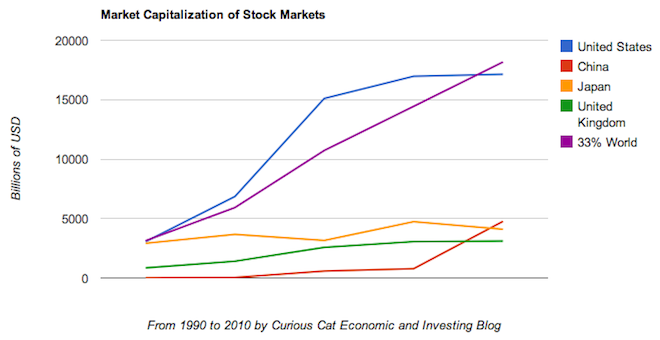
    • Stock Market Capitalization by Country from 1990 to 2010 by John Hunter – The USA was 32.5% of the total stock market capitalization of the global stock markets in 1990. The USA grew to 46.9% as the tech, finance and housing bubbles were all underway (also Japan was stagnating and the Chinese stock market hadn’t started booming to a significant extent) in 2000. By 2010 the USA was back down to 31.4%.
    • 5 stages of retirement crisis–and what to do about yours by Jim Jubak – “Certainly you weren’t planning for three-month Treasury bills to be paying you 0.08% or 10-year Treasuries 1.61%. And you’re worried by projections that say the real return on stocks going forward is going to be more like 5% (if we’re lucky) than the 7.5% real return that has been the assumption of choice recently. (That assumption replaces the 10% assumption that was the common wisdom in the years before the 2000 bear market.)
    • (more…)

  • Stock Market Capitalization by Country from 1990 to 2010

    The stock market capitalization by country gives some insight into how countries, and stocks, are doing. Looking at the total market capitalization by country doesn’t equate to the stock holdings by individuals in a country or the value of companies doing work in a specific country.

    Chart of largest stock market capitalizations by country from 1990 to 2010
    Chart of largest stock market capitalizations by country from 1990 to 2010

    In the chart, I divided the world total by 3: just to make the chart look better. The USA was 32.5% of the total in 1990. The USA grew to 46.9% as the tech, finance and housing bubbles were all underway (also Japan was stagnating and the Chinese stock market hadn’t started booming to a significant extent). In 2010 the USA was back down to 31.4%. This will likely continue to decrease (at a much slower pace – I wouldn’t be surprised to see the USA at 25% in 2020) as the rest of the world’s markets continue to grow more quickly.

    As with so much recent economic data China’s performance here is remarkable and Japan’s is distressing. China grew from nothing in 1990 to the 2nd largest country in 2010. Hong Kong add another $1 trillion to China’s $4.5 trillion. Canada is the only country above $2 trillion not included on this chart. China grew by $4 trillion from 2005 to 2010.

    Related: Don’t Expect to Spend Over 4% of Your Retirement Investment Assets AnnuallyTop 10 Countries for Manufacturing Production from 1980 to 2010
    Investment Risk Matters Most as Part of a Portfolio, Rather than in IsolationGovernment Debt as Percent of GDP 1998-2010

    (more…)