Author: John Hunter

  • Curious Cat Investing, Economics and Personal Finance Carnival #33

    Welcome to the Curious Cat Investing, Economics and Personal Finance Carnival. The carnival is published twice each month with links to new, related, interesting content online. Greece just voted for the party that wants to attempt to keep Greece in the Eurozone. We will see how that works. I don’t think the odds are great unless Greece is willing to substantially change their recent (last few decades) running of their economy.

    • Big Investors Don’t Know Where to Put Their Cash by Sven Böll and Martin Hesse – “‘In the past, we searched for risk-free returns.’ He pauses for effect. ‘Today we know that what we mainly have are investments with return-free risk.’… Corporate bonds and the sovereign debt of emerging economies, once something for the intrepid, are suddenly seen as safe havens.”
    • Are More Bailouts to Banker and Politicians the Answer to the Credit Crisis Aftermath? by John Hunter – “It feels to me similar to a situation where I have maxed out 8 credit cards and have a little bit left on my 9th. You can say that failing to approve my 10th credit card will lead to immediate pain. Not just to me, but all those I owe money to. That is true. But wasn’t the time to intervene likely when I maxed out my 2nd credit card and get me to change my behavior of living beyond my means then?”
    • my parents in front of the Acropolis in Athens, Greece
      My parents in front of the Acropolis in Athens, Greece. Photo by John Hunter, see more of my photos.
    • The Great Recession is changing our behavior–in ways that point to slower growth for a longer period of time by Jim Jubak – “The third, most powerful in its effects and the least obvious, is the way that the Great Recession has undermined existing belief in financial security. That decline in real and perceived security is likely to change where people put their money, what kinds of returns they think they can count on, and, therefore, how much money they think they can spend and how much they have to put away.”
    • A Global Perfect Storm by Nouriel Roubini – “To prevent a disorderly outcome in the eurozone, today’s fiscal austerity should be much more gradual, a growth compact should complement the EU’s new fiscal compact, and a fiscal union with debt mutualization (Eurobonds) should be implemented. In addition, a full banking union, starting with eurozone-wide deposit insurance, should be initiated, and moves toward greater political integration must be considered, even as Greece leaves the eurozone.
      CommentsUnfortunately, Germany resists all of these key policy measures…”

    • (more…)

  • Global Trends in Renewable Energy Investment

    Global Trends in Renewable Energy Investment 2012

    in 2011, global investment in the renewable energy sector hit another record, up 17% to $257 billion. This was a six fold increase on the 2004 figure and 93% higher than the total in 2007.

    renewable power (excluding large hydro) accounted for 44% of new generation
    capacity added worldwide in 2011, up from 34% in 2010 [and 10% in 2004]. The $237 billion invested in building these green power plants compares with $223 billion of net new expenditure annually on building additional fossil-fuelled power plants globally last year.

    Current predictions are that total installed capacity in non-hydro renewable power will rise ninefold to 2.5Tw by 2030, with investment in assets rising from $225 billion in 2011 to $395 billion-a-year by 2020 and $460 billion-a-year by 2030

    Total investment in solar in 2011 increased 52% to $147 billion, driven by a drop of 50% in photovoltaic module prices. Investment in wind dropped 12% to $84 billion, while onshore wind turbine prices fell between 5 and 10%. Biomass and waste to energy was the 3rd largest renewable sector at $11 billion in investments (down 12% from 2010).

    USA investment surged 51% to $51 billion just behind China at $52 billion (China increased investment in renewable energy by 17% from 2010). German investment dropped 12% to $31 billion.

    In 2011 renewable energy power capacity (excluding large hydropower), as a percentage of total system capacity, reached 9%, up from 4% in 2004. Total renewable energy generation (excluding large hydro) reached 6%, up from 4% in 2004.

    Related: Top Countries For Renewable Energy CapacityWind Energy Capacity Exceeds 2.5% of Global Electricity NeedsLeasing or Purchasing a Solar Energy System For Your Home

  • Is Adding More Banker and Politician Bailouts the Answer?

    When critics say that Europe is running out of time to deal with the financial crisis I wonder if they are not years too late. Both in Europe responding and those saying it is too late.

    It feels to me similar to a situation where I have maxed out 8 credit cards and have a little bit left on my 9th. You can say that failing to approve my 10th credit card will lead to immediate pain. Not just to me, but all those I owe money to. That is true.

    But wasn’t the time to intervene likely when I maxed out my 2nd credit card and get me to change my behavior of living beyond my means then? If you only look at how to avoid the crisis this month or year, yeah another credit card to buy more time is a decent “solution.”

    But I am not at all sure that bailing out more bankers and politicians for bad financial decisions is a great long term strategy. It has been the primary strategy in the USA and Europe since the large financial institution caused great recession started. And, actually, for long before that the let-the-grandkids-pay-for-our-high-living-today has been the predominate economic “strategy” of the last 30 years in the USA and Europe.

    That has not been the strategy in Japan, Korea, China, Singapore, Brazil, Malaysia… The Japanese government has adopted that strategy (with more borrowing than even the USA and European government) but for the economy overall in Japan has not been so focused on living beyond what the economy produces (there has been huge personal savings in Japan). Today the risks of excessive government borrowing in Japan and borrowing in China are potentially very serious problems.

    I can understand the very serious economic problems people are worried about if bankers and governments are not bailed out. I am very unclear on how those wanting more bailout now see the long term problem being fixed. Unless you have some system in place to change the long term situation I don’t see the huge benefit in delaying the huge problems by getting a few more credit cards to maintain the fiction that this is sustainable.

    We have seen what bankers and politicians have done with the trillions of dollars they have been given (by governments and central banks). It hardly makes me think giving them more is a wonderful strategy. I would certainly consider it, if tied to some sensible long term strategy. But if not, just slapping on a few more credit cards to let the bankers and politicians continue their actions hardly seems a great idea.

    Related: Is the Euro Going to Survive in the Long Run? (2010)Which Currency is the Least Bad?Let the Good Times Roll (using Credit)The USA Economy Needs to Reduce Personal and Government Debt (2009 – in the last year this has actually been improved, quite surprisingly, given how huge the federal deficit is) – What Should You Do With Your Government “Stimulus” Check?Americans are Drowning in DebtFailure to Regulate Financial Markets Leads to Predictable Consequences

  • Looking for Yields in Stocks and Real Estate

    The extremely low interest rate environment created by the too big to fail financial institution bailouts has severely harmed savers. Most severely harmed those in retirement that didn’t count on irresponsibly regulators and bankers creating a situation where to avoid a depression they had to punish savers to favor large banks (and others).

    For some savings that might normally go into bonds (if the bond market were not so manipulated by the central banks to punish savers) dividend stocks are a good option. The stocks have risks but frankly with extremely strong companies with huge amounts of positive cash flow the future looks brighter than it does for those debt ridden governments.

    Apple (AAPL) announced they will start paying a $2.65 quarterly dividend which works out to $10.60 annually. At the current stock price, this is a yield of nearly 1.9%. That is hardly going to make you rich but it is extremely attractive when you can get a much higher yield than savings account, treasury bills… and have the potential gains in stock price. Yes you do also have risk of a declining stock price, but as I have said I think Apple’s stock is an extremely good investment now.

    Other good options include: Intel (INTL) which offers a 3.3% yield and Abbott (ABT) which offers a 3.4% yield. I own those 3 and also ONEOK Partners (OKS) which sports a 4.8% yield (but is a bit tricker situation that is suitable for a lower investment I think).

    Even a stock like Toyota (TM), which I like as an investment, while it offers only a 1.8% yield that is much higher than you get for savings or treasury bills. So even stocks that are not about yield in the normal market conditions offer an attractive yield today.

    I am a bit nervous about health care dividend investments but Pfizer (PFE) is worth considering at 4.1% (as are JNJ and MRK). I really like ABT (they have raised dividends for over 40 straight years, I think), sadly they are splitting into 2 companies. Even so I am planning on staying invested but it is avery big change and would make me worried about having too much committed to ABT.

    (more…)

  • Curious Cat Investing, Economics and Personal Finance Carnival #32

    Welcome to the Curious Cat Investing, Economics and Personal Finance Carnival. This carnival is different than other carnivals: I select posts, and articles, from what I read (instead of posting those that submit to the carnival as many carnivals do). If you would like to host the carnival add a comment below.

    • How Much Should You Contribute To Your 401k? by David Weliver – “If your employer matches 401k funds, contribute enough to get the full match. Do this first. Even if you’re in debt. Even if you don’t put in a penny more. Next, if you can contribute to a Roth IRA, work on contributing the full $5,000 a year to that account before you contribute elsewhere.”
    • Sunrise at Angkor Wat Cambodia
      Sunrise at Angkor Wat, Siem Reap, Cambodia by John Hunter
    • USA’s creaking infrastructure holds back economy by Paul Davidson – “The U.S. is spending about half of the $2.2 trillion that it should over a five-year period to repair and expand overburdened infrastructure, says Andrew Herrmann, president of the American Society of Civil Engineers.
      Inland waterways, for example, carry coal to power plants, iron ore to steel mills and grain to export terminals. But inadequate investment led to nearly 80,000 hours of lock outages in fiscal 2010, four times more than in fiscal 2000. Most of the nation’s 200 or so locks are past their 50-year design life.”
    • Earth to Dimon: Banks Don’t Have a Right to Profit by Yves Smith – “banks that exist only by virtue of state-granted charters — and more recently, huge transfers from the public — have persuaded public officials and regulators that they have a God-granted right not just to high levels of profit but also high levels of employee and executive compensation.”
    • Road Map for Saving Health Care with Fareed Zakaria – “our [USA] out-of-control health care costs continue to climb. No other nation spends more than 12 percent of its economy on health care. America spends 17 percent. What’s more, we don’t really benefit from the huge price tag. Our healthy life expectancy, the standard measurement, ranks only 29th in the world, behind Slovenia… All of them, including free market havens like Taiwan, have found that they need to use an insurance or government sponsored model. And all of them provide universal health care at much, much lower costs than we do.”
    • (more…)

  • Curious Cat Investing, Economics and Personal Finance Carnival #31

    Welcome to the Curious Cat Investing, Economics and Personal Finance Carnival. The carnival is published twice each month with links to new, related, interesting content online.

    • Long Term Care Insurance – Financially Wise but Current Options are Less Than Ideal by John Hunter – “The questions about long term care insurance are not about the sensibility of the coverage abstractly, it is very wise. But the complexities, today, in the real world make the question of buying more a guess about what coverage you will actually receive if you need it.”
    • Figuring Out The Real Price Of College by Jacob Goldstein – “For the current school year, the average sticker price for tuition and fees at a private, nonprofit college is $28,500, according to a report from the College Board.

      The average price students actually pay is less than half that — $12,970. That’s almost identical to the $12,650 that students paid, on average, in the 2001-2002 school year. (These are inflation-adjusted dollars.) Of course, this is just the average. What students actually pay varies wildly.”

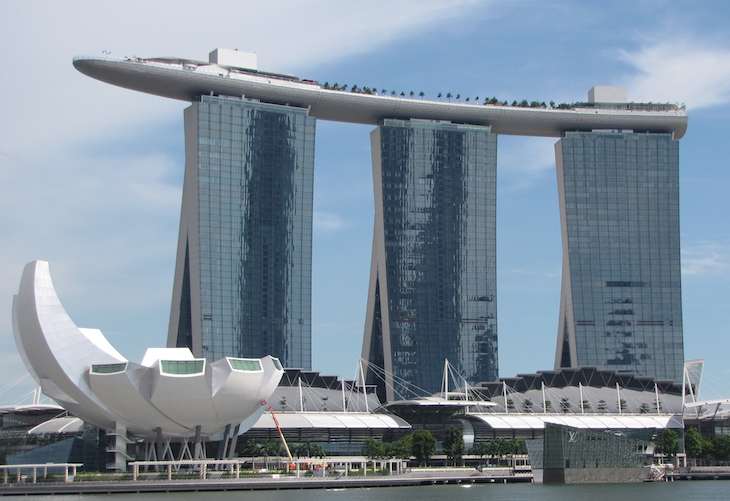
    • photo of Marina Bay Sands Casino in Singapore
      Marina Bay Sands Casino, Singapore. Singapore added their first two casinos in 2010 and have already the 2nd most gambling revenue of any area: after Macau and ahead of Las Vegas.
    • The Philippines Astounds the Skeptics by Bruce Einhorn – “Much of the credit for the good feeling should go to Aquino and his efforts to tackle corruption and improve the country’s infrastructure… As wages rise in China, the Philippines has a chance to attract investment from companies looking for low-wage alternatives, but the country’s notorious culture of bribery remains a major obstacle to growth”
    • Periodic Table Of Dividend Champions by David Van Knapp – the post looks at the 105 stocks raising dividends 25 straight years and looking at current yield and dividend growth rate highlights 34 for further study by an investor “Similarly, some investors may be interested in stocks that have a low current yield coupled with a high rate of dividend growth.”
    • (more…)

  • Long Term Care Insurance – Financially Wise but Current Options are Less Than Ideal

    The expenses for long term care is exactly the type of financial risk insurance is best for. The problem is the whole area is so uncertain that what you buy may not provide the coverage you planned on (the health care system is so broken that it is not certain insurance will cover the costs, companies can go bankrupt, change coverage rules drastically…).

    The questions about long term care insurance are not about the sensibility of the coverage abstractly, it is very wise. But the complexities, today, in the real world make the question of buying more a guess about what coverage you will actually receive if you need it.

    Many of my posts here are focused on the USA but applicable elsewhere, or just applicable wherever you are. This post is mainly focused on the USA, long term care insurance options in other locations will be very different and have different considerations (in many countries it may not even apply, mainly due to a less broken health care system than the USA has).

    Long-Term-Care Insurance: Who Needs It? by Marilyn Geewax

    “the reality is that each year, an estimated 11 million U.S. adults need some type of long-term care.

    Such care can be crushingly expensive: Just one hour of home-health-aide care costs roughly $20, while the average private nursing home room costs $87,000 a year. Neither routine employer-based medical insurance nor Medicare will pay for extended periods of custodial care.”

    Also, some people pay their premiums for years, and then get hit with rate hikes they can’t afford.

    Insurance has a transaction cost. Paying that transaction cost for expenses you can afford is just waste. You should pay the cost directly. This is why higher deductibles are most often wise. It doesn’t make sense to cover pay insurance costs every year to pay for a $500 risk you can afford to absorb yourself.

    But huge expenses are exactly what you want coverage for. Long term care expenses are huge. However, long term care insurance is still in flux, which isn’t good for something you want to provide long term protection. A huge risk is paying premiums for years, and then getting hit with rate hikes that may well be designed primarily just to get people to drop coverage (or be so expensive that those that stay pay enough that the insurance company makes money).

    Ideally such insurance would be set so maybe the cost rose at some preset limit when you signed up. The problem is the USA health care system is so broken this won’t work. No one can predict how much more excessively expensive long term coverage will be in 30 years so the insurance companies can’t predict. It leaves consumers in a risky place.

    Insurance is regulated by the states. There are huge differences in which states do a good job regulating long term care insurance and those that don’t. The majority don’t.

    This is one of the more important areas of personal finance. Unfortunately there is no easy answer. If the system were stable, reliable and predictable, long term care insurance would be a definite requirement for a sound financial plan. Today it is wise to insure yourself from those risks, the problem is determining whether any of the options available are worth it. The risk of needing this insurance is high: it is both likely and costly. So getting coverage is definitely wise if you can find some you think is reliable over the long term. Because of the uncertain nature of the options, this will require much more effort on your part than many personal finance actions (I included several links below to help your research).

    Also look at how long the coverage is for. This is another limitation insurance companies have put in place that makes it much less worthwhile.

    Related: Personal Finance Basics: Long-term Care InsuranceNational Clearinghouse for Long-Term Care InformationAARP adviceDisability Insurance is Very ImportantHow to Protect Your Financial Health

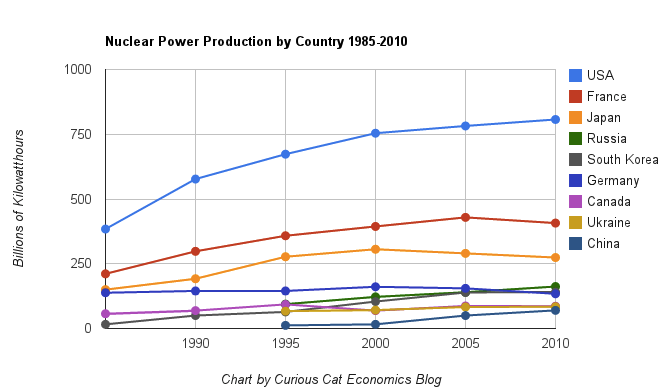
  • Nuclear Power Generation by Country from 1985-2010

    chart of nuclear power generation by the largest producing countries from 1985 to 2010The chart shows the top nuclear power producing countries from 1985 to 2010. The chart created by Curious Cat Investing and Economics Blog may be used with attribution. Data from US Department of Energy.

    ___________________

    Nuclear power provided 14% of the world’s electricity in 2010. Wind power capacity increased 233% Worldwide from 2005 2010, to a total of 2.5% of global electricity needs. Nuclear power generation declined by .72% for the same period.

    Burning coal was responsible for 41% of electricity generation in 2010. Burning natural gas accounted for 21% and hydroelectric generation accounted for 15%.

    Japan just announced that they have closed their last operating nuclear power plant. They have no nuclear power plant generating electricity for the first time in more than 40 years. It will be interesting to see how low their actual generation totals fall this year. They plan to re-open some of the plants but it is a political issue that is far from settled.

    Globally nuclear power production increased 84% from 1985 to 2010. This is a very low percentage. Global output over that period increased much more than that, as did global electricity use. The share of electricity production provided by nuclear power peaked at about 17% for much of the 1990s.

    Related: Nuclear Power Production Globally from 1985 to 2009Oil Production by Country 1999-2009Top 10 Countries for Manufacturing Production from 1980 to 2010: China, USA, Japan, Germany…Japan to Add Personal Solar SubsidiesNuclear Energy Institute (statistics)

    Another view of data on nuclear power shows which of the leading nuclear producing countries have the largest percentages of their electrical generating capacity provided by nuclear power plants (as of 2009). France has 75% of all electricity generated from nuclear power. Ukraine had the second largest percentage at 49%, then Sweden at 37% and South Korea at 35%. Japan is at 28% compared to 20% for the USA. Russia was at 18% and China was at just 2%.

  • Curious Cat Investing, Economics and Personal Finance Carnival #30

    Welcome to the Curious Cat Investing, Economics and Personal Finance Carnival: find useful recent personal finance, investing and economics blog posts and articles. This carnival is different than other carnivals: I select posts from what I read (instead of posting those that submit to the carnival as many carnivals do). If you would like to host the carnival add a comment below.

    • Hospital of Cards by Andrew Foy, MD – “For some perspective on the magnitude of the healthcare bubble consider that from 1990 to 2007 the cost of all items, as measured by the Bureau of Labor Statistics (BLS), rose by 159 percent while housing rose 163 percent and medical care rose a staggering 216 percent. A recent study by the Kaiser Family Foundation found that between 1999 and 2011, health-insurance premiums increased 168 percent while workers’ total earnings increased only 50 percent. Over that same time period, government spending on healthcare increased 240 percent while GDP increased 62 percent. The BLS reported that over the last 50 years, the percent of workers employed in private-sector healthcare has gone from 3 percent to over 11 percent and employment has continued to grow throughout the current recession.”
    • Apple’s Earning are Again Great, Significantly Exceeding High Expectations by John Hunter – Apple posted quarterly quarterly net profit of $11.6 billion (an increase of 94% in net income)… Apple’s Gross margin was 47.4% (the best ever) compared to 41.4% in the year-ago quarter. International sales accounted for 64% of the quarter’s revenue…
    • Demand for Rental Units Could Disrupt Fed by Kathleen Madigan – “The supply among rental housing is the tightest in more than a decade as only 8.8% of units were vacant in the first quarter. And given the steep fall in homeownership rates in the U.S., the demand for rental units is the highest in 15 years.”
    • 5 Reasons Why Dividend Investing Rocks – “Dividend investors always look for high and sustainable dividend growth and any stock that decides to slow that down or even stop growing the dividend entirely raises red flags.”
    • (more…)

  • Apple’s Earning are Again Great, Significantly Exceeding High Expectations

    Apple posted quarterly revenue of $39.2 billion and quarterly net profit of $11.6 billion, or $12.30 per share (an increase of 94% in net income). These results compare to revenue of $24.7 billion and net profit of $6.0 billion, or $6.40 per diluted share, for the same quarter in 2011. Apple’s Gross margin was 47.4% (the best ever) compared to 41.4% in the year-ago quarter. International sales accounted for 64% of the quarter’s revenue.

    Apple sold 35.1 million iPhones in the quarter, 88% unit growth over the year-ago quarter. Apple sold 11.8 million iPads during the quarter, a 151% unit increase over the year-ago quarter. And they sold 4 million Macs during the quarter, a 7% unit increase over the year-ago quarter. Apple sold 7.7 million iPods, a 15% unit decline from the year-ago quarter.

    “Our record March quarter results drove $14 billion in cash flow from operations,” said Peter Oppenheimer, Apple’s CFO. “Looking ahead to the third fiscal quarter, we expect revenue of about $34 billion and diluted earnings per share of about $8.68.” Don’t be surprised to see Apple significantly beat these numbers, they usually provide “estimates” that are far bellow what results turn out to be.

    Apple built their cash stockpile to over $110 billion. Even paying the dividend that they have announced, they are going to be building their cash stockpile going forward without some amazingly large purchases. The announced dividend will cost Apple about $10 billion annually. I wish Apple would increase the dividend. They have also announced a plan to repurchase about $10 billion in stock starting in about 6 months. That would be a huge commitment for most companies, for Apple it seems to be about 2 months of cash the business will generate. I worry they will make foolish purchases just because having that much sitting in the bank makes it so easy.

    The results are again fantastic. Apple’s stock price, relative to earnings, continues to be very reasonable (even cheap). Increases in the stock price have been more than outpaced by profit growth. It does seems profit growth has to slow, and likely dramatically (of course it seemed incredibly unreasonable to expect increases of even 33% of what Apple has done in the last 3 years). The stock price is not expensive, even if earnings growth collapsed, which it isn’t expected to do in the next year. On fundamental factors the stock remains very attractive.

    The biggest risk is that when so much has gone so right for Apple for so long aren’t they poised to suffer some major setbacks? I can accept the case for a dramatic slowing in earning for the iPhone, which is their primary driver of earnings. It is hardly certain but there is this potential. I don’t foresee significant actual declines (earning less in 2013 than 2012, for example). But even assuming no growth in iPhone profits from 2013 to 2016 at this price Apple seems to be a good investment (and few expect no growth for iPhone earning for that period). iPhone sales now account for 58% of Apple’s revenue; three years ago, they totaled 27% of revenue.

    Other areas should be strong in 2012, 2013 and beyond: iPads, Macs, iTunes and App sales. And everyone is expecting some huge new product or products. The leading candidate is a new Apple TV that actually makes a big move into the market. The stock price doesn’t even need some big new product but if it comes that is just more reason to be positive on Apple as an investment.

    I don’t see any signs of troubles brewing. The only reason to be nervous is that it seems crazy that such extraordinary success on such a huge scale can continue. That can explain being nervous but it doesn’t justify missing out on this attractive investment.

    Related: Apple’s Impossibly Good QuarterThe Economy is Weak and Prospects May be Grim, But Many Companies Have Rosy Prospects (Sept 2011)Leadership quotes from Steve JobsIntel Reports Their Best Quarter Ever (March 2010)12 stocks for 10 years portfolio