Author: John Hunter

  • Retirement Planning – Looking at Assets

    The basics of retirement planning are not tricky. Save 10-15% of your income for about 40 years working career (likely over 15%, if you don’t have some pension or social security – with some pension around 10+% may be enough depending on lots of factors). That should get you in the ballpark of what you need to retire.

    Of course the details are much much more complicated. But without understanding any of the details you can do what is the minimum you need to do – save 10% for retirement of all your income. See my retirement investing related posts for more details. Only if you actually understand all the details and have a good explanation for exactly why your financial situation allows less than 10% of income to be saved for retirement every year after age 25 should feel comfortable doing so.

    There is value in the simple rules, when you know they are vast oversimplifications. I am amazed how many professionals don’t understand how oversimplified the rules of thumb are.

    Here is one thing I see ignored nearly universally. I am sure some professions don’t but most do. If you have retirement assest such as a pension or social security (something that functions as an annuity, or an actually annuity) that is often a hugely important part of your retirement portfolio. Yet many don’t consider this when setting asset allocations in retirement. That is a mistake, in my opinion.

    A reliable annuity is most like a bond (for asset allocation purposes). Lets look at an example for if you have $1,500 a month from a pension or social security and $500,000 in other financial assets. $1,500 * 12 gives $18,000 in annual income.

    To get $18,000 in income from an bond/CD… yielding 3% you need $600,000. That means, at 3%, $600,000 yields $18,000 a year.

    Ignoring this financial asset worth the equivalent of $600,000 when considering how to invest you $500,000 is a big mistake. Granted, I believe the advice is often too biased toward bonds in the first place (so reducing that allocation sounds good to me). To me it doesn’t make sense to invest that $500,000 the same way as someone else that didn’t have that $18,000 annuity is a mistake.

    I also don’t think it makes sense to just say well I have $1,100,000 and I want to be %50 in bonds and 50% in stocks so I have “$600,000 in bonds now” (not really after all…) so the $500,000 should all be in stocks. Ignoring the annuity value is a mistake but I don’t think it is as simple as just treating it as though it were the equivalent amount actually invested.

    Related: Immediate AnnuitiesManaging Retirement Investment RisksHow to Protect Your Financial HealthMany Retirees Face Prospect of Outliving Savings

    (more…)

  • Reconsidering Tesco as an Investment

    Tesco is in my 12 stocks for 10 years portfolio. One of the big reasons I bought is management’s commitment to using good management practices, in particular lean thinking (based on Toyota’s management principles). These principles include: investing in the long term, customer focus, respect for employees.

    With those practices in place and the good international expansion potential (including the USA) the opportunities are good (thus I liked the investment). Short term hiccups don’t really bother me. I would rather avoid them but I can accept them. The think that worries me about Tesco is I am becoming less and less convinced they are committed to lean management principles. Instead they seem to just be practicing the same lame management that so many companies employ. They can still be successful that way but the lost value to shareholders is great and makes me very close to deciding to eliminate my investment. I already sold half of the position, last year.

    I now live in Malaysia and the Tesco’s here are horrible. There is no evidence of customer focus. They have lousy “fresh” (often not) vegetables. It is very easy to be sloppy as you expand. They obviously are not concerned enough to practice lean thinking in Malaysia. That is a concern. But large organizations often struggle to manage themselves competently and one small area ignoring lean thinking principles isn’t enough to say Tesco is ignoring them completely. More and more evidence is pointing to Tesco being sloppy and ignore lean thnking, however.

    The main current financial problems are in the home market issues not directly related to lean thinking. Those I could easily chose to wether, if I believe the company is committed to smart lean management principle, but I am not any longer (sadly). For me, I need to see more evidence of commitment to lean principles or I will likely sell out my investment.

    Another problem I have is Amazon was my other retail investment and I have significant valuation concerns – I am closer to selling more than buying more (I have sold some). I have long been looking at Costco – I would have been much better off buying it over Tesco 🙁 I am still considering it (I would love to buy Costco, it is just a valuation concern that holds me back, the company and the future prospects look great).

    I lost no faith in Toyota (another stock in my sleep well portfolio) during the recent struggles. There were some slip-ups. Toyota’s responses were great – just as I would expect. Mainly the stories were greatly overblown.

    Related: Tesco: Consistent Earnings Growth at Attractive PriceApple’s Impossibly Good QuarterTaking a Look at Some Dividend Aristocrats

  • Curious Cat Investing, Economics and Personal Finance Carnival #29

    Welcome to the Curious Cat Investing, Economics and Personal Finance Carnival. The carnival is published twice each month with links to new, related, interesting content online.

    • For Capitalism to Survive, Crime Must Not Pay by Bruce Judson – “Justice must be blind so that both parties — whether weak or powerful — can assume that an agreement between them will be equally enforced by the courts.

      There is a second, perhaps even more fundamental, reason that equal justice is essential for capitalism to work. When unequal justice prevails, the party that does not need to follow the law has a distinct competitive advantage. A corporation that knowingly breaks the law will find ways to profit through illegal means that are not available to competitors. As a consequence, the competitive playing field is biased toward the company that does not need to follow the rules.” (the crony capitalism that has grown in the last few decades in the USA is poisoning the country with a failure to justly prosecute those that break laws if they are rich and connected to the other powerful cronies. This is a serious problem. – John).

    • Don’t Expect to Spend Over 4% of Your Retirement Investment Assets Annually by John Hunter – “This is likely one of the top 5 most important things to know about saving for retirement (and just 10% of the population got the answer right). You need to know that you can safely spend 5%, or likely less, of your investment assets safely in retirement (without dramatically eating into your principle.”
    • What America Pays In Taxes – In 2011 the USA government collected $1,100 billion in personal income taxes, $741 billion in payroll taxes (social security and medicare) [this should be a hint that look only at income taxes paid it might be very misleading – John], $200 billion in corporate taxes, $10 billion in estate and gifts taxes and $268 billion in other taxes (customs duties, excise taxes on products such as gasoline…).
    • Value Investing is Not Necessarily Buy and Hold Investing by Shailesh Kumar – “Value investors choose to buy a stock when it is cheaper than the intrinsic value of the stock and sell it when it becomes more expensive.”
    • (more…)

  • Investing in the Poorest of the Poor

    I have donated more to Tricke Up than any other charity for about 20 years now. There is a great deal of hardship in the world. It can seem like what you do doesn’t make a big dent in the hardship. But effective help makes a huge difference to those involved.

    My personality is to think systemically. To help put a band aid on the current visible issue just doesn’t excite me. Lots of people are most excited to help whoever happens to be in their view right now. I care much more about creating systems that will produce benefits over and over into the future. This view is very helpful for an investor.

    Trickle Up invests in helping people create better lives for themselves. It provides some assistance and “teaches people to fish” rather than just giving them some fish to help them today.

    The stories in this video show examples of the largest potential for entrepreneurship. While creating a few huge visible successes (like Google, Apple…) is exciting the benefits of hundreds of millions of people having small financial success (compared to others) but hugely personally transforming success is more important. Capitalism is visible in these successes. What people often think of as capitalism (Wall Street) has much more resonance with royalty based economic systems than free market (free of market dominating anti-competitive and anti-market behavior) capitalism.

    Related: Kiva Loans Give Entrepreneurs a Chance to SucceedMicro-credit ResearchUsing Capitalism in Mali to Create Better Lives

  • Don’t Expect to Spend Over 4% of Your Retirement Investment Assets Annually

    Pitfalls in Retirement (pdf) is quite a good white paper from Meril Lynch, I strongly recommend it.

    A survey asked investors at least 41 years of age how much of their retirement savings they can safely spend each year without running the risk of exhausting their assets. Forty percent had no idea; an additional 29% said they
    could safely spend 10% or more of their savings each year.

    But, as explained below, the respondents most on target were the one in 10 who estimated sustainable spending rates to be 5% or less. This is significantly impacted by life expectancy; if you have a much lower life expectancy due to retiring later or significant health issues perhaps you can spend more. But counting on this is very risky.

    This is likely one of the top 5 most important things to know about saving for retirement (and just 10% of the population got the answer right). You need to know that you can safely spend 5%, or likely less, of your investment assets safely in retirement (without dramatically eating into your principle.

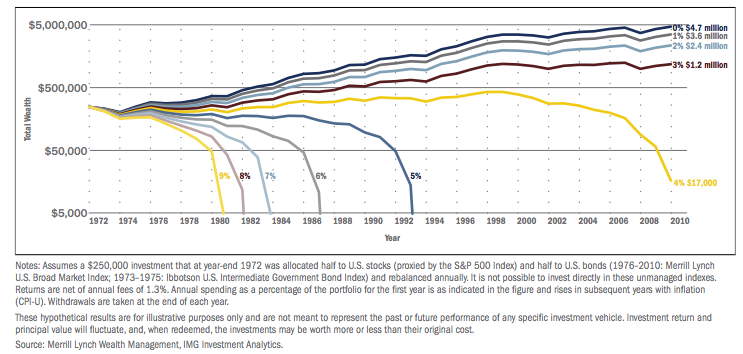
    chart showing retirement assets over time based on various spending levels
    Chart showing retirement assets over time based on various spending levels, from the Merill Lynch paper.

    The chart is actually quite good, the paper also includes another good example (which is helpful in showing how much things can be affected by somewhat small changes*). One piece of good news is they assume much larger expense rates than you need to experience if you choose well. They assume 1.3% in fees. You can reduce that by 100 basis points using Vanguard. They also have the portfolio split 50% in stocks (S&P 500) and 50% in bonds.

    Several interesting points can be drawn from this data. One the real investment returns matter a great deal. A 4% withdrawal rate worked until the global credit crisis killed investment returns at which time the sustainability of that rate disappeared. A 5% withdrawal rate lasted nearly 30 years (but you can’t count on that at all, it depends on what happens with you investment returns).

    Related: What Investing Return Projections to Use In Planning for RetirementHow Much Will I Need to Save for Retirement?Saving for Retirement

    (more…)

  • USA Adds Just 120,000 Job in March, Unemployment Rate Falls to 8.2%

    Nonfarm payroll employment rose by 120,000 in March, and the unemployment rate dropped to 8.2%, the United States Bureau of Labor Statistics reported today. Employment rose in manufacturing, food services, and health care, but was down in retail trade. The change in total nonfarm payroll employment for January was revised from +284,000 to +275,000, and the change for February was revised from +227,000 to +240,000 (together this adds just 4,000 more jobs brining the total added jobs with this report to 124,000.

    Adding 120,000 jobs in a month is mediocre in general for the USA economy. The biggest reason for disappointment is during recoveries jobs are normally added at a higher rate, and given how many jobs were lost in the during the credit crisis outsized job gains are needed. The other reason adding 120,000 jobs was disappointing is the consensus estimate was for over 200,000 jobs to be added.

    The number of long-term unemployed (those jobless for 27 weeks and over) was essentially unchanged at 5.3 million in March and remains one of the biggest employment problems for the economy. These individuals accounted for 42.5% of the unemployed. Since April 2010, the number of long-term unemployed has fallen by 1.4 million.

    In the prior 3 months, payroll employment had risen by an average of 246,000 per month. Private-sector employment grew by 121,000 in March, including gains in manufacturing, food services, and health care.

    Manufacturing employment rose by 37,000 in March, with gains in motor vehicles and parts (+12,000), machinery (+7,000), fabricated metals (+5,000), and paper manufacturing (+3,000). Factory employment has risen by 470,000 since a recent low point in January 2010. Manufacturing continues providing some of the best employment news.

    Related: Latest USA Jobs Report Adds 286,000 Jobs; Another Very Strong Month (Mar 2012)USA Adds 216,00 Jobs in March 2011; the Unemployment Rate Stands at 8.8%USA Added 162,000 Jobs in March 2010Another 663,000 Jobs Lost in March 2009 in the USA

    (more…)

  • Warren Buffett’s 2011 Letter to Shareholders

    Warren Buffett continues to write his excellent annual shareholder letter. It is a pleasure to read them every year. I have selected a few passages to include:

    The logic is simple: If you are going to be a net buyer of stocks in the future, either directly with your own money or indirectly (through your ownership of a company that is repurchasing shares), you are hurt when stocks rise. You benefit when stocks swoon. Emotions, however, too often complicate the matter: Most people, including those who will be net buyers in the future, take comfort in seeing stock prices advance. These shareholders resemble a commuter who rejoices after the price of gas increases, simply because his tank contains a day’s supply.

    Charlie and I don’t expect to win many of you over to our way of thinking – we’ve observed enough human behavior to know the futility of that – but we do want you to be aware of our personal calculus. And here a confession is in order: In my early days I, too, rejoiced when the market rose. Then I read Chapter Eight of Ben Graham’s The Intelligent Investor, the chapter dealing with how investors should view fluctuations in stock prices. Immediately the scales fell from my eyes, and low prices became my friend. Picking up that book was one of the luckiest moments in my life.

    Investors face challenges within their own psychology. This is one, but not the only one.

    At bottom, a sound insurance operation needs to adhere to four disciplines. It must (1) understand all exposures that might cause a policy to incur losses; (2) conservatively evaluate the likelihood of any exposure actually causing a loss and the probable cost if it does; (3) set a premium that will deliver a profit, on average, after both prospective loss costs and operating expenses are covered; and (4) be willing to walk away if the appropriate premium can’t be obtained.

    Many insurers pass the first three tests and flunk the fourth. They simply can’t turn their back on business that their competitors are eagerly writing. That old line, “The other guy is doing it so we must as well,” spells trouble in any business, but in none more so than insurance. Indeed, a good underwriter needs an independent mindset akin to that of the senior citizen who received a call from his wife while driving home. “Albert, be careful,” she warned, “I just heard on the radio that there’s a car going the wrong way down the Interstate.” “Mabel, they don’t know the half of it,” replied Albert, “It’s not just one car, there are hundreds of them.”

    Tad has observed all four of the insurance commandments, and it shows in his results. General Re’s huge float has been better than cost-free under his leadership, and we expect that, on average, it will continue to be. In the first few years after we acquired it, General Re was a major headache. Now it’s a treasure.

    The insurance business is explained well in this, and his other shareholder letter.

    Related: Warren Buffett’s 2010 Letter to ShareholdersWarren Buffett’s Q&A With Shareholders 2009Warren Buffett’s 2007 Letter to Shareholders

    (more…)

  • Curious Cat Investing, Economics and Personal Finance Carnival #28

    Welcome to the Curious Cat Investing, Economics and Personal Finance Carnival: find useful recent personal finance, investing and economics blog posts and articles. The carnival is published twice each month. This carnival is different than other carnival: I select posts from the blogs I read (instead of just posting those that submit to the carnival as many carnivals do). If you would like to host the carnival add a comment below.

    • Why the April Jobs Report Could Be a Disaster – “the one-two punch of a warmer winter and unusual seasonal adjustment factors stemming from the financial crisis could combine to create something of a disaster for those writing the labor market headlines in early-May when the April jobs data is reported.” [it also may not turn out to be an issue, but it is an interesting post and the type of thing you need to consider when looking at economic data – John]
    • Evaluating Your Auto Insurance Policy – “many companies offer defensive driver discounts if you take a course or install a device in your car to monitor your habits. You can also get good student discounts for students on your policy, low mileage discounts for cars you don’t drive much, accident-free discounts when you haven’t been in an accident lately, and loyalty discounts for sticking with the company.”
    • Buyting Foreclosed Homes as Rental Investments – “Since 2007, investors have been trolling the cratered suburbs stretching from California to Florida for cheap houses to flip. And firms such as PennyMac Mortgage Investment Trust have sought value in subprime-mortgage-backed securities. Waypoint, which owns 1,100 houses and is buying five more a day, is betting that converting foreclosures into rentals is a better way to make a profit.”
    • How Long Can We Finance the Debt? by James Kwak – “Since the Federal Reserve is expected to reduce its balance sheet as the economy recovers, if foreign holdings of U.S. government debt simply remain at current levels (as a share of GDP), they expect that 10-year yields would climb to 7.9 percent by 2020—rather than 5.4 percent as forecast in the CBO’s baseline.”
    • The Case for Raising Top Tax Rates – “In 1980, the top marginal rate was 70 percent for families making more than $215,400 — about $587,000 in current dollars. And these families pocketed a much smaller share of the nation’s income than they do now. Today, people earning over $200,000 a year capture more than a third of national income.”
  • Avoiding Hedge Fund Investments is One of the Benefits of Being in the 99%

    Hedge funds sell themselves as investments for elites and justify their extraordinary expenses mainly by appealing to elites egos. Well, hedge funds by and large do poorly. This is largely due to huge expenses. Add to that the incentives managers have to take huge risks: the managers often get 20% of extraordinary gains and if they lose, well you lose your money. These incentives to take huge risks do mean a few hedge funds do spectacularly well each year (of course more usually do spectacularly poorly over time).

    Warren Buffett knew this and wagered a long term investment in a low cost Vanguard S&P 500 Index fund would beat a hedge fund over the long term.

    Buffett Seizes Lead in Bet on Stocks Beating Hedge Funds

    The wager that began on Jan. 1, 2008, pits the Omaha, Nebraska, billionaire against Protégé Partners LLC, a New York fund of hedge funds co-founded by Ted Seides and Jeffrey Tarrant. Protégé built an index of five funds that invest in hedge funds to compete against a Vanguard mutual fund that tracks the Standard & Poor’s 500 Index. The winner’s charity of choice gets $1 million when the bet ends on Dec. 31, 2017.

    Buffett’s argument, like the large pension funds, is that funds of hedge funds cost too much, according to a statement he posted on longbets.org, a website backed by the nonprofit Long Now Foundation that fosters “long-term thinking.” In addition to the 2 percent management fee and 20 percent performance fee that hedge funds typically charge, the funds of funds add another layer of fees, on average 1.25 percent of assets and 7.5 percent of any gains, according to data compiled by Bloomberg.

    There may be many nice things about being in the 1% of the USA (being in 1% of the World is something more people in the USA should realize they are – more than 50% of the USA is in the 1% of everyone) but investing in hedge funds is mainly fools helping make a few more of the 1% by paying huge fees for lousy investments. Yes a few hedge funds will manage to do well. As would a few monkey’s throwing darts at a page of investments each quarter. The odds of picking a hedge fund for a long period of time that does so well the huge fees are justified are not great. Missing out on this investment option is not one you should feel sad about.

    Related: Is the Stock Market Efficient?Investment Risk Matters Most as Part of a Portfolio, Rather than in Isolation12 Stocks for 10 Years: January 2012 Update

  • Curious Cat Investing, Economics and Personal Finance Carnival #27

    Welcome to the Curious Cat Investing, Economics and Personal Finance Carnival. The carnival is published twice each month. This carnival is different than others in two significant ways. First, I select posts from the blogs I read (instead of just posting those that submit to the carnival). I think this provides readers a better selection of valuable material (many of the best blogs don’t take time to submit to carnivals). And second, I include articles when I think they are interesting. If you are interested in hosting the carnival, add a comment including a link to your blog.

    • Savers, who did nothing to create the financial crisis, are being punished – “Our policy makers do need to think about what we are transferring to the banks,” Mr. Todd said. “Why is the public obligated to provide them with all those subsidies? Nobody will ask these questions.” [I agree, the large financial institutions are most responsible for the credit crisis and what they get is welfare paid for by others and they don’t even admit to their welfare status, pretending that the large financial institutions are not getting billions of dollars in direct and indirect aid from the rest of us]
    • You’d Be A Fool To Hold Anything But Cash Now, interview with David Stockman – “Q: You sound as if we’re facing a financial crisis like the one that followed the collapse of Lehman Brothers in 2008.
      A: Oh, far worse than Lehman. When the real margin call in the great beyond arrives, the carnage will be unimaginable.”
    • The end of cheap China – “Labour costs have surged by 20% a year for the past four years… Labour costs are often 30% lower in countries other than China, says John Rice, GE’s vice chairman, but this is typically more than offset by other problems, especially the lack of a reliable supply chain.”
    • Killing the competition: How the new monopolies are destroying open markets by Barry Lynn – “the basic characteristics shared by all real markets. Most important is an equality between the seller and the buyer, achieved by ensuring that there are many buyers as well as many sellers.” [this is fundamental to how capitalism provides benefits to the society. As markets are made less free (think of any market with very few buyer or sellers – that is lots of them today) the risks increase that society will lose to those few players who can extract monopolistic rents from the broken markets. The concept that free markets result in benefit to society through competition require real markets and competition, just using the word capitalism doesn’t bring the benefits, the system must have capitalistic traits – John]
    • What Portion Of Your Portfolio Should You Invest In Bonds? – “The universal rule is quite simple. If you own 100% of your portfolio in stocks and bonds you would invest so that: Bond proportion = your age %; Stock proportion = 100% – bond proportion” [I have a long comment on the post, I disagree with this specific advice today, the concept is sound, but bonds are not the right investment to balance the portfolio – John]
    • Adam Smith versus Business by Sheldon Richman – “Smith knew the difference between being sympathetic to the competitive economy – which he called the ‘system of natural liberty’ — and being sympathetic to owners of capital (who might well have acquired it by less-than-kosher means, that is, through political privilege). He knew something about business lobbies.”
    • USA Consumer and Real Estate Loan Delinquency Rates from 2001 to 2011 by John Hunter – “Residential real estate delinquency rates fell just 25 basis points (to a still extremely large 9.86%). Commercial real estate delinquency rates fell an impressive 186 basis points (to a still high 6.12%). Credit card delinquency rates fell 86 basis points to a 17 year low, 3.27%.”