Author: John Hunter

  • USA Unemployment Rate Drops to 8.6%

    The unemployment rate fell from 9.0% to 8.6% in November, however that is not an accurate representation of employment in the USA. The news is good, but very mildly good, while a decrease in the unemployment rate by 40 basis points would lead you to believe the improvement was dramatic. Nonfarm payroll employment rose by 120,000 which is about the number needed to keep up with population growth each month. Employment continued to trend up in retail trade, leisure and hospitality, professional and business services, and health care. Government employment continued to trend down.

    The change in total nonfarm payroll employment for September was revised from +158,000 to +210,000, and the change for October was revised from +80,000 to +100,000. This means this report shows an increase of 192,000 jobs which is pretty good news (especially for those that think the economy has been in a recession – it has not).

    One year ago the unemployment rate stood at 9.6%.

    The number of unemployed persons, at 13.3 million, was down by 594,000 in November. The labor force, which is the sum of the unemployed and employed, was down by a little more than half that amount. What this means is the reduction in the unemployment rate was largely due to the decrease in those actively looking for jobs.

    Among the major worker groups, the unemployment rate for adult men fell to 8.3% in November. The jobless rate rates for adult women (7.8%), teenagers (23.7%), African-Americans (15.5%), and Hispanics (11.4%) showed little or no change. The jobless rate for Asians was 6.5%.

    The number of long-term unemployed (those jobless for 27 weeks and over) was little changed at 5.7 million and accounted for 43.0% of the unemployed. This is one of the numbers that has to come down drastically for the job situation to really show good improvement.

    Related: Jobs News in the USA is not Good, Unemployment Remains at 9.1% (Aug 2011)USA Economy Adds 151,000 Jobs in October, Unemployment Rate Steady at 9.6% (Oct 2010)Unemployment Rate Reached 10.2% (Oct 2009)Over 500,000 Jobs Disappeared in November (2008)

    (more…)

  • Curious Cat Investing, Economics and Personal Finance Carnival #20

    Welcome to the Curious Cat Investing, Economics and Personal Finance Carnival. Investing markets continue to move in seemingly haphazard ways. The risks from excessive debt, failure to regulate financial institutions, political weakness (both of politicians and of populaces electing such incapable politicians), financial fraud and more make this a very difficult time to invest. We hope to help find useful recent personal finance, investing and economics blog posts and articles.

    • The Unemployment Plan – “I just found out that I’m being “downsized” at the end of the year. While I have a small emergency fund, I do have a mortgage and a bit of credit card debt. I also have three kids at home. My wife will continue to work, but she has only a part-time job with minimal benefits. I am receiving a pretty good severance package, though.
      Rather than panicking, I’m trying to be calm and rational about figuring out what’s next…”
    • Choosing Between An Annuity And A Dividend Portfolio – “Personally, I consider the choice between an annuity or a dividend portfolio to be a no-brainer. I think a systematic, sustainable and disciplined approach to dividend investing will outperform in almost all cases and while it will require a bigger time investment, that is a small price to get more flexibility, better returns and a much stronger growth potential.”
    • From the webcast (see above) with Jim Rodgers. He sees a difficult period worldwide the next 2 years. He is short many shares everywhere (including emerging market). He also owns some shares. But overall he sees a difficult few years for stock markets.
      He says China has a price bubble in real estate and many bankruptcies will take place. But it is not as bad as the USA problems where there was a credit bubble (you have to have a job to get real estate loans, while in the USA and UK you didn’t have too). Chinese banks are is less bad shape than the USA and Europe.
    • Manufacturing Employment Data: USA, Japan, Germany, UK… 1990-2009 by John Hunter – “Compensation in the countries currency is remarkably consistent across all countries from 1990-2009. Japan shows the only significant divergence in the period of 2002 – 2009 actually decreasing pay in real terms (a small amount – from 100 to 98) while the average increases to about 110.”
    • (more…)

  • Where are Profit Margins Headed?

    Where is the economy headed? With the troubles of huge debt (by governments and consumers) and the possible collapse of the Euro it is very hard to be certain. And where is the stock market headed? That is also difficult to predict. Of course, where the stock market is headed in the short term is never easy to predict. If you can predict, you should be rich (though it likely takes a bit more, knowing how much to risk…).

    At least by knowing what has happened you can be ahead of where many people are. The USA economy has not been in a recession, we have actually been growing. Just doing so very slowly. And doing so without many added jobs. Companies however, have been doing very well.

    U.S. companies’ ability to squeeze more profit from each dollar of sales is pushing earnings higher, even as the economy has grown at a below-average clip since the recession ended in June 2009.

    For investors knowing if this is a positive trend that can be expected to continue or an aberration is key. But I have no way of knowing. My guess is it is at least partially something that will continue (but maybe a portion of the gains are an aberration) – but this is just a guess. This bloomberg article looks more at the issue.

    Grantham, who called corporate profits “freakishly high” in an August commentary, sees wide margins as an aberration. Some of his competitors say changes in the economy and the way firms operate could keep them near peak levels for another year or two. “We don’t think they have to fall,” Doll, whose New York- based firm is the world’s largest asset manager, said in a phone interview. BlackRock oversees $3.35 trillion.

    The margins of non-financial companies in the U.S., a widely used measure of profitability, reached 15 percent in the third quarter, according to data from Moody’s Analytics Inc. in West Chester, Pennsylvania. That was the highest level since 1969. When the recession ended in the second quarter of 2009, the comparable number was 8.7 percent.

    The most compelling data supporting my belief is the long term trend.

    Profit margins have been trending higher since the mid-1980s, said Chris Christopher, an economist at IHS (IHS) Global Insight, who has written on the subject. Quarterly margins peaked at 11.9 percent in the 1980s, 13.6 percent in the 1990s and 14.5 percent in the most recent decade, Moody’s data show.

    But where this trend ends and starts reversing won’t be obvious until years after it happens. But investors that can predict (or guess) margin changes will likely be rewarded financially.

    Related: The Economy is Weak and Prospects May be Grim, But Many Companies Have Rosy ProspectsIs the Stock Market Efficient?Investment Risk Matters Most as Part of a Portfolio, Rather than in Isolation

  • Supplemental Income: Consulting by the Minute

    Trying to create significant supplementary income is not easy. There are lots of people selling get rich quick schemes and ways to earn big money for little effort. But those schemes don’t offer what they claim (they just don’t work for any, but a few people).

    In trying to figure out a good way to create another income stream I thought of the idea of consulting over the internet in very small chunks of time. I explored the options to be a consultant that way and they were not good. But the idea seemed excellent to me and I worked with a friend to develop the idea of us creating such a online service. The potential was great I think. The end service would provide value to those seeking answers and those providing consultation (and to us).

    We did get a domain and plan out the service and begin coding the application but didn’t progress very far. It was still a great idea and something I planned to consider if I had a bit more time. Well there is now an offering that appears to actually be fairly decent (on first glance): Minute Box.

    Minute Box allows you several of the things we planned on offering (but not all of them – at least not yet). You can register as an expert and then be available for those wanting advice. You sign in when you are available to answer questions (and people can send you a note while you are offline). You set your rate. Essentially IM is used for consultation and the billing is taken care of by Minute Box.

    One of the keys is matching people to experts well. Minute Box does one thing we planned on doing, which is to emphasize the experts tapping those that already value their advice. This would work very well for bloggers and those with an online presence and reputation.

    portrait of John Hunter

    I signed up and created my expert account, so if you want to get some advice from me you can get consulting by the minute from John Hunter.

    I think this consulting by the minute model is a great way to create a secondary income stream for those that have a positive online reputation. You can adjust your pay to manage demand. If you have a free week and want to make some extra income you can reduce your rate and offer your readers a special discount. This is potentially a great way to capitalize on your expertise. I haven’t had much experience with Minute Box yet so it isn’t certain they are the answer (but I haven’t seen any other solution that is very good). And no matter the service provider used, I believe the internet enabled micro consulting is a great way to provide some extra income and make your personal finances more robust.

    The range of advice you can offer is huge. For nearly anything there are people that need advice: how to cook thanksgiving dinner, helping a child with math homework, fashion advice, editing a resume, which mortgage offer is better in a specific situation, fixing a bug in a WordPress blog, what are good plants for a shady area… The list is nearly endless.

    I wish I had been able to create a web site to facilitate this process. I believe the potential is huge. That is why I was so interested in making this idea work. It is the only web business I have seriously considered (and even started). I have numerous web sites but they involve providing content online not any software as service businesses.

    Related: Earning More MoneySave Some of Each RaiseIf you can’t pay cash, earn more money or save until you have the cash

  • Manufacturing Employment Data: USA, Japan, Germany, UK… 1990-2009

    I try to find global economic data on manufacturing and manufacturing jobs, but it isn’t easy. This is one of the areas I will be working on with the time I have freed up by moving to Malaysia (and taking a “sabbatical” [it isn’t really a sabbatical, I guess, just me studying and working on what I want to instead of what someone pays me to]).

    I found some interesting data from the USA census bureau on manufacturing employment in several countries (it would be interesting to see the data for more countries but for now I am limited to this data). Sadly they just use indexed data (I would rather see raw data). This data for example lets you see the changes in countries but I don’t see any way to compare the absolute values between countries – all you can compare is the changes between countries.

    The data is all indexed at 2002 = 100. Interestingly the USA has increased output per hour much more than any other country since 2002. The USA index stands at 146, the next highest is Sweden at 127 then the UK at 120. Italy is the only country tracked that fell since 2002, to 94. Japan (the 3rd largest manufacturer and 2nd largest of the countries include, China isn’t included) only increased to 113. Germany (4th and 3rd) increased to 111.

    The data also lets you look back from 1990 to 2002 and again the USA has increased productivity very well (2nd most) – the value in 1990 was 58. Sweden actually had the largest gain from 1990-2002, rising from 49. In 1990 Japan stood at 71 and Germany 70.

    (more…)

  • Curious Cat Investing, Economics and Personal Finance Carnival #19

    Welcome to the Curious Cat Investing and Economics Carnival: find useful recent personal finance, investing and economics blog posts and articles.

  • Looking at the Value of Different College Degrees

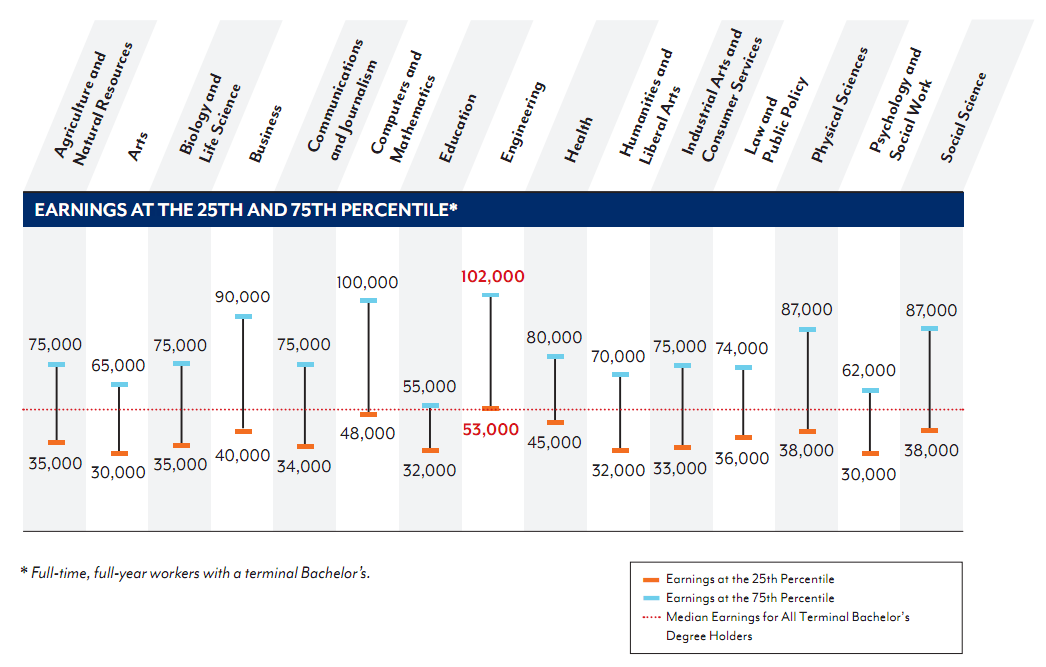
    Georgetown University Center on Education and the Workforce has produced a new report looking at the value of different college degrees in the USA. I have seen a great increase in discussions of the “bubble” in education. Those articles often say a college degree doesn’t assure the success it used to. The data I review seems to show extremely large benefits for those with a college degree (higher salaries but, much more importantly, in my opinion, they also have much lower unemployment rates).

    Those benefits are greatest for several majors including science, math and engineering. The problem I see is not so much that significant benefits are lacking for college degrees but the huge increases in costs of getting a degree are so large that for some majors the cost is just so large that even with the benefits it is arguable whether it is worth the cost (while a few decades ago the benefits were universal and so large the economic benefit was not debatable).

    The authors of the report found that all undergraduate majors are worthwhile, even taking into account the cost of college and lost earnings. However, the lifetime advantage ranges from $1,090,000 for Engineering majors to $241,000 for Education majors. As I have written frequently on the Curious Cat Science and Engineering blog, engineering degrees are very financially rewarding.

    The top 10 majors with the highest median earnings for new graduates are:

    • Petroleum Engineer ($120,000)
    • Pharmacy/pharmaceutical Sciences and Administration ($105,000)
    • Mathematics and Computer Sciences ($98,000)
    • Aerospace Engineering ($87,000)
    • Chemical Engineering ($86,000)
    • Electrical Engineering ($85,000)
    • Naval Architecture and Marine Engineering ($82,000)
    • Mechanical Engineering, Metallurgical Engineering and Mining and Mineral Engineering (each with median earnings of $80,000)
    chart showing the salaries by major in the USA (2009)
    Chart of salaries (25th and 75th percentile) by major in the USA based on data from 2009

    Related: 10 Jobs That Provide a Great Return on InvestmentMathematicians Top List of Best OccupationsNew Graduates Should Live Frugally

    (more…)

  • How Economic Inequality Harms Societies

    The increases in income inequality creates problems and increases serious risks. Some people have a political ideology that drives their thoughts on any economic policy. I instead, look to economic issues if they benefit society. The reason capitalism is great is because society benefits. The policies that create huge income inequality are bad for society and should be changed.

    Sadly the strong support for policies to elevate trust fund babies in the USA have created a society where economic wealth in the USA is now greatly defined by how rich your parents are instead of your ability and effort. The USA used to have great social mobility now we have changed society to become more like feudal Europe, while Scandinavia has become more like the USA used to be for social mobility.

    Related: Economic Fault, Income InequalityMiddle Class Families from 1970-2005Income Inequality in the USA (2006)The Widening “Marriage Gap” is Breeding Income Inequality

  • Consumer and Real Estate Loan Delinquency Rates from 2000 to 2011

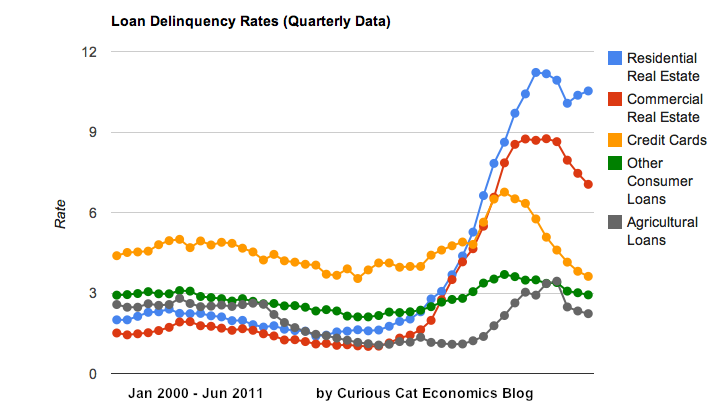
    chart showing loan delinquency rates from 2000-2011 in the USA
    Chart showing loan delinquency rates from 2000-2011, shows seasonally adjusted data for all banks for consumer and real estate loans. The chart is available for use with attribution. Data from the Federal Reserve.

    Residential real estate delinquency rates increased in the first half of 2011 in the USA. Other debt delinquency rates decreased. Credit card delinquency rates have actually reached a 17 year low.

    While the job market remains poor and the serious long term problems created by governments spending beyond their means (for decades) and allowing too big to fail institutions to destroy economic wealth and create great risk for world economic stability the USA economy does exhibit positive signs. The economy continues to grow – slowly but still growing. And the reduction in delinquency rates is a good sign. Though the residential and business real estate rates are far far too high.

    Related: Consumer and Real Estate Loan Delinquency Rates 2000-2010Real Estate and Consumer Loan Delinquency Rates 1998-2009Government Debt as Percent of GDP 1998-2010 for OECD

    (more…)

  • Curious Cat Investing, Economics and Personal Finance Carnival #18

    Welcome to the Curious Cat Investing, Economics and Personal Finance Carnival: find useful recent personal finance, investing and economics blog posts and articles. If you want to have an post considered for the next carnival please submit it to quixperito: money.

    • How I live on $7,000 per year by Jacob Lund Fisker – “If I had to venture a guess, I’d say I’m more frugal (the way your grandparents were frugal—in fact what I do wouldn’t be considered very extreme by your grandparents or great grandparents—I’d probably be average from their perspective) and I adhere more to a do-it-your-self ethics.”
    • Invest in Communities to Advance Capitalism by Howard Schultz (CEO of Starbucks) – “It is no longer enough to serve customers, employees, and shareholders. As corporate citizens of the world, it is our responsibility — our duty — to serve the communities where we do business by helping to improve, for example, the quality of citizens’ education, employment, health care, safety, and overall daily life, plus future prospects.” [similar to Dr. Deming ideas from decades ago on the purpose of organizations, which I share – John].
    • My dad taught me cashflow with a soda machine by Rob Fitzpatrick – “The vending machine didn’t magically make me want to be an entrepreneur. I wanted to be a video game designer, then an engineer, then a video game designer again, and then an academic. I get the impression kids are a bit slippery in that regard.
      But when I stumbled into the startup world two decades later, the dots began to connect. Cashflow wasn’t a new concept.”
    • photo of path up through the Forest Glen Preserve
      Forest Glen Preserve, Illinois, Illinois by John Hunter
    • Disability Insurance is Very Important by John Hunter – “When I would have had gaps in coverage from work, I have purchased disability insurance myself. I am all in favor of saving money. About the only 2 things I don’t believe in saving money being very important are health and disability insurance.”
    • What Other Dividend Lists Exist Besides the Dividend Aristocrats? – “companies that have increased their annual regular dividends for at least the past 10 consecutive years and have met specific liquidity screening criteria… The members of the Dividend Champions List include, those stocks (not limited to the S&P 500) that have increased their dividend for the past 25 years.”
    • Buying a New Home and Converting Your Current Home Into a Rental Property by Philip Taylor – “By refinancing our mortgage, we reduced our mortgage payment by enough to allow us to rent out the property by at least a hundred more per month than all of our expenses: mortgage, property taxes, insurance, home owners association dues, repairs, and property management fees.”
    • The perils of near monopoly by Joshua Gans – “Had Qantas had market shares akin to airlines in more competitive markets, the shut down would not have had the external spillovers, publicity and also the ability to shield Qantas — both managers and workers — from personal long-term consequences of such brinkmanship.”
    • (more…)