Author: John Hunter

  • Company Spotlight on Campaign Monitor by 37Signals

    Profitable and proud: Campaign Monitor

    we’ve managed to more than double our revenues and profits every year for the last six years. All without taking any outside investment.

    The idea for selling our own software really came out of frustration more than anything else. We were designing email newsletters for a lot of our clients but couldn’t find the right tool for the job. After trying everything on the market, we built a simple app that let our clients manage their own newsletters. All our clients loved it and it created a nice new revenue stream for us.

    Over the last six years we’ve gone from open plan, to all closed offices and then to a combination of both. I’ve paid close attention to the pros and cons of each layout, and I’m convinced that closed offices are the best layout for a software company.

    The reason for this is fairly simple. It’s all about removing distractions. Jobs like software development, design and copywriting often require juggling lots of different things in your head at once.

    Very interesting article on successful entrepreneurship. I also appreciate the management ideas discussed which resonate with those I discuss in my management blog.

    Related: Small Business Profit and Cash FlowY-Combinator’s Fresh Approach to Entrepreneurship

  • Fiscal Irresponsibility Results from Financial Illiteracy

    Failing to pay for the deferred costs of current expenditures gets all those practicing credit card budget thinking in trouble. That includes lots of individuals. But it also includes many governments. They pay huge rewards to special interests and act like they think the cost doesn’t exist. Only an extremely financially illiterate society could elect so many of these people. We have not learned that in the modern financial economies financial illiteracy is a huge societal problem (along with scientific illiteracy).

    Padded Pensions Add to New York Fiscal Woes

    In Yonkers, more than 100 retired police officers and firefighters are collecting pensions greater than their pay when they were working. One of the youngest, Hugo Tassone, retired at 44 with a base pay of about $74,000 a year. His pension is now $101,333 a year.

    Such poor financial management by public sector organization (California is horrible also) are causing huge damage to those living in such poorly managed states.

    the cost of public pensions has been systemically underestimated nationwide for more than two decades, say some analysts. By these estimates, state and local officials have promised $5 trillion worth of benefits while thinking they were committing taxpayers to roughly half that amount.

    The use of public money for outsize retirement pay really stings when budgets don’t balance, teachers are being laid off, furloughs are being planned

    Roughly one of every 250 retired public workers in New York is collecting a six-figure pension, and that group is expected to grow rapidly in coming years, based on the number of highly paid people in the pipeline.

    Thirteen New York City police officers recently retired at age 40 with pensions above $100,000 a year; nine did so in their 30s.

    Before Yonkers adopted a richer pension formula for police in 2000, for instance, it was told the maximum cost would be $1.3 million a year. But instead, the yearly cost is now $3.75 million and rising. David Simpson, a spokesman for the mayor of Yonkers, said pension cost projections were “often lowballs,” so the city could get stuck. “Once you give something, you can’t take it away,” he said.

    It isn’t complicated. So long as you elect people that are financial illiterate and only care about granting favors to special interests, not the consequences of doing so, you are setting yourself up for a great deal of pain once your credit card bill comes due.

    Related: NY State Raises Pension Age to Save $48 BillionCharge It to My KidsBogle on the Retirement CrisisPoliticians Again Raising Taxes On Your Children

  • Mortgage Foreclosure Rate Reaches Record 4.63%

    The fallout of the credit crisis continues. The delinquency rate for mortgage loans on one-to-four-unit residential properties increased to a seasonally adjusted rate of 10.1% percent of all loans outstanding as of the end of the first quarter of 2010, an increase of 59 basis points from the fourth quarter of 2009, and up 94 basis points from one year ago, according to the Mortgage Bankers Association’s (MBA) National Delinquency Survey. The non-seasonally adjusted delinquency rate decreased 106 basis points from 10.4% in the fourth quarter of 2009 to 9.40% this quarter.

    The percentage of loans on which foreclosure actions were started during the first quarter was 1.23%, up 3 basis points from last quarter but down 14 basis points from one year ago.

    The delinquency rate includes loans that are at least one payment past due but does not include loans in the process of foreclosure. The percentage of loans in the foreclosure process at the end of the first quarter was 4.63%, an increase of five basis points from the fourth quarter of 2009 and 78 basis points from one year ago. This represents another record high. The combined percentage of loans in foreclosure or at least one payment past due was 14.0% on a non-seasonally adjusted basis, a decline from 15.0%.

    The serious delinquency rate, the percentage of loans that are 90 days or more past due or in the process of foreclosure, was 9.54%, a decrease of 13 basis points from last quarter, but an increase of 230 basis points from the first quarter of last year.

    “The issue this quarter is that the seasonally adjusted delinquency rates went up while the unadjusted rates went down. Delinquency rates traditionally peak in the fourth quarter and fall in the first quarter and we saw that first quarter drop in the data. The question is whether the drop represents anything more than a normal seasonal decline or a more fundamental improvement. Most importantly, the normal seasonal drop is coming right at the point where we believe delinquencies could potentially be declining and the problem for the statistical models is determining which is which,” said Jay Brinkmann, MBA’s chief economist.

    “The seasonal models say it is not a fundamental improvement and that the seasonal drop should have been larger to represent a true improvement, hence the increase in the seasonally adjusted numbers. Yet there is reason to believe the seasonally adjusted numbers could be too high. Simply put, fundamental market factors may be having a greater influence on the delinquency rates than is normally the case, but mathematical models have difficulty discerning the difference over a short period of time.

    “Since discerning what represents a fundamental improvement versus a simply seasonal improvement is probably more of an art than a mathematical science at this point, the seasonally adjusted numbers should be viewed with a degree of caution.

    The seasonally adjusted delinquency rate increased for all loan types with the exception of FHA loans. On a seasonally adjusted basis, the delinquency rate stood at 6.2% for prime fixed loans, 13.5% for prime ARM loans, 25.7% for subprime fixed loans, 29.1% percent for subprime ARM loans, 13.2% for FHA loans, and 8.0% for VA loans. On a non-seasonally adjusted basis, the delinquency rate fell for all loan types.

    The foreclosure starts rate increased for all loan types with the exception of subprime loans. The foreclosure starts rate increased six basis points for prime fixed loans to 0.7%, 17 basis points for prime ARM loans to 2.3%, 18 basis points for FHA loans to 1.5%, and 8 basis points for VA loans to 0.9%. For subprime fixed loans, the rate decreased nine basis points to 2.6% and for subprime ARM loans the rate decreased 39 basis points to 4.3%.

    Predicting is much harder than explaining past data. But I believe the odds for better reports on foreclosures and delinquencies over the next 12 months. Delinquencies may well rise. But it is certainly possibly things will get worse. And if the jobs added each month doesn’t average close to 200,000 things will likely not be very good. My guess is we will add over 2.0 million jobs in the USA in the next 12 months but that is far from certain.

    Related: Real Estate and Consumer Loan Delinquency Rates 1998-2009Another Wave of Foreclosures Loom (July 2009)Nearly 10% of Mortgages Delinquent or in Foreclosure (Dec 2008)
  • Forum on the Future of Manufacturing in the US and Europe

    The Future of Manufacturing in the US and Europe, The German Marshall Fund. Speakers: Ron A. Bloom, Simon Fraser, Wilfried Porth and Philip Stephens. I must admit I didn’t find this to be the most useful webcast but for those interested it may be worth watching.

    Related: Manufacturing Driving USA RecoveryUSA Manufacturing Output Continues to Increase (over the long term)Manufacturing Output in Historically by USA, Europe and AsiaCapacity Utilization Rate Up Slightly From All Time Low (Aug 2009)

  • Charlie Munger’s Thoughts on the Credit Crisis and Risk

    Charlie Munger’s Thoughts on Just About Everything by Morgan Housel

    The academic elites failed us with their utterly asinine ideas of risk control. It was grounded on the idea that all risk took Gaussian distributions, which is just totally wrong. Very high IQ people can be completely useless. And many of them are.

    Benjamin Graham used to say, “It’s not the bad investment ideas that fail; it’s the good ideas that get pushed into excess.” And that’s a lot of what happened here.

    Some economic distortions come from the masses believing that other people are right. Others come from the need to make a living through behavior that may be less than socially desirable. I’ve always been skeptical of conventional wisdom. You have to be able to keep your head on when everyone else is losing theirs.

    Take soccer as an example. It’s a tremendously competitive sport, and often times one team tries to work mayhem on the other team’s best player. The referee’s job is to limit this mayhem and rein in extreme forms of competition.

    Regulation is similar. Most ambitious young men will be more aggressive than they should. That’s what happened with investment banking. I mean, look at Lehman Brothers. Everyone did what they damn well wanted until the whole place was pathological about its extremeness.

    A lot of this [financial collapse] can be blamed on accountants. Accountants as a whole have been trained with too much math and not enough horse sense. If some of these insane accounting practices were never allowed, huge messes could have been avoided. Bankers have become quite good at manipulating accountants

    Learning has never been work for me. It’s play. I was born innately curious. If that doesn’t work for you, figure out your own damn system.

    More good thoughts from Warren Buffett’s partner at Berkshire Hathaway.

    Related: Buffett and Munger’s 2009 Q&A With ShareholdersBerkshire Hathaway Annual Meeting 2008Misuse of Statistics, Mania in Financial MarketsLeverage, Complex Deals and Mania

  • Is the Euro Going to Survive in the Long Run?

    To me, the prospects of a Euro currency surviving over the long term were not helped this week. The markets have behaved as though some great solutions have been adopted but it seems to me the fundamental problems if anything are worse now. It is true the short term is more stable. But at what cost?

    Bailout Is ‘Nail in the Coffin’ for Euro, Rogers Says

    The 16-nation currency weakened for a second day against the dollar after rallying as much as 2.7 percent on May 10, when the governments of the 16 euro nations agreed to make loans of as much as 750 billion euros ($962 billion) available to countries under attack from speculators and the European Central Bank pledged to intervene in government securities markets.

    “I was stunned,” Rogers, chairman of Rogers Holdings, said in a Bloomberg Television interview in Singapore. “This means that they’ve given up on the euro, they don’t particularly care if they have a sound currency, you have all these countries spending money they don’t have and it’s now going to continue.”

    “It’s a political currency and nobody is minding the economics behind the necessities to have a strong currency,” Rogers said. “I’m afraid it’s going to dissolve. They’re throwing more money at the problem and it’s going to make things worse down the road.”

    This makes sense to me. The problems with the Euro also explain why the dollar hasn’t fallen more over the last few years. The only significant alternative is the Yen. The BRIC countries (Brazil, Russia, India and China) are looking to increase the profile of their currencies supposedly – or even forming their version of the Euro (I can’t see how that could happen).

    Greece’s budget deficit of 13.6 percent of gross domestic product is the second-highest in the euro zone after Ireland’s 14.3 percent. As part of the bailout plan, Spain and Portugal also pledged deeper deficit reductions than previously planned.

    [Rogers suggests] Investors should instead buy precious metals including gold or currencies of countries that have large natural resources, Rogers said. Among other asset classes, he favors agricultural commodities as the best bet for the next decade as well as silver because prices haven’t rallied.

    It is very difficult for the politicians in the USA, United Kingdom and other countries to behave fiscally responsible when their taxpayers will eventually have to pay the bill. When you can hope to have others bail you out it seems that much less likely people will behave responsibly. Then again I was skeptical the Euro would be created without first having more consolidation of European governments. There are lots of good things about having the Euro, but in the long run there are very challenging issues to deal with.

    Related: Jim Rogers on the Financial Market MessWhy the Dollar is FallingA Bull on China

  • Bond Rates Remain Low, Little Change in Last 6 Months

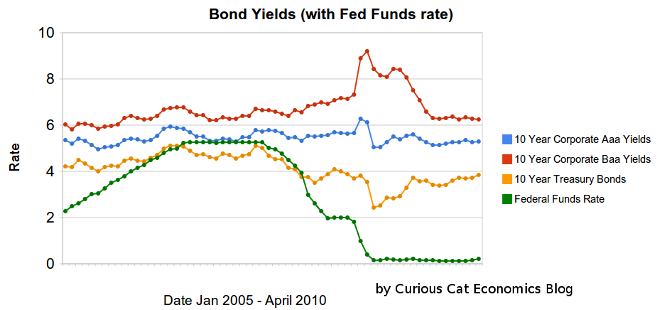
    chart showing corporate and government bond yieldsChart showing corporate and government bond yields from 2005-2010 by Curious Cat Investing Economics Blog, Creative Commons Attribution, data from the Federal Reserve.

    Bond yields have remained low, with little change over the last 6 months. 10 year Aaa corporate bonds yields have increase 10 basis points to 5.29%. 10 year Baa yields have decreased 7 basis points to 6.25%. 10 year USA treasury bonds have increased 45 basis points (largely the effective of money scared into the safety of US treasuries leaving as the credit crisis eased. The federal funds rate remains under .25%.

    The United States economy appears to be gaining strength and if job growth can continue the Fed will likely reduce the amount giveaways to the banks by increasing the fed funds rate (though when this will happen is still very hard to judge). The Fed will also likely sell mortgages back to the market which will increase long term rates. The Fed will likely start by changing the wording that the economic conditions “are likely to warrant exceptionally low levels of the federal funds rate for an extended period.” When this language changes rates may well go up 25 to 50 basis points quickly.

    Related: Bond Yields Change Little Over Previous Months (December 2009)Chart Shows Wild Swings in Bond Yields in Late 2008Real Estate and Consumer Loan Delinquency Rates 1998-2009Government Debt as Percentage of GDP 1990-2008 in OECD: USA, Japan, Germany…

  • Bogle on the Stock Market and Investing

    Bogle on Bankers, Buffett, Obama; an interview of John Bogle, from February 2010.

    Bogle: What happened over the last 10 years were two things, and one of which we have never encountered before. The 17% returns we had over the two previous consecutive decades, the ’80s and the ’90s, were born largely on ascending price-earnings multiples. If the price-to-earnings ratio goes from 8 to 16 in one decade, and then to 32 in the next decade, that accounts for 7% per year of that 17% return. So the market was driven by the revaluation of corporate America and that just can’t keep recurring at those rates. I projected in the original book that the price-earnings multiple might get down below 20, which is exactly what it’s done, so that was fairly predictable.

    But what made the decade quite so bad is that we then had a major recession or light depression at the end of 2008 to 2009 which is still with us. That coming with the market so highly valued meant that earnings growth was much less than what we might have expected. So looking out from here, I think we can look for better earnings growth. And dividend yields are back in decent territory but not great. We started this decade with a 1% dividend yield, and that’s an important part of investment returns, and now the dividend yield is around 2.25%, so a higher dividend yield contributing to future growth. So I think it’s highly likely that stocks will outpace bonds in the decade that just began.

    Are we on the right path now? Has America learned its lesson?
    Bogle: No. Unequivocally not. The long overdue reforms being discussed in Washington do not go nearly far enough, in my opinion. We need protection for consumers. Canada has a financial structure similar to ours except it has a consumer-protection board, which would prevent banks from giving people mortgages if they have no ability to pay them back. To get that done has been very difficult. Also, Senators (John) McCain and (Maria) Cantwell have proposed a return of the Glass-Steagall Act, and that’s gotten nowhere but it is long overdue. We should have banks behave as banks and not as investment banks or hedge-fund managers.

    But let’s suppose the stock market creates a 10% return. And the value of the stock market today is around $13 trillion so 10% is $1.3 trillion. By my numbers, Wall Street and the mutual fund industry take $600 billion a year out of that return. That’s half of the return. So the only way investors are going to get their fair share of the $1.3 trillion is to reduce the costs and get the casinos out.

    As usually John Bogle provides excellent analysis and vision.

    Related: Bogle on the Retirement CrisisIs Trying to Beat the Market Foolish?Lazy Portfolios Seven-year Winning StreakSneaky Fees

  • USA Added 290,000 Jobs In April

    The stock market showed again yesterday how non-efficient it can be at times. Several stocks fell to pennies a share for awhile before returning to tens of a dollars a share. While the markets continue to react violently, the economy appears to be gaining more strength.

    Nonfarm payroll employment rose by 290,000 in April, the unemployment rate increase to 9.9%, and the labor force increased sharply, the U.S. Bureau of Labor Statistics reported today. Job gains occurred in manufacturing, professional and business services, health care, and leisure and hospitality. Federal government employment also rose, reflecting continued hiring of temporary workers for Census 2010. Since December, nonfarm payroll employment has expanded by 573,000, with 483,000 jobs added in the private sector. The vast majority of job growth occurred during the last 2 months.

    Household Survey Data

    In April, the number of unemployed persons was 15.3 million, and the unemployment rate edged up to 9.9%. The rate had been 9.7% for the first 3 months of this year.

    The number of long-term unemployed (those jobless for 27 weeks and over) continued to trend up over the month, reaching 6.7 million. In April, 45.9% of unemployed persons had been jobless for 27 weeks or more.

    In April, the civilian labor force participation rate increased by 0.3 percentage point to 65.2 percent, as the size of the labor force rose by 805,000. Since December, the participation rate has increased by 0.6 percentage point. The employment-population ratio rose to 58.8 percent over the month and has increased by 0.6 percentage point since December.

    Manufacturing added 44,000 jobs in April. Since December, factory employment has risen by 101,000. Over the month, gains occurred in several durable goods industries, including fabricated metals (9,000) and machinery (7,000). Employment also grew in nondurable goods manufacturing (14,000).

    Related: USA Added 162,000 Jobs in MarchUnemployment Rate Reached 10.2% (Oct 2009)USA Unemployment Rate Rises to 8.1%, Highest Level Since 1983 (March 2009)Over 500,000 Jobs Disappeared in November, 2008
    (more…)

  • Middle Class Families from 1970-2005

    As I have said before, Elizabeth Warren is one of the people I find most informative on the economy we have created. This lecture (from January 31, 2008) is very interesting: The Coming Collapse of the Middle Class: higher risks, lower rewards and a shrinking safety net. It is important for us to realize that the decisions we make have consequences. If we allow corruption to grow and grow in the USA we will suffer more and more. If we continue to elect people that give away society wealth to those the pay them to the detriment of society (investment banks, drug companies, “intellectual property” lawyers, retail banks, farmers, trial lawyers, hedge fund managers, trust fund babies, physicians…) that naturally means their is less wealth for the rest of society.

    Interesting data. Looking at standard family (Mom, Dad and 2 kids from 1970 to 2005), in inflation adjusted dollars: earnings increased a great deal (due to women working much more) but disposable income decreased. This is because basic expenses increased: health care, housing, transportation… (and this is with assuming employer provided health care – which has really been decreasing in likelihood over time). Those families are also more deeply in debt and reliant on 2 incomes. And if either income producer losses their jobs the economics of the family fail. Which means the family is much more at risk.

    It really is great that lectures like this are available to us now.

    Related: Elizabeth Warren Webcast On Failure to Fix the SystemIn the USA 43% Have Less Than $10,000 in Retirement SavingsFailure to Regulate Financial Markets Leads to Predictable ConsequencesLobbyists Keep Tax Off Billion Dollar Private Equities Deals and On For Our Grandchildren