The Curious Cat Investing and Economics Carnival highlight recent interesting personal finance, investing and economics blog posts.
- The money made by Microsoft, Apple and Google, 1985 until today – “In terms of profit Apple was ahead of Microsoft in the 1980s, but was then passed and left behind. This chart actually reveals that Apple’s upswing the last few years is the first time the company’s profits have really taken off in a big way. Another interesting observation is how closely the profits of Apple and Google match, even though Apple’s revenues are significantly higher.”
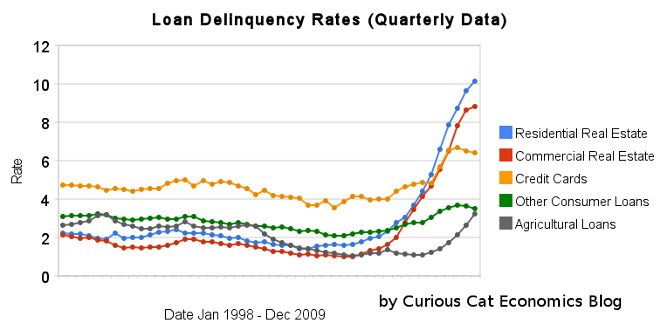
- Real Estate and Consumer Loan Delinquency Rates 1998-2009 by John Hunter – “That last half of 2009 saw residential real estate delinquencies increased 143 basis points to 10.14% and commercial real estate delinquencies increase 98 basis points to 8.81%. Consumer loan delinquencies decreased with credit card delinquencies down 18 basis points to 6.4% and other consumer loan delinquencies down 19 basis points to 3.49%.”
- The Principle That Can Make You Rich or Keep You Broke by David Weliver – “Unfortunately, inertia can also keep us at rest; the same principle that helps us achieve positive goals can make it increasingly difficult to escape bad habits.” (John: Very true, see my post on habits).
- Why do we work so much? – “The countries that consistently rank as having the world’s “happiest people” also tend to work fewer hours than people in the U.S… Most corporate ladders are designed to reward employees with money instead of time. Assuming we only want money to use as a tool for happiness, this makes no sense.”
- How Does Apple Become a $300 Billion Company? by Eric Bleeker – “The more Apple can look like the Microsoft of the mobile world, the more it will be worth. Commanding a market with even half the dominance Microsoft did with operating systems is a once-in-a-generation opportunity, but I’m not so sure the mobile world is built in a way that’ll allow that.”
- Top Fed Official Wants To Break Up Megabanks, Stop The Fed From Guaranteeing Wall Street’s Profits by Shahien Nasiripour – “I don’t think we have any business guaranteeing Wall Street spreads,” Hoenig said. “We need to recognize that and address it by removing these guaranteed extremely low rates. I think it’s extremely important that we do that, and not create the conditions for speculative activity and a new crisis down the road.”
- Evaluating Microfinance by Michael Frank – “I decided to use a variation on the “waiting list-control group” method regularly used in medical studies. My evaluation design requires a call for loan applicants in the most similar nearby community that does not have a similar microfinance program already present.”