Author: John Hunter

  • The 20 Most Valuable Companies in the World

    The 10 publicly traded companies with the largest market capitalizations.

    Company Country Market Capitalization
    1 Apple USA $626 billion
    2 Exxon Mobil USA $405 billion
    3 Microsoft USA $383 billion
    4 Google USA $379 billion
    5 Berkshire Hathaway USA $337 billion
    6 Johnson & Johnson USA $295 billion
    7 Wells Fargo USA $270 billion
    8 GE USA $260 billion
    9 Wal-Mart USA $246 billion
    10 Alibaba China $246 billion

    Alibaba makes the top ten, just weeks after becoming a publicly traded company. The next ten most valuable companies:

    Company Country Market Capitalization
    11 China Mobile China $240 billion*
    12 Hoffmann-La Roche Switzerland $236 billion
    13 Procter & Gamble USA $234 billion
    14 Petro China China $228 billion
    15 ICBC (bank) China $228 billion**
    16 Royal Dutch Shell Netherlands $227 billion
    17 Novartis Switzerland $224 billion
    18 Nestle Switzerland $224 billion***
    19 JPMorgan Chase USA $224 billion
    20 Chevron USA $210 billion

    Petro China reached to top spot in 2010. I think NTT (Japan) also made the top spot (in 1999); NTT’s current market cap is $66 billion.

    Market capitalization shown are of the close of business today, as shown on Yahoo Finance.

    According to this March 2014 report the USA is home to 47 of the top 100 companies by market capitalization. From 2009 to 2014 that total has ranged from 37 to 47.

    The range (during 2009 to 2014) of top 100 companies by country: China and Hong Kong (8 to 11), UK (8 to 11), Germany (2 to 6), France (4 to 7), Japan (2 to 6), Switzerland (3 to 5).

    Related: Stock Market Capitalization by Country from 1990 to 2010Global Stock Market Capitalization from 2000 to 2012Investing in Stocks That Have Raised Dividends ConsistentlyThe Economy is Weak and Prospects May be Grim, But Many Companies Have Rosy Prospects (2011)

    A few other companies of interest:
    Facebook, USA, current market cap is $210 billion.
    Pfizer, USA, $184 billion.
    Toyota, Japan, $182 billion.
    (more…)

  • International Migrants: Economics and Banking

    In 2013, international migrants sent $413 billion home to families and friends — three times more than the total of global foreign aid (about $135 billion). This money, known as remittances, makes a significant difference in the lives of those receiving it and plays a major role in the economies of many countries.

    India received $72 billion and Egypt $18 billion in 2013.

    I liked an interesting point he made. These remittences often include business advice to those relatives in the home country.

    This is a great talk if you are interested in economics and global development. It is very important to understand the issues we face in helping billions living in poverty. As he says regulation of small remittences must be reduced. Policies forced by countries like the USA have damaged poor people’s lives worldwide with extremely onerous regulation.

    Web site of the speaker: Dilip Ratha

    Related: International Development Fair: The Human FactorCreating a World Without PovertySupporting Virtual WorkersSolar Power Market Solutions For Hundreds of Millions Without Electricity

  • Debate Should be Encouraged – Calling Judgement “Extremely Paternalistic” is Normally Unwise

    My response to a comment by John Green on Reddit

    I really really like your work and webcasts (example included below).

    It seems to me extremely paternalistic for people in rich countries to claim to know what is best for people in poor countries

    This seems to me to make it really difficult on people trying to use judgement. Calling people’s actions “extremely paternalistic” if they are not definitely so, I think impedes debate. And I think debate should be encouraged.

    When making Kiva loans I do steer away from loans with rates above 40% (I also prefer loans that are geared toward a capital investment that will increase earning power going forward though this is hard – lots of loans are essentially for inventory that will be sold at a profit so a fine use of loans but not as powerful [in my opinion] and new capital investments – say a new tool, solar power that will be resold to users…).

    Just like people anywhere, people taking Kiva loans are capable of getting themselves into trouble. Choosing to allocate my lender toward certain loans does not mean I am being paternalistic.

    I am not being paternalistic if I chose not to invest in the stock of some company that vastly overpays executives and uses high leverage to do very well (in good times).

    I do like the idea of direct cash to people in need. I give cash that way (and in fact did it a long time ago, 20 years, for several years – before any of this new hipster cachet :-). And I still do like it.

    (more…)

  • The Time to Payback the Investment in a College Education in the USA Today is Nearly as Low as Ever – Surprisingly

    While people question the value of a college degree a recent study by the New York Federal Reserve shows a degree is close to as valuable today as it has ever been. The costs to get that value have risen but even with the increased cost students earn on average a 15% annual rate of return on their investment.

    Of course, not every student will earn that, some will earn more and some less.

    The Value of a College Degree

    We estimate that the value of a college degree fell from about $120,000 in the early 1970s to about $80,000 in the early 1980s, before more than tripling to nearly $300,000 by the late 1990s, where it has remained, more or less, ever since. Despite drifting down somewhat in the aftermath of the Great Recession, the value of a bachelor’s degree has remained near its all-time high.

    The time required to recoup the costs of a bachelor’s degree has fallen substantially over time, from more than twenty years in the late 1970s and early 1980s to about ten years in 2013. So despite the challenges facing today’s college graduates, the value of a college degree has remained near its all-time high, while the time required to recoup the costs of the degree has remained near its all-time low.

    graph showing averthe years to recoup the cost of college decline from 30 to 10 from 1970 to 2010

    So a college education is a great investment for most people. This can create a problem however, when people then assume that all they need to do is go to college and they will do well no matter what. The same thing happens in other markets. Real estate has proven to be a great investment. that doesn’t mean every real estate investment is good. It doesn’t mean you can ignore the costs and risks of a particular investment. The same goes for stocks.

    (more…)

  • There is No Such Thing as “True Unemployment Rate”

    The article, What’s the Real U.S. Unemployment Rate? We Have No Idea, provides interesting information on the process for calculating the unemployment rate.

    But it also misleads in saying “real US unemployment rate.”

    As Dr. Deming said: “there is no true value” of any measured process. The results depend on the process which includes the operation definitions used.

    Over time the value of a measure (as a proxy measure for some condition you care to monitor) can change.

    It is important to update measures to avoid using proxies that lose value.

    The unemployment rate certainly has proxy issues. But there is no “true unemployment rate.” There are ways to change the process to focus on different things (make the proxy better matched to certain issues). But also it seems to me, unemployment rate needs to have other related measures that are considered in concert with the unemployment rate (such as the labor force participation rate, perhaps some measure of under-employment etc.).

    Those paying much attention do use other measures in concert but the last few years I read lots of different people complaining that the unemployment rate doesn’t capture various aspects of how the job market is poor (and often claiming the unemployment rate was “inaccurate” as though there was a platonic form of the actual rate divorced from the measure process.

    Related: What Do Unemployment Stats Mean?Economic Measurement Issues Arising from GlobalizationWhy China’s Economic Data is Questionable

  • Making Credit Cards More Secure and Useful

    Business should not be allowed to store credit card numbers that can be stolen and used. The credit card providers should generate a unique credit card number for the business to store that will only work for the purchaser at that business.

    Also credit card providers should let me generate credit card numbers as I wish for use online (that are unique and can be stopped at any time I wish). If I get some customer hostile business that makes canceling a huge pain I should just be able to turn off that credit card “number.”

    Laws should be adjusted to allow this consumer controlled spending and require that any subscription service must take the turning off of the payments as cancellation.

    For some plan where the consumer agrees up front to say 12 months of payments then special timed numbers should be created where the potentially convoluted process used now remain for the first 12 months.

    Also users should be able to interact with there credit reports and do things like turn on extra barriers to granting credit (things like they have to be delayed for 14 days after a text, email [to as many addresses and the consumer wants to enter] and postal notification are sent to the user. Variations on how these work is fine (for example, setting criteria for acceptance of the new credit early at the consumers option if certain conditions are met (signing into the web site and confirming information…).

    Better security on the cards themselves are also needed in the USA. The costs of improvement are not just the expenses credit card and retailers face but the huge burden to consumers from abuse of the insecure system in place for more than a decade. It is well past time the USA caught up with the rest of the world for on-card security.

    The providers have done a lousy job of reducing the enormous burden of fraud on consumers. As well as failing to deal adequately with customer hostile business practices (such as making canceling very cumbersome and continuing to debit the consumer’s credit card account).

    Related: Protect Yourself from Credit Card FraudPersonal Finance Tips on the Proper use of Credit CardsContinued Credit Card Company Customer Dis-ServiceBanks Hoping they Paid Politicians Enough to Protect Billions in Excessive Fees

  • Could Amazon Significantly Impact Google’s Adsense Income?

    Amazon Prepares Online Advertising Program

    The people familiar with the matter said Amazon’s offering would resemble Google’s AdWords, the engine that Google uses to place keyword-targeted ads alongside Google search results and on more than two million other websites. AdWords is the foundation of Google’s roughly $50 billion-a-year advertising business, and Google counts Amazon as one of its biggest buyers of text link ads.

    This is potentially a real risk to Google. The odds of such a huge success it decreases Google’s profits are tiny (I think). But there is a real risk that the increase in Google’s profits going forward are materially affected by a well done competitor to Adsense.

    Adwords is Google’s platform for buying ads. Those ads are then displayed on Google’s websites and on millions of other websites. Other websites can host ads via the Adsense program. It seems to me what is really at risk is better seen as Adsense business. The business on Google’s own websites is not at risk (Google’s profit from its sites are double I think all the other sites [via Adsense] combined).

    If Amazon took away 10% of what Google’s Adsense business 4 years would have been that is likely material to Google’s earning. Not huge but real.

    Even losing the ads on Amazon’s web site is likely noticeable (though not a huge deal, for Google, for many companies it would be significant, I would guess).

    There is even the potential Google has to reduce their profitability, on Adsense, to compete – giving web sites a better cut of revenue.

    (more…)

  • Companies Trumpet Stock Buybacks and Act as Though Stock Givaways Don’t Matter

    One of the things that annoy me as an investor is how happy the executives are to grant themselves huge amount of pay in general and stock in particular. The love to giveaway huge amounts of stock to themselves and their buddies and then pretend that isn’t a cost.

    Thankfully the GAAP rules changed a few years ago to require making the costs of stock giveaways show up on official earnings statements. Now, the companies love to trumpet non-GAAP earnings that exclude stock based compensation to employees.

    The stock based costs are huge.

    SG Securities estimates that corporates bought back $480 billion in stock last year, and then reissued about $180 billion.

    The theme of the article is that stock buybacks have declined drastically very recently. There has been a huge bubble recently fueled by the too-big-too-fail bailout (quantitative easing). But don’t expect the executives giving themselves tons of stock to decline.

    Accounting isn’t as straight forward as people who have never looked at it would like to think. While giving away stock is definately a cost, it isn’t a cash cost. The cash flow statement is best for looking at cash anyway. And the better your company does the more the free spirited giveaway of stock costs (both in your reduced share of the well performing company and the higher cost to buy back the shares they gave away).

    They have excuses that they hire people who are not motivated enough to do their job for their pay so they need to offer stock options as a extra payment. But the main reason they like it is they can pretend that the pay to employees isn’t costing as much as it is because we gave them stock options not cash. As if paying $1 billion in cash is somehow more costly than giving away options and then spending $1 billion on buybacks of the stock they gave away.

    Options make a lot of sense for small private companies. In a very limited way they can make sense as companies grow. But the practices of executives in huge bureaucracies giving away large amounts of your equity, on top of huge paychecks, is very harmful.

    Related: Apple’s Outstanding Shares Increased from 848 to 939 million shares from 2006 to 2013 (while I think Apple’s large buyback is good, the huge share giveaways continue and are bad policy) – Google is Diluting Shareholder Equity by 1% a year (2009-2013) – Executives Again Treating Corporate Treasuries as Their Money

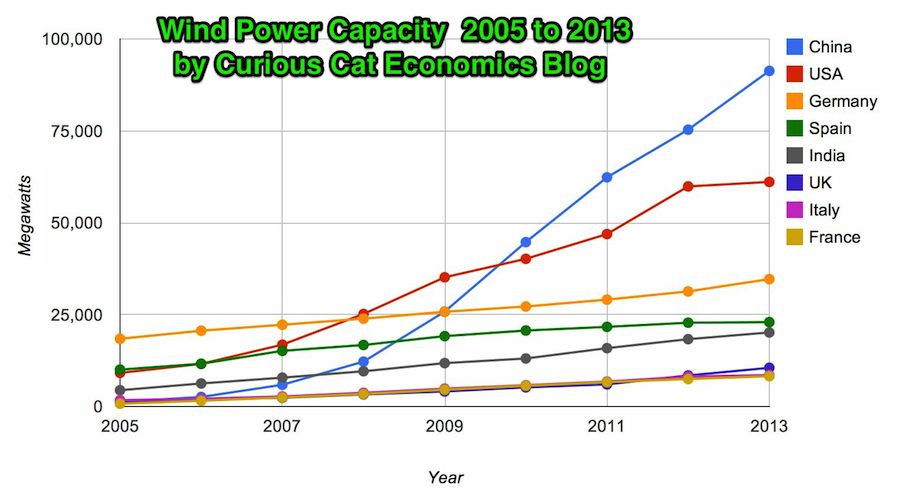
  • Chart of Global Wind Energy Capacity by Country 2005 to 2013

    chart of Wind power capacity by country 2005 to 2013
    Chart by Curious Cat Economics Blog using data from the Wind Energy Association. Chart may be used with attribution as specified here.

    In 2013 the addition to wind power capacity slowed a great deal in most countries. Globally capacity was increased just 13% (the increases in order since 2006: 26%, 27%, 29%, 32%, 25%, 19% and again 19% in 2012). China alone was responsible for adding 16,000 megawatts of the 25,838 total added globally in 2013.

    At the end of 2013 China had 29% of global capacity (after being responsible for adding 62% of all the capacity added in 2013). In 2005 China had 2% of global wind energy capacity.

    The 8 countries shown on the chart account for 81% of total wind energy capacity globally. From 2005 to 2013 those 8 countries have accounted for between 79 and 82% of total capacity – which is amazingly consistent.

    Wind power now accounts for approximately 4% of total electricity used.

    Related: Chart of Global Wind Energy Capacity by Country 2005 to 2012In 2010 Global Wind Energy Capacity Exceeded 2.5% of Global Electricity NeedsGlobal Trends in Renewable Energy InvestmentNuclear Power Generation by Country from 1985-2010

    (more…)

  • Index Fund Beats Hedge Funds

    Hedge funds seek to pay the managers extremely well and claim to justify enormous paydays with claims of superior returns. Markets provide lots of volatility from which lots of different performances will result. Claiming the random variation that resulted in the superior performance of there portfolio as evidence the deserve to take huge payments for themselves from the current returns is not sensible. But plenty of rich people fall for it.

    As I have written before: Avoiding Hedge Fund Investments is One of the Benefits of Being in the 99%.

    This is pretty well understood by most knowledgeable investors, financial planners and investing experts. But funds that charge huge fees continue to get away with it. If you are smart you will avoid them. A few simple investing rules get you well into the top 10% of investors

    From a personal finance perspective, saving money is a key. Most people fail at being decent investors before they even get a chance to invest by spending more than they can afford and failing to save, and even worse going into debt (other than to some extent for college education and house). Consistently putting aside 10-20% of your income and investing wisely will put you in good shape over the long term.

    (more…)