Category: economic data

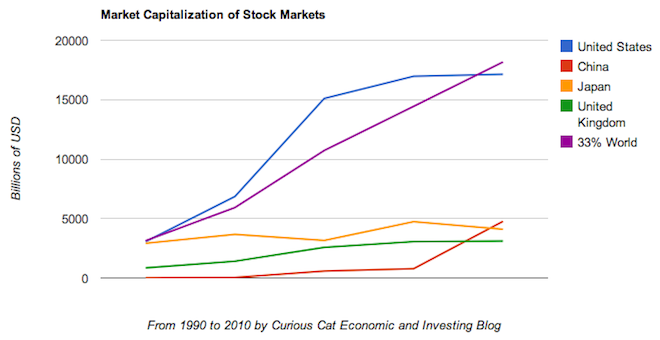
  • Stock Market Capitalization by Country from 1990 to 2010

    The stock market capitalization by country gives some insight into how countries, and stocks, are doing. Looking at the total market capitalization by country doesn’t equate to the stock holdings by individuals in a country or the value of companies doing work in a specific country.

    Chart of largest stock market capitalizations by country from 1990 to 2010
    Chart of largest stock market capitalizations by country from 1990 to 2010

    In the chart, I divided the world total by 3: just to make the chart look better. The USA was 32.5% of the total in 1990. The USA grew to 46.9% as the tech, finance and housing bubbles were all underway (also Japan was stagnating and the Chinese stock market hadn’t started booming to a significant extent). In 2010 the USA was back down to 31.4%. This will likely continue to decrease (at a much slower pace – I wouldn’t be surprised to see the USA at 25% in 2020) as the rest of the world’s markets continue to grow more quickly.

    As with so much recent economic data China’s performance here is remarkable and Japan’s is distressing. China grew from nothing in 1990 to the 2nd largest country in 2010. Hong Kong add another $1 trillion to China’s $4.5 trillion. Canada is the only country above $2 trillion not included on this chart. China grew by $4 trillion from 2005 to 2010.

    Related: Don’t Expect to Spend Over 4% of Your Retirement Investment Assets AnnuallyTop 10 Countries for Manufacturing Production from 1980 to 2010
    Investment Risk Matters Most as Part of a Portfolio, Rather than in IsolationGovernment Debt as Percent of GDP 1998-2010

    (more…)

  • Global Trends in Renewable Energy Investment

    Global Trends in Renewable Energy Investment 2012

    in 2011, global investment in the renewable energy sector hit another record, up 17% to $257 billion. This was a six fold increase on the 2004 figure and 93% higher than the total in 2007.

    renewable power (excluding large hydro) accounted for 44% of new generation
    capacity added worldwide in 2011, up from 34% in 2010 [and 10% in 2004]. The $237 billion invested in building these green power plants compares with $223 billion of net new expenditure annually on building additional fossil-fuelled power plants globally last year.

    Current predictions are that total installed capacity in non-hydro renewable power will rise ninefold to 2.5Tw by 2030, with investment in assets rising from $225 billion in 2011 to $395 billion-a-year by 2020 and $460 billion-a-year by 2030

    Total investment in solar in 2011 increased 52% to $147 billion, driven by a drop of 50% in photovoltaic module prices. Investment in wind dropped 12% to $84 billion, while onshore wind turbine prices fell between 5 and 10%. Biomass and waste to energy was the 3rd largest renewable sector at $11 billion in investments (down 12% from 2010).

    USA investment surged 51% to $51 billion just behind China at $52 billion (China increased investment in renewable energy by 17% from 2010). German investment dropped 12% to $31 billion.

    In 2011 renewable energy power capacity (excluding large hydropower), as a percentage of total system capacity, reached 9%, up from 4% in 2004. Total renewable energy generation (excluding large hydro) reached 6%, up from 4% in 2004.

    Related: Top Countries For Renewable Energy CapacityWind Energy Capacity Exceeds 2.5% of Global Electricity NeedsLeasing or Purchasing a Solar Energy System For Your Home

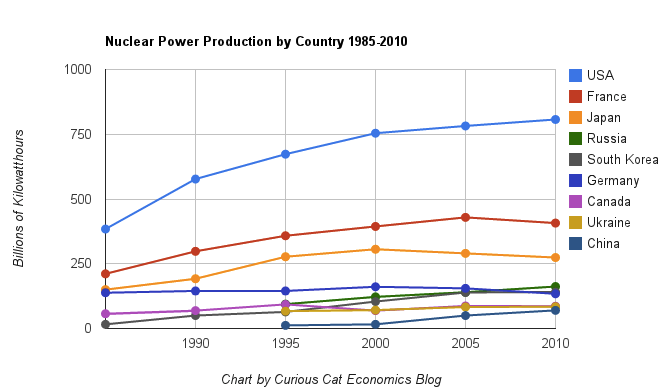
  • Nuclear Power Generation by Country from 1985-2010

    chart of nuclear power generation by the largest producing countries from 1985 to 2010The chart shows the top nuclear power producing countries from 1985 to 2010. The chart created by Curious Cat Investing and Economics Blog may be used with attribution. Data from US Department of Energy.

    ___________________

    Nuclear power provided 14% of the world’s electricity in 2010. Wind power capacity increased 233% Worldwide from 2005 2010, to a total of 2.5% of global electricity needs. Nuclear power generation declined by .72% for the same period.

    Burning coal was responsible for 41% of electricity generation in 2010. Burning natural gas accounted for 21% and hydroelectric generation accounted for 15%.

    Japan just announced that they have closed their last operating nuclear power plant. They have no nuclear power plant generating electricity for the first time in more than 40 years. It will be interesting to see how low their actual generation totals fall this year. They plan to re-open some of the plants but it is a political issue that is far from settled.

    Globally nuclear power production increased 84% from 1985 to 2010. This is a very low percentage. Global output over that period increased much more than that, as did global electricity use. The share of electricity production provided by nuclear power peaked at about 17% for much of the 1990s.

    Related: Nuclear Power Production Globally from 1985 to 2009Oil Production by Country 1999-2009Top 10 Countries for Manufacturing Production from 1980 to 2010: China, USA, Japan, Germany…Japan to Add Personal Solar SubsidiesNuclear Energy Institute (statistics)

    Another view of data on nuclear power shows which of the leading nuclear producing countries have the largest percentages of their electrical generating capacity provided by nuclear power plants (as of 2009). France has 75% of all electricity generated from nuclear power. Ukraine had the second largest percentage at 49%, then Sweden at 37% and South Korea at 35%. Japan is at 28% compared to 20% for the USA. Russia was at 18% and China was at just 2%.

  • USA Adds Just 120,000 Job in March, Unemployment Rate Falls to 8.2%

    Nonfarm payroll employment rose by 120,000 in March, and the unemployment rate dropped to 8.2%, the United States Bureau of Labor Statistics reported today. Employment rose in manufacturing, food services, and health care, but was down in retail trade. The change in total nonfarm payroll employment for January was revised from +284,000 to +275,000, and the change for February was revised from +227,000 to +240,000 (together this adds just 4,000 more jobs brining the total added jobs with this report to 124,000.

    Adding 120,000 jobs in a month is mediocre in general for the USA economy. The biggest reason for disappointment is during recoveries jobs are normally added at a higher rate, and given how many jobs were lost in the during the credit crisis outsized job gains are needed. The other reason adding 120,000 jobs was disappointing is the consensus estimate was for over 200,000 jobs to be added.

    The number of long-term unemployed (those jobless for 27 weeks and over) was essentially unchanged at 5.3 million in March and remains one of the biggest employment problems for the economy. These individuals accounted for 42.5% of the unemployed. Since April 2010, the number of long-term unemployed has fallen by 1.4 million.

    In the prior 3 months, payroll employment had risen by an average of 246,000 per month. Private-sector employment grew by 121,000 in March, including gains in manufacturing, food services, and health care.

    Manufacturing employment rose by 37,000 in March, with gains in motor vehicles and parts (+12,000), machinery (+7,000), fabricated metals (+5,000), and paper manufacturing (+3,000). Factory employment has risen by 470,000 since a recent low point in January 2010. Manufacturing continues providing some of the best employment news.

    Related: Latest USA Jobs Report Adds 286,000 Jobs; Another Very Strong Month (Mar 2012)USA Adds 216,00 Jobs in March 2011; the Unemployment Rate Stands at 8.8%USA Added 162,000 Jobs in March 2010Another 663,000 Jobs Lost in March 2009 in the USA

    (more…)

  • 60% of Workers in the USA Have Less Than $25,000 in Retirement Savings

    2012 Retirement Confidence Survey

    (60 percent) report they and/or their spouses have less than $25,000 in total savings and investments (excluding their home and defined benefit plans), including 30 percent who have less than $1,000

    The data would be better if some value were placed on defined benefit plans; currently it is a bit confusing how much they may help. But the $25,000 threshold is so low that no matter what being under that value is extremely bad news for anyone over 40. And failing to have saved over just $25,000 toward retirement is bad news for anyone over 30 without a defined benefit plan.

    The large majority of workers who have not saved for retirement have little in savings. Almost two-thirds (63 percent) report they have less than $1,000 in savings and investments, and another quarter (25 percent) have $1,000–$9,999.

    Thirty-four percent of workers report they had to dip into savings to pay for basic expenses in the past 12 months.

    Thirty-five percent of all workers think they need to accumulate at least $500,000 by the time they retire to live comfortably in retirement. Eighteen percent feel they need between $250,000 and $499,999, while 34 percent think they need to save less than $250,000 for a comfortable retirement.

    Workers who have performed a retirement needs calculation are more than twice as likely as those who have not (23 percent vs. 10 percent) to expect they will need to accumulate at least $1 million before retiring.

    66% of workers say their family has retirement savings and 58% say they are currently saving for retirement. These results are fairly consistent over the last few decades (the current values are in the lower ranges of results).

    Nearly everyone wishes they had more money. One way to act as though you have more than you do is to borrow and spend (which is normally unwise – it can make sense for a house and in limited amounts when you are first going out on your own). Another is to ignore long term needs and just live it up today. That is a very bad personal finance strategy but one many people follow. Saving for retirement is a personal finance requirement. If you can’t save for retirement given your current income and lifestyle you need to reduce your current spending to save or increase your income and then save for retirement.

    A year or two of failing to do so is acceptable. Longer stretches add more and more risk to your personal financial situation. It may not be fun to accept the responsibilities of adulthood and plan for the long term. But failing to do so is a big mistake. Determining the perfect amount to save for retirement is complicated. A reasonable retirement saving plan is not.

    Saving 10% of your gross income from the time you are 25 until 65 gives you a decent ballpark estimate. Then you can adjust even 5 or 10 years as you can look at your situation. It will likely take over 10% to put you in a lifestyle similar to the one you enjoy while working. But many factors are at play. To be safer saving at 12% could be wise. If you know you want to work less than 40 years saving more could be wise. If you have a defined benefit plan (rare now, but, for example police or fire personnel often still do you can save less but you must work until you gain those benefits or you will be in extremely bad shape.

    IRAs, 401(k) and 403(b) plans are a great way to save for retirement (giving you tax deferral and Roth versions of those plans are even better – assuming tax rates rise).

    Related: In the USA 43% Have Less Than $10,000 in Retirement SavingsSaving for Retirement

  • Latest USA Jobs Report Adds 286,000 Jobs; Another Very Strong Month

    Nonfarm payroll employment rose by 227,000 in February, and the unemployment rate was unchanged at 8.3%, the U.S. Bureau of Labor Statistics reported today. The change in total nonfarm payroll employment for December was revised from +203,000 to +223,000, and the change for January was revised from +243,000 to +284,000. Which brings the total new jobs for this report to 286,000 (227+20+39). This is very good news. There are other serious economic concerns (failure, after years, to take any meaningful action to prevent systemic too big to fail risk, policies harming savers to benefit too big to fail institutions, extremely large and dangerous budget deficits…) and the employment situation still has a long way to go to recover from the credit crisis crash but the recent job news is strongly positive.

    The number of unemployed persons, at 12.8 million, was essentially unchanged in February. The unemployment rate held at 8.3%, 80 basis points below the August 2011 rate of 9.1%.

    The number of long-term unemployed (those jobless for 27 weeks and over) remains at very damaging levels; it was little changed at 5.4 million in February. These individuals accounted for 42.6% of the unemployed.

    Both the labor force and employment rose in February. The civilian labor force participation rate, at 63.9 percent, and the employment-population ratio, at 58.6 percent, edged up over the month.

    Private-sector employment grew by 233,000, with job gains in professional and business services, health care and
    social assistance, leisure and hospitality, manufacturing, and mining. Government jobs declined by 6,000. In 2011,
    government lost an average of 22,000 jobs per month.

    Professional and business services added 82,000 jobs in February. Just over half of the increase occurred in temporary help services (+45,000). Job gains also occurred in computer systems design (+10,000) and in management and technical consulting services (+7,000). Employment in professional and business services has grown by 1.4 million since a recent low point in September 2009.

    Health care and social assistance employment rose by 61,000 over the month. Within health care, ambulatory care services added 28,000 jobs, and hospital employment increased by 15,000. Over the past 12 months, health care employment has risen by 360,000.

    In February, employment in leisure and hospitality increased by 44,000, with nearly all of the increase in food services and drinking places (+41,000). Since a recent low in February 2010, food services has added 531,000 jobs.

    Manufacturing employment rose by 31,000 in February. All of the increase occurred in durable goods manufacturing, with job gains in fabricated metal products (+11,000), transportation equipment (+8,000), machinery (+5,000), and furniture and related products (+3,000). Durable goods manufacturing has added 444,000 jobs since a recent trough in January 2010. Of all the good news the continued manufacturing gains may well be the best news.

    Related: Nov 2010 USA Unemployment Rate Rises to 9.8%USA Unemployment Rate Remains at 9.7% (Feb 2010)Another 663,000 Jobs Lost in March 2009, in the USA

    (more…)
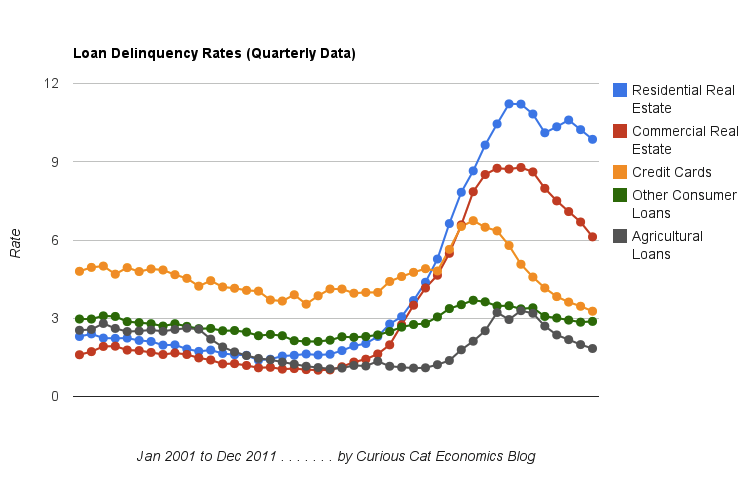
  • Consumer and Real Estate Loan Delinquency Rates from 2001 to 2011 in the USA

    chart showing loan delinquency rates from 2001 to 2011 in the USA
    Chart showing loan delinquency rates from 2001-2011. It shows seasonally adjusted data for all banks for consumer and real estate loans. The chart is available for use with attribution. Data from the Federal Reserve.

    2011 saw delinquency rates for loans fall across the board in the USA. Residential real estate delinquency rates fell just 25 basis points (to a still extremely large 9.86%). Commercial real estate delinquency rates fell an impressive 186 basis points (to a still high 6.12%). Credit card delinquency rates fell 86 basis points to a 17 year low, 3.27%.

    The job market continues to struggle, though it is doing fairly well the last few months. The serious long term problems created by governments spending beyond their means (for decades) and allowing too big to fail institutions to destroy economic wealth and create great risk to the economy are not easy to solve: and we made no progress in doing so in 2011. The reduction in delinquency rates is a good sign for the economy. The residential real estate delinquency rates are still far too high as is government debt. And the failure to address the too big to fail (big donors to the politicians) is continuing to cause great damage to the economy.

    We need to reduce consumer and government debt. Many corporations are actually flush with cash, so at least we don’t have a huge corporate debt problem. Reducing debt load will decrease risks to the economy and provide wealth for consumers to tap as they move into retirement. The too-big-to-fail big political donors like to keep policies in place that encourage too much debt and favor complex financial instruments that they take huge fees from and then let the government deal with the aftermath. The politicians continued favors to too-big-to-fail institutions is very damaging to out economic well being.

    Across the board, the wealthy economies are facing a rapidly aging population (the USA is actually acing this at a much slower rate than most other rich countries – which is helpful).

    Related: Consumer and Real Estate Loan Delinquency Rates 2000-2011Real Estate and Consumer Loan Delinquency Rates 1998-2009Government Debt as Percent of GDP 1998-2010 for OECD

    (more…)

  • The USA Is Not as Dependent on China Economically as People Think

    3 Economic Misconceptions That Need to Die

    Just 2.7% of personal consumption expenditures go to Chinese-made goods and services. 88.5% of U.S. consumer spending is on American-made goods and services… Walmart’s $260 billion in U.S. revenue isn’t exactly reflective of America’s $14.5 trillion economy. Walmart might sell a broad range of knickknacks, many of which are made in China, but the vast majority of what Americans spend their money on is not knickknacks.

    Just 6.4% of nondurable goods — things like food, clothing and toys — purchased in the U.S. are made in China; 76.2% are made in America. For durable goods — things like cars and furniture — 12% are made in China; 66.6% are made in America.

    Those numbers are significantly less than I expected but the concept matches my understanding – that we greatly underestimate the purchasing of USA goods and services.

    We have an inflated notion of how large the China macro economic numbers are for the USA (both debt and manufacturing exports to us). The China growth in both is still amazingly large: we just overestimate the totals today. We also forget that 25 years ago both numbers (imports from China and USA government debt owned by China) were close to 0.

    We also greatly underestimate how much manufacturing the USA does, as I have been writing about for years. In fact, until 2010, the USA manufactured more than China.

    China owns 7.6% of U.S. government debt outstanding. As of November, China owned $1.13 trillion of Treasuries. Government debt stood at $14.9 trillion that month. That’s 7.6%.

    Who owns the rest? The largest holder of U.S. debt is the federal government itself. Various government trust funds like the Social Security trust fund own about $4.4 trillion worth of Treasury securities. The Federal Reserve owns another $1.6 trillion.

    Ok, this figure is a bit misleading. But even if you thrown out the accounting games 1.13/8.9 = 12.7%. That is a great deal. But it isn’t a majority of the debt or anything remotely close. Other foreign investors own $3.5 trillion trillion in federal debt (Japan $1 trillion, UK $500 billion). The $4.6 trillion of federal debt owned by foreigners is a huge problem. With investors getting paid so little for that debt though it isn’t one now. But it is a huge potential problem. If interest reates increase it will be a huge transfer of wealth from the USA to others.

    Just 9.8% of oil consumed in the U.S. comes from the Middle East. According the U.S. Energy Information Administration, the U.S. consumes 19.2 million barrels of petroleum products per day. Of that amount, a net 49% is produced domestically. The rest is imported.

    The oil figure is a bit less meaningful, I think. Oil import are hugely fungible. The USA cutting back Middle East imports and pushing up imports from Canada, Mexico, Nigeria… doesn’t change the importance of Middle East oil to the USA in reality (the data might seem to suggest that but it is misleading due to the fungible nature of oil trading). Whether we get it directly from the Middle East or not our demand (and imports) creates more demand for Middle East oil. It is true the USA has greatly increased domestic production recently (and actually decreased the use of oil in 2009). So while I believe the data on Middle East oil I think that it is a bit misleading. If we had 0 direct imports from there we would still be greatly dependent on Middle East oil (because if France and China and India… were not getting their oil there they would buy it where we buy ours… Still the USA uses far more oil than any other country and is extremely dependent on imports. Several other countries are also extremely dependent on oil imports, including the next two top oil consuming countries: China, Japan.

    Related: Oil Production by Country 1999-2009Government Debt as Percentage of GDP 1990-2009: USA, Japan, Germany, China…Manufacturing Output as a Percent of GDP by CountryThe Relative Economic Position of the USA is Likely to Decline

  • USA Individual Earnings Levels: Top 1% $343,000, 5% $154,000, 10% $112,000, 25% $66,000

    Very interesting USA federal tax data via the tax foundation. Top 1% has adjusted gross income of $343,000; over $154,000 puts you in the top 5%; $112,000 puts you in the top 10% and $66,000 puts you in the top 25%.

    The chart only shows federal income tax data. So the costly social security tax (which is directly based on earned income* so in reality is federal income tax but is handled in a separate account so is consistently not classified as income tax data) for outside the top 5% (income above $106,800 [for 2011] does not have to pay the social security tax) is not reflected in the rates paid here.

    Looking at the data excluding social security is fine, but it is very important to remember the social security (plus medicare) tax is the largest tax for, I would guess, most people in the USA. Social security tax is 6.2% paid by the employee plus 6.2% paid by the company – a total of 12.4%. That part of the tax was capped at $106,800 in income for 2011. The medicare tax is 1.45% of income paid by the employee and 1.45% paid by the employer (and it has no cap). So that totals 2.9% (for the employee and employer tax) and brings the total to 15.3%** for most earned income.


    Number of Returns with Positive AGI

    AGI ($ millions)

    Income Taxes Paid ($ millions)

    Group’s Share of Total AGI

    Group’s Share of Income Taxes

    Income Split Point

    Average Tax Rate

    All Taxpayers

    137,982,203

    $7,825,389

    $865,863

    100.0%

    100.0%

    11.06%

    Top 1%

    1,379,822

    $1,324,572

    $318,043

    16.9%

    36.7%

     $343,927.00

    24.01%

    1-5%

    5,519,288

    $1,157,918

    $189,864

    14.8%

    22.0%


    16.40%

    Top 5%

    6,899,110

    $2,482,490

    $507,907

    31.7%

    58.7%

     $154,643.00

    20.46%

    5-10%

    6,899,110

    $897,241

    $102,249

    11.5%

    11.8%


    11.40%

    Top 10%

    13,798,220

    $3,379,731

    $610,156

    43.2%

    70.5%

     $112,124.00

    18.05%

    10-25%

    20,697,331

    $1,770,140

    $145,747

    22.6%

    17.0%


    8.23%

    Top 25%

    34,495,551

    $5,149,871

    $755,903

    65.8%

    87.3%

     $ 66,193.00

    14.68%

    25-50%

    34,495,551

    $1,620,303

    $90,449

    20.7%

    11.0%


    5.58%

    Top 50%

    68,991,102

    $6,770,174

    $846,352

    86.5%

    97.7%

     > $32,396

    12.50%

    Bottom 50%

    68,991,102

    $1,055,215

    $19,511

    13.5%

    2.3%

     < $32,396

    1.85%

    Source: Internal Revenue Service. Table via the tax foundation.

    Other interesting data shows that the top 1% earn 16.9% of the total income and pay 36.7% of the total federal income taxes. Those in the top 1-5% earn 14.8% of the total income and pay 22% of the income taxes. Those in the top 5-10% earn of the income 11.5% of the income and pay 11.8% of the federal income taxes. So once you exclude the main tax on income (social security) and use adjusted gross income the tax rates are slightly progressive (higher rates for those that are making the most – and presumably have benefited economically the most from the economic system we have).

    Given that this is skewed by excluding the regressive (higher taxes paid by those earning less – social security is the same rate for everyone except those earning the very most who don’t have to pay it on their income above $106,800 [in 2011]) social security tax I believe we should have a more progressive tax system. But that is mainly a political debate. There are good economic arguments for the bad consequences of too unequal a distribution of wealth (which the USA has been moving toward the last few decades – unfortunately).

    In addition to the other things I mention there are all sorts of games played by those that desire a royalty type system (where wealth is just passed down to the children of those who are rich, instead of believing in a capitalist system where rewards are given not to the children of royalty but to those that are successful in the markets). A good example of the royalty model is Mitch Romney giving his trust fund children over $100 million each. These schemes use strategies to avoid paying taxes at all. Obviously these schemes also make the system less progressive (based on my understanding of the tax avoidance practiced by these trust fund babies and those that believe it is ethical to give such royalty sized gifts to their royal heirs).

    I don’t like the royalty based model of behavior. I much prefer the actions of honorable capitalist such as Warren Buffett and Bill Gates that give their children huge benefits that any of us would be thrilled with, but do not treat them as princes and princesses who should live in a style of luxury that few kings have every enjoyed based solely off their birthright. Both Bill Gates and Warren Buffett have honorably refused to engage in royal seeking behavior that many of their less successful business peers have chosen to engage in. Those that favor trust fund babies are welcome to their opinion and have managed to get most of congress to support their beliefs instead of a capitalist model that I would prefer so they are free to engage in their desire to parrot royalty and honor the royalty model of behavior.

    * earned income – you also don’t have to pay social security or medical tax on unearned income (dividends, capital gains, rental income…). Again this by and large favors wealthy taxpayers. Everyone is eligible for the same favorable tax treatment but only those that have the wealth to make significant amounts of unearned income get this advantage.

    ** the social security tax has been reduced by 200 basis points (this relief was recently extended) as part of dealing with the results of the too big to fail banking caused credit crisis. So under the temporary reduction the personal tax rate is 4.2% and the total cost is 13.2%.

    Related: Taxes – Slightly or Steeply Progressive?Taxes per Person by CountryUSA State Governments Have $1,000,000,000,000 in Unfunded Retirement ObligationsRetirement: Roth IRA Earnings and Contribution Limits

  • USA Apartment Market in 2011

    The national occupancy climbed 110 basis points during the year, and effective rents jumped 4.7% according MPF Research.

    Occupancy rates increased to 94.6% at the end of 2011, up from 93.5% a year ago and from 91.8% when the occupancy rates bottomed in late 2009.

    MPF Research predicts occupancy rates to increase another 50 basis points, and rents to rise 4.5%.

    Northern California’s apartment markets ranked as the nation’s rent growth leaders during calendar 2011, despite the fact that some weakness registered in the performances recorded in parts of the Pacific Northwest specifically during the fourth quarter. Year-over-year, effective rents for new leases jumped 14.6% in San Francisco, 12.3% in San Jose, and 9% in Oakland. With rents down 0.4%, Las Vegas was the nation’s only major apartment market that lost pricing power during calendar 2011.

    Rent Growth Leaders in Calendar 2011

    Rank Metro Area Annual Rent Growth
    1 San Francisco 14.6%
    2 San Jose 12.3%
    3 Oakland 9.0%
    4 Boston 8.3%
    5 New York 7.3%
    6 Austin 7.2%

    Related: Apartment Vacancies Fall to Lowest in 3 Years in the USA (April 2011)Top USA Markets for Buying Rental PropertyApartment Rents Rise, Slightly, for First Time in 5 QuartersIt’s Now a Renter’s Market