Category: Economics

  • 30 Year Fixed Rate Mortgage Rates Remain Low

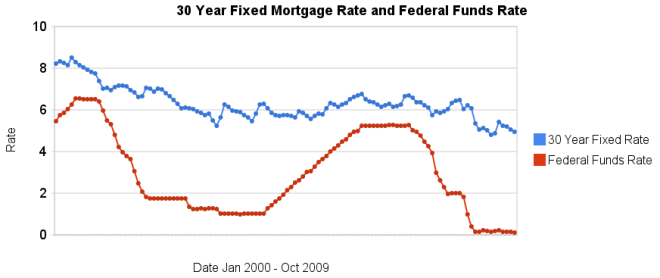
    30 year fixed mortgage rates have declined a bit over the last few months and remain at very low levels.

    30 year fixed mortgage rate chart 2000-2009

    The poor economy, Unemployment Rate Reached 10.2%, has the Fed continuing massive intervention into the economy. The Fed is keeping the fed funds rate at close to 0% (.12% in October). They also continue to hold massive amounts of long term government and mortgage debt (in order to suppress interest rates on long term bonds – by reducing the supply of such bonds in the market).

    I can’t see how lending US dollars, over the long term, at 5%, makes any sense. I would much rather borrow at those rates than lend. If you have not refinanced yet, doing so now may well make sense. And if you are looking at a new real estate purchase, financing a 30 year mortgage sure is attractive at rates close to 5%.

    Related: historical comparison of 30 year fixed mortgage rates and the federal funds rateLowest 30 Year Fixed Mortgage Rates in 37 YearsJumbo v. Regular Fixed Mortgage Rates: by Credit ScoreWhat are mortgage definitionsIgnorance of Many Mortgage Holders

    For more data, see graphs of the federal funds rate versus mortgage rates for 1980-1999. Source data: federal funds rates30 year mortgage rates

  • Consumer Debt Down Over $100 Billion So Far in 2009

    One of the few good recent results of the economy has been a continuous decline in consumer debt. Consumer debt fell for the 8th consecutive month, for the first time, in September, declining by $15 billion.

    Consumer debt grew by about $100 each year from 2004 through 2007. In 2008 it increased $40 billion. In 2009 it has fallen over $100 billion so far: from $2,559 billion to $2,456 billion. This still leaves over $8,000 in consumer debt for every person in the USA and $20,000 per family.

    The huge amount of outstanding consumer and government debt remains a burden for the economy. At least some progress is being made to decrease consumer debt.

    Those living in USA have consumed far more than they have produced for decades. That is not sustainable. You don’t fix this problem by encouraging more spending and borrowing: either by the government or by consumers. The long term problem for the USA economy is that people have consuming more than they have been producing.

    The solution to this problem is to stop spending beyond your means by even increasing levels of personal and government debt. Thankfully over the last year at least consumer debt has been declining. Government debt has been exploding so unfortunately that problem has continued to get worse.

    As we know, interest rates have fallen a great deal over the last few years. the federal funds rate sits at essentially 0% and money market funds now yield under 1%. However, credit card accounts that are charging interest increase to an interest rate of 14.9% from 13.6% in the 3rd quarter of 2008. In 2004 the credit card interest rate was 13.2%, 2005 – 14.6%, 2006 – 14.7%, 2007 – 14.7%, 2008 – 13.6%. All credit card balances should be paid off every month to avoid these excessive interest rates.

    Data from the federal reserve and census bureau.

    Related: Consumer Debt Declined a Record $21.5 Billion in JulyThe USA Economy Needs to Reduce Personal and Government DebtLet the Good Times Roll (using Credit)

  • Unemployment Rate Reached 10.2%

    The unemployment rate rose from 9.8 to 10.2% in October, and nonfarm
    payroll employment continued to decline (down another 190,000 jobs), the U.S. Bureau of Labor Statistics reported today. The largest job losses over the month were in construction, manufacturing, and retail trade.

    In October, the number of unemployed persons increased by 558,000 to 15.7
    million. The unemployment rate rose to 10.2%, the highest rate since April 1983. Since the start of the recession in December 2007, the number of unemployed persons has risen by 8.2 million, and the unemployment rate has grown by 530 basis points.

    Among the major worker groups, the unemployment rates for adult men (10.7%) rose in October. The jobless rates for adult women (8.1 percent), teenagers (27.6%), African-Americans (15.7%), and Hispanics (13.1%) were little changed over the month.

    The number of long-term unemployed (those jobless for 27 weeks and over) was little changed over the month at 5.6 million. In October, 35.6% of
    unemployed persons were long-term unemployed.

    The civilian labor force participation rate was little changed over the month
    at 65.1%. The employment-population ratio continued to decline in
    October, falling to 58.5%.

    The number of persons working part time for economic reasons (sometimes referred to as involuntary part-time workers) was little changed in October at 9.3 million. These individuals were working part time because their hours had been cut back or because they were unable to find a full-time job.

    Related: Unemployment Rate Rises to 8.1%, Highest Level Since 1983 (March 2009)posts on employmentUSA Unemployment Rate Jumps to 9.4%Unemployment Rate Increases to 9.7%
    (more…)

  • USA Heath Care System Needs Reform

    There are several factors that need to be addressed relating to the broken health care system in the USA.

    1) It is bankrupting the government
    2) It is severely handicapping business that must pay for the expensive and poorly performing system
    3) It is bankrupting individuals (Employees Face Soaring Health Insurance Costs)
    4) It is hampering economic freedom due to the model that ties health care to employment. If I want to go start my own small business, I not only have to worry about all the risks of running a business I have to risk my heath coverage (coverage is expensive and if you get sick you can be dropped, or rates increased so dramatically that they are not affordable – hardly insurance when you are dropped when you need it).
    5) social inequity – no other rich country denies basic health care to everyone
    6) the results are poor to mediocre (at by far the highest cost of any country)

    The idea that a system that is far more expensive than any in the world and performs, at best, in the middle of the pack of rich countries while creating huge economic and human hardships should not be reformed is crazy. Unless you believe the USA is just incapable of performing even at a mediocre level in health care, for some reason, you have to believe they current performance needs to be dramatically improved.

    Now there may well be disagreement about which failures are most important. Some may not care about the huge competitive disadvantage companies are put in by the current broken system. Others may not care that millions don’t have basic coverage. Others may not care that sick people go bankrupt. Others may not care that the heath results are mediocre at best – that tens of millions have much less healthy lives than they would. Others may like that they make a great deal of money from the current system. Others may like that they personally get good health care. So in what ways the broken system in place now needs to be fixed is open for debate.

    The long term result is very simple to see. The current system is very broken and will not work. Different people suffer differently depending on what solution is adopted. My desire would be to reduce spending on hugely expensive miracle cures (especially for terminal ill patients) and increase spending dramatically on preventative and healthy living (versus spending on managing sickness) but I can see that such a solution is not at all popular. So we are not going to adopt that part of what I would like to see.

    But I have no doubt the system will be dramatically reformed. Because if not the economic costs will destroy the economic future of the country. I don’t believe tens of millions without health care will drive action – we have seen that we are perfectly willing to allow that to continue. If the economic costs (say reducing the economic benefit to every person in the USA by $5,000 a year) just stayed at that level, it seems those that are benefiting from the current system are able to hold off improvement. But that figure is increasing each and every year. Eventually the costs grow too large and too many people will demand the broken system be improved.

  • Why the Dollar is Falling

    Why the dollar is falling

    On Tuesday October 20th, for example, the dollar index had slipped to 75.24, its lowest point in more than a year.

    This hardly constitutes an outright collapse, nor is it necessarily cause for concern. American exporters, whose goods have become more competitive abroad, are happy with their weaker currency. Similarly domestic producers may be cheered that rival, imported goods are more expensive. And European tourists, who can buy more for their euros during weekend shopping excursions to America, may cheer too. However, the continued decline of the dollar does come against a backdrop of ominous murmurs from the likes of China and Russia, who hold much of their reserves in dollars, about the need to shift their reserves out of the greenback. Brazil’s imposition of a 2% levy on portfolio inflows is also a sign that other countries are getting nervous about seeing their currencies rise against the dollar.

    But it is hard, also, to think of a parallel in history. A country heavily in debt to foreigners, with a government deficit it is making little headway at controlling, is creating vast amounts of additional currency. Yet it is allowed to get away with very low interest rates. Eventually such an arrangement must surely break down, bringing a new currency system into being, just as Bretton Woods emerged in the 1940s.

    The absence of a credible alternative to the dollar means that, despite its declining value, its status as the world’s reserve currency is not seriously under threat. But the system could change in other ways. A world where currencies traded within bands, or where foreign creditors insist on America issuing some debt in other currencies, are all real possibilities as the world adjusts to a declining dollar.

    The issuance of USA government debt of any significant size in other currencies would be an amazing event, to me. However, that does not mean it won’t happen. In my opinion it is hard to justify the non-collapse of the dollar, and has been for quite some time.

    The huge future tax liability imposed over the last few decades along with the failure to save by those in the country creates a hollow economy. Granted the USA had a huge surplus of wealth built up since the end of World War II. The USA has to a great extent sold off that wealth to finance living beyond the productive capacity of the country the last 20-30 years. But that can only go on so long.

    The only thing saving the dollar is that other countries do not want the dollar to decline because they don’t want the competition of American goods (either being sold to their country or for the goods they hope to export). So they intervene to stop the fall of the dollar (and buy USA government debt). That can serve to artificially inflate the dollar for some time. However, eventually I think that will collapse. And when it does it will likely be very quick. The idea of the USA issuing debt in other currencies seems crazy now. It could then go from possibility to necessity within months.

    You cannot print money forever to live beyond your means and have people accept it as valuable. The government can runs deficits if the citizen’s finance that debt with savings: and still maintain a sound currency. But the recent period, given the macro-economic conditions, don’t justify the value of the dollar. It should have fallen much further a long time ago. The other saving grace for the dollar is few large economies have untarnished economies. The Euro has strengths but is hardly perfect. The Chinese Renminbi is possibly the strongest contender but the economy is still very controlled, financial data is untrustworthy, political freedom is not sufficient… The Japanese Yen does have some strengths but really their long term macro-economic conditions is far from sound.

    In the current economic environment investing in currencies is one way to look for higher returns and even to diversify and hedge your portfolio using forex trading strategies.

    Related: The USA Economy Needs to Reduce Personal and Government DebtLet the Good Times Roll (using Credit)Federal Reserve to Buy $1.2T in Bonds, Mortgage-Backed SecuritiesWho Will Buy All the USA’s Debt?

  • Small Banks Having Trouble Competing with Bailed Out Banks

    FDIC chief: Small banks can’t compete with bailed-out giants

    As the Federal Deposit Insurance Corp. braces for the 100th bank failure this year — the most since 1992 — Bair warned that small community banks are struggling to compete against behemoths such as Citigroup and Bank of America. The reason: Last year’s $700 billion bank bailout proved that the federal government is willing to spend whatever it takes to keep the biggest banks from going under.

    ” ‘Too big to fail’ has become worse,” Bair told USA TODAY. “It’s become explicit when it was implicit before. It creates competitive disparities between large and small institutions, because everybody knows small institutions can fail. So it’s more expensive for them to raise capital and secure funding.”

    The left-leaning Center for Economic and Policy Research last month found that banks with more than $100 billion in assets paid 1.15% for funds, and all others paid 1.93% late last year and early this year. That amounted to an annual subsidy worth up to $34.1 billion for the 18 biggest bank companies.

    Too big to fail is too big to exist. The actions to provide massive taxpayer bailouts to banks deemed too big to fail so that they could pay out billions in bonuses to those who failed so completely in managing their banks has been a continuing example of how bad an idea corporate welfare is. Not only are those given the huge bailouts just looting those payments for their friends much of the rest was just forwarded onto other big financial institutions (that had made bad bets in the unregulated financial markets they lobbied for) to have worthless financial instruments payoff with billions from taxpayer welfare payments to them.

    If we allow the continual increase in anti-competitive behavior by financial institution to be encouraged by the politicians they provide with huge payments we are going to have much bigger problems than we have seen so far.

    If you have accounts with these mega welfare financial institutions: close them. Move to some other institution that can support itself and does not abuse the taxpayers with support from “your” politician.

    Related: Looting: Bankruptcy for ProfitSmall Business Owners Angry at Big BanksCanada’s Sound Regulation Resulted in a Sound Banking System Even During the Credit CrisisMore Outrageous Credit Card Fees

  • Micro-credit Research

    I really like micro-credit as a tool to improve the lives of those willing to put in the effort to build a successful business. I do worry however, that the actual success is less than what is hoped. The idea is so appealing but objective results are not as obvious (for one thing the results, do not seem to be available). I want to find research that indicates what will make micro-credit most effective at improving the economic well being of people. Small change by Drake Bennett

    two new research papers suggest that microcredit is not nearly the powerful tool it has been made out to be. The papers, by leading development economists affiliated with MIT’s Jameel Poverty Action Lab, have not yet been published, but they are already being called the most thorough, careful studies yet done on the topic. What they find is that, by most measures, microcredit does not offer a way out of poverty. It helps a few of the more entrepreneurial poor to start up businesses, and at the margins it may boost the profits of existing microenterprises, but that doesn’t translate into gains for the borrowers, as measured by indicators like income, spending, health, or education.

    They created their controlled experiment by altering the algorithm the bank used to evaluate creditworthiness so that some borderline applicants were randomly denied loans while other otherwise identical applicants had loans approved.

    Working with a microcredit bank in India that was looking to expand in the city of Hyderabad, the researchers did find some small positive effects. Borrowers who already had a business did see some increase in profit. Households without businesses that the researchers judged more predisposed to start one were found to cut back on spending, suggesting they were saving to augment their loan for a capital business expense like a pushcart or a sewing machine.

    Overall the article suggests that the data is hard to get. The time of the studies may be too short to see improvement. And the gains seen are small. I do believe we are in danger of creating problems with the rapid expansion of micro-credit. I can understand why, the situation is desperate for billions of people still. And we do not have many good methods for improving economic conditions for the world’s poor. I still strongly support micro-credit but I worry, especially if interest rates are high, that it may not help. We need to study what is working and adopt methods that will bring about improved results.

    Related: Creating a World Without PovertyCapitalism from the Ground UpMicroFinance Currency Risk2006 Nobel Peace Prize to Grameen Bank Founder

  • Data on the Largest Manufacturing Countries in 2008

    Manufacturing is an powerful driver of economic wealth. For years I have been providing data to counter the contention that the manufacturing base of the USA is gone and the little bit left was shrinking. The latest data again shows the USA is the largest manufacturer, and manufacturing in the USA continues to grow. It is true global manufacturing has begun to grow more rapidly than USA manufacturing in the last few years. I doubt many suspect that the USA’s share of manufacturing stayed stable from 1990 to 1995 then grew to 2000 took until 2006 to return to the 1990-1995 levels and then has declined in 2007 and 2008 a bit below the 1990 level and during that entire time was growing (even in 2007 and 2008).

    The USA’s share of the manufacturing output, of the countries that manufactured over $185 billion in 2008, 28% in 1990, 28% in 1995, 32% in 2000, 28% in 2005, 28% in 2006, 26% in 2007 and 24% in 2008. China’s share has grown from 4% in 1990, 6% in 1995, 10% in 2000, 13% in 2005, 14% in 2006, 16% in 2007 to 18% in 2008. Japan’s share has fallen from 22% in 1990 to 14% in 2008 (after increasing to 26% in 1995 then steadily falling). The USA has about 4.5% of the world population, China about 20%.

    Based on the latest UN Data, for global manufacturing, in billions of current US dollars:

    Country 1990 1995 2000 2005 2006 2007 2008
    USA 1,041 1,289 1,543 1,624 1,712 1,756 1,831
    China 145 300 484 734* 891* 1,106* 1,399**
    Japan 810 1,219 1,034 979 927 923 1,045
    Germany 438 517 392 571 608 711 767
    Italy 240 226 206 295 302 345 381
    United Kingdom 206 218 226 264 295 323 323
    France 200 233 190 255 255 287 306
    Russian Federation 120 64 45 124 157 206 256
    Brazil 120 125 96 137 163 201 237
    Korea 66 131 136 211 234 260 231
    Spain 112 104 98 160 170 196 222
    Mexico 62 67 133 154 175 182 197
    Canada 92 100 129 168 182 197 195
    India 51 61 69 122 141 177 188

    * I am using the data from last year that separated the manufacturing data (this year the data does not provide separate manufacturing data for China) instead of that shown in the most recent data (which doesn’t separate manufacturing)
    ** The China data is not provided for manufacturing alone. The percentage of manufacturing (to manufacturing, mining and utilities) was 78% for 2005-2007 (I used 78% of the manufacturing, mining and utilities figure provided in the 2008 data).

    I hope to write a series of posts examining global manufacturing data including looking at manufacturing data specifically (excluding mining and utility data).
    (more…)

  • 2009 Nobel Prize for Economics

    The Royal Swedish Academy of Sciences awarded The Sveriges Riksbank Prize in Economic Sciences in Memory of Alfred Nobel for 2009 to Elinor Ostrom, Indiana University, USA, “for her analysis of economic governance, especially the commons” and Oliver E. Williamson, University of California, Berkeley, USA, “for his analysis of economic governance, especially the boundaries of the firm.”

    Elinor Ostrom has challenged the conventional wisdom that common property is poorly managed and should be either regulated by central authorities or privatized. Based on numerous studies of user-managed fish stocks, pastures, woods, lakes, and groundwater basins, Ostrom concludes that the outcomes are, more often than not, better than predicted by standard theories. She observes that resource users frequently develop sophisticated mechanisms for decision-making and rule enforcement to handle conflicts of interest, and she characterizes the rules that promote successful outcomes.

    Oliver Williamson has argued that markets and hierarchical organizations, such as firms, represent alternative governance structures which differ in their approaches to resolving conflicts of interest. The drawback of markets is that they often entail haggling and disagreement. The drawback of firms is that authority, which mitigates contention, can be abused. Competitive markets work relatively well because buyers and sellers can turn to other trading partners in case of dissent. But when market competition is limited, firms are better suited for conflict resolution than markets. A key prediction of Williamson’s theory, which has also been supported empirically, is therefore that the propensity of economic agents to conduct their transactions inside the boundaries of a firm increases along with the relationship-specific features of their assets.

    Related: 2006 Nobel Peace Prize to Economist
    Failure to Regulate Financial Markets Leads to Predictable ConsequencesMyths About Adam Smith Ideas v. His IdeasIs Productivity Growth Bad?

    Elinor Ostrom starts talking at the 9 minute mark.

  • Economics Analysis of Why Delhi’s Buses are so Deadly

    Why delhi’s buses are so deadly: an economic analysis

    At least 115 people were killed by Blueline buses in 2008. The Blueline’s grim numbers stem entirely from two perverse economic incentives: the driver’s salary is wholly dependant on how many fares he picks up, and each bus is in direct competition with every other bus on the route.

    Which is why the last thing a Blueline driver ever wants to do is come to a stop. Every move he makes is done with the intent of keeping the bus in motion: slowing just enough so debarking passengers can jump off, then picking up speed as the new passengers run alongside the bus, swinging themselves up and in as the conductor screams at them to hurry.

    But with an estimated 2,200 Blueline buses careening across Delhi on any given day, it’s no wonder the newspaper reports are almost identical every day. After an accident, the driver tries to flee, an angry mob beats him, the police impound the bus, the driver is thrown in jail, the owner of the bus is not mentioned. Sometimes the driver escapes, in which case the mob finds its release in setting fire to the bus.

    This is a good example of looking at problems economically. It also shows the problem with failure to regulate. I am perfectly happy to live with regulation that removes the economic pressure to risk human life.

    Related: Failing Infrastructure in the USAInternational Development Fair: The Human FactorChina May Take Car Sales Lead from USA in 2009