Category: Economics

  • 100th Entrepreneur Loan

    photo of Cesar Augusto Santamaría Escotophoto of Cesar Augusto Santamaría Escoto in his welding workshop, Chinandega, Nicaragua.

    I made my 100th contribution to a micro-loan through Kiva last week. Participating with Kiva is a great antidote to reading about the unethical “leaders” taking huge sums to run their companies into the ground (or even just taking obscene sums to maintain their company). The opportunity to give real capitalists an chance at a better life is wonderful.

    Kiva allows you to lend money to entrepreneur (in increments of $25). The most you get back is the amount you loaned, and if the entrepreneur, does not pay back the loan then you take a loss. This is something you do if you believe if giving people an opportunity to make a better life for themselves through hard work and intelligent economic choices.

    I encourage you to join me: let me know if you contribute to Kiva and I will add your Kiva page to our list of Curious Cat Kivans. Also join the Curious Cats Kiva Lending Team.

    My loans have been made to in 32 countries including: Ghana, Cambodia, Uganda, Viet Nam, Peru, Ukraine, Mongolia, Ecuador and Tajikistan. Kiva provides sector (but I think this data is a not that accurate – it depends on the Kiva partners that are not that accurate on identifying the sectors (it seems to me). A large number of the loans are in retail, clothing and food. I like making loans that will improve productivity (manufacturing, providing productivity enhancing services…) but can’t find as many of those as I would like (8% of my loans are in manufacturing, 11% agriculture, retail 18%, 23% food, 25% services (very questionable – these are normally really retail or food, it seems to me).

    Some examples of the entrepreneurs I have lent to: welding workshop (Nicaragua), expanding generator services business with computer services (Cambodia), food production (Ghana), manufacturing nylon (Nigeria), internet cafe (Lebanon), electronics repair (Benin), new engine for mill (Togo), weaving (Indonesia) and a food market (Mexico).

    Related: Financial ThanksgivingMicroFinance Currency RiskCreating a World Without PovertyProvide a Helping Hand

    21 of my loans have been paid back in full. 3 have defaulted. Those figure give a distorted picture though (I believe). There was a problem with a Kiva partner (they partner with micro-finance banks around the world) MIFEX, in Ecuador. Kiva discovered that MIFEX (i) improperly inflated the loan amounts it posted for entrepreneurs on the Kiva website and (ii) kept the excess amount of the posted loan to fund its own operational expenses. Kiva does not expect any further payments on these loans. I had 2, so I think those 2 give a fair impression. The 3rd default is from Kenya. That loan was to a business selling bicycle parts. In 2008, in Kenya, the prevailing political crisis deteriorated and businesses have either been destroyed or closed in fear of looters. Technically the loan did default, however, I was paid $71.50 out of $75 loan (so the defaulted amount was very small.
    (more…)
  • The Value of Home Ownership

    Home Ownership Shelter, or Burden?

    The collapse in house prices matters most directly to two overlapping groups: those who bought property at the peak of the market and now face “negative equity”; and those (in America) who took out subprime mortgages. Roughly 10m Americans are in negative equity—ie, the cost of their mortgage exceeds the value of their home. In Britain about 3% of households are in negative equity. For homeowners, negative equity makes houses more like a trap than a piggy bank. Those who cannot meet their payments lose their house, their savings and (in America, usually) their credit rating for seven years.

    The other area of concentrated distress is subprime mortgages, which increased their share of the American mortgage market from 7% in 2001 to over 20% in 2006. According to the Mortgage Bankers Association, the delinquency rate was 22% in the fourth quarter of 2008, compared with only 5% for prime loans.

    “Perhaps the most compelling argument for housing as a means of wealth accumulation”, argues Richard Green of the University of Southern California, “is that it gives households a default mechanism for savings.” Because people have to pay off a mortgage, they increase their home equity and save more than they otherwise would. This is indeed a strong argument: social-science research finds that people save more if they do so automatically rather than having to choose to set something aside every month.

    Yet there are other ways to create “default savings”, such as companies offering automatic deductions to retirement plans. In any case, some of the financial snake oil peddled at the height of the housing bubble was bad for saving.

    The debate over whether home ownership is a wise investment or not, is contentious (more so in the last year than it was several years ago). I believe in most cases it probably is wise, but there are certainly cases where it is not. If you put yourself in too much debt that is often a big problem. I also think you should save a down payment first. If you are going to move (or have good odds you may want to) then renting is often the better option.

    The “default saving” feature is one of the large benefits of home ownership. That benefit is destroyed when you take out loans against the rising value of the house. And in fact this can not just remove the benefit but turn into a negative. If you spend money you should have (increasing your debt) that can not only remove you default saving benefit but actual make your debt situation worse than if you never bought.

    Related: Your Home as an InvestmentNearly 10% of Mortgages Delinquent or in ForeclosureHousing Rents Falling in the USAIgnorance of Many Mortgage Holders

  • April 2009 Federal Reserve Beige Book

    Federal Reserve Beige Book highlights for April 15th. The Beige Book documents comments received from business and other contacts outside the Federal Reserve and is not a commentary on the views of Federal Reserve officials. The book is published eight times a year.

    Manufacturing activity continued to decline in most Districts and across a wide range of industries. Several reports, however, noted that the pace of decline had slowed or that factory activity had stabilized. The Boston, Philadelphia, Richmond, Atlanta, St. Louis, Minneapolis, and San Francisco Districts cited decreases in production. The Chicago and Kansas City Districts said declines in production had slowed.

    Manufacturers’ assessments of future factory activity improved marginally over the survey period as well.

    Consumer spending remained generally weak. However, several Districts said sales rose slightly or declines moderated compared with the previous survey period.

    Home prices continued to decline in most Districts, although a few reports noted that prices were unchanged or that the pace of decline had eased. Low mortgage rates were fueling refinancing activity. Outlooks for the housing sector were generally more optimistic than in earlier surveys, with respondents hopeful that increased buyer interest would lead to better sales.

    Commercial real estate investment activity weakened further.

    Labor market conditions were weak and reports of layoffs, reductions in work hours, temporary factory shutdowns, branch closures and hiring freezes remained widespread across Districts.

    Related: Central Bank Intervention Unprecedented in scale and ScopeWhy do we Have a Federal Reserve Board?Manufacturing Employment Data – 1979 to 2007Oil Consumption by Country

  • Buying Favors from Congress

    It is no surprise that paying politicians lot of money gets you favors: Politicians Change rules for Big DonorsLobbyists Keep Tax Off Billion Dollar Private Equities Deals (2007)Congress Eases Bank Laws to Aid Big Donors (1999)More Government WasteMonopolies and Oligopolies do not a Free Market Make

    Investments Can Yield More on K Street, Study Indicates by Dan Eggen

    The study by researchers at the University of Kansas underscores the central reason that lobbying has become a $3 billion-a-year industry in Washington: It pays.

    The paper by three Kansas professors examined the impact of a one-time tax break approved by Congress in 2004 that allowed multinational corporations to “repatriate” profits earned overseas, effectively reducing their tax rate on the money from 35 percent to 5.25 percent. More than 800 companies took advantage of the legislation, saving an estimated $100 billion in the process, according to the study.

    The largest recipients of tax breaks were concentrated in the pharmaceutical and technology fields, including Pfizer, Merck, Hewlett Packard, Johnson & Johnson and IBM. Pfizer alone repatriated $37 billion, representing 70 percent of its revenue in 2004

    Mazza added that the results are “troubling” because they show how large companies can distort tax policy to benefit their bottom line.

  • It’s Now a Renter’s Market

    It’s Now a Renter’s Market by Prashant Gopal

    Effective rents fell in 64 of 79 markets that Reis tracks. Effective rents in San Francisco dropped 2.8% in the first quarter of this year, compared with the previous quarter—the nation’s largest quarterly decline. Rents fell 2.6% in New York City (all five boroughs), 1.3% in Charlotte, 2.5% in San Jose, 0.9% in San Antonio, 0.9% in Cleveland, 1.2% in Chicago, and 2.3% on Long Island.

    Oklahoma City, where people spent just 12% of their income on rent, was the most affordable. Other cheap markets included Indianapolis, Denver, Fort Worth, and Cleveland. The least affordable market was New York, where people spent 57% of their income on rent.

    Rental markets are driven largely by 2 factors, vacancy rates and jobs. If jobs in a metropolitan area are increasing rents usually increase. If more new apartments are added to the market than jobs (which then increases vacancy rates) this will push down rates. Other factors influence vacancy rates (such as people moving back in with parent, people sharing apartments…). Those factors often are largely influenced by losing jobs in an area.

    D.C. apartment market remains strong

    The D.C. area continues to boast one of the best apartment markets in the U.S., with a vacancy rate well below the national number

    Rent increases over the past 12 months for all investment grade apartments kept under the long-term average of 4.2 percent per annum, at 0.5 percent since March 2008.

    Related: Housing Rents Falling in the USAHome Values and Rental RatesReal estate investing articlesUrban PlanningLonger Commutes Translate to Larger Housing Price Declines
    (more…)

  • Companies Keeping Older Workers as Economy Slows

    This Time, Old Hands Are Keeping Their Jobs

    Figures from the Bureau of Labor Statistics tell the tale: The number of people aged 55 and up with jobs actually rose nearly 900,000 from the start of the recession, in December 2007, through last year. By comparison, people aged 25 to 54 lost nearly 2.9 million jobs. The share of older Americans who have jobs has risen during the recession, while the share of younger Americans with jobs has plunged.

    That’s a big change from the last serious recession, in 1990-91, when older workers, especially in manufacturing, were hard-hit. Today’s pattern is closer to that of the mild 2001 recession, when older workers did reasonably well.

    Boeing’s buyouts in the 1990s encouraged workers near retirement to jump ship. “We’ve learned from that,” says Hartnett. While Boeing says it doesn’t look at age in making cuts, it and others want to save the most productive workers—often employees whom companies have invested in most and who have “demonstrated track records,” says Chicago lawyer Gerald L. Maatman Jr., who recently advised 10 companies on downsizing. Such workers “tend to be more experienced and are often older.”

    Related: Keeping Older WorkersOur Only Hope: Retiring LaterFocus on Customers and EmployeesPeople are Our Most Important Asset

  • Continued Large Spreads Between Corporate and Government Bond Yields

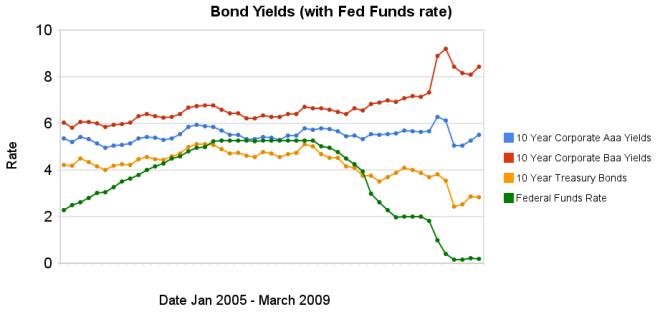
    graph of 10 year Aaa, Baa and corporate bond rates from 2005-2009Chart showing corporate and government bond yields by Curious Cat Investing Economics Blog, Creative Commons Attribution, data from the Federal Reserve.

    The federal funds rate remains under .25%. The large spread between government bonds and corporate bonds remains very large. In the last 3 months the yields on Aaa corporate bonds have increased 45 basis points, Baa corporate bond yields have decreased 1 basis points, while treasury bond yields have increased 40 basis points.

    The spread between 10 year Aaa corporate bond yields and 10 year government bond yields is now 268 basis points. In January, 2008 the spread was 159 points. The larger the spread the more people demand in interest, to compensate for the increased risk. The spread between government bonds and Baa corporate bonds decreased to a still very large 566 basis points, the spread was 280 basis point in January 2008, and 362 basis points in September 2008.

    Data from the federal reserve: corporate Aaacorporate Baaten year treasuryfed funds

    Related: Chart Shows Wild Swings in Bond YieldsFed to Start Buying Treasury Bonds TodayCorporate and Government Bond Rates Graph (Oct 2008)investing and economic charts

  • The Best Way to Rob a Bank is as An Executive at One

    William Black wrote The Best Way to Rob a Bank Is to Own One: How Corporate Executives and Politicians Looted the S&L. I think he a bit off on the “owning one,” being the best way to loot. The looters are not owners, they are executives that loot from owners, taxpayers, customers… And those looters pay politicians a great deal of money to help them. He appeared on Bill Moneys Journal discussing the huge mess we know are in and how little is being done to hold those responsible for the enormous crisis created by them.

    Fraud is deceit. And the essence of fraud is, “I create trust in you, and then I betray that trust, and get you to give me something of value.” And as a result, there’s no more effective acid against trust than fraud, especially fraud by top elites, and that’s what we have.

    The FBI publicly warned, in September 2004 that there was an epidemic of mortgage fraud, that if it was allowed to continue it would produce a crisis at least as large as the Savings and Loan debacle. And that they were going to make sure that they didn’t let that happen. So what goes wrong? After 9/11, the attacks, the Justice Department transfers 500 white-collar specialists in the FBI to national terrorism. Well, we can all understand that. But then, the Bush administration refused to replace the missing 500 agents. So even today, again, as you say, this crisis is 1000 times worse, perhaps, certainly 100 times worse, than the Savings and Loan crisis. There are one-fifth as many FBI agents as worked the Savings and Loan crisis.

    Well, certainly in the financial sphere, I am. I think, first, the policies are substantively bad. Second, I think they completely lack integrity. Third, they violate the rule of law. This is being done just like Secretary Paulson did it. In violation of the law. We adopted a law after the Savings and Loan crisis, called the Prompt Corrective Action Law. And it requires them to close these institutions. And they’re refusing to obey the law.

    In the Savings and Loan debacle, we developed excellent ways for dealing with the frauds, and for dealing with the failed institutions. And for 15 years after the Savings and Loan crisis, didn’t matter which party was in power, the U.S. Treasury Secretary would fly over to Tokyo and tell the Japanese, “You ought to do things the way we did in the Savings and Loan crisis, because it worked really well. Instead you’re covering up the bank losses, because you know, you say you need confidence. And so, we have to lie to the people to create confidence. And it doesn’t work. You will cause your recession to continue and continue.”

    And their ideologies, which swept away regulation. So, in the example, regulation means that cheaters don’t prosper. So, instead of being bad for capitalism, it’s what saves capitalism. “Honest purveyors prosper” is what we want. And you need regulation and law enforcement to be able to do this. The tragedy of this crisis is it didn’t need to happen at all.

    Related: Fed Continues Wall Street WelfareCredit Crisis the Result of Planned Looting of the World EconomyLobbyists Keep Tax Off Billion Dollar Private Equities DealsPoll: 60% say Depression LikelyCanadian Banks Avoid Failures Common ElsewhereToo Big to FailWhy Pay Taxes or be Honest

  • Curious Cat Investing and Economics Carnival #1

    I have been running the Curious Cat Management Management Improvement Carnival for several years and decided to start one on the investing and economics theme. I hope you enjoy the inaugural edition. If you like these posts you may also be interested in the Invest Reddit where a community of those interested in investing submit and rate articles and blog posts.

    • Case-Shiller: Is it Really THAT Bad? by Stan Humphries – “Unfortunately, in combining both foreclosures and non-foreclosures into a single metric, you’re not really getting a good insight into either market. In the current climate, you’re underestimating the decline in value of foreclosed homes and overestimating the decline in value of non-foreclosure homes.”
    • This is unquestionably the worst global economic crisis since the 1930s by Brad Setser – “Both the IMF and World Bank are now forecasting an outright fall in global output in 2009… Anything below 2% [growth] is generally considered a global recession.”
    • Value Added Tax (VAT): The Pros and Cons by Eric Stinson – “The VAT is also a consumption tax, so there is incentive for you to limit your spending. Like the Fair Tax, if you spend less than you make, you’ll pay less in taxes (all else equal).”
    • Face To Face With The Deficit by Scott Bittle – “The public simply will not permit Washington to raise their taxes, change their health insurance, or cut programs without their consent. Nor should they. But the public should understand the rules, too. It’s not enough to complain about red ink and then reject any possible solution.”
    • Confusing price discrimination – “Any way I think about it, the discount should either be to all consumers or to students for the entire day. Why would it be only to students in the afternoon?”
    • Leave Your Money in Your Retirement Accounts by Patrick – “At this point, the best thing you can do is stick to your retirement savings and investment plans. Continue contributing to your retirement accounts, make sure your asset allocation is set at your desired level, and don’t withdraw your retirement savings.”
    • Invisible Hands Explain Nothing: a response to a critic by Gavin Kennedy – “Indeed, Smith gives over 60 instances in Books I and II of Wealth Of Nations where the actions of individuals for their own ‘gain’ have less than beneficial consequences on those around them”

    A couple of my posts have appeared in other carnivals recently: California Unemployment Rate Climbs to 10.5 Percent in the Money Hacks Carnival and Add to Your 401(k) and IRA in the Carnival of Personal Finance.

    Related: Money Hacks Carnival #50Curious Cat Investing and Economics Search

  • Another 663,000 Jobs Lost in March in the USA

    663,000 jobs were lost in the USA in March and the unemployment rate rose from 8.1 to 8.5 percent, the Bureau of Labor Statistics of the U.S. Department of Labor reported today. Since the recession began in December 2007, 5.1 million jobs have been lost, with almost two-thirds (3.3 million) of the decrease occurring in the last 5 months. In March, job losses were large and widespread across the major industry sectors.

    In March, the number of unemployed persons increased by 694,000 to 13.2 million, and the unemployment rate rose to 8.5 percent. Why is that different than the numbers above? The numbers are from different sources of data, the first from BLS surveys of businesses and the 694,000 from household surveys. This reminds us that this data is approximate, not exact. Undoubtedly the figures will be revised as more data is analyzed.

    Over the past 12 months, the number of unemployed persons has grown by about 5.3 million, and the unemployment rate has risen by 3.4 percentage points. Half of the increase in both the number of unemployed and the unemployment rate occurred in the last 4 months.

    The unemployment rates continued to trend upward in March for adult men, 8.8%, adult women 7.0%, whites 7.9% and Hispanics 11.4%. The jobless rates for African Americans, 13.3% and teenagers 21.7% were little changed over the month. The unemployment rate for Asians was 6.4% in March, not seasonally adjusted, up from 3.6% a year earlier.

    Related: Over 500,000 Jobs Disappeared in NovemberManufacturing Employment Data – 1979 to 2007What Do Unemployment Stats Mean?