Category: Economics

  • The Economy is in Serious Trouble

    It doesn’t take much effort to notice the economic news is increasingly dire. And this is not just a few alarmist reports, the economy is in serious trouble. The decades of spending beyond their means (for consumers and those the consumers elected to run government) are creating a very difficult situation. And the credit crisis precipitating the current slide has brought to light many failures to properly regulate the economy. U.S. Slump May Be Longest in Decades as Growth Fell Off ‘Cliff’

    The U.S. downturn will be the longest in three decades, and the drought in consumer spending may be the worst ever, according to economists surveyed by Bloomberg News.

    The implosion of credit markets last month will cause the economy to shrink at a 3 percent annual rate in the fourth quarter and decline at a 1.5 percent pace in the first three months of 2009, according to the median estimate of 59 economists surveyed Nov. 3 to Nov. 11. Following last quarter’s 0.3 percent drop, the slump would be the longest since 1974-75.

    Falling demand will cause an even bigger increase in unemployment than projected last month. Economists surveyed forecast the jobless rate will rise to 7 percent in the first quarter of 2009, up from last month’s forecast of 6.6 percent. The rate will climb to 7.7 percent by the end of 2009, the highest level since 1992, the survey showed.

    The jobless rate rose to 6.5 percent in October, the highest since 1994

    There is little doubt the economy is in for serious trouble. What investment moves are wise now is less obvious. I have been buying during the decline and continue to do so. I bought some Google yesterday at the same price I first bought Google for several years ago. I think in 10 years that will pay off quite well, but time will tell. My purchases of Google earlier this year would obviously have been better if I had made them yesterday than when I did.

    I discussed the Economic Crisis on my Curious Cat Management Blog last month:

    With personal finance I still believe the same smart personal financial decisions last year, or five years ago are wise today: avoid credit card debt, have an emergency fund of 6 months of expenses, save for retirement, have proper health insurance, don’t buy what you don’t need and can’t afford… The biggest change I see is that the risks of failing to do these things (and the risks of failing to have done them in the past) are increasing greatly.

    One of the challenges with personal financial matters is they are by nature long term issues. What you did over the last 5 years cannot be fixed in a few weeks, most likely it takes years.

    Related: Stock Market DeclineBad News on Jobs

  • Consumer Debt Gets Bailout Attention

    Consumer debt gets bailout attention

    Treasury Secretary Henry Paulson said Wednesday that the government would broaden the reach of its $700 billion bailout plan to support non-bank financial institutions that provide consumer credit, such as credit cards and auto loans.

    “Approximately 40 percent of U.S. consumer credit is provided through securitization of credit card receivables, auto loans and student loans and similar products. This market, which is vital for lending and growth, has for all practical purposes ground to a halt.”

    The Next Meltdown: Credit-Card Debt

    The next horror for beaten-down financial firms is the $950 billion worth of outstanding credit-card debt—much of it toxic.

    Innovest estimates that credit-card issuers will take a $41 billion hit from rotten debt this year and a $96 billion blow in 2009.

    Risky borrowers with low credit scores account for roughly 30% of outstanding credit-card debt, compared with 11% of mortgage debt. More than 45% of Washington Mutual’s credit-card portfolio is subprime, according to Innovest.

    Related: Americans are Drowning in DebtHow to Use Your Credit CardCredit Crisis (Aug 2007)Curious Cat Economics Search Engine

  • Easiest Countries for Doing Business 2008

    Singapore is again ranked first for Ease of Doing Business by the World Bank. For some reason they call the report issued in any given year as the report for the next year (which makes no sense to me). The data shown below is for the year they released the report.

    Country 2008 2007 2006 2005
    Singapore 1 1 1 2
    New Zealand 2 2 2 1
    United States 3 3 3 3
    Hong Kong 4 4 5 6
    Denmark 5 5 7 7
    United Kingdom 6 6 6 5
    Ireland 7 8 10 10
    Canada 8 7 4 4
    other countries of interest
    Japan 12 12 11 12
    Germany 25 20 21 21
    France 31 31 35 47
    Korea 23 30 23 23
    Mexico 56 44 43 62
    China 83 83 93 108
    India 122 120 134 138
    Brazil 125 122 121 122

    The rankings include ranking of various aspects of running a business. Some rankings for 2008: starting a business (New Zealand 1st, Singapore 10th, USA 6th, Japan 64th), Dealing with Construction Permits (St. Vincent and the Grenadines 1st, Singapore and New Zealand 2nd, USA 26th, China 176th), Employing Workers (Singapore and the USA 1st, Germany 142, Korea 152), protecting investors (New Zealand 1st, Singapore 2nd, Hong Kong 3rd, Malaysia 4th, USA 5th), enforcing contracts (Singapore 1, Hong Kong 2, USA 6, China 18), getting credit (Malaysia 1; UK and Hong Kong 2; Singapore, New Zealand and USA 5th), paying taxes (Maldives 1, Hong Kong 3, USA 46, Japan 112, China 132).

    These rankings are not the final word on exactly where each country truly ranks but they do provide a valuable source of information. With this type of data there is plenty of room for judgment and issues with the data. Several of my posts, from my other blogs, that I recommend on this topic: The Future is Engineering, Science and Engineering in Global Economics (more…)

  • What Does That Say About the Field of Economics?

    So few economists foresaw the current credit disaster, New York Times interview of James Galbraith.

    NYT: there are at least 15,000 professional economists in this country, and you’re saying only two or three of them foresaw the mortgage crisis?
    Dr. Galbraith: Ten or 12 would be closer than two or three.

    NYT: What does that say about the field of economics, which claims to be a science?
    Dr. Galbraith: It’s an enormous blot on the reputation of the profession. There are thousands of economists. Most of them teach. And most of them teach a theoretical framework that has been shown to be fundamentally useless.

    NYT: You’re referring to the Washington-based conservative philosophy that rejects government regulation in favor of free-market worship?
    Dr. Galbraith: Reagan’s economists worshiped the market, but Bush didn’t worship the market. Bush simply turned over regulatory authority to his friends. It enabled all the shady operators and card sharks in the system to come to dominate how we finance.

    Related: Rodgers on the US and Chinese EconomiesGreenspan Says He Was Wrong On RegulationLeverage, Complex Deals and ManiaWhat is Economics?

  • Why America Needs an Economic Strategy

    In a recent article in Business Week Michael E. Porter makes some excellent points – Why America Needs an Economic Strategy:

    First, the U.S. has an unparalleled environment for entrepreneurship and starting new companies.

    Second, U.S. entrepreneurship has been fed by a science, technology, and innovation machine that remains by far the best in the world. While other countries increase their spending on research and development, the U.S. remains uniquely good at coaxing innovation out of its research and translating those innovations into commercial products.

    Third, the U.S. has the world’s best institutions for higher learning, and they are getting stronger. They equip students with highly advanced skills and act as magnets for global talent, while playing a critical role in innovation and spinning off new businesses.

    Fourth, America has been the country with the strongest commitment to competition and free markets.

    An inadequate rate of reinvestment in science and technology is hampering America’s feeder system for entrepreneurship. Research and development as a share of GDP has actually declined, while it has risen in many other countries.

    A creeping relaxation of antitrust enforcement has allowed mergers to dominate markets. Ironically, these mergers are often justified by “free market” rhetoric. The U.S. is seeing more intervention in competition, with protectionism and favoritism on the rise. Few Americans know that the U.S. ranks only 20th among countries in openness to capital flows, 21st on low trade barriers, and 35th on absence of distortions from taxes and subsidies

    I have discussed similar idea in this blog and the Curious Cat Science and Engineering Blog: The Future is EngineeringEngineering the Future EconomyScience GapNot Understanding Capitalism

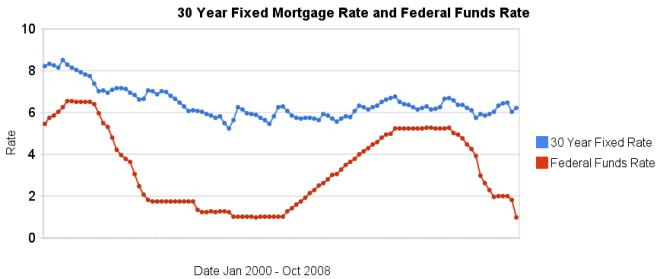
  • 30 Year Mortgage Rate and Federal Funds Rate Chart

    More dramatic evidence that changing in the federal funds rate do not lead to similar changes in 30 year fixed mortgage rates. It is true the last few months are very unusual times for the credit market. However, the current lack of correlation is not the exception, the graph clearly shows there is very little correlation between changes in the two interest rates.

    30 year fixed mortgage rates and the federal funds rate 2000-2008

    Related: historical comparison of 30 year fixed mortgage rates and the federal funds rateAffect of Fed Funds Rates Changes on Mortgage Ratesposts on financial literacyJumbo v. Regular Fixed Mortgage Rates: by Credit Score

    For more data, see graphs of the federal funds rate versus mortgage rates for 1980-1999. Source data: federal funds rates30 year mortgage rates

  • Corrupt Officials Have Fled China With As Much As $100 billion

    As many as 10,000 corrupt government officials have fled China with $100 billion.

    he joins as many as 10,000 corrupt Chinese officials who have fled the country over the past decade, taking as much as $100 billion of public funds with them, according to an estimate by Li Chengyan, head of Peking University’s Anticorruption Research Institute.

    More unexpected, however, was the heavy press coverage that Yang’s walkabout attracted in a country where the government is generally reluctant to wash its dirty linens in public. That suggests that “the government is sending a signal” that it regards “the number of officials fleeing as a very important problem which needs to be solved,” says Mao Zhaohui, director of anticorruption studies at Beijing’s Renmin University.

    Corruption is pervasive at almost every level of the government, and it is a major factor eroding faith in the ruling Communist Party. Earlier this year, after thousands of schoolchildren died in the Sichuan earthquake, the Internet was ablaze with accusations that local officials had taken bribes to approve substandard materials for school construction.

    Chinese President Hu Jintao has repeatedly declared that the fight against fraud is a top government priority and courts have handed down heavy sentences against prominent offenders. Last year, the former head of the Chinese Food and Drug Administration, Zheng Xiaoyu, was executed after being found guilty of taking bribes to approve thousands of new drugs.

    China has many strong winds for economic growth. Corruption is an anchor holding back their progress.

    Related: Capitalism in ChinaNot Understanding CapitalismOil Consumption by CountryData on Leading Manufacturing CountriesCurious Cat Economics Search Engine

  • National Debt Down Almost $1 Billion Yesterday

    The USA national debt decreased almost $1 billion yesterday. If it decreased by $1 billion dollars a day in just 10,526 days the USA government would be out of debt. That is just under 29 years, that doesn’t seem so bad. Unfortunately the decrease yesterday is not likely the start of a new trend (it is just daily variation).

    In the last month the debt is up over $580 Billion. At that rate, well lets just say if that rate continued long we would be in even more serious trouble than we have been placed in by the amazingly irresponsible behavior of the politicians increasing taxes on our grandchildren (with massive spending they chose to fund by huge tax increases on our grandchildren) have been doing the last 5 years. In the last year they have spent $1.46 Trillion more than they paid for (which will have to be paid for by future taxes – although the recent decision to purchase $125 billion in bank stocks perhaps opens another option for the the government to start buying companies and use profits they make to pay off the debt they are taking on).

    The current debt stands at $10,525,823,144,117. That is a bit over $10.5 Trillion.

    Related: True Level of USA Federal DeficitUSA Federal Debt Now $516,348 Per HouseholdWashington Paying Out Money it Doesn’t Have

  • Treasury Bought $125B in Bank Stocks

    On Tuesday the United States Treasury department purchased $125 billion of bank stocks becoming one of the largest stockholders in the world instantly.

    $25 billion was invested in Citigroup, JPMorgan Chase and Wells Fargo.

    $15 billion was invested in Bank of America and $10 billion in Merrill Lynch (which is being acquired by Bank of America).

    $10 billion was invested in Goldman Sachs and Morgan Stanley. And the treasury department invested $3 billion in Bank of New York Mellon $2 billion in State Street.

    Related: Goldman Sachs Rakes In Profit in Credit Crisis (Nov 2007)Warren Buffett Webcast on the Credit CrisisRodgers on the US and Chinese Economies (Feb 2008)Credit Crisis

  • Farmer in Chief

    Farmer in Chief by Michael Pollan

    After cars, the food system uses more fossil fuel than any other sector of the economy — 19 percent. And while the experts disagree about the exact amount, the way we feed ourselves contributes more greenhouse gases to the atmosphere than anything else we do — as much as 37 percent, according to one study.

    Spending on health care has risen from 5 percent of national income in 1960 to 16 percent today, putting a significant drag on the economy. The goal of ensuring the health of all Americans depends on getting those costs under control. There are several reasons health care has gotten so expensive, but one of the biggest, and perhaps most tractable, is the cost to the system of preventable chronic diseases. Four of the top 10 killers in America today are chronic diseases linked to diet: heart disease, stroke, Type 2 diabetes and cancer.

    You cannot expect to reform the health care system, much less expand coverage, without confronting the public-health catastrophe that is the modern American diet.

    It must be recognized that the current food system — characterized by monocultures of corn and soy in the field and cheap calories of fat, sugar and feedlot meat on the table — is not simply the product of the free market. Rather, it is the product of a specific set of government policies that sponsored a shift from solar (and human) energy on the farm to fossil-fuel energy.

    Read the full, long, interesting article. I have discussed both the failed special interest focused federal spending on farmers and the failed health care system.

    Related: Farming Without Subsidies in New ZealandEat food. Not too much. Mostly plants.International Health Care System PerformanceUSA Paying More for Health Care