Category: Financial Literacy

  • Bond Yields Show Dramatic Increase in Investor Confidence

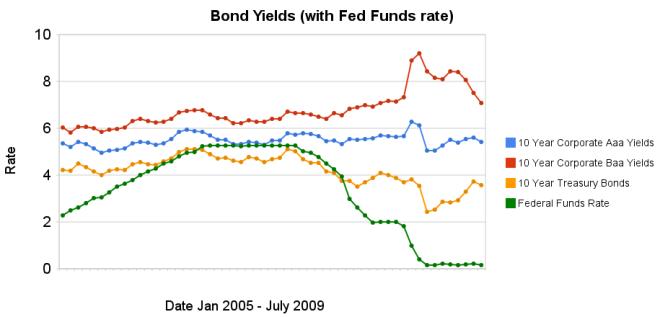
    graph of 10 year Aaa, Baa and corporate bond rates from 2005-2009Chart showing corporate and government bond yields by Curious Cat Investing Economics Blog, Creative Commons Attribution, data from the Federal Reserve.

    The changes in bond yields over the last 3 months months indicate a huge increase in investor confidence. The yield spread between corporate Baa 10 year bonds and 10 year treasury bonds increased 304 basis points from July 2008 to December 2008, indicating a huge swing in investor sentiment away from risk and to security (US government securities). From April 2009 to July 2009 the yield spread decreased by 213 basis points showing investors have moved away from government bonds and into Baa corporate bonds.

    From April to July 10 year corporate Aaa yields have stayed essentially unchanged (5.39% to 5.41% in July). Baa yields plunged from 8.39% to 7.09%. And 10 year government bond yields increased from 2.93% to 3.56%. federal funds rate remains under .25%.

    Investors are now willing to take risk on corporate defaults for a much lower premium (over government bond yields) than just a few months ago. This is a sign the credit crisis has eased quite dramatically, even though it is not yet over.

    Data from the federal reserve: corporate Aaacorporate Baaten year treasuryfed funds

    Related: Continued Large Spreads Between Corporate and Government Bond Yields (April 2009)Chart Shows Wild Swings in Bond Yields (Jan 2009)investing and economic charts

  • Lazy Portfolios Seven-year Winning Streak

    Here is an excellent article on how to invest in the stock market. I personally tweak this advice a bit but it is much better than most advice you get. Basically keep costs down (don’t pay large fees) and diversify. Lazy Portfolios seven-year winning streak by Paul Farrell

    Greed drives this [mutual fund] industry. The “world’s largest skimming operation” has now lost over 50% of America’s savings in the decade since the peak of 2000. The track record of actively managed funds during the recent subprime-credit meltdown continues to prove that the industry is failing America. The only way to invest is with index funds, which make up just 14% of the total.

    In short, even though we know that the average compensation of portfolio managers is often $400,000 to more than a $1 million, the hot-shot managers of these actively managed funds provided no value-added to their funds’ performance. Conclusion: Their investors would be better off investing in index funds.

    Yes, the market was in negative territory the past few years, but still all eight Lazy Portfolios outperformed each of the six actively-managed funds.

    Customize your own Lazy Portfolio following these six rules and you’ll win. More important, you’ll have lots of time left to enjoy what really counts, your family, friends, career, sports, hobbies, living.

    2) Frugality, savings versus financial obesity. Tools like starting early, autopilot saving plans, dollar-cost averaging, frugal living and other tricks are familiar to long-term investors. Trust your frugality instincts — living below your means — it’s a trait common among America’s “millionaires next door.”

    Related: Lazy Portfolio Results (April 2008)Allocations Make A Big Difference12 stocks for 10 years401(k)s are a Great Way to Save for Retirement

  • The Long-Term USA Federal Budget Outlook

    The decisions over the past 30 years to pass huge huge tax bills to those in the future is unsustainable. Saying you cut taxes when all you actually do is postpone them is dishonest. However, many people go along with such false statements so politicians have learned to buy votes today by raising taxes on the future. Since the public keeps voting for such people when the facts are clear the only explanation is they support raising taxes, not today, but in the future (or, I suppose, they are not able to understand the clear implications of what they vote for). The Long-Term Budget Outlook

    Under current law, the federal budget is on an unsustainable path, because federal debt will continue to grow much faster than the economy over the long run. Although great uncertainty surrounds long-term fiscal projections, rising costs for health care and the aging of the population will cause federal spending to increase rapidly under any plausible scenario for current law.

    For decades, spending on Medicare and Medicaid has been growing faster than the economy. CBO projects that if current laws do not change, federal spending on Medicare and Medicaid combined will grow from roughly 5 percent of GDP today to almost 10 percent by 2035. By 2080, the government would be spending almost as much, as a share of the economy, on just its two major health care programs as it has spent on all of its programs and services in recent years.

    CBO projects that Social Security spending will increase from less than 5 percent of GDP today to about 6 percent in 2035 and then roughly stabilize at that level.

    Federal interest payments already amount to more than 1 percent of GDP; unless current law changes, that share would rise to 2.5 percent by 2020.

    The cost of paying for a dysfunctional medical system has been a huge drain on the USA economy for decades. But that is nothing compared to what the future holds if we don’t adopted sensible strategies that reduce the huge extra costs we pay and the worse performance we receive for that cost.

    Social security is not the huge problem many think it is. Still I would support reducing the payout to wealthy individuals and bringing the age limits more in line with the changes in life expectancy. 12.4% of pay for low and middle wage workers (high income earners stop paying social security taxes so in effect marginal tax rates decrease by 12% for any income above $106,800). Medicare taxes add 2.9% bringing the total social security and Medicare taxes to 15.1% (including both the amount paid directly by the employee and the amount paid for the employee by the employer).

    Related: True Level of USA Federal DeficitUSA Federal Debt Now $516,348 Per Householdquotations about economicsarticles on improving the health care systemUSA Spent $2.2 Trillion, 16.2% of GDP, on Health Care in 2007

  • Mobius Says Derivatives, Stimulus to Spark New Crisis

    Mobius Says Derivatives, Stimulus to Spark New Crisis

    A new financial crisis will develop from the failure to effectively regulate derivatives and the extra global liquidity from stimulus spending, Templeton Asset Management Ltd.’s Mark Mobius said.

    “Political pressure from investment banks and all the people that make money in derivatives” will prevent adequate regulation, said Mobius, who oversees $25 billion as executive chairman of Templeton in Singapore. “Definitely we’re going to have another crisis coming down,”

    A “very bad” crisis may emerge within five to seven years as stimulus money adds to financial volatility, Mobius said. Governments have pledged about $2 trillion in stimulus spending.

    “Banks have lobbied hard against any changes that would make them unable to take the kind of risks they took some time ago,” said Venkatraman Anantha-Nageswaran, global chief investment officer at Bank Julius Baer & Co. in Singapore. “Regulators are not winning the battle yet and I’m not sure if they are making a strong case yet for such changes.”

    Mobius also predicted a number of short, “dramatic” corrections in stock markets in the short term, saying that “a 15 to 20 percent correction is nothing when people are nervous.” Emerging-market stocks “aren’t expensive” and will continue to climb

    I share this concern for those we bailed out using the money we paid them to pay politicians for more favors. Those paying our politicians like very much paying themselves extremely well and then being bailed out by the taxpayers when their business fails. They are going to try to retain the system they have in place. And they are likely to win – politicians are more likely to provide favors to those giving them large amounts of money than they are to learn about proper management of an economy.

    Related: Congress Eases Bank Laws for Big Donors (1999)Lobbyists Keep Tax Off Billion Dollar Private Equities Deals and On For Our GrandchildrenGeneral Air Travel Taxes Subsidizing Private Plane AirportsCEOs Plundering Corporate Coffers

  • Bad Math, Bad Statistics

    Here is a good blog post showing one great feature of the blogosphere (that term seems to have fallen out of use hasn’t it): interaction. It also shows that you have to think critically. You can’t just accept what you read (you never can, but that is even more true with blogs than it is with newspapers that at least have some standards normally). I tend to agree with this posts look at the data, though I have not examined the issue closely.

    Bad Math, Bad Statistics: Trying to get a blogger to admit a mistake

    So what’s wrong with this picture? If you guessed, “he’s comparing a gross value with per capita value” you win a cookie. US population is increasing all the time, and therefore, even if per capita incomes have dropped, that doesn’t mean total income hasn’t. So if you multiply those figures by the population and then compare them, you get this (source):

    1981: 229465714 * 8476.0 = 1.944 trillion
    1992: 255029699 * 14847.0 = 3.786 trillion (94% gain)
    2005: 292892127 * 25036.0 = 7.332 trillion (93.6% gain)

    Er, doesn’t look like a lag to me. In fact, it looks like it’s doubling every 12-13 years just as much as GDP is. I also looked up total income statistics for the US, and found the following figures (source). (Note these figures are different. More on that later.)

    1981: $2,580,600,000 (2.58 / 3.1 = 83% of GDP)
    1992: $5,349,384,000 (more than double!) (5.34 / 6.2 = 86% of GDP)
    2005: $10,252,973,000 (another double!) (10.25 / 12.4 = 82% of GDP)

    Anyway it is a much more interesting argument than I would hear when I listened to TV “pundits” years ago spout meaningless talking points at each other. Granted they argument is not going to be studied as a wonderful example of how we should debate. Still it is much above what passes for debate from our politicians (yes this is more a sad commentary on how failed our politicians are than a statement of how marvelous the argument on the GDP issue is between the two bloggers).

    Here is a math question for you, what has a bigger impact moving from 15 to 18 mpg or 50 to 100 mpg?

    Related: Government Debt as a Percentage of GDPUSA Consumers Paying Down DebtIs Productivity Growth Bad?Americans are Drowning in Debt

  • The Formula That Killed Wall Street

    The Formula That Killed Wall Street

    For five years, Li’s formula, known as a Gaussian copula function, looked like an unambiguously positive breakthrough, a piece of financial technology that allowed hugely complex risks to be modeled with more ease and accuracy than ever before. With his brilliant spark of mathematical legerdemain, Li made it possible for traders to sell vast quantities of new securities, expanding financial markets to unimaginable levels.

    His method was adopted by everybody from bond investors and Wall Street banks to ratings agencies and regulators. And it became so deeply entrenched—and was making people so much money—that warnings about its limitations were largely ignored.

    Then the model fell apart. Cracks started appearing early on, when financial markets began behaving in ways that users of Li’s formula hadn’t expected. The cracks became full-fledged canyons in 2008—when ruptures in the financial system’s foundation swallowed up trillions of dollars and put the survival of the global banking system in serious peril.

    Very nice article on the dangers of financial markets to those that believe that math can provide all the answers. Math can help find opportunities. However markets have physical, psychological and regulatory limitations. And markets frequently experience huge panics or manias. People continue to fail to model that properly.

    Related: All Models Are Wrong But Some Are UsefulLeverage, Complex Deals and ManiaFinancial Markets with Robert ShillerFinancial Market MeltdownFailure to Regulate Financial Markets Leads to Predictable Consequences

  • Managing Retirement Investment Risks

    The Society for Actuaries has published a good resource: Managing post-retirement risks.

    Experts disagree about when annuitization is a good strategy. Disadvantages include losing control of assets, costs, and inability to leave money to one’s heirs. Annuities without inflation protection are only partial protection against living “too long.”

    Many investors try to own some assets whose value may grow in times of inflation. However, this sometimes will trade inflation risk for investment risk.
    Common stocks have outperformed inflation in the long run, but are
    poor short-term hedges. The historically higher returns from stocks
    are not guaranteed and may vary greatly during retirement years.

    Retirement planning should not rely heavily on income from a bridge job. Many retirees welcome the chance to change careers and move into an area with less pay but more job satisfaction, or with fewer demands on their time and energy.

    Terminating employment before age 65 may make it difficult to find a source of affordable health insurance before Medicare is available.

    Insurance for long-term care covers disabilities so severe that assistance is needed with daily activities such as bathing, dressing and eating. Some policies require a nursing home stay; others do not. The cost of long-term care insurance is much less if purchased at younger ages, well before anticipated need.

    The full document is well worth reading.

    Related: Many Retirees Face Prospect of Outliving SavingsHow to Protect Your Financial HealthFinancial Planning Made Easypersonal finance tips

  • Another 450,000 Jobs Lost in June

    Nonfarm payroll employment continued to decline in June (by 467,000), and the unemployment rate increased to 9.5% (with a total of 14.7 million unemployed), the Bureau of Labor Statistics of the U.S. Department of Labor reported today. Job losses were widespread across the major industry sectors, with large declines occurring in manufacturing, professional and business services, and construction.

    Since the start of the recession in December 2007, the number of unemployed persons has increased by 7.2 million, and the unemployment rate has risen by 460 basis points (from 4.9% to 9.5%). The number of long-term unemployed (those jobless for 27 weeks or more) increased by 433,000 over the month to 4.4 million. In June, 30% of unemployed persons were jobless for 27 weeks or more.

    Employment in manufacturing fell by 136,000 over the month and has declined by 1.9 million during the recession. Health care employment increased by 21,000 in June. Job gains in health care have averaged 21,000 per month thus far in 2009, down from an average of 30,000 per month during 2008.

    The number of persons working part time for economic reasons (sometimes referred to as involuntary part-time workers) was little changed in June at 9.0 million. Since the start of the recession, the
    number of such workers has increased by 4.4 million.

    About 2.2 million persons (not seasonally adjusted) were marginally attached to the labor force in June, 618,000 more than a year earlier. These individuals wanted and were available for work and had looked for a job sometime in the past 12 months. They were not counted as unemployed because they had not searched for work in the 4 weeks preceding the survey.

    Related: posts on employmentUnemployment Rate Increased to 8.9%Can unemployment claims predict the end of the American recession?The Economy is in Serious TroubleOver 500,000 Jobs Disappeared in November 2008

  • Saving Spurts as Spending Slashed

    One factor you must understand when evaluating economic data is that the data is far from straight forward. Even theoretically it is often confusing what something like “savings rate” should represent. And even if that were completely clear the ability to get data that accurately measures what is desired is often difficult if not impossible. Therefore most often there is plenty of question about economic conditions even when examining the best available data. Learning about these realities is important if you wish to be financially literate.

    Bigger U.S. Savings Than Official Stats Suggest

    The official data from the Bureau of Economic Analysis say that in February personal spending was down 0.4%, or $40 billion, from the year before. Certainly any drop is bad news, since consumer spending rarely decreases – but $40 billion out of total spending of $10 trillion doesn’t seem like enough to wreak economic havoc.

    A closer look, however, shows that Americans have tightened their belts more sharply than the numbers report. The reason? Official figures for personal spending include a lot of categories, such as Medicare outlays, that are not under the control of households. They also include items, such as education spending, that should be treated as investment in the future rather than current consumption.

    After removing these spending categories from the data, let’s call what’s left “pocketbook” spending – the money that consumers actually lay out at retailers and other businesses. By this measure, Americans have cut consumption by $200 billion, or 3.1%, over the past year. This explains why the downturn has hit Main Street hard.

    Finally, for technical reasons the BEA throws in some “spending” categories where no money actually changes hands. The biggest is “rent on owner-occupied housing,” the money that people supposedly pay themselves for living in their own homes. Despite the housing bust, this number rose by 2.6% over the past year, to $1.1 trillion.

    A closer look at BEA numbers shows that Americans reduced spending by 3.1% in the past year, indicating that the savings rate has risen to 6.4%

    He raises good issues to consider though I am not sure I agree 100% with his reasoning.

    Related: The USA Should Reduce Personal and Government DebtFinancial Markets with Robert ShillerSave Some of Each RaiseOver 500,000 Jobs Disappeared in November (2008)

  • Manage Your Borrowing and Avoid Debt Negotiators

    Debt Negotiators May Give Little Relief to Consumers

    “They never told me that the money I was paying wasn’t going to my debt, it was going to them,” said Hopkins, 59, who quit work in January 2008 after a brain tumor led to surgery. He now receives $1,539 a month in disability checks. “You are better on your own.”

    Credit-card delinquencies are at record highs, according to Fitch Ratings, and the U.S. unemployment rate of 8.9 percent is the highest since 1983. As more consumers fall behind on bills, settlement companies often end up adding to the debt burden rather than offering a cost-saving solution, said Gail Cunningham, a spokeswoman for the National Foundation for Credit Counseling in Silver Spring, Maryland.

    New York Attorney General Andrew Cuomo has begun a national investigation of settlement companies, and has sued two for fraud and false advertising. Illinois Attorney General Lisa Madigan has also filed two lawsuits against debt-settlement companies, alleging they “engage in deceptive marketing practices” and “do little or nothing to improve consumers’ financial standings.” Texas Attorney General Greg Abbott sued a debt settlement company in March, saying it engaged in “deceptive and misleading acts,” according to court documents.

    It is much better to avoid this problem by taking wise personal finance actions – don’t take on personal debt for minor purchases (for a mortgage then debt is fine, probably fine for a car – though avoid debt if you can). The “secret” is not very secret. Just don’t buy what you can’t pay for. It is very simple, many people just don’t want to follow that simple strategy. Also save money in an emergency fund, so when some emergency comes along you don’t go into debt. You just use your emergency fund.

    Once you are stuck in a bad situation with more debt than you can afford to pay back you have bad choices. Obviously many try to take advantage of you. Frankly they realize many that are stuck in bad financial position make bad financial decisions. Therefor it is a good place for those trying to rip people off to find people to take advantage of. The best way to deal with this is not to try and find the best debt negotiators it is to manage you finances well and not get in trouble.

    Related: Personal Saving and Personal Debt in the USAHow to Use a Credit Card SuccessfullyCredit Card Companies Willing to Deal Over DebtWhere to Keep Your Emergency Funds?Americans are Drowning in Debt