Category: Financial Literacy

  • Volcker: Economic Decline Faster Now Than Any Time He Remembers

    Paul Volcker said some pretty alarming words recently. Volcker: Crisis May be Even Worse than Depression

    “I don’t remember any time, maybe even in the Great Depression, when things went down quite so fast, quite so uniformly around the world,” Volcker told a luncheon of economists and investors at Columbia University.

    He stressed the importance of preventing financial institutions large enough to pose a threat to the entire system from engaging in risky behavior such as running hedge funds or trading for its own accounts.

    He is certainly right on the second point. I must say the decline is bad. And the recent new on jobs and GDP have been bad. It doesn’t strike me as approaching the depression type problems but he didn’t say the economy was approaching a depression, just that the decline was steeper now, perhaps. When he says something like that it makes me at least want to pay a bit more attention to the economy.

    Related: Too Big to Fail, is Too BigTreasury Now (1987) Favors Creation of Huge BanksMonopolies and Oligopolies do not a Free Market Make
  • Who Will Buy All the USA’s Debt?

    Who Will Buy All the USA’s Debt? That is a question worth thinking about. The USA is a huge net borrower. The government can’t borrow from consumers because they are hugely in debt themselves. Over the last few decades huge investments from Japan, China and the Middle East in USA government debt have allowed the huge amount of federal debt to continue to grow rapidly. But who is going to buy the increasing amounts of debt; in the next few years, and the next few decades?

    China is right to have doubts about who will buy all America’s debt

    Chinese doubts about the value of US Treasury bonds highlight a crucial question: who will buy the estimated $2.7 trillion (£1.9 trillion) to $4.2 trillion of debt expected to be issued over the next two years?

    The other area of concern for China is the value of its Treasuries. Given the US borrowing requirement and its lax monetary policy, Treasury bond yields could well rise sharply, causing a corresponding price decline. If China’s holdings match Treasuries’ average 48-month duration, then a 5pc rise in yields, from 1.72pc on the 5-year note to 6.72pc, would lose China 17.5pc of its holdings’ value, or $119bn.

    Foreign buyers have absorbed a little over $200bn of Treasuries annually, a useful contribution to financing the $459bn 2008 deficit, but only a modest help towards the $1.35 trillion minimum average deficit forecast for 2009 and 2010.

    Unless that changes substantially, there will be $1 trillion annually to be raised by the Treasury from domestic sources, more than double the previous record from domestic and foreign sources together, plus whatever is needed to bail out the banks.

    Even if the US savings rate were to rise from zero to its long-term average of 8% of disposable personal income, that would create only an additional $830bn of savings — not enough to fund the domestic share of the deficit. Interest rates would probably have to rise substantially to pull in more foreign investors.

    Very true. Anyone buying government debt at these rates has reason to question the wisdom of doing so. Exporters to the USA have macro-economic reasons for buying debt (to keep the value of the dollar from collapsing) but the investing reasons for buying USA debt I find very questionable (I wouldn’t be buying it as an investment, if I were them).

    Related: Personal Saving and Personal Debt in the USAAmericans are Drowning in DebtUSA Federal Debt Now $516,348 Per HouseholdIs the USA Broke?

  • China and USA Exports and Imports Drop Sharply

    China and USA exports and imports have been dropping sharply. The USA has decreased the excess consumption over production by $20 billion a month (from $60B to $40B monthly deficit). China maintains a trade surplus and as imports drop faster than export this is actually increasing on a percentage basis.

    Can the improvement in the US trade balance continue?

    The US trade deficit — which is a good proxy for the current account balance (the income surplus offsets a transfers deficit) — is now around $40b a month. At its peak it was more like around $60b a month. That implies, if nothing changes, the 2009 current account deficit would be around $500b, down from a peak of $700b.

    Deficits and surpluses are shrinking globally now that the price of oil is at levels that roughly cover the oil exporters imports.* Right now China’s (growing) surplus is clearly the main counterpart to the United States’ (shrinking) deficit.

    It is hard to put lipstick on a pig (or even an ox):

    The sharp fall in China’s exports (down 17.5% y/y) and imports (down 43% y/y) shouldn’t have been a complete surprise. Korean and Taiwanese exports are down far more than China’s exports, in large part because of sharp falls in their exports to China. And, given the intra-Asian supply chain, that has long augered bad news for China.

    Related: The Budget Deficit, the Current Account Deficit and the Saving DeficitTop 12 Manufacturing Countries in 2007Personal Saving and Personal Debt in the USACharge It to My Kids

  • GDP Down 3.8%, Worst Since 1982

    GDP slides 3.8%, worst since 1982

    That was the steepest drop since a 6.4% decline in 1982, easily surpassing the downturns seen during the 1990-91 and 2001 recessions. It also provided the second consecutive drop in GDP, after the 0.5% drop in the third quarter of 2008.

    “All of this points towards real GDP declining faster in the first quarter than the fourth quarter,” Levy said. Another bad portent was a sharp decline in exports. U.S. sales to other countries had been strong in recent years, boosted by high demand overseas and the relatively low value of the dollar. But that situation reversed sharply in the last three months of 2008, with exports plummeting 19.7%.

    According to the International Monetary Fund, the decline in the U.S. is matched by other leading economies, which contracted about 5.5% in the fourth quarter of 2008.

    The decline was a bit less than anticipated but obviously shows an economy in serious trouble. U.S. GDP Falls At 3.8 Percent Pace In 4th Quarter

    The figure showed how rapidly the economy was contracting. In the previous quarter, the economy slipped 0.5 percent. For all of 2008, GDP rose 1.3 percent, the slowest growth since 2001, when the economy expanded 0.8 percent. In 2007, the GDP increased by 2 percent.

    The Commerce report showed consumer spending – which accounts for a whopping two-thirds of U.S. economic activity – fell another 3.5 percent in the fourth quarter after declining 3.8 percent in the third quarter. Spending on durable goods such as cars and furniture plunged 22.4 percent, the steepest decline since the first quarter of 1987.

    As I have been saying for awhile the economy is in trouble and 2009 looks to be difficult. We should be happy if a recovery is underway in the 4th quarter of 2009 and we have not too drastically increased the burden on the future to pay for current spending.

    Related: Financial Market Meltdown (Oct 2008)Cracks in US Economy? (Dec 2006)Fed Continues Wall Street WelfareForecasting Oil PricesCrisis May Push USA Federal Deficit to Above $1 Trillion for 2009

  • Too Much Leverage Killed Mervyns

    I do not like the actions of many in “private equity.” I am a big fan of capitalism. I also object to those that unjustly take from the other stakeholders involved in an enterprise. It is not the specific facts of this case, that I see as important, but the thinking behind these types of actions. Which specific actions are to blame for this bankruptcy is not my point. I detest that financial gimmicks by “private capital” that ruin companies.

    Those gimmicks that leave stakeholders that built such companies in ruin should be criticized. It is a core principle that I share with Dr. Deming, Toyota… that companies exist not to be plundered by those in positions of power but to benefit all the stakeholders (employees, owners, customers, suppliers, communities…). I don’t believe you can practice real lean manufacturing and subscribe to this take out cash and leave a venerable company behind kind of thinking.

    How Private Equity Strangled Mervyns

    Much of the blame for its demise lies with three private equity titans: Cerberus Capital Management, Sun Capital Partners, and Lubert-Adler.

    When those firms bought Mervyns from Target for $1.2 billion in 2004, they promised to revive the limping West Coast retailer. Then they stripped it of real estate assets, nearly doubled its rent, and saddled it with $800 million in debt while sucking out more than $400 million in cash for themselves, according to the company. The moves left Mervyns so weak it couldn’t survive.

    Mervyns’ collapse reveals dangerous flaws in the private equity playbook. It shows how investors with risky business plans, unrealistic financial assumptions, and competing agendas can deliver a death blow to companies that otherwise could have survived. And it offers a glimpse into the human suffering wrought by owners looking to turn a quick profit above all else.

    Too much debt is not just a personal finance problem it is a problem for companies too. Continue reading on my original post on the Curious Cat Management Blog.

    Related: Leverage, Complex Deals and ManiaFailed Executives Used Too Much Leverageposts on debt

  • Teaching Teens About Credit Cards

    How Should Parents Teach Teens About Credit Cards? by Nancy Trejos

    a 2007 Charles Schwab survey that showed that only 45 percent of teens know how to use a credit card. Even worse, just 26 percent of teens understood credit card interest and fees

    there are prepaid cards targeted specifically at teens, such as the Visa Buxx card. With such a card, Bellamkonda would be able to log in and monitor his daughter’s spending online

    Bill Hardekopf, chief executive of LowCards.com, said parents should pull out their own credit card bills and talk their children through them. Explain the interest rate, minimum payments, grace period and finance charges. If they’ve had late fees or payment problems, they shouldn’t hide them. “Use these as teaching examples,” he said. “Getting a teenager a credit card while she lives in your home is a great teaching opportunity on finances.”

    I agree it is wise to explain the use of credit cards to teenagers. I also agree it is wise to have them actually use their own card, assuming they aren’t unreasonably immature and have shown an understanding of personal finance.

    Books: Money Sense for KidsGrowing Money: A Complete Investing Guide for KidsThe Motley Fool Investment Guide for TeensRaising Financially Fit KidsA Smart Girl’s Guide to Money: How to Make It, Save It, And Spend It

    Related: Teaching Children About Money MattersStudent Credit CardsMajoring in Credit Card Debt

  • The Impact of Credit Scores and Jumbo Size on Mortgage Rates

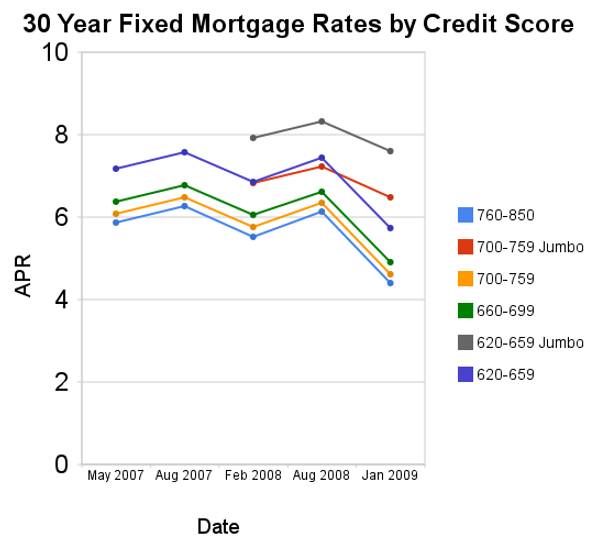
    Since August of 2008 conforming mortgage rates are have declined a huge amount. Jumbo rates have fallen a large amount also, but much less (for example for a credit score of 700-759 the jumbo rates declined 73 basis points while the conventional rate declined 172 basis points.

    chart of 30 year fixed mortgage rates by credit score from May 2007 to Jan 2009

    For scores above 620, the APRs above assume a mortgage with 1 point and 80% Loan-to-Value Ratio. For scores below 620, these APRs assume a mortgage with 0 points and 60 to 80% Loan-to-Value Ratio. You can see, with these conditions the rate difference between a credit score of 660 and 800 is not large (remember this is with 20% down-payment) and has not changed much (the difference between the rates if fairly consistent).

    Related: Low Mortgage Rates Not Available to Everyone30 Year Fixed Rate Mortgage Rate DataReal Free Credit Report (in USA)Jumbo Mortgage Shoppers Get Little Relief From Ratesposts on mortgages
    (more…)

  • Chart Shows Wild Swings in Bond Yields

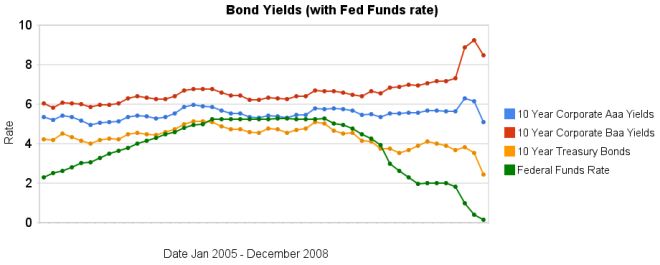
    graph of 10 year Aaa, Baa and corporate bond rates from 2008-2008

    The recent reactions to the credit and financial crisis have been dramatic. The federal funds rate has been reduced to almost 0. The increase in the spread between government bonds and corporate bonds has been dramatic also. In the last 3 months the yields on Baa corporate bonds have increased significantly while treasury bond yields have decreased significantly. Aaa bond yields have decreased but not dramatically (57 basis points), well at least not compared to the other swings.

    The spread between 10 year Aaa corporate bond yields and 10 year government bonds increased to 266 basis points. In January, 2008 the spread was 159 points. The larger the spread the more people demand in interest, to compensate for the increased risk. The spread between government bonds and Baa corporate bonds increased to 604 basis points, the spread was 280 basis point in January, and 362 basis points in September.

    When looking for why mortgage rates have fallen so far recently look at the 10 year treasury bond rate (which has fallen 127 basis points in the last 3 months). The rate is far more closely correlated to mortgage rates than the federal funds rate is.

    Data from the federal reserve – corporate Aaacorporate Baaten year treasuryfed funds

    Related: Corporate and Government Bond Rates Graph (Oct 2008)Corporate and Government Bond Yields 2005-2008 (April 2008) – 30 Year Fixed Mortgage Rates versus the Fed Funds Rateposts on interest ratesinvesting and economic charts

  • Insurers Raise Fees on Variable Annuities

    More Insurers Raise Fees on Variable Annuities

    Many insurance companies radically underestimated the cost of hedging their guarantees in a market meltdown. Now that the markets have crashed, some investors will find they’re paying a lot more for the same product.

    As SmartMoney has reported, this is one way that annuities are failing to live up to their big promises. The guarantees attached to the products – minimum returns of 6% per year or better, market upside, no chance of loss and a lifetime income stream – were designed to attract people in retirement or close to it.

    And it worked, attracting $650 billion in assets in the last five years. But the guarantees are only as good as the insurance company’s ability to hedge them, and even when the markets were rising, some insurance company executives admitted their strategies hadn’t been tested by real-life crisis conditions. Now some estimates suggest that hedging costs have doubled in the last year, and insurers are passing those costs along to their customers.

    For example, an investor might purchase a $100,000 annuity that pays a guaranteed 6% annual return for 10 years, or market returns — whichever is better. The fees for a product like that might look something like this:

    • 1.3% annually on the current balance to cover the underlying investment
    • 1% annually on the current balance for the insurance wrapper (called the mortality and expense charge)
    • 1% of the original purchase price to cover the guarantee

    The fees now rising are all in that last category — charges that cover guarantees. At the Hartford, the fees of three different kinds of guarantees are rising, from the current charge of 0.35% to 0.75%.

    In general I am not inclined to insurance investment products. They are frequently overloaded with fees. Annuities can provide some balance in retirement, so annuitizing a portion of assets at retirement may be reasonable. But I would not use insurance investment products for a significant portion of my retirement assets.

    Related: Personal Finance: Long-term Care InsuranceMany Retirees Face Prospect of Outliving SavingsInvestor Protection NeededRetirement Tips from TIAA CREF

  • Lowest 30 Year Fixed Mortgage Rates in 37 Years

    We now have the lowest 30 year fixed mortgage rates since data has been collected (37 years) in the USA. Is this due to the Fed cutting the discount rate? I do not think so. As I have said previously 30 year fixed rates are not correlated with federal reserve rates. But this time the government is actively seeking to reduce mortgage rates.

    U.S. Treasury Secretary Henry Paulson said the Bush administration was looking at ways to lower mortgage rates because it was essential to stem the drop in home prices to foster an economic recovery.

    Mortgage Rate Hits 37-Year Low

    The benchmark 30-year fixed-rate home mortgage in the U.S. fell to a national average of 5.17% this week, the lowest since Freddie Mac began its weekly rate survey in 1971.

    The 15-year fixed-rate mortgage averaged 4.92%, down from last week when it averaged 5.20%. A year ago the 15-year loan averaged 5.79%. The 15-year mortgage hasn’t been lower since April 1, 2004, when it averaged 4.84%.

    Homeowners refinance, put savings under mattress

    This time around, lenders say up to a third of the callers seeking to refinance simply can’t. And if they can, the future savings are headed straight for the piggy bank.

    These rates sure are fantastic if you are in the market. I was not in the market, but I am considering re-financing now. You need to be careful and not just withdraw money because you can. If you can refinance and reduce your payments it may well be a wise move though. One problem can be extending the date you will finally be free of mortgage debt. If you re-finance a current 30 year loan, that you got 5 years ago, you will now be paying 5 more years. One option is to see if you can get a 25 or 20 year loan. Or if you can make a 15 year loan work, do that (15 and 30 year fixed rate mortgages are common).
    (more…)