Category: Financial Literacy

  • Bogle on the Stock Market and Investing

    Bogle on Bankers, Buffett, Obama; an interview of John Bogle, from February 2010.

    Bogle: What happened over the last 10 years were two things, and one of which we have never encountered before. The 17% returns we had over the two previous consecutive decades, the ’80s and the ’90s, were born largely on ascending price-earnings multiples. If the price-to-earnings ratio goes from 8 to 16 in one decade, and then to 32 in the next decade, that accounts for 7% per year of that 17% return. So the market was driven by the revaluation of corporate America and that just can’t keep recurring at those rates. I projected in the original book that the price-earnings multiple might get down below 20, which is exactly what it’s done, so that was fairly predictable.

    But what made the decade quite so bad is that we then had a major recession or light depression at the end of 2008 to 2009 which is still with us. That coming with the market so highly valued meant that earnings growth was much less than what we might have expected. So looking out from here, I think we can look for better earnings growth. And dividend yields are back in decent territory but not great. We started this decade with a 1% dividend yield, and that’s an important part of investment returns, and now the dividend yield is around 2.25%, so a higher dividend yield contributing to future growth. So I think it’s highly likely that stocks will outpace bonds in the decade that just began.

    Are we on the right path now? Has America learned its lesson?
    Bogle: No. Unequivocally not. The long overdue reforms being discussed in Washington do not go nearly far enough, in my opinion. We need protection for consumers. Canada has a financial structure similar to ours except it has a consumer-protection board, which would prevent banks from giving people mortgages if they have no ability to pay them back. To get that done has been very difficult. Also, Senators (John) McCain and (Maria) Cantwell have proposed a return of the Glass-Steagall Act, and that’s gotten nowhere but it is long overdue. We should have banks behave as banks and not as investment banks or hedge-fund managers.

    But let’s suppose the stock market creates a 10% return. And the value of the stock market today is around $13 trillion so 10% is $1.3 trillion. By my numbers, Wall Street and the mutual fund industry take $600 billion a year out of that return. That’s half of the return. So the only way investors are going to get their fair share of the $1.3 trillion is to reduce the costs and get the casinos out.

    As usually John Bogle provides excellent analysis and vision.

    Related: Bogle on the Retirement CrisisIs Trying to Beat the Market Foolish?Lazy Portfolios Seven-year Winning StreakSneaky Fees

  • Government Debt, Greece is a Very Small Part of the Problem

    Roubini Says Rising Sovereign Debt Leads to Inflation, Defaults

    Credit-rating cuts on Greece, Portugal and Spain this week are spurring investors’ concern that the European deficit crisis is spreading and intensifying pressure on policy makers to widen a bailout package. Roubini’s remarks underscore statements by officials such as Dominique Strauss-Kahn, managing director of the IMF, that the global economy still faces risks.

    “The thing I worry about is the buildup of sovereign debt,” said Roubini

    If the problem isn’t addressed, he said, nations will either fail to meet obligations or experience higher inflation as officials “monetize” their debts, or print money to tackle the shortfalls.

    “While today markets are worried about Greece, Greece is just the tip of the iceberg, or the canary in the coal mine for a much broader range of fiscal problems,”

    Greece “could eventually be forced to get out” of the 16- nation euro region, he said in a Bloomberg Television interview yesterday. That would lead to a decline in the euro and make it “less of a liquid currency,” he said. While a smaller euro zone “makes sense,” he said, “it could be very messy.”

    [Roubini supports] a carbon tax on gasoline, with Roubini saying it would reduce American dependence on oil from overseas, shrink the trade deficit and carbon emissions, and help pay down the U.S. budget deficit.

    I agree that the damage done by those (which is nearly all of them) countries living beyond their means is significant. The USA and many countries in Europe and Asia (South Korea and China are two exceptions) have raised taxes on the future (by default – spending more than you have necessarily increases taxes later) to consume today. The strong emerging markets are another exception, many having learned their lessons and stopped spending money they didn’t have in the 1990’s.

    However the richest countries have been spending money they don’t have for decades and the increase in government debt as a portion of GDP is an increasingly serious problem. It would be nice if the government of the rich countries could behave responsibly but it does not look like many of them have citizens who will elect honest and competent leaders. As long as they elect leaders that insist on raising taxes on the future (and lying to the populace by claiming they cut taxes – because they eliminate taxes today) those countries will pay severely for the irresponsible spending.

    Saying you cut taxes when you just delay them is equivalent to saying I paid off my credit card bill when all I did was get 2 new credit cards, borrow all the money I owed on my original card, pay that one off, and then borrow more to increase my debt even more. Yes it is true I did pay off my original credit card, but that is hardly the salient point. My credit card debt increase. All that has happened in the USA since the Clinton administration had a balanced budget is politicians used a credit card thinking to lower taxes while necessarily increasing them in the future. You don’t reduce debt by spending money you don’t have.
    (more…)

  • The 4% Rule is Overly Simplistic

    Time to replace the 4% rule

    Conventional wisdom suggests that you withdraw on average 4% adjusted for inflation. Now comes a paper co-authored by William Sharpe, the winner of the 1990 Nobel Prize in Economics, challenging the conventional wisdom.

    According to Sharpe, who is also the founder of Financial Engines, the typical 4% rule recommends that a retiree annually spend a fixed, real amount equal to 4% of his initial wealth, and rebalance the remainder of his money in a 60%-40% mix of stocks and bonds throughout a 30-year retirement period.

    What’s more, he shows the price paid for funding what he calls “unspent surpluses and the overpayments made to purchase its spending policy.” According to Sharpe, a typical rule allocates 10%-20% of a retiree’s initial wealth to surpluses and an additional 2%-4% to overpayments.

    The only problem with what academia knows to be right and what’s practical in the field — even by Sharpe’s own admission — is this: “Many practical issues remain to be addressed before advisers can hope to create individualized retirement financial plans that maximize expected utility for investors with diverse circumstances, other sources of income, and preferences,” Sharpe wrote in his paper.

    Meanwhile, Stephen P. Utkus, a principal with the Vanguard Center for Retirement Research, agrees that the 4% rule is flawed. But he also notes, as did Sharpe, that there’s no practical mechanism to replace it with and that further research is required.

    I think this is exactly right. The proper personal financial actions in this case are not easy. The 4% rule is far from perfect but it does give a general idea that is a decent quick snapshot. But you can’t rely on such a quick, overly simplified method. At the same time there are simple ideas that do work, such as saving money for retirement is necessary. The majority of people continue to fail to take the most basis steps to save money each year for retirement.

    Related: Spending Guidelines in RetirementHow Much Will I Need to Save for Retirement?Bogle on the Retirement Crisis

  • Private Foreign Banking Deposits by Country

    According to a new report on Privately Held, Non-Resident Deposits in Secrecy Jurisdictions the United States is the country with the largest amount of private, non-resident, deposits. Cayman Islands takes second, upholding its commonly held reputation as a tax haven often used to avoid paying taxes own by wealthy people. Switzerland comes in 9th.

    The countries with the most private, foreign deposits in billion of $US.

    Country June 2008 June 2009
    1 United States $2,899 $2,183
    2 Cayman Islands $1,515 $1,550
    3 United Kingdom $1,796 $1,534
    4 Luxembourg 588 435
    5 Germany 494 426
    6 Jersey 544 393
    7 Netherlands 413 316
    8 Ireland 273 276
    9 Switzerland 289 274
    10 Hong Kong 325 268

    Since 2001 deposits in the Cayman Islands have more than tripled, while those in the UK have close to tripled and in the USA they have a bit more than doubled.

    • Total Current total deposits by non-residents in offshore centers and secrecy jurisdictions are just under US$10 trillion;
    • The United States, the United Kingdom, and the Cayman Islands top the list of jurisdictions, with the United States out in front with more than US$2 trillion in non-resident, privately held deposits in the most recent quarter for which data are available (June 2009);
    • Contrary to expectations of perceived favorability for deposits, Asia accounts for only 6 percent of worldwide offshore deposits, although Hong Kong is the tenth most popular secrecy jurisdiction by deposits in this report;
    • The rate of growth of offshore deposits in secrecy jurisdictions has expanded at an average of 9 percent per annum since the early 1990s, significantly outpacing the rise of world wealth in the last decade. The gap between these two growth rates may be attributed to increases in illicit financial flows from developing countries and tax evasion by residents of developed countries.

    The report is an interesting read and provides some background on the banking practices often used in concert with wealthy people avoiding paying taxes. As you may we recall we noted that rich USA tax evaders tried to sue to hide their illegal activities from the Department of Justice. As far as I know those rich thieves have not been put in jail. I guess stealing tens and hundreds of thousands of dollars from the United States of America, by rich people, is not seen as important (either that or brides work to make sure the way rich people steal isn’t punished) say compared to some teenager stealing from a store.

    Related: Government Debt Globally as Percentage of GDP 1990-2008USA, China and Japan Lead Manufacturing Output in 2008Oil Consumption by Country in 2007

    (more…)

  • Taxes – Slightly or Steeply Progressive?

    The Wall Street Journal wrote “Their Fair Share” in July of 2008 claiming that the rich are paying their fair share of taxes.

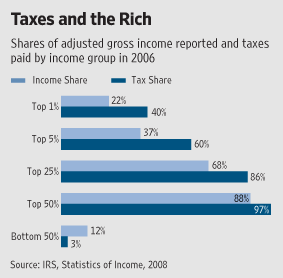
    The nearby chart shows that the top 1% of taxpayers, those who earn above $388,806, paid 40% of all income taxes in 2006, the highest share in at least 40 years. The top 10% in income, those earning more than $108,904, paid 71%. Barack Obama says he’s going to cut taxes for those at the bottom, but that’s also going to be a challenge because Americans with an income below the median paid a record low 2.9% of all income taxes, while the top 50% paid 97.1%. Perhaps he thinks half the country should pay all the taxes to support the other half.

    Wow. The Wall Street Journal against a tax cut? Well I guess if it is a tax on the poor they don’t support cutting those taxes. I think it may well make sense to reduce the social security and medicare taxes on the working poor (including the company share). Of all the taxes we have this is the one I would reduce, if I reduced any (given the huge amount of government debt any reduction may well be unwise). But reducing income taxes for those under the median income doesn’t seem like something worth doing to me.

    The top 1% earned 22% of all reported income. But they also paid a share of taxes not far from double their share of income. In other words, the tax code is already steeply progressive.

    chart of taxes by income distribution

    They seem to ignore that income inequality has drastically increased. When you have a system that puts a huge percentage of the cash in a few people’s pockets of course those people end up paying a lot of cash per person. One affect of massive wealth concentration is that the limited people all the money is flowing to naturally will pay an increasing portion of taxes.

    It is fine to argue that the rich pay too much tax, if you want. I don’t agree. I think Warren Buffett explains the issue much more clearly and truthfully when he says he, and all his fellow, billionaires (and those attempting to join the club) pay a lower percent of taxes on income than their secretaries do. He offers $1 million to any of them that prove that isn’t true.

    And I guess you can say that the top 22% of the income paying the top 40% of the taxes is “steeply progressive.” I wouldn’t call that steep, but… It is nice the graphic is at least decently honest. Saying just “top 1% of taxpayers, those who earn above $388,806, paid 40% of all income ” is fairly misleading. It is much more honest (I believe) to say that “the top 1% (that made 22% of the income) paid…” Those with the top 22% of income paid 40% of the taxes, the next 15% payed 20%, the next 31% paid 26% the next 20% 11% and the final 12% paid 3%. That is progressive. From my perspective it could be more progressive but I can see others saying it it progressive enough.

    If 22% to 40% is “steeply” progressive what is 1% to 22%? The income distribution seems to be what? very hugely massively almost asymptotently progressive? The to 1% of people, by income, take 22% of the income, the next 4% take the next 15% of the total income, the next 20% take 31%, the next 25% take 30% and the bottom 50% take 12%. This level of income inequality is much more a source of concern than any concern someone should have about a slightly progressive tax result.

    Related: House Votes to Restore Partial Estate Tax on the Very Richest: Over $7 MillionIRS Tax dataRich Americans Sue to Keep Evidence of Their Tax Evasion From the Justice Department
    (more…)

  • Will The Savings Rate Fall Back Again

    Welcome to the False Recovery by Eric Janszen

    Because of the way the government measures household savings, the increase doesn’t signify more money in people’s wallets; instead, it suggests that consumers are paying off their mounting debt during a period of reduced borrowing. That’s no harbinger of growth.

    Companies planning for sudden and relatively near-term growth should reshape their strategies to make the best of economic flatness.

    He makes a decent point for companies, but the he flips back and forth between the need to save more (because we are buried in debt) and the need to spend more (because we need to grow the economy right now). And while I wouldn’t stake my life on it I wouldn’t be surprised that we have a strong economic rebound (it is also perfectly conceivable we have a next to no growth or even fall into a recession). But it seems to me the return to bubble thinking and spending beyond our means is making a strong comeback.

    The money is not going under mattresses or into bank accounts, from where it will emerge one day to jump-start the economy. It’s actually subsidizing the previous boom, which was built on debt and the presumption that assets would always cover that debt.

    Another ok, point but we have hardly paying off anything of the previous living beyond our means. It would take decades at this rate.

    Banks can loosen lending policies to allow people to borrow and spend again—but for that to solve anything, consumers must be extremely judicious in how they take on and use their debt. It’s more likely that consumer debt levels will rise again as individuals stretch themselves to afford what they want. Alas, this will drive the reported savings rate back down. By the end of 2010, I expect it to dip below 3%. Then, any drop in asset values will set off the debt trap. We’ll again see a rising savings rate and tightened lending, followed by loosened lending and a declining savings rate. The recovery will become a series of starts and stops: promising progress, periods of retreat.

    So the problem is the saving are not actually resulting in increased ability to spend (first point above) – which is bad he says, because it means their won’t be more spending (because people won’t have the ability to spend). Then he says when banks lend the consumers money they will spend and the saving rate will go down (which is bad – though he doesn’t seem to really want more savings (because that means business won’t get increased sales).

    The conventional wisdom likes to point out the long term problem of low savings rate but then quickly point out we need more spending or the economy will slow. Yes, when you have an economy that is living beyond its means if you want to address the long term consequences of that it means you have to live within your means. It isn’t tricky. We need to save more. If that means the economy is slower compared to when we lived beyond our means that is what it takes. The alternative is just to live beyond your means for longer and dig yourself deeper into debt.
    (more…)

  • Making Debt Holders into Unpaid Regulators

    The credit crisis has shown the lack of political (or regulatory) skill, ethics and character that the USA has now. The solutions are not simple. Some are obvious, like limiting leverage, not providing huge favors to those that pay politicians huge amounts of cash… While Canadian banking regulators actually did their jobs well it is hard to believe most any American regulators will do well given the last 20 years of failures. Raghuram Rajan provides some interesting thoughts on potential improvement in: Making Debt Holders into Watchdogs

    The type of risks that put banks in the greatest jeopardy – and led to the recent crisis – are called tail risks. They have a small probability of turning out badly but are extremely costly if they do. Banks took on two kinds of tail risks prior to the crisis. One was economywide default risk, the risk that a broad portfolio of assets, such as mortgages, would suffer deep losses. The other was liquidity risk, essentially the way they financed the first kind of risk.

    Some banks – such as Citibank, Lehman Brothers, and Royal Bank of Scotland – loaded up on both risks, holding enormous quantities of mortgage-backed securities on the asset side and paying for them with short maturity debt on the liability side. Why did they do it? The simple answer: It was very profitable, provided the tail events did not materialize. Think of insurers that write a lot of earthquake policies (another tail risk). If you didn’t know they were writing earthquake insurance and not setting aside reserves, you would think they were enormously profitable until there’s a quake. For banks, there was always the threat of a day of reckoning when liquidity dried up and defaults skyrocketed. But they set aside few reserves against that happening.

    Particularly worrisome, as my colleague Douglas Diamond and I have argued, is that once banks are leveraged enough that they will be severely distressed if economywide liquidity dries up, they double down on risky bets.

    Here’s the drill: To make it harder for tail-risk-taking banks to grow, all banks should be required to issue a minimum level of debt (say, 10% of assets) that is automatically impaired – either converted to equity or written down – if the bank suffers sufficient losses. This will quickly change debt holders’ views on risky expansion. Moreover, no financial institution should be allowed to hold this debt.

    Related: Why Congress Won’t Investigate Wall StreetScientists Say Biotechnology Seed Companies Prevent ResearchDrug Prices in the USA

  • USA Added 162,000 Jobs in March

    Nonfarm payroll employment increased by 162,000 in March, and the unemployment rate held at 9.7%, based on U.S. Bureau of Labor Statistics surveys. Hiring for the census added 48,000 jobs in March, a large temporary increase, but less than expected amount, for the month. The change in total nonfarm payroll employment for January was revised from -26,000 to +14,000, and the change for February was revised from -36,000 to -14,000 together this results in an addition of 90,000 jobs.

    The 162,000 added jobs is the largest increase since March of 2007. It is a good start but the economy will have to continue to increase the number of job added each month to reduce unemployment. Population growth requires an addition of approximately 125,000 jobs a month. The current labor pool has been temporarily reduced by those who have dropped out of the labor market. As jobs return they will come back into the market.

    The economy has lost 8.2 million jobs since the recession started in December 2007. Now that was the bubble induced peak still, by the time the economy adds 8 million jobs many more jobs will be needed (since 125,000 additional jobs are needed each month). Still if we added 200,000 a month it would take 40 months to get back to the previous peak total. And by that time the economy would have accumulated another 9 million jobs needed (it would be about Dec 2013 = 6 * 12 months *125,000/month). While the bubble induced peak may well be a unrealistic target, the job market needs to add over 200,000 jobs a month to regain ground lost over the last several years.

    In March, the number of unemployed persons was little changed at 15.0 million, and the unemployment rate remained at 9.7%. The number of long-term unemployed (those jobless for 27 weeks and over) increased by 414,000 over the month to 6.5 million. In March, 44.1% of unemployed persons were jobless for 27 weeks or more. Both are all time highs.

    The civilian labor force participation rate (64.9%) and the employment-population ratio (58.6%) continued to edge up in March. The average length of unemployment rose to 31 weeks – the highest average ever (since 1948).
    Related: USA Unemployment Rate Remains at 9.7%663,000 Jobs Lost in March, 2009 in the USAAnother 450,000 Jobs Lost in June, 2009Manufacturing Employment Data – 1979 to 2007
    (more…)

  • Bill Gross Warns Bond Investors

    Bill Gross Warning May Catch Bond Investors Off-Guard

    Pacific Investment Management Co.’s Gross, manager of the world’s biggest bond fund, said yesterday in an interview with Tom Keene on Bloomberg Radio that “bonds have seen their best days.” Pimco, which announced in December that it would offer stock funds, is advising investors to buy the debt of countries such as Germany and Canada that have low deficits and higher- yielding corporate securities.

    The prospect of a strengthening U.S. economy and rising interest rates makes an “argument to not own as many” bonds, Gross said in the interview.

    Treasuries have rallied for almost three decades, pushing the yield on the 10-year Treasury note from a high of 15.8 percent in September 1981 to 3.89 percent as of yesterday. The yield reached a record low of 2.03 percent in December 2008 during the height of the credit crunch.
    Excess borrowing in nations including the U.S., U.K. and Japan will eventually lead to inflation as governments sell record amounts of debt to finance surging deficits, Gross said.

    “People have been making money on fixed income for so long, people assume it’s going to continue when mathematically, it cannot,” said Eigen, whose fund is the third-best selling bond fund this year, according to Morningstar. “When people finally start to lose money in fixed-income, they won’t hesitate to pull money out very soon,” he said.

    John Hancock Funds President and Chief Executive Officer Keith Hartstein said retail investors are already late in reversing their rush into bond funds, repeating the perennial mistake of looking to past performance to make current allocation decisions.

    I agree bonds don’t look to be an appealing investment. They still may be a smart way to diversify your portfolio. I am investing some of my retirement plan in inflation adjusted bonds and continue to purchase them. My portfolio is already significantly under-weighted in bonds. I would not be buying them if it were not just to provide a small increasing of my bond holdings.

    Related: Municipal Bonds, After Tax Return10 Stocks for Income InvestorsBond Yields Show Dramatic Increase in Investor ConfidenceInvestors Sell TIPS as They Foresee Tame Inflation

  • Paying Back Direct Cash from Taxpayers Does not Excuse Bank Misdeeds

    Many people are ignoring huge costs (to the economy) and benefits (to those financial companies that ruined so many people’s lives and severely damaged the economy. Paying back money the government paid you is not that same as being innocent. While several of the too big to fail banks have paid back the direct cash they were given that is not an indication they are now off the hook for their disastrous behavior.

    First we know that much of the money “sent to AIG” just went directly to Goldman Sachs and others. Those big banks had taken risks and the only way those risks paid off was with billions from taxpayers. Without that they would have been bankrupt. And then when they paid the money they received directly they still haven’t paid back the billions they got from taxpayers (via AIG). And this money was paid back at 100 cents on the dollar though those instruments were trading for much less in the market (the government certainly would have found a less costly solution but for ignorance or a desire to reward their former company and friends at Goldman Sachs.

    Second, rates have been kept artificially low, to among other things, allow the big banks to make tens of billions (and costing savers tens of billions). Those savers have not been reimbursed for the losses caused by the big banks.

    And third if I gamble with money from my company and win my bet on the Super Bowl and then put the money back, I am still not innocent. Just because many of the big banks have paid back the money they were given directly by taxpayers does not mean they didn’t get huge benefits from the government. Pretending they are not bad guys because after ruining the economy, costing millions of people their jobs and savings, getting many benefits from the government, they then pay back the direct cash payments is not accurate.

    Response to: The New Bank Tax

    Related: Elizabeth Warren Webcast On Failure to Fix the SystemThe Best Way to Rob a Bank is as An Executive at OneFailure to Regulate Financial Markets Leads to Predictable ConsequencesJim Rogers on the Financial Market MessCongress Eases Bank Laws (1999)