Category: Investing

  • How to Thrive When this Bear Market Ends

    How to thrive when this bear dies by Jim Jubak

    Believe it or not, someday, almost certainly within the next 12 months, the bear market will be over. Then investors will have an opportunity to rebuild their wealth if stocks come roaring back, as they typically do.

    In the case of the 2000-02 bear, the initial rush after the end of the bear delivered a huge share of the 101% gain for the bull market that ran from October 2002 through October 2007. In the 16 months from the Oct. 9, 2002, low through Feb. 9, 2004, the S&P 500 gained 47%. The gains from the remaining years of the “great” bull market of the “Oughts” were rather anemic: just 9% in 2004, 3% in 2005 and 14% in 2006.

    If I’m right about the arrival of a secular bear, emerging economies and their stock markets will deliver higher returns, despite relatively slow growth, than the even more slowly growing developed economies. If I’m wrong about the secular bear, emerging economies will still deliver stronger growth than the world’s developed economies. Under either scenario, investors want to increase their exposure to the world’s emerging economies, which deliver more performance bang for less risk than most investors think.

    Jim Jubak is one of my favorite investing writers. He can of course be wrong but he provides worthwhile insight, backed with research, and specific suggestions. I am also positive on the outlook for stocks (though what the next year or so hold I am less certain) and on emerging markets.

    Related: Why Investing is Safer OverseasRodgers on the US and Chinese EconomiesBeating the MarketThe Growing Size of non-USA EconomiesWarren Buffett’s 2004Annual Report

  • S&P 500 Dividend Yield Tops Bond Yield: First Time Since 1958

    S&P 500 Payout Tops Bond Yield, a First Since 1958 (site broke the link, so I removed it):

    U.S. stocks’ dividend yields were lower than the yield on 10-year Treasury notes for half a century. Not any more. Dividends paid by Standard & Poor’s 500 Index companies in the past 12 months amounted to 3.51 percent of the benchmark’s closing value yesterday. In early trading today, the 10-year yield fell as low as 3.42 percent.

    Treasuries routinely had higher yields than stocks before 1958, according to Bernstein. When this relationship came to an end, yields were near their current levels. The S&P 500 dividend yield fell 0.58 percentage point, to 3.24 percent, in the third quarter of 1958. The 10-year yield rose about the same amount, 0.6 point, to 3.80 percent.

    Two explanations later emerged for the reversal, he wrote. One held that the economy’s recovery from the 1957-58 recession showed “investors could finally put to rest the widely held expectation of an imminent return to the Great Depression.” The second was the increasing popularity of investing in growth stocks, or shares of companies whose sales and earnings rose at a relatively fast pace. Because of their expansion, the companies often paid below-average dividends.

    Reversal of Fortunes Between Stocks and Bonds

    Even more telling was the relative movements in stock and bond yields over the years. Bernstein calculates that from 1954 to 1969 — while inflation was relatively low and stable — bond and stock yields moved mostly in tandem. But from 1970 to 1999 — the Great Inflation — bond and stock yields moved inversely. From 2000 on, bond and stock yields have been back in sync.

    Arnott takes it a step further. “In a world of deleveraging, both for the financial services arena and for the economy at large, growth is less certain,” he says. “And with the economy eroding sharply, so is inflation. If stocks don’t deliver nominal growth in dividends and earnings, then their yield ‘must’ exceed the Treasury yield, in order to give us any sort of risk premium.”

    Related: Corporate and Government Bond Rates GraphHighest Possible Returnsposts on interest ratesinvesting strategy

  • Soros on Financial Crisis and Markets

    The New Paradigm for Financial Markets is George Soros‘ newest book. Here is an interview with him in May of this year, on PBS, Financial World Shifts Gears Amid Economic Tumult, about the ideas in the book and the current crisis.

    JUDY WOODRUFF: How do you assess the strength of the financial system today?
    GEORGE SOROS: I think this is the most serious crisis of our lifetime. It’s not just a housing crisis, but a crisis of the financial system.

    GEORGE SOROS: The regulators have failed to regulate, and they really have to — they left it to the market. That was this market fundamentalist philosophy, that markets will take care of themselves.

    And I contend that there’s been what I call a super bubble that has been growing over the last 25 years at least, which basically consisted of an extension in credit, increasing use of leverage. That was the trend in reality.

    And the misconception that credit is that markets can be left to their own devices. Now, in fact, they are given to excesses, and occasionally they create crises, but each time the authorities intervene and bail out the failing institutions, provide fiscal stimulus, monetary stimulus.

    So it seems like the market corrects itself, but it’s actually the intervention of the authorities that saves the market.

    Related: Soros on the Financial Market CollapseJim Rogers on the Financial Market MessLeverage, Complex Deals and Mania

  • Personal Finance Basics: Dollar Cost Averaging

    With the recent turmoil in the financial market this is a good time to look at Dollar cost averaging. The strategy is one that helps you actually benefit from market volatility simply.

    You actually are better off with wild swings in stock prices, when you dollar cost average, than if they just went up .8% every single month (if both ended with stocks at the same price 20 years later). Really the wilder the better (the limit is essentially the limit at which the economy was harmed by the wild swings and people decided they didn’t want to take risk and make investments.

    Here are two examples, if you invest $1,000 in a mutual fund and the price goes up every year (for this example the prices I used over 20 years: 10, 11, 12, 13, 14, 15, 16, 17, 18, 19, 20, 22, 24, 26, 28, 30, 33, 36,39) you would end up with $40,800 and you would have invested $20,000. The mutual fund went from $10 a share to $39 over that period (which is a 7% return compounded annually for the share price). If you have the same final value but instead of the price going up every year the price was volatile (for example: 10, 11, 7, 12, 16, 18, 20, 13, 10, 16, 20, 15, 24,29, 36, 27, 24, 34, 39) you end up with more most often (in this example: $45,900).

    You could actually end up with less if the price shot up well above the final price very early on and then stayed there and then dropped in the last few years. As you get close to retirement (10 years to start paying close attention) you need to adopt a strategy that is very focused on reducing risk of investment declines for your entire portfolio.

    The reason you end up with more money is that when the price is lower you buy more shares. Dollar cost averaging does not guaranty a good return. If the investment does poorly over the entire period you will still suffer. But if the investment does well over the long term the added volatility will add to your return. By buying a consistent amount each year (or month…) you will buy more share when prices are low, you will buy fewer shares when prices are high and the effect will be to add to your total return.

    Now if you could time the market and sell all your shares when prices peaked and buy again when prices were low you could have fantastic returns. The problem is essentially no-one has been able to do so over the long term. Trying to time the market fails over and over for huge numbers of investors. Dollar cost averaging is simple and boring but effective as long as you chose a good long term investment vehicle.

    Investing to your IRA every year is one great way to take advantage of dollar cost averaging. Adding to your 401(k) retirement plan at work is another (and normally this will automatically dollar cost average for you).

    Related: Does a Declining Stock Market Worry You?Save Some of Each RaiseStarting Retirement Account Allocations for Someone Under 40Save an Emergency Fund

  • Would the Dow Dump General Motors?

    Would the Dow Dump General Motors?

    General Motors may get dumped by the Dow Jones Industrial Average if the nation’s biggest carmaker strikes the wrong kind of bailout deal with the government.

    At this point, it’s not clear if the government will be willing to take on the horribly mismanaged automaker. It’s one thing to save a financial firm that continues to make money and another thing to rescue a business that for decades has been unable to control labor and legacy costs or deliver a product that consumers want. GM could be allowed to declare bankruptcy.

    But for some reason nostalgic Americans refuse to let the carmakers take a hit and learn from their mistakes. A bailout seems to be preferred. It worked so well for Chrysler.

    Is it important to the Dow editors to keep an auto presence in the index?

    And since the Dow is meant to be a barometer of the U.S. market, Toyota and Honda can’t be considered. Then again maybe they should leave a bankrupt company in the Dow. It might be the most accurate barometer of the market yet by tracking all the blue chips that have gone bankrupt.

    I discussed dropping GM from the Dow Jones Industrial Average in December of 2005: “I agree removing GM makes sense, though I see no reason to wait.”

    Related: Dow Jones Industrial Average ChangesAnother Great Quarter for Amazon (July 2007)Stop Picking StocksCurious Cat Investing Web Search

  • FDIC Details Plan To Alter Mortgages

    FDIC Details Plan To Alter Mortgages

    Officials at the Federal Deposit Insurance Corp. yesterday detailed a plan to prevent 1.5 million foreclosures in the next year by offering financial incentives to companies that agree to sharply reduce monthly payments on mortgage loans.

    Agency officials estimated the cost to the government at $22.4 billion.

    The mortgage industry is concerned that any new modification plan will persuade some people to stop making mortgage payments in addition to helping people who already have stopped making payments. The industry argues this will translate into higher interest rates because investors will demand compensation for the increased risk of loan defaults. That, in turn, would limit the number of people who can afford mortgage loans.

    FDIC estimates that 1.4 million borrowers with such loans are at least two months late on their payments, and another 3 million borrowers will miss at least two payments by the end of next year. The agency estimates that half those borrowers, or about 2.2 million people, would receive a loan modification under the program, and that about 1.5 million will successfully avoid foreclosure.

    Under the terms of the proposed FDIC program, lenders would reduce monthly payments primarily by cutting the borrower’s interest rate to a minimum rate of 3 percent. If necessary, the company could also extend the repayment period on the loan beyond 30 years, reducing each monthly payment. Finally, in some cases, companies could defer repayment of some principal. The borrower still would be on the hook for the full value of the loan.

    Officials said their experience at IndyMac showed that principal reductions were not necessary. So far, FDIC has modified about 20,000 IndyMac loans. In 70 percent of the cases, FDIC was able to create an affordable payment solely by reducing the interest rate. In 21 percent of the cases, the agency also extended the life of the loan. In 9 percent of the cases, it delayed repayment of some principal.

    An interesting proposal I would support. Ideally this type of action would not be necessary but since banks were allowed to degrade their standards so far and allowed to grow so large their failures threaten the economy some radical actions are being taken. Compared to many others this is sensible.

    Related: How Much Worse Can the Mortgage Crisis Get?JPMorgan Chase Freezes Mortgage ForeclosuresFed Plans To Curb Mortgage Excesses (Dec 2007)

  • 30 Year Mortgage Rate and Federal Funds Rate Chart

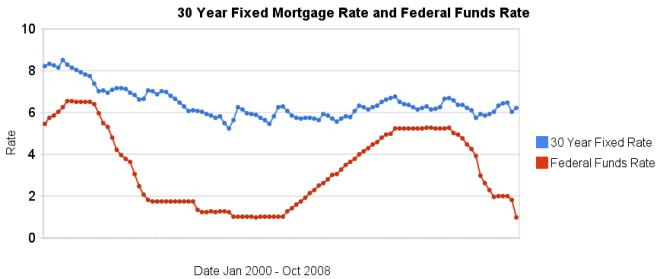
    More dramatic evidence that changing in the federal funds rate do not lead to similar changes in 30 year fixed mortgage rates. It is true the last few months are very unusual times for the credit market. However, the current lack of correlation is not the exception, the graph clearly shows there is very little correlation between changes in the two interest rates.

    30 year fixed mortgage rates and the federal funds rate 2000-2008

    Related: historical comparison of 30 year fixed mortgage rates and the federal funds rateAffect of Fed Funds Rates Changes on Mortgage Ratesposts on financial literacyJumbo v. Regular Fixed Mortgage Rates: by Credit Score

    For more data, see graphs of the federal funds rate versus mortgage rates for 1980-1999. Source data: federal funds rates30 year mortgage rates

  • JPMorgan Chase Freezes Mortgage Foreclosures

    JPMorgan Chase Freezes Foreclosures

    For the next 90 days, JPMorgan will not place any new homes into foreclosure. The banking behemoth, which acquired troubled lender Washington Mutual on Sept. 25, says it hopes to modify terms for 400,000 homeowners, accounting for $70 billion in loans. Among the steps it is taking: eliminating toxic “pay option” loans, offering new loan terms to homeowners before they default

    According to the most recent data compiled by the Hope Now Alliance of lenders, counselers, and other industry players, lenders started the foreclosure process on 565,000 homeowners in this year’s third quarter. Some 265,000 homes were actually foreclosed on, nearly twice the number from the third quarter of 2007. Moreover, more than 2.2 million homeowners are more than 60 days delinquent in their mortgage payments, also a near doubling from last year.

    FDIC Chairman, Sheila Bair, has been encouraging banks to take such action and instituted such action on the mortgages the FDIC acquired when they took over Indymac – Loan Modification Program for Distressed Indymac Mortgage Loans

    IndyMac Federal Bank, FSB (“Indymac Federal”) will implement a new program to systematically modify troubled mortgages. The program is designed to achieve affordable and sustainable mortgage payments for borrowers and increase the value of distressed mortgages by rehabilitating them into performing loans. This in turn will maximize value for the FDIC, as well as improve returns to the creditors of the former IndyMac Bank and to investors in those mortgages.

    Related: Ignorance of Many Mortgage Holders (July 2007)Foreclosure Filings Continue to RiseHistorical 30 Year Fixed Mortgage RatesHomes Entering Foreclosure at Record (Sep 2007)2nd Largest Bank Failure in USA History

  • Scott Adams on Investing

    In his blog Scott Adams, author of Dilbert, provides often quite intelligent and interesting thoughts. In a recent post he wrote on investing and Diversification:

    When I first started making serious Dilbert money, I let experts manage half of it, and I managed the rest, as a hedge against both the experts and myself. The experts invested in Enron, Worldcom, and a number of other companies that promptly exploded. The experts reduced their portion of my money by about a third over five years. (The experts work for one of the most respected financial institutions on Earth, by the way.) My own investments did better, precisely because they were more diversified. So now I handle my own investments, probably incompetently.

    I didn’t own much in the way of stocks for the past several years, thanks to not using professional advisors. A big chunk of my money has been in California Municipal bonds of various types, and all are insured.

    In order to diversify more, I started migrating money over to the stock market during this recent plunge. The market could go a lot lower still, but this is either the beginning of the end of the United States as we know it, in which case it doesn’t matter how I invested, or it is a once-in-a-lifetime stock buying opportunity. It was an easy decision.

    Related: Stock Market DeclineWarren Buffett on DiversificationInvestment Allocations Make A Big Difference

    Dilbert comic on investors