Category: Stocks

  • The Risks of Too Big to Fail Financial Institutions Have Only Gotten Worse

    Printing money (and the newer fancier ways to introduce liquidity/capital) work until people realize the money is worthless. Then you have massive stagflation that is nearly impossible to get out from under. The decision by the European and USA government to bail out the too big to fail institutions and do nothing substantial to address the problem leaves an enormous risk to the global economy unaddressed and hanging directly over our heads ready to fall at any time.

    The massively too big to fail financial institutions that exist on massive leverage and massive government assistance are a new (last 15? years) danger make it more likely the currency losses value rapidly as the government uses its treasury to bail out their financial friends (this isn’t like normal payback of a few million or billion dollars these could easily cost countries like the USA trillions). How to evaluate this risk and create a portfolio to cope with the risks existing today is extremely challenging – I am not sure what the answer is.

    Of the big currencies, when I evaluate the USA $ on its own I think it is a piece of junk and wouldn’t wan’t my financial future resting on it. When I look at the other large currencies (Yen, Yuan, Euro) I am not sure but I think the USD (and USA economy) may be the least bad.

    In many ways I think some smaller countries are sounder but smaller countries can very quickly change – go from sitting pretty to very ugly financial situations. How they will wether a financial crisis where one of the big currencies losses trust (much much more than we have seen yet) I don’t know. Still I would ideally place a bit of my financial future scattered among various of these countries (Singapore, Australia, Malaysia, Thailand, Brazil [maybe]…).

    Basically I don’t know where to find safety. I think large multinational companies that have extremely strong balance sheets and businesses that seem like they could survive financial chaos (a difficult judgement to make) may well make sense (Apple, Google, Amazon, Toyota, Intel{a bit of a stretch}, Berkshire Hathaway… companies with lots of cash, little debt, low fixed costs, good profit margins that should continue [even if sales go down and they make less they should make money – which many others won’t]). Some utilities would also probably work – even though they have large fixed costs normally. Basically companies that can survive very bad economic times – they might not get rich during them but shouldn’t really have any trouble surviving (they have much better balance sheets and prospects than many governments balance sheets it seems to me).

    In many ways real estate in prime areas is good for this “type” of risk (currency devaluation and financial chaos) but the end game might be so chaotic it messes that up. Still I think prime real estate assets are a decent bet to whether the crisis better than other things. And if there isn’t any crisis should do well (so that is a nice bonus).

    Basically I think the risks are real and potential damage is serious. Where to hide from the storm is a much tricker question to answer. When in that situation diversification is often wise. So diversification with a focus on investments that can survive very bad economic times for years is what I believe is wise.

    Related: Investing in Stocks That Have Raised Dividends ConsistentlyAdding More Banker and Politician Bailouts in Not the Answer
    Failures in Regulating Financial Markets Leads to Predictable ConsequencesCharlie Munger’s Thoughts on the Credit Crisis and RiskThe Misuse of Statistics and Mania in Financial Markets
  • Investment Options Are Much Less Comforting Than Normal These Days

    I think the current investing climate worldwide continues to be very uncertain. Historically I believe in the long term success of investing in successful businesses and real estate in economically vibrant areas. I think you can do fairly well investing in various sold long term businesses or mutual funds looking at things like dividend aristocrates or even the S&P 500. And investing in real estate in most areas, over the long term, is usually fine.

    When markets hit extremes it is better to get out, but it is very hard to know in advance when that is. So just staying pretty much fully invested (which to me includes a safety margin of cash and very safe investments as part of a portfolio).

    I really don’t know of a time more disconcerting than the last 5 years (other than during the great depression, World War II and right after World War II). Looking back it is easy to take the long term view and say post World War II was a great time for long term investors. I doubt it was so easy then (especially outside the USA).

    Even at times like the oil crisis (1973-74…, stagflation…, 1986 stock market crash) I can see being confident just investing in good businesses and good real estate would work out in the long term. I am much less certain now.

    I really don’t see a decent option to investing in good companies and real estate (I never really like bonds, though I understand they can have a role in a portfolio, and certainly don’t know). Normally I am perfectly comfortable with the long term soundness of such a plan and realizing there would be plenty of volatility along the way. The last few years I am much less comfortable and much more nervous (but I don’t see many decent options that don’t make me nervous).

    One of the many huge worries today is the extreme financial instruments; complex securities; complex and highly leveraged financial institution (that are also too big to fail); high leverage by companies (though many many companies are one of the more sound parts of the economy – Apple, Google, Toyota, Intel…), high debt for governments, high debt for consumers, inability for regulators to understand the risks they allow too big to fail institutions to take, the disregard for risking economic calamity by those in too big to fail institutions, climate change (huge insurance risks and many other problems), decades of health care crisis in the USA…

    A recent Bloomberg article examines differing analyst opinions on the Chinese banking system. It is just one of many things I find worrying. I am not certain the current state of Chinese banking is extremely dangerous to global economic investments but I am worried it may well be.

    China Credit-Bubble Call Pits Fitch’s Chu Against S&P

    (more…)

  • 12 Stocks for 10 Years – May 2013 Update

    The 12 stock for 10 years portfolio consists of stocks I would be comfortable putting into an IRA for 10 years. The main criteria is for companies with a history of large positive cash flow, that seemed likely to continue that trend.

    Since April of 2005 the portfolio Marketocracy* calculated annualized rate or return (which excludes Tesco) is 7.5% (the S&P 500 annualized return for the period is 6.8%).

    Marketocracy subtracts the equivalent of 2% of assets annually to simulate management fees – as though the portfolio were a mutual fund – so without that (it is not like this portfolio takes much management), the return beats the S&P 500 annual return by about 270 basis points annually (9.5% to 6.8%). And I think the 270 basis point “beat” of the S&P rate is really under-counting as the 200 basis point “deduction” removes what would be assets that would be increasing (so the gains that would have been made on the non-existing deductions in the real world – are missing). Tesco reduces the return, still I believe the rate would stay close to a 200 basis point advantage.

    I make some adjustments (selling of buying a bit of the stocks depending on large price movements – this rebalances and also lets me sell a bit if I think things are getting highly priced and buy a bit if they are getting to be a better bargin). So I have sold some Amazon and Google as they have increased greatly and bought some Toyota as it declined (and now sold a bit of Toyota as it soared). This purchases and sales are fairly small. Those plus changes (selling Dell and buying Apple for example) have resulted in a annual turnover rate under 5%.

    I am strongly considering buying ABBV and maybe ABT. Abbot recently split into these 2 separate companies. I probably would have added this last year but I wasn’t sure what to do given the breakup so I waited (luckily I bought it, personally, as they have performed quite well) I may also sell some or all of Tesco and PetroChina.

    The current stocks, in order of return:

    Stock Current Return % of sleep well portfolio now % of the portfolio if I were buying today
    Amazon – AMZN 486% 8% 8%
    Google – GOOG 311% 17% 15%
    PetroChina – PTR 104% 6% 6%
    Templeton Dragon Fund – TDF 89% 4% 4%
    Danaher – DHR 78% 9% 9%
    Toyota – TM 70% 13% 11%
    Templeton Emerging Market Fund – EMF 50% 6% 8%
    Apple – AAPL 22% 12% 15%
    Pfizer – PFE 20% 7% 7%
    Cisco – CSCO 19% 4% 5%
    Intel – INTC 9% 7% 7%
    Cash 7%* 4%
    Tesco – TSCDY -5%** 0%* 4%

    The current marketocracy results can be seen on the Sleep Well marketocracy portfolio page.

    Related: 12 Stocks for 10 Years: Oct 2012 Update12 Stocks for 10 Years, July 2011 Update12 Stocks for 10 Years, July 2009 Updatehand selected articles on investing

    (more…)

  • Apple’s Outstanding Shares Increased a Great Deal the Last Few Years

    One of the frustrating things for shareholders is how readily companies give away stock. A huge company like Apple has been giving away huge amounts of stock (through stock options) even while adding tens of billions in cash to their stockpile.

    Outstanding stock for Apple

    Jan 2006 – 848 million shares
    Jan 2007 – 862 million shares
    Jan 2008 – 879 million shares
    Jan 2009 – 891 million shares
    Jan 2010 – 907 million shares
    Jan 2011 – 921 million shares
    Jan 2012 – 932 million shares
    Jan 2013 – 939 million shares

    So even in the last year, while promoting a $10 billion buyback – the net result was 7 million more shares (not fewer as a “buyback” suggests); it did reduce the amount of increase to less than it has been recently. 7 million more shares * $425 = $2.975 billion more stock in place. If Apple uses $50 billion more to buy back stock that would allow purchase of 100 million shares at $500 a share ($500 is less than I would guess the average price will be, but we will see what actually happens). That would get the share balance back to the Jan 2006 level, if there were not huge new additions during the buyback period (which there probably will be).

    Companies certainly like to heavily publicize share buyback programs. They don’t trumpet how much additional stock they issue each year with the same zeal (most of which, for successful companies not in desperate need for cash, is provided through extremely sweetheart stock options for executives and board members at the expense of diluting stockholder’s equity – the easiest form of excessive executive pay to give away as it doesn’t cost the company cash).

    It will be interesting to see to what extent share buybacks actually decrease the share balance and to what extent they just eliminate the exploding issuance of shares Apple has engaged in while piling up the largest cash reserves ever recorded.

    Given Apple’s financial position I do not believe diluting stockholders equity by issuing huge amounts of stock was a wise policy the last 7 years. I think reversing that policy is wise. Buying back the stock they gave away is sensible but it would have been wiser not to give so much away in the first place. I’ll be surprised, and happy, if the outstanding share balance drops below 890 million (the Jan 2009 figure).

    I do think Apple is a great buy at these levels (I bought some more last week). The earnings reported today are not as spectacular as those reported recently but they still made a profit of $9.5 billion in the quarter (and had positive cash flow of $12.5 billion bringing total cash on hand to $145 billion). It isn’t like this is a company that is failing. It is just a company that isn’t growing earnings as rapidly. They are still earning enormous amounts of cash.

    The decline in margins is disappointing (but not surprising) but the margins are still great (just not as amazingly great as recently). The worry over further declines in margins seems justified to me and is one of the big risks for the stock going forward. I think margins will remains at a level that justifies a much higher price than the stock has today, but only time will tell.

    I would have liked to see the dividend increase more, but a dividend increase was a good move.

    Related: Is it Time to Sell Apple?Apple’s Impossibly Good Quarter (Jan 2012)Google to Let Workers Sell Options Online

  • Is it Time to Sell Apple?

    No, it is not time to sell Apple, if your portfolio is not already too heavily overweighted in Apple it would make sense to buy. There is about as much wrong with Apple today as Toyota 3 years ago, which means essentially nothing is wrong. Yes, neither company is perfect. Maybe people were carried away with how awesome Apple was, but I don’t think the stock price every was.

    Apple was a great buy at $700. Of course in the same situation buying it at $500 would be even better. I think it is a great buy at $500 today. I think Apple is going to move ahead just as Toyota has the last few years. The people jumping around at every single rumor of a data point are going beyond reacting to each data point they are reacting to rumors of data points.

    I could be wrong. If Apple’s earnings cave over the next 5 years people can claim they say early signals. After a long time watching investors react to data and rumors and speculation I think they are just being foolish. Even if Apple is deteriorating, there needs to be a much better explanation for why investors should believe that than I have seen.

    The best reason to question Apple is how long of a run they are on. Figuring the “law” of convergence in mean should make investors wary. That isn’t really true but that idea – that you just don’t stay on such a run (especially when you are huge and the have the largest market capitalization in the world).

    But that is more just saying Toyota can’t keep being awesome. There is some sense that most likely they will stumble. But the problem is it is more likely about every other company will stumble first. The winners keep winning more than they start failing. But they also do often start failing. 100 years from now there is a decent chance Apple doesn’t exist. But there is a greater change most of the other companies you can invest in won’t. And there is a greater chance most other investments will do worse than Apple. That is my guess. Other investors get to place their money where there mouth is and we will see in 5 and 10 years how things stand.

    I’ll stick with Apple and Toyota and Google and Danaher and Intel and….

    Related: Apple’s Earning are Again Great, Significantly Exceeding High Expectations (April 2012)Apple Tops Google (Aug 2008)12 Stocks for 10 Years: Oct 2010 Update

  • 12 Stocks for 10 Years – October 2012 Update

    The 12 stock for 10 years portfolio consists of stocks I would be comfortable putting into an IRA for 10 years. The main criteria is for companies with a history of large positive cash flow, that seemed likely to continue that trend.

    Since April of 2005 the portfolio Marketocracy* calculated annualized rate or return (which excludes Tesco) is 7.1% (the S&P 500 annualized return for the period is 5.4%).

    Marketocracy subtracts the equivalent of 2% of assets annually to simulate management fees – as though the portfolio were a mutual fund – so without that (it is not like this portfolio takes much management), the return beats the S&P 500 annual return by about 370 basis points annually (9.1% – 5.4%). And I think the 370 basis point “beat” of the S&P rate is really under-counting as the 200 basis point “deduction” removes what would be assets that would be increasing (so the gains that would have been made on the non-existing deductions in the real world – are missing). Tesco reduces the return, still I believe the rate would stay above a 300 basis point advantage.

    The current stocks, in order of return:

    Stock Current Return % of sleep well portfolio now % of the portfolio if I were buying today
    Amazon – AMZN 473% 11% 8%
    Google – GOOG 252% 18% 15%
    PetroChina – PTR 104% 6% 6%
    Apple – AAPL 94% 15% 13%
    Templeton Dragon Fund – TDF 84% 6% 4%
    Danaher – DHR 60% 10% 10%
    Templeton Emerging Market Fund – EMF 43% 5% 8%
    Pfizer – PFE 6% 6% 7%
    Toyota – TM 5% 7% 12%
    Intel – INTC 1% 5% 7%
    Cisco – CSCO -3% 3% 4%
    Cash 8%* 4%
    Tesco – TSCDY -18%** 0%* 5%

    The current marketocracy results can be seen on the Sleep Well marketocracy portfolio (the site broke the link, so I removed the link).

    Related: 12 Stocks for 10 Years: Jan 2012 Update12 Stocks for 10 Years, July 2011 Update12 Stocks for 10 Years, July 2009 Updatehand picked articles on investing
    (more…)

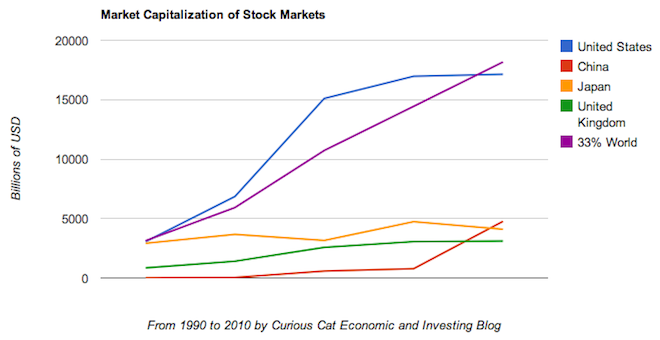
  • Stock Market Capitalization by Country from 1990 to 2010

    The stock market capitalization by country gives some insight into how countries, and stocks, are doing. Looking at the total market capitalization by country doesn’t equate to the stock holdings by individuals in a country or the value of companies doing work in a specific country.

    Chart of largest stock market capitalizations by country from 1990 to 2010
    Chart of largest stock market capitalizations by country from 1990 to 2010

    In the chart, I divided the world total by 3: just to make the chart look better. The USA was 32.5% of the total in 1990. The USA grew to 46.9% as the tech, finance and housing bubbles were all underway (also Japan was stagnating and the Chinese stock market hadn’t started booming to a significant extent). In 2010 the USA was back down to 31.4%. This will likely continue to decrease (at a much slower pace – I wouldn’t be surprised to see the USA at 25% in 2020) as the rest of the world’s markets continue to grow more quickly.

    As with so much recent economic data China’s performance here is remarkable and Japan’s is distressing. China grew from nothing in 1990 to the 2nd largest country in 2010. Hong Kong add another $1 trillion to China’s $4.5 trillion. Canada is the only country above $2 trillion not included on this chart. China grew by $4 trillion from 2005 to 2010.

    Related: Don’t Expect to Spend Over 4% of Your Retirement Investment Assets AnnuallyTop 10 Countries for Manufacturing Production from 1980 to 2010
    Investment Risk Matters Most as Part of a Portfolio, Rather than in IsolationGovernment Debt as Percent of GDP 1998-2010

    (more…)

  • Looking for Yields in Stocks and Real Estate

    The extremely low interest rate environment created by the too big to fail financial institution bailouts has severely harmed savers. Most severely harmed those in retirement that didn’t count on irresponsibly regulators and bankers creating a situation where to avoid a depression they had to punish savers to favor large banks (and others).

    For some savings that might normally go into bonds (if the bond market were not so manipulated by the central banks to punish savers) dividend stocks are a good option. The stocks have risks but frankly with extremely strong companies with huge amounts of positive cash flow the future looks brighter than it does for those debt ridden governments.

    Apple (AAPL) announced they will start paying a $2.65 quarterly dividend which works out to $10.60 annually. At the current stock price, this is a yield of nearly 1.9%. That is hardly going to make you rich but it is extremely attractive when you can get a much higher yield than savings account, treasury bills… and have the potential gains in stock price. Yes you do also have risk of a declining stock price, but as I have said I think Apple’s stock is an extremely good investment now.

    Other good options include: Intel (INTL) which offers a 3.3% yield and Abbott (ABT) which offers a 3.4% yield. I own those 3 and also ONEOK Partners (OKS) which sports a 4.8% yield (but is a bit tricker situation that is suitable for a lower investment I think).

    Even a stock like Toyota (TM), which I like as an investment, while it offers only a 1.8% yield that is much higher than you get for savings or treasury bills. So even stocks that are not about yield in the normal market conditions offer an attractive yield today.

    I am a bit nervous about health care dividend investments but Pfizer (PFE) is worth considering at 4.1% (as are JNJ and MRK). I really like ABT (they have raised dividends for over 40 straight years, I think), sadly they are splitting into 2 companies. Even so I am planning on staying invested but it is avery big change and would make me worried about having too much committed to ABT.

    (more…)

  • Apple’s Earning are Again Great, Significantly Exceeding High Expectations

    Apple posted quarterly revenue of $39.2 billion and quarterly net profit of $11.6 billion, or $12.30 per share (an increase of 94% in net income). These results compare to revenue of $24.7 billion and net profit of $6.0 billion, or $6.40 per diluted share, for the same quarter in 2011. Apple’s Gross margin was 47.4% (the best ever) compared to 41.4% in the year-ago quarter. International sales accounted for 64% of the quarter’s revenue.

    Apple sold 35.1 million iPhones in the quarter, 88% unit growth over the year-ago quarter. Apple sold 11.8 million iPads during the quarter, a 151% unit increase over the year-ago quarter. And they sold 4 million Macs during the quarter, a 7% unit increase over the year-ago quarter. Apple sold 7.7 million iPods, a 15% unit decline from the year-ago quarter.

    “Our record March quarter results drove $14 billion in cash flow from operations,” said Peter Oppenheimer, Apple’s CFO. “Looking ahead to the third fiscal quarter, we expect revenue of about $34 billion and diluted earnings per share of about $8.68.” Don’t be surprised to see Apple significantly beat these numbers, they usually provide “estimates” that are far bellow what results turn out to be.

    Apple built their cash stockpile to over $110 billion. Even paying the dividend that they have announced, they are going to be building their cash stockpile going forward without some amazingly large purchases. The announced dividend will cost Apple about $10 billion annually. I wish Apple would increase the dividend. They have also announced a plan to repurchase about $10 billion in stock starting in about 6 months. That would be a huge commitment for most companies, for Apple it seems to be about 2 months of cash the business will generate. I worry they will make foolish purchases just because having that much sitting in the bank makes it so easy.

    The results are again fantastic. Apple’s stock price, relative to earnings, continues to be very reasonable (even cheap). Increases in the stock price have been more than outpaced by profit growth. It does seems profit growth has to slow, and likely dramatically (of course it seemed incredibly unreasonable to expect increases of even 33% of what Apple has done in the last 3 years). The stock price is not expensive, even if earnings growth collapsed, which it isn’t expected to do in the next year. On fundamental factors the stock remains very attractive.

    The biggest risk is that when so much has gone so right for Apple for so long aren’t they poised to suffer some major setbacks? I can accept the case for a dramatic slowing in earning for the iPhone, which is their primary driver of earnings. It is hardly certain but there is this potential. I don’t foresee significant actual declines (earning less in 2013 than 2012, for example). But even assuming no growth in iPhone profits from 2013 to 2016 at this price Apple seems to be a good investment (and few expect no growth for iPhone earning for that period). iPhone sales now account for 58% of Apple’s revenue; three years ago, they totaled 27% of revenue.

    Other areas should be strong in 2012, 2013 and beyond: iPads, Macs, iTunes and App sales. And everyone is expecting some huge new product or products. The leading candidate is a new Apple TV that actually makes a big move into the market. The stock price doesn’t even need some big new product but if it comes that is just more reason to be positive on Apple as an investment.

    I don’t see any signs of troubles brewing. The only reason to be nervous is that it seems crazy that such extraordinary success on such a huge scale can continue. That can explain being nervous but it doesn’t justify missing out on this attractive investment.

    Related: Apple’s Impossibly Good QuarterThe Economy is Weak and Prospects May be Grim, But Many Companies Have Rosy Prospects (Sept 2011)Leadership quotes from Steve JobsIntel Reports Their Best Quarter Ever (March 2010)12 stocks for 10 years portfolio

  • Reconsidering Tesco as an Investment

    Tesco is in my 12 stocks for 10 years portfolio. One of the big reasons I bought is management’s commitment to using good management practices, in particular lean thinking (based on Toyota’s management principles). These principles include: investing in the long term, customer focus, respect for employees.

    With those practices in place and the good international expansion potential (including the USA) the opportunities are good (thus I liked the investment). Short term hiccups don’t really bother me. I would rather avoid them but I can accept them. The think that worries me about Tesco is I am becoming less and less convinced they are committed to lean management principles. Instead they seem to just be practicing the same lame management that so many companies employ. They can still be successful that way but the lost value to shareholders is great and makes me very close to deciding to eliminate my investment. I already sold half of the position, last year.

    I now live in Malaysia and the Tesco’s here are horrible. There is no evidence of customer focus. They have lousy “fresh” (often not) vegetables. It is very easy to be sloppy as you expand. They obviously are not concerned enough to practice lean thinking in Malaysia. That is a concern. But large organizations often struggle to manage themselves competently and one small area ignoring lean thinking principles isn’t enough to say Tesco is ignoring them completely. More and more evidence is pointing to Tesco being sloppy and ignore lean thnking, however.

    The main current financial problems are in the home market issues not directly related to lean thinking. Those I could easily chose to wether, if I believe the company is committed to smart lean management principle, but I am not any longer (sadly). For me, I need to see more evidence of commitment to lean principles or I will likely sell out my investment.

    Another problem I have is Amazon was my other retail investment and I have significant valuation concerns – I am closer to selling more than buying more (I have sold some). I have long been looking at Costco – I would have been much better off buying it over Tesco 🙁 I am still considering it (I would love to buy Costco, it is just a valuation concern that holds me back, the company and the future prospects look great).

    I lost no faith in Toyota (another stock in my sleep well portfolio) during the recent struggles. There were some slip-ups. Toyota’s responses were great – just as I would expect. Mainly the stories were greatly overblown.

    Related: Tesco: Consistent Earnings Growth at Attractive PriceApple’s Impossibly Good QuarterTaking a Look at Some Dividend Aristocrats