Category: Personal finance

  • Defaults Pare USA Consumer Debt

    Default, Not Thrift, Pares U.S. Debt

    As of the end of March, the average U.S. household’s total mortgage, credit-card and other debt stood at 122% of annual disposable income

    That sounds like a lot, but it’s better than it was before: At its peak in the first quarter of 2008, the debt-to-income ratio stood at 131%. Economists tend to see 100% as a reasonable level, so we’re almost a third of the way there.

    Since household debt hit its peak in early 2008, banks have charged off a total of about $210 billion in mortgage and consumer loans, including credit cards. If one assumes that investors suffered at least that much in losses on similar loans that banks packaged and sold as securities (a very conservative assumption), then the total – that is, the amount of debt consumers shed through defaults – comes to much more than $400 billion.

    Problem is, that’s more than the concurrent decrease in household debts, which amounts to only $372 billion, according to the Federal Reserve. That means consumers, on average, aren’t paying down their debts at all. Rather, the defaulters account for the whole decline, while the rest have actually been building up more debt straight through the worst financial crisis and recession in decades.

    Interesting data, and not good news. We need to reduce consumer debt levels by reducing the borrowing we are doing. This is not a new need. We have been living beyond our means for far too long. That is not a solid base for an economy. It does boost current GDP but only by consuming future productive capacity (when you borrow from external sources – other countries – as we have been doing).

    Related: USA Consumer Debt Stands at $2.44 TrillionHow a Family Shed $106,000 in Debt

  • Investing in Companies You Hate

    Scott Adams (Dilbert’s creator) has some new investing advice: Betting on the Bad Guys

    I have a theory that you should invest in the companies that you hate the most. The usual reason for hating a company is that the company is so powerful it can make you balance your wallet on your nose while you beg for their product. Oil companies such as BP don’t actually make you beg for oil, but I think we all realize that they could. It’s implied in the price of gas.

    Perhaps you think it’s absurd to invest in companies just because you hate them. But let’s compare my method to all of the other ways you could decide where to invest.

    Technical Analysis
    Technical analysis involves studying graphs of stock movement over time as a way to predict future moves. It’s a widely used method on Wall Street, and it has exactly the same scientific validity as pretending you are a witch and forecasting market moves from chicken droppings.

    Investing in Well-Managed Companies
    When companies make money, we assume they are well-managed. That perception is reinforced by the CEOs of those companies who are happy to tell you all the clever things they did to make it happen. The problem with relying on this source of information is that CEOs are highly skilled in a special form of lying called leadership.

    But What About Warren Buffett?
    The argument goes that if Warren Buffett can buy quality companies at reasonable prices, hold them for the long term and become a billionaire, then so can you. Do you know who would be the first person to tell you that you aren’t smart enough or well-informed enough to pull that off? His name is Warren Buffett.

    Again, I remind you to ignore me.

    As usual he is funny, he also makes many good points. We have mentioned his financial advice previously: Financial Planning Made Easy, Scott Adams on Investing.

  • USA Consumer Debt Stands at $2.44 Trillion

    Consumer debt grew by about $100 billion each year from 2004 through 2007. In 2009 it has fallen over $112 billion so far: from $2,561 billion to $2,449 billion. Through April of 2010 total outstanding consumer debt $9 billion (so essentially it has been at a standstill). This still leaves over $8,000 in consumer debt for every person in the USA and $20,000 per family.

    The huge amount of outstanding consumer and government debt remains a burden for the economy. At least some progress is being made to decrease consumer debt.

    Those living in USA have consumed far more than they have produced for decades. That is not sustainable. You don’t fix this problem by encouraging more spending and borrowing: either by the government or by consumers. The long term problem for the USA economy is that people have consuming more than they have been producing.

    The solution to this problem is to stop spending beyond your means by even increasing levels of personal and government debt. Thankfully over the last year at least consumer debt has been declining. Government debt has been exploding so unfortunately that problem has continued to get worse.

    Data from the federal reserve.

    Related: Consumer Debt Declined a Record $21.5 Billion in JulyThe USA Economy Needs to Reduce Personal and Government Debt

  • Retiring Overseas is an Appealing Option for Some Retirees

    Retiring overseas has been growing in popularity over the recent decades. A lower cost of living and health care systems that work are two of the big draws. Americans Who Seek Out Retirement Homes Overseas

    With life expectancies growing — and some pension plans diminishing — baby boomers are doing the numbers and concluding that moving overseas makes more sense than aging in place.

    She said a minimum amount for a comfortable retirement in a number of appealing places — Cuenca, Ecuador, and La Barra, Uruguay, being two examples — would be about $1,200 a month.

    Mr. Holman said that if you purchased a home in Medellin, you could live quite comfortably on less than $2,000 a month. As time goes on, retirement hot spots change along with countries’ economic and political situations.

    Ms. Peddicord said she used to recommend Ireland, Thailand and Costa Rica, but no longer does. She cited the high cost of living in Ireland, the anti-foreign sentiments in Thailand, and the growing crime rates both within and outside of San Jose, the Costa Rican capital.

    “In Panama, for example, your rent could be $1,500 a month for a two-bedroom apartment in a nice building in Panama City with a doorman and a pool,” Ms. Peddicord said, “or it could be $200 a month if you choose instead to settle in a little house near the beach in Las Tablas, a beautiful, welcoming region.”

    Lee Harrison, an American who retired to Ecuador several years ago and then moved in 2006 to Uruguay, said there were a wide range of financial issues to consider before making the leap to retire abroad.

    For example, he recommends that retirees maintain a bank account and credit cards in their country of origin as well as in their new country, to facilitate money transfer. He also said that retirees should investigate their home country’s system of sending pension money to retirees abroad, as well as their new destination’s ability to accept electronic bank transfers.

    Retirees also should request help from a tax adviser and make certain their move doesn’t trigger the need for a new will.

    Financial considerations aside, advisers say that when making the decision to retire abroad, most retirees find that the journey itself is the reward.

    “I know lots of people who retired to one country and then decided to move again somewhere else but never back” to their home, Ms. Peddicord said. “I don’t know of anyone who has decided to move back full-time after having had a taste of living abroad.”

    Living overseas is something a significant portion of people in the USA have no interest in at all. But for those that like the idea there are appealing options with some strong benefits. At the same time you need to understand the significant change this bring to your life and plan for it I suggest visiting the location several times over the years – before you retire.

    Related: In the USA 43% Have Less Than $10,000 in Retirement SavingsMany Retirees Face Prospect of Outliving SavingsSaving for Retirement

  • Bond Rates Remain Low, Little Change in Last 6 Months

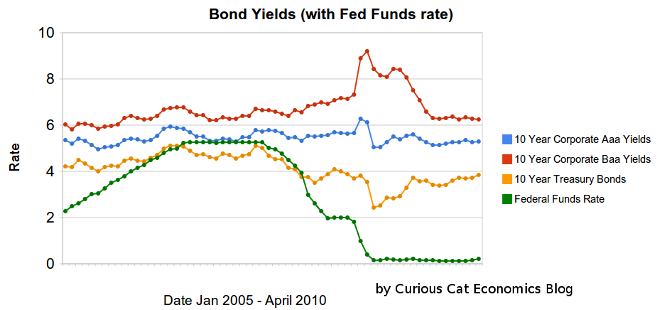
    chart showing corporate and government bond yieldsChart showing corporate and government bond yields from 2005-2010 by Curious Cat Investing Economics Blog, Creative Commons Attribution, data from the Federal Reserve.

    Bond yields have remained low, with little change over the last 6 months. 10 year Aaa corporate bonds yields have increase 10 basis points to 5.29%. 10 year Baa yields have decreased 7 basis points to 6.25%. 10 year USA treasury bonds have increased 45 basis points (largely the effective of money scared into the safety of US treasuries leaving as the credit crisis eased. The federal funds rate remains under .25%.

    The United States economy appears to be gaining strength and if job growth can continue the Fed will likely reduce the amount giveaways to the banks by increasing the fed funds rate (though when this will happen is still very hard to judge). The Fed will also likely sell mortgages back to the market which will increase long term rates. The Fed will likely start by changing the wording that the economic conditions “are likely to warrant exceptionally low levels of the federal funds rate for an extended period.” When this language changes rates may well go up 25 to 50 basis points quickly.

    Related: Bond Yields Change Little Over Previous Months (December 2009)Chart Shows Wild Swings in Bond Yields in Late 2008Real Estate and Consumer Loan Delinquency Rates 1998-2009Government Debt as Percentage of GDP 1990-2008 in OECD: USA, Japan, Germany…

  • Bogle on the Stock Market and Investing

    Bogle on Bankers, Buffett, Obama; an interview of John Bogle, from February 2010.

    Bogle: What happened over the last 10 years were two things, and one of which we have never encountered before. The 17% returns we had over the two previous consecutive decades, the ’80s and the ’90s, were born largely on ascending price-earnings multiples. If the price-to-earnings ratio goes from 8 to 16 in one decade, and then to 32 in the next decade, that accounts for 7% per year of that 17% return. So the market was driven by the revaluation of corporate America and that just can’t keep recurring at those rates. I projected in the original book that the price-earnings multiple might get down below 20, which is exactly what it’s done, so that was fairly predictable.

    But what made the decade quite so bad is that we then had a major recession or light depression at the end of 2008 to 2009 which is still with us. That coming with the market so highly valued meant that earnings growth was much less than what we might have expected. So looking out from here, I think we can look for better earnings growth. And dividend yields are back in decent territory but not great. We started this decade with a 1% dividend yield, and that’s an important part of investment returns, and now the dividend yield is around 2.25%, so a higher dividend yield contributing to future growth. So I think it’s highly likely that stocks will outpace bonds in the decade that just began.

    Are we on the right path now? Has America learned its lesson?
    Bogle: No. Unequivocally not. The long overdue reforms being discussed in Washington do not go nearly far enough, in my opinion. We need protection for consumers. Canada has a financial structure similar to ours except it has a consumer-protection board, which would prevent banks from giving people mortgages if they have no ability to pay them back. To get that done has been very difficult. Also, Senators (John) McCain and (Maria) Cantwell have proposed a return of the Glass-Steagall Act, and that’s gotten nowhere but it is long overdue. We should have banks behave as banks and not as investment banks or hedge-fund managers.

    But let’s suppose the stock market creates a 10% return. And the value of the stock market today is around $13 trillion so 10% is $1.3 trillion. By my numbers, Wall Street and the mutual fund industry take $600 billion a year out of that return. That’s half of the return. So the only way investors are going to get their fair share of the $1.3 trillion is to reduce the costs and get the casinos out.

    As usually John Bogle provides excellent analysis and vision.

    Related: Bogle on the Retirement CrisisIs Trying to Beat the Market Foolish?Lazy Portfolios Seven-year Winning StreakSneaky Fees

  • Middle Class Families from 1970-2005

    As I have said before, Elizabeth Warren is one of the people I find most informative on the economy we have created. This lecture (from January 31, 2008) is very interesting: The Coming Collapse of the Middle Class: higher risks, lower rewards and a shrinking safety net. It is important for us to realize that the decisions we make have consequences. If we allow corruption to grow and grow in the USA we will suffer more and more. If we continue to elect people that give away society wealth to those the pay them to the detriment of society (investment banks, drug companies, “intellectual property” lawyers, retail banks, farmers, trial lawyers, hedge fund managers, trust fund babies, physicians…) that naturally means their is less wealth for the rest of society.

    Interesting data. Looking at standard family (Mom, Dad and 2 kids from 1970 to 2005), in inflation adjusted dollars: earnings increased a great deal (due to women working much more) but disposable income decreased. This is because basic expenses increased: health care, housing, transportation… (and this is with assuming employer provided health care – which has really been decreasing in likelihood over time). Those families are also more deeply in debt and reliant on 2 incomes. And if either income producer losses their jobs the economics of the family fail. Which means the family is much more at risk.

    It really is great that lectures like this are available to us now.

    Related: Elizabeth Warren Webcast On Failure to Fix the SystemIn the USA 43% Have Less Than $10,000 in Retirement SavingsFailure to Regulate Financial Markets Leads to Predictable ConsequencesLobbyists Keep Tax Off Billion Dollar Private Equities Deals and On For Our Grandchildren

  • 10 Jobs That Provide a Great Return on Investment

    10 Jobs With Great Return on Investment

    For those who feel pressure to make the most of their education, here are some careers that offer major bang for the buck.

    Radiation therapist

    Most common degree: Associate’s
    Median pay: $72,910

    Employment in the occupation is expected to grow by nearly a third between 2008 and 2018

    Dental hygienist

    Most common degree: Associate’s
    Median pay: $66,570
    It’s no surprise that the healthcare field is home to several careers that offer the best pay and opportunities for the education required, given that the healthcare industry has faced steady increases in demand despite the recession.

    Petroleum engineer

    Most common degree: Bachelor’s
    Median pay: $108,020
    When it comes to jobs for which the typical degree is a bachelor’s, only airline pilots earn more than petroleum engineers. For one thing, engineers’ salaries reflect the technical skills required, says Margaret Watson of the Society of Petroleum Engineers. But the salaries are also a result of supply and demand, as there are relatively few graduates in petroleum engineering—some enter the field with degrees in other engineering disciplines, as well—and demand is expected to increase as more engineers reach retirement age.

    Nuclear power reactor operator

    Most common training: Long-term, on-the-job training
    Median pay: $73,320
    Nuclear power reactor operators might start their careers as plant equipment operators while they become familiar with the operations. In fact, reactor operators need at least three years of experience working in a power plant—including at least one year in a nuclear plant. To earn the right to control the equipment as reactor operators, they must be licensed by the Nuclear Regulatory Commission. Employment of nuclear power reactors is expected to grow by 20 percent between 2008 and 2018.

    Follow the link for more of the top 10 job paths that payoff well. I certain don’t think it makes sense to pursue a career that doesn’t interest you just because it pays well. But if you are choosing among several careers that appeal to you, one factor worth considering are the employment prospects in the careers.

    Related: Engineering Majors Hold 8 of Top 10 Highest Paid MajorsThe Declining Value of a college degreeManufacturing Jobs Data: USA and ChinaMedieval Peasants had More Vacation Time

  • Using Your Credit Card Properly

    Many people get into financial trouble in part due to their misuse of credit cards. By following a few simple rules you can avoid the missteps and use credit cards to improve you personal finances instead of falling into the credit card traps.

    Most importantly, don’t use your credit card for loans. Pay off your balance each month. Pretty obvious advice but far too many people don’t follow it. If you use your credit card for a loans most of time that is a mistake and big risk to your personal financial future. Don’t do it. There is a reason pretty much all the advice from financial advisers on credit cards starts with this – it is the most important advice.

    Second, if you don’t follow the advise above pay off your loan as soon as possible. Payment the minimum payment is huge mistake. You should not be making any discretionary purchases if you are not paying down your credit card debt substantially each month.

    Continue reading tips on using your credit card in a smart way.

    Related: Majoring in Credit Card DebtOutrageous Credit Card FeesCredit Card Debt and Delinquencies Decline

  • The 4% Rule is Overly Simplistic

    Time to replace the 4% rule

    Conventional wisdom suggests that you withdraw on average 4% adjusted for inflation. Now comes a paper co-authored by William Sharpe, the winner of the 1990 Nobel Prize in Economics, challenging the conventional wisdom.

    According to Sharpe, who is also the founder of Financial Engines, the typical 4% rule recommends that a retiree annually spend a fixed, real amount equal to 4% of his initial wealth, and rebalance the remainder of his money in a 60%-40% mix of stocks and bonds throughout a 30-year retirement period.

    What’s more, he shows the price paid for funding what he calls “unspent surpluses and the overpayments made to purchase its spending policy.” According to Sharpe, a typical rule allocates 10%-20% of a retiree’s initial wealth to surpluses and an additional 2%-4% to overpayments.

    The only problem with what academia knows to be right and what’s practical in the field — even by Sharpe’s own admission — is this: “Many practical issues remain to be addressed before advisers can hope to create individualized retirement financial plans that maximize expected utility for investors with diverse circumstances, other sources of income, and preferences,” Sharpe wrote in his paper.

    Meanwhile, Stephen P. Utkus, a principal with the Vanguard Center for Retirement Research, agrees that the 4% rule is flawed. But he also notes, as did Sharpe, that there’s no practical mechanism to replace it with and that further research is required.

    I think this is exactly right. The proper personal financial actions in this case are not easy. The 4% rule is far from perfect but it does give a general idea that is a decent quick snapshot. But you can’t rely on such a quick, overly simplified method. At the same time there are simple ideas that do work, such as saving money for retirement is necessary. The majority of people continue to fail to take the most basis steps to save money each year for retirement.

    Related: Spending Guidelines in RetirementHow Much Will I Need to Save for Retirement?Bogle on the Retirement Crisis