Category: Personal finance

  • Long Term Care Insurance – Financially Wise but Current Options are Less Than Ideal

    The expenses for long term care is exactly the type of financial risk insurance is best for. The problem is the whole area is so uncertain that what you buy may not provide the coverage you planned on (the health care system is so broken that it is not certain insurance will cover the costs, companies can go bankrupt, change coverage rules drastically…).

    The questions about long term care insurance are not about the sensibility of the coverage abstractly, it is very wise. But the complexities, today, in the real world make the question of buying more a guess about what coverage you will actually receive if you need it.

    Many of my posts here are focused on the USA but applicable elsewhere, or just applicable wherever you are. This post is mainly focused on the USA, long term care insurance options in other locations will be very different and have different considerations (in many countries it may not even apply, mainly due to a less broken health care system than the USA has).

    Long-Term-Care Insurance: Who Needs It? by Marilyn Geewax

    “the reality is that each year, an estimated 11 million U.S. adults need some type of long-term care.

    Such care can be crushingly expensive: Just one hour of home-health-aide care costs roughly $20, while the average private nursing home room costs $87,000 a year. Neither routine employer-based medical insurance nor Medicare will pay for extended periods of custodial care.”

    Also, some people pay their premiums for years, and then get hit with rate hikes they can’t afford.

    Insurance has a transaction cost. Paying that transaction cost for expenses you can afford is just waste. You should pay the cost directly. This is why higher deductibles are most often wise. It doesn’t make sense to cover pay insurance costs every year to pay for a $500 risk you can afford to absorb yourself.

    But huge expenses are exactly what you want coverage for. Long term care expenses are huge. However, long term care insurance is still in flux, which isn’t good for something you want to provide long term protection. A huge risk is paying premiums for years, and then getting hit with rate hikes that may well be designed primarily just to get people to drop coverage (or be so expensive that those that stay pay enough that the insurance company makes money).

    Ideally such insurance would be set so maybe the cost rose at some preset limit when you signed up. The problem is the USA health care system is so broken this won’t work. No one can predict how much more excessively expensive long term coverage will be in 30 years so the insurance companies can’t predict. It leaves consumers in a risky place.

    Insurance is regulated by the states. There are huge differences in which states do a good job regulating long term care insurance and those that don’t. The majority don’t.

    This is one of the more important areas of personal finance. Unfortunately there is no easy answer. If the system were stable, reliable and predictable, long term care insurance would be a definite requirement for a sound financial plan. Today it is wise to insure yourself from those risks, the problem is determining whether any of the options available are worth it. The risk of needing this insurance is high: it is both likely and costly. So getting coverage is definitely wise if you can find some you think is reliable over the long term. Because of the uncertain nature of the options, this will require much more effort on your part than many personal finance actions (I included several links below to help your research).

    Also look at how long the coverage is for. This is another limitation insurance companies have put in place that makes it much less worthwhile.

    Related: Personal Finance Basics: Long-term Care InsuranceNational Clearinghouse for Long-Term Care InformationAARP adviceDisability Insurance is Very ImportantHow to Protect Your Financial Health

  • Retirement Planning – Looking at Assets

    The basics of retirement planning are not tricky. Save 10-15% of your income for about 40 years working career (likely over 15%, if you don’t have some pension or social security – with some pension around 10+% may be enough depending on lots of factors). That should get you in the ballpark of what you need to retire.

    Of course the details are much much more complicated. But without understanding any of the details you can do what is the minimum you need to do – save 10% for retirement of all your income. See my retirement investing related posts for more details. Only if you actually understand all the details and have a good explanation for exactly why your financial situation allows less than 10% of income to be saved for retirement every year after age 25 should feel comfortable doing so.

    There is value in the simple rules, when you know they are vast oversimplifications. I am amazed how many professionals don’t understand how oversimplified the rules of thumb are.

    Here is one thing I see ignored nearly universally. I am sure some professions don’t but most do. If you have retirement assest such as a pension or social security (something that functions as an annuity, or an actually annuity) that is often a hugely important part of your retirement portfolio. Yet many don’t consider this when setting asset allocations in retirement. That is a mistake, in my opinion.

    A reliable annuity is most like a bond (for asset allocation purposes). Lets look at an example for if you have $1,500 a month from a pension or social security and $500,000 in other financial assets. $1,500 * 12 gives $18,000 in annual income.

    To get $18,000 in income from an bond/CD… yielding 3% you need $600,000. That means, at 3%, $600,000 yields $18,000 a year.

    Ignoring this financial asset worth the equivalent of $600,000 when considering how to invest you $500,000 is a big mistake. Granted, I believe the advice is often too biased toward bonds in the first place (so reducing that allocation sounds good to me). To me it doesn’t make sense to invest that $500,000 the same way as someone else that didn’t have that $18,000 annuity is a mistake.

    I also don’t think it makes sense to just say well I have $1,100,000 and I want to be %50 in bonds and 50% in stocks so I have “$600,000 in bonds now” (not really after all…) so the $500,000 should all be in stocks. Ignoring the annuity value is a mistake but I don’t think it is as simple as just treating it as though it were the equivalent amount actually invested.

    Related: Immediate AnnuitiesManaging Retirement Investment RisksHow to Protect Your Financial HealthMany Retirees Face Prospect of Outliving Savings

    (more…)

  • Curious Cat Investing, Economics and Personal Finance Carnival #29

    Welcome to the Curious Cat Investing, Economics and Personal Finance Carnival. The carnival is published twice each month with links to new, related, interesting content online.

    • For Capitalism to Survive, Crime Must Not Pay by Bruce Judson – “Justice must be blind so that both parties — whether weak or powerful — can assume that an agreement between them will be equally enforced by the courts.

      There is a second, perhaps even more fundamental, reason that equal justice is essential for capitalism to work. When unequal justice prevails, the party that does not need to follow the law has a distinct competitive advantage. A corporation that knowingly breaks the law will find ways to profit through illegal means that are not available to competitors. As a consequence, the competitive playing field is biased toward the company that does not need to follow the rules.” (the crony capitalism that has grown in the last few decades in the USA is poisoning the country with a failure to justly prosecute those that break laws if they are rich and connected to the other powerful cronies. This is a serious problem. – John).

    • Don’t Expect to Spend Over 4% of Your Retirement Investment Assets Annually by John Hunter – “This is likely one of the top 5 most important things to know about saving for retirement (and just 10% of the population got the answer right). You need to know that you can safely spend 5%, or likely less, of your investment assets safely in retirement (without dramatically eating into your principle.”
    • What America Pays In Taxes – In 2011 the USA government collected $1,100 billion in personal income taxes, $741 billion in payroll taxes (social security and medicare) [this should be a hint that look only at income taxes paid it might be very misleading – John], $200 billion in corporate taxes, $10 billion in estate and gifts taxes and $268 billion in other taxes (customs duties, excise taxes on products such as gasoline…).
    • Value Investing is Not Necessarily Buy and Hold Investing by Shailesh Kumar – “Value investors choose to buy a stock when it is cheaper than the intrinsic value of the stock and sell it when it becomes more expensive.”
    • (more…)

  • Investing in the Poorest of the Poor

    I have donated more to Tricke Up than any other charity for about 20 years now. There is a great deal of hardship in the world. It can seem like what you do doesn’t make a big dent in the hardship. But effective help makes a huge difference to those involved.

    My personality is to think systemically. To help put a band aid on the current visible issue just doesn’t excite me. Lots of people are most excited to help whoever happens to be in their view right now. I care much more about creating systems that will produce benefits over and over into the future. This view is very helpful for an investor.

    Trickle Up invests in helping people create better lives for themselves. It provides some assistance and “teaches people to fish” rather than just giving them some fish to help them today.

    The stories in this video show examples of the largest potential for entrepreneurship. While creating a few huge visible successes (like Google, Apple…) is exciting the benefits of hundreds of millions of people having small financial success (compared to others) but hugely personally transforming success is more important. Capitalism is visible in these successes. What people often think of as capitalism (Wall Street) has much more resonance with royalty based economic systems than free market (free of market dominating anti-competitive and anti-market behavior) capitalism.

    Related: Kiva Loans Give Entrepreneurs a Chance to SucceedMicro-credit ResearchUsing Capitalism in Mali to Create Better Lives

  • Don’t Expect to Spend Over 4% of Your Retirement Investment Assets Annually

    Pitfalls in Retirement (pdf) is quite a good white paper from Meril Lynch, I strongly recommend it.

    A survey asked investors at least 41 years of age how much of their retirement savings they can safely spend each year without running the risk of exhausting their assets. Forty percent had no idea; an additional 29% said they
    could safely spend 10% or more of their savings each year.

    But, as explained below, the respondents most on target were the one in 10 who estimated sustainable spending rates to be 5% or less. This is significantly impacted by life expectancy; if you have a much lower life expectancy due to retiring later or significant health issues perhaps you can spend more. But counting on this is very risky.

    This is likely one of the top 5 most important things to know about saving for retirement (and just 10% of the population got the answer right). You need to know that you can safely spend 5%, or likely less, of your investment assets safely in retirement (without dramatically eating into your principle.

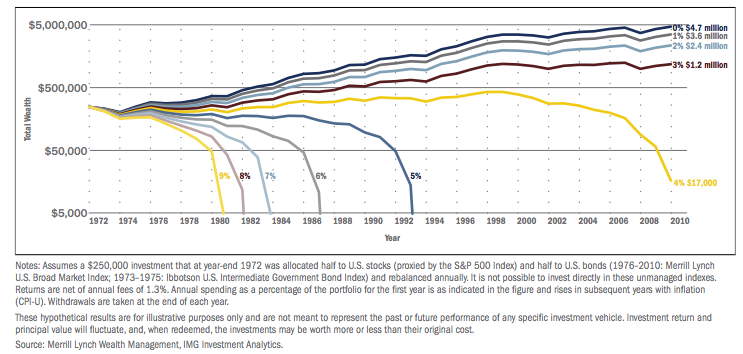
    chart showing retirement assets over time based on various spending levels
    Chart showing retirement assets over time based on various spending levels, from the Merill Lynch paper.

    The chart is actually quite good, the paper also includes another good example (which is helpful in showing how much things can be affected by somewhat small changes*). One piece of good news is they assume much larger expense rates than you need to experience if you choose well. They assume 1.3% in fees. You can reduce that by 100 basis points using Vanguard. They also have the portfolio split 50% in stocks (S&P 500) and 50% in bonds.

    Several interesting points can be drawn from this data. One the real investment returns matter a great deal. A 4% withdrawal rate worked until the global credit crisis killed investment returns at which time the sustainability of that rate disappeared. A 5% withdrawal rate lasted nearly 30 years (but you can’t count on that at all, it depends on what happens with you investment returns).

    Related: What Investing Return Projections to Use In Planning for RetirementHow Much Will I Need to Save for Retirement?Saving for Retirement

    (more…)

  • 60% of Workers in the USA Have Less Than $25,000 in Retirement Savings

    2012 Retirement Confidence Survey

    (60 percent) report they and/or their spouses have less than $25,000 in total savings and investments (excluding their home and defined benefit plans), including 30 percent who have less than $1,000

    The data would be better if some value were placed on defined benefit plans; currently it is a bit confusing how much they may help. But the $25,000 threshold is so low that no matter what being under that value is extremely bad news for anyone over 40. And failing to have saved over just $25,000 toward retirement is bad news for anyone over 30 without a defined benefit plan.

    The large majority of workers who have not saved for retirement have little in savings. Almost two-thirds (63 percent) report they have less than $1,000 in savings and investments, and another quarter (25 percent) have $1,000–$9,999.

    Thirty-four percent of workers report they had to dip into savings to pay for basic expenses in the past 12 months.

    Thirty-five percent of all workers think they need to accumulate at least $500,000 by the time they retire to live comfortably in retirement. Eighteen percent feel they need between $250,000 and $499,999, while 34 percent think they need to save less than $250,000 for a comfortable retirement.

    Workers who have performed a retirement needs calculation are more than twice as likely as those who have not (23 percent vs. 10 percent) to expect they will need to accumulate at least $1 million before retiring.

    66% of workers say their family has retirement savings and 58% say they are currently saving for retirement. These results are fairly consistent over the last few decades (the current values are in the lower ranges of results).

    Nearly everyone wishes they had more money. One way to act as though you have more than you do is to borrow and spend (which is normally unwise – it can make sense for a house and in limited amounts when you are first going out on your own). Another is to ignore long term needs and just live it up today. That is a very bad personal finance strategy but one many people follow. Saving for retirement is a personal finance requirement. If you can’t save for retirement given your current income and lifestyle you need to reduce your current spending to save or increase your income and then save for retirement.

    A year or two of failing to do so is acceptable. Longer stretches add more and more risk to your personal financial situation. It may not be fun to accept the responsibilities of adulthood and plan for the long term. But failing to do so is a big mistake. Determining the perfect amount to save for retirement is complicated. A reasonable retirement saving plan is not.

    Saving 10% of your gross income from the time you are 25 until 65 gives you a decent ballpark estimate. Then you can adjust even 5 or 10 years as you can look at your situation. It will likely take over 10% to put you in a lifestyle similar to the one you enjoy while working. But many factors are at play. To be safer saving at 12% could be wise. If you know you want to work less than 40 years saving more could be wise. If you have a defined benefit plan (rare now, but, for example police or fire personnel often still do you can save less but you must work until you gain those benefits or you will be in extremely bad shape.

    IRAs, 401(k) and 403(b) plans are a great way to save for retirement (giving you tax deferral and Roth versions of those plans are even better – assuming tax rates rise).

    Related: In the USA 43% Have Less Than $10,000 in Retirement SavingsSaving for Retirement

  • Leasing or Purchasing a Solar Energy System For Your House

    The economics of solar energy make sense today. The main stumbling block is financing the initial purchase (for homeowners, businesses or utilities). For new power generation solar is economically competitive in many locations today and prices continue to decline. One aspect that has harmed financing is the historical depreciation has been high (assuming a short lifespan of solar panels) but the panels now have much longer lifespans, meaning that when computing the return of solar investments you can expect a longer payback period. Combine that with falling prices and the economic case is great.

    For a homeowner there is still the problem of financing what could be a $30,000 installation. Of course, the extremely low interest rates help here. First you have low cost capital (when calculating your return). Second, your alternative yields are very low (so it isn’t like you would earn 8% on your money just buying a CD). But for those that don’t want to take on the loan many companies are being formed to work on the financing for you (they deal with financing and then sell you the electricity they generate with panels on your home). It is a good business model I think. I personally think you are better off cutting out the intermediary and financing it yourself, but if you don’t want to, you can get cheaper electricity and help the environment.

    In the USA there is a 30% federal tax credit for solar installation. Several states also offer tax credits for solar installation. There are also incentives in many other countries including Japan, Germany, Spain, Italy…

    Where the U.S. Solar Industry Is Shining

    The residential market for solar is still nascent, with less than 0.1 percent of U.S. homes outfitted with panels. That number could climb to 2.4 percent by 2020, estimates Bloomberg New Energy Finance. Prices for solar cells fell 51 percent in 2011, to 88¢ a watt, according to data compiled by Bloomberg.

    Developers in the U.S. added 449.2 megawatts of solar-generating capacity in the third quarter of 2011, the latest data available, up 140 percent from the same quarter a year earlier.

    SunRun hires local companies in 10 states to install solar arrays on customers’ roofs. The company charges clients for the electricity they generate— at monthly rates as much as 15 percent below those of regular utilities. Jurich says she expects SunRun to have a presence in 15 to 20 states within five years.

    I own JinkoSolar stock which manufactures solar panels. This is based on the belief that solar has reached a point where it is a good way to generate electricity and we have huge needs for electrical power generation world wide.

    Related: Top Countries For Renewable Energy CapacityGlobal Wind Energy Capacity Exceeds 2.5% of Global Electricity NeedsSolar Energy: Economics, Government and TechnologyOil Consumption by Country 1990-2009

    (more…)

  • USA Individual Earnings Levels: Top 1% $343,000, 5% $154,000, 10% $112,000, 25% $66,000

    Very interesting USA federal tax data via the tax foundation. Top 1% has adjusted gross income of $343,000; over $154,000 puts you in the top 5%; $112,000 puts you in the top 10% and $66,000 puts you in the top 25%.

    The chart only shows federal income tax data. So the costly social security tax (which is directly based on earned income* so in reality is federal income tax but is handled in a separate account so is consistently not classified as income tax data) for outside the top 5% (income above $106,800 [for 2011] does not have to pay the social security tax) is not reflected in the rates paid here.

    Looking at the data excluding social security is fine, but it is very important to remember the social security (plus medicare) tax is the largest tax for, I would guess, most people in the USA. Social security tax is 6.2% paid by the employee plus 6.2% paid by the company – a total of 12.4%. That part of the tax was capped at $106,800 in income for 2011. The medicare tax is 1.45% of income paid by the employee and 1.45% paid by the employer (and it has no cap). So that totals 2.9% (for the employee and employer tax) and brings the total to 15.3%** for most earned income.


    Number of Returns with Positive AGI

    AGI ($ millions)

    Income Taxes Paid ($ millions)

    Group’s Share of Total AGI

    Group’s Share of Income Taxes

    Income Split Point

    Average Tax Rate

    All Taxpayers

    137,982,203

    $7,825,389

    $865,863

    100.0%

    100.0%

    11.06%

    Top 1%

    1,379,822

    $1,324,572

    $318,043

    16.9%

    36.7%

     $343,927.00

    24.01%

    1-5%

    5,519,288

    $1,157,918

    $189,864

    14.8%

    22.0%


    16.40%

    Top 5%

    6,899,110

    $2,482,490

    $507,907

    31.7%

    58.7%

     $154,643.00

    20.46%

    5-10%

    6,899,110

    $897,241

    $102,249

    11.5%

    11.8%


    11.40%

    Top 10%

    13,798,220

    $3,379,731

    $610,156

    43.2%

    70.5%

     $112,124.00

    18.05%

    10-25%

    20,697,331

    $1,770,140

    $145,747

    22.6%

    17.0%


    8.23%

    Top 25%

    34,495,551

    $5,149,871

    $755,903

    65.8%

    87.3%

     $ 66,193.00

    14.68%

    25-50%

    34,495,551

    $1,620,303

    $90,449

    20.7%

    11.0%


    5.58%

    Top 50%

    68,991,102

    $6,770,174

    $846,352

    86.5%

    97.7%

     > $32,396

    12.50%

    Bottom 50%

    68,991,102

    $1,055,215

    $19,511

    13.5%

    2.3%

     < $32,396

    1.85%

    Source: Internal Revenue Service. Table via the tax foundation.

    Other interesting data shows that the top 1% earn 16.9% of the total income and pay 36.7% of the total federal income taxes. Those in the top 1-5% earn 14.8% of the total income and pay 22% of the income taxes. Those in the top 5-10% earn of the income 11.5% of the income and pay 11.8% of the federal income taxes. So once you exclude the main tax on income (social security) and use adjusted gross income the tax rates are slightly progressive (higher rates for those that are making the most – and presumably have benefited economically the most from the economic system we have).

    Given that this is skewed by excluding the regressive (higher taxes paid by those earning less – social security is the same rate for everyone except those earning the very most who don’t have to pay it on their income above $106,800 [in 2011]) social security tax I believe we should have a more progressive tax system. But that is mainly a political debate. There are good economic arguments for the bad consequences of too unequal a distribution of wealth (which the USA has been moving toward the last few decades – unfortunately).

    In addition to the other things I mention there are all sorts of games played by those that desire a royalty type system (where wealth is just passed down to the children of those who are rich, instead of believing in a capitalist system where rewards are given not to the children of royalty but to those that are successful in the markets). A good example of the royalty model is Mitch Romney giving his trust fund children over $100 million each. These schemes use strategies to avoid paying taxes at all. Obviously these schemes also make the system less progressive (based on my understanding of the tax avoidance practiced by these trust fund babies and those that believe it is ethical to give such royalty sized gifts to their royal heirs).

    I don’t like the royalty based model of behavior. I much prefer the actions of honorable capitalist such as Warren Buffett and Bill Gates that give their children huge benefits that any of us would be thrilled with, but do not treat them as princes and princesses who should live in a style of luxury that few kings have every enjoyed based solely off their birthright. Both Bill Gates and Warren Buffett have honorably refused to engage in royal seeking behavior that many of their less successful business peers have chosen to engage in. Those that favor trust fund babies are welcome to their opinion and have managed to get most of congress to support their beliefs instead of a capitalist model that I would prefer so they are free to engage in their desire to parrot royalty and honor the royalty model of behavior.

    * earned income – you also don’t have to pay social security or medical tax on unearned income (dividends, capital gains, rental income…). Again this by and large favors wealthy taxpayers. Everyone is eligible for the same favorable tax treatment but only those that have the wealth to make significant amounts of unearned income get this advantage.

    ** the social security tax has been reduced by 200 basis points (this relief was recently extended) as part of dealing with the results of the too big to fail banking caused credit crisis. So under the temporary reduction the personal tax rate is 4.2% and the total cost is 13.2%.

    Related: Taxes – Slightly or Steeply Progressive?Taxes per Person by CountryUSA State Governments Have $1,000,000,000,000 in Unfunded Retirement ObligationsRetirement: Roth IRA Earnings and Contribution Limits

  • Curious Cat Investing, Economics and Personal Finance Carnival #25

    Welcome to the Curious Cat Investing, Economics and Personal Finance Carnival: find useful recent personal finance, investing and economics blog posts and articles. The carnival is published twice each month.

    • India’s panel price crash could spark solar revolution – “In India, electricity from solar supplied to the grid has fallen to just 8.78 rupees per kilowatt-hour compared with 17 rupees for diesel.”
    • Buffett Says Bonds Among Most Dangerous Assets on Inflation – “Over the past century these instruments have destroyed the purchasing power of investors in many countries, even as these holders continued to receive timely payments of interest and principal… Current rates… do not come close to offsetting the purchasing-power risk that investors assume.”
    • How much should you save with each paycheck to reach retirement goals? – “For many, saving 10-15% will indeed be enough. If you find that you’re not currently on track for the retirement you envisioned, you can take steps now to change that.” [10-15% of income for retirement probably can be about right if you plan on working a standard 40-50 years and start adding close to 10% before you reach 30, and investment results are decent, and … and … and … Obviously if you don’t add at those levels starting earlier you will need to save more later. – John
    • Why Spain’s Unemployed Are Heading For Germany – “Spain’s near-23 percent unemployment rate is driving highly educated people like Fuente and Sandino abroad by the tens of thousands. This year more people left Spain than moved there for the first time in more than a generation. And Germany’s a principal destination.”
    • We Prefer Being Forced To Save – “Employers can do a number of things in addition to automatically enrolling employees and increasing their contributions amounts. They can make the websites easy to understand and be proactive about forcing the providers of the plans to make things less complicated. Even something so simple as having the retirement account website automatically bookmarked on work computers could go a long way.”
    • Why Has the Baltic Dry Index Collapsed? by Steven Hansen – “just a small increase in the supply of ships can make a major difference in a very competitive marketplace. It makes the BDI an inoperative economic indicator, and one less tool which can be used as an economic metric.”
    • Looking for higher dividend yields–and dividend growth? Here are three picks by Jim Jubak – “Pipeline master limited partnership Kinder Morgan Energy Partners (KMP). The partnership paid $4.32 a unit in 2010 and $4.58 in 2011 and thanks to new pipelines serving the U.S. energy boom and the likely drop down of assets from general partner Kinder Morgan’s (KMI) acquisition of El Paso (EP), I think the partnership will see growing cash flows that it can pass through to unit holders.”
    • 5 Big Car Buying Mistakes by David Weliver – “We ignore financing terms. This makes no sense: Fighting tooth and nail with a car salesman for three hours to get an extra $500 off the price, and then financing the car with no money down at 6.0% for four years at a cost of over $2,000.”

    For the second time in 2 weeks WordPress just completely failed to save a post I wrote 🙁 this is my second creation of this post.

  • Investing in Stocks That Have Raised Dividends Consistently

    The Dividend Aristocrats index measures the performance of S&P 500 companies “that have followed a policy of increasing dividends every year for at least 25 consecutive years.” S&P makes additions and deletions from the index annually. This year 10 companies were added and 1 was deleted.

    Stock Yield
       
    div/share 2011 div/share 2000 % increase
    AT&T (T) 6% $1.72 $1.006 72%
    HCP Inc (HCP) 4.9% $1.92 $1.47 31%
    Sysco (SYY) 3.7% $1.04 $0.24 333%
    Nucor (NUE) 3.7% $1.45 $0.15 867%
    Illinois Tool Works (ITW) 3.1% $1.40 $0.38 268%
    Genuine Parts (GPC) 3.1% $1.80 $1.10 64%
    Medtronic (MDT) 2.8% $0.936 $0.181 417%
    Colgate-Palmolive (CL) 2.6% $2.27 $0.632 259%
    T-Rowe Price (TROW) 2.9% $1.24 $0.27 359%
    Franklin Resources (BEN) 1.2% $1.00 $.0245 308%

    You can’t expect members of the Dividend Aristocrats to match the dividend increases shown here. As companies stay in this screen of companies the rate of growth often decreases as they mature. Also some have already increased the payout rate (so have had an increasing payout rate boost dividend increases) significantly.

    The chart also shows that a smaller current yield need not dissuade investing in a company even when your target is dividend yield, giving the large dividend increase in just 10 years. Nucor yielded just 1.5% in 2000 (at a price of $10). Ignoring reinvested dividends your current yield on that investment would be 14.5%. To make the math easy 10 shares in 2000 cost $100, and they paid $1.50 in dividends (%1.5). Dividends have now increase so those 10 shares are paying $14.50 in dividends (14.5%). Of course Nucor worked out very well; that type of return is not common. But the idea to consider is that the long term dividend yield is not only a matter of looking at the current yield.

    The period from 2000 to 2011 was hardly a strong one economically. Yet look at how many of these companies dramatically increased their dividend payouts. Even in tough economic times many companies do well.

    Related: Looking for Dividend Stocks in the Current Extremely Low Interest Rate EnvironmentWhere to Invest for Yield Today10 Stocks for Income Investors