Blog

  • Delaying the Start of Social Security Payments Can Pay Off

    Delaying when you start collecting Social Security benefits in the USA can enhance your personal financial situation. You may start collecting benefits at 62, but each year you delay collecting increases your payment by 5% to 8% (see below). If you retire before your “normal social security retirement age” (see below) your payments are reduced from the calculated monthly payment (which is based on your earnings and the number of years you paid into the social security fund). If you delay past that age you get a 8% bonus added to your monthly payment for each year you delay.

    The correct decision depends on your personal financial situation and your life expectancy. The social security payment increases are based on life expectancy for the entire population but if your life expectancy is significantly different that can change what option makes sense for you. If you live a short time you won’t make up for missing payments (the time while you delayed taking payments) with the increased monthly payment amount.

    The “normal social security retirement age” is set in law and depends on when you were born. If you were born prior to 1938 it is 65 and if you are born after 1959 it is 67 (in between those dates it slowly increases. Those born in 1959 will reach the normal social security retirement age of 67 in 2026.

    The social security retirement age has fallen far behind demographic trends – which is why social security deductions are so large today (it used to be social security payments for the vast majority of people did not last long at all – they died fairly quickly, that is no longer the case). The way to cope with this is either delay the retirement ago or increase the deductions. The USA has primarily increased the deductions, with a tiny adjustment of the retirement age (increasing it only 2 years over several decades). We would be better off if they moved back the normal retirement age at least another 3 to 5 years (for the payment portion – given the broken health care system in the USA retaining medicare ages as they are is wise).

    In the case of early retirement, a benefit is reduced 5/9 of one percent for each month (6.7% annually) before normal retirement age, up to 36 months. If the number of months exceeds 36, then the benefit is further reduced 5/12 of one percent per month (5% annually).

    For delaying your payments after you have reached normal social security retirement age increases payments by 8% annually (there were lower amounts earlier but for people deciding today that is the figure to use).

    Lets take a quick look at a simple example:
    (more…)
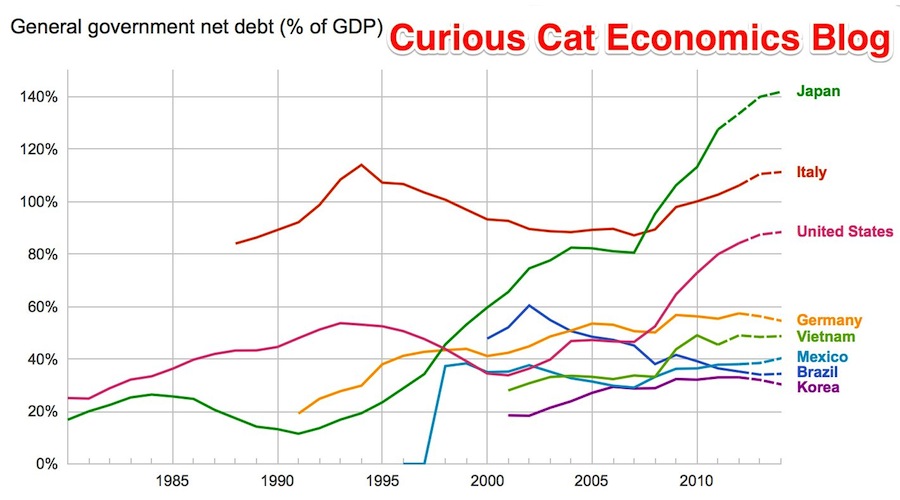
  • Chart of Net Government Debt from 1980 to 2013 by Country

    chart of Government debt from 1980 to 2013

    The data, from IMF, does not include China or India.

    The chart shows data for net debt (gross debt reduced by certain assets: gold, currency deposits, debt securities etc.).

    Bloomberg converted [broken link was removed] the data to look at debt load per person (looking at gross debt – estimated for 2014). Japan has ill-fortune to lead in this statistic with $99,725 in debt per person (242% of GDP), Ireland is in second with $60, 356 (121% of GDP). USA 3rd $58,604 (107%). Singapore 4th $56,980 (106%). Italy 6th $46,757 (133%). UK 9th $38,939 (95%). Greece 12th $38,444 (174%). Germany 14th $35,881 (78%). Malaysia 32nd $6,106 (57%). China 48th $1,489 (21%). India 53rd $946 (68%). Indonesia 54th $919 (27%).

    I think the gross debt numbers can be more misleading than net debt figures. I believe Singapore has very large assets so that the “net” debt is very small (or non-existent). Japan is 242% in gross debt to GDP but 142% of net debt (which is still huge but obviously much lower). The USA in contrast has gross debt at 107% with a net debt of 88%.

    Related: Government Debt as Percent of GDP 1998-2010 for OECDGross Government Debt as Percentage of GDP 1990-2009: USA, Japan, Germany, ChinaChart of Largest Petroleum Consuming Countries from 1980 to 2010Top Countries For Renewable Energy Capacity

  • Cockroach Portfolio

    Dylan Grice suggests the Cockroach Portfolio: 25% cash; 25% government bonds; 25% equities; and 25% gold. What we can learn from the cockroach

    Each of those asset buckets protects against a different type of risk. And that is a very sensible approach to investing in the year ahead. Cash will protect you against a market collapse in anything (provided it’s cash held with a solid institution).

    Government bonds protect against deflation (provided your money’s invested in solid government bonds and not trash). Equities offer capital growth and income. And gold, as we know, protects against currency depreciation, inflation, and financial collapse. It’s vitally important to maintain holdings in each, in my opinion.

    The beauty of a ‘static’ allocation across these four asset classes is that it removes emotion from the investment process.

    I don’t really agree with this but I think it is an interesting read. And I do agree the standard stock/bond/cash portfolio model is not good enough.

    I would rather own real estate than gold. I doubt I would ever have more than 5% gold and only would suggest that if someone was really rich (so had money to put everywhere). Even then I imagine I would balance it with investments in other commodities.

    One of the many problems with “stock” allocations is that doesn’t tell you enough. I think global exposure is wise (to some extent S&P 500 does this as many of those companies have huge international exposure – still I would go beyond that). Also I would be willing to take some stock in commodities type companies (oil and gas, mining, real estate, forests…) as a different bucket than “stocks” even though they are stocks.

    And given the super low interest rates I see dividend paying stocks as an alternative to bonds.

    The Cockroach Portfolio does suggest only government bonds (and is meant for the USA where those bonds are fairly sensible I think) but in the age of the internet many of my readers are global. It may well not make sense to have a huge portion of your portfolio in many countries bonds. And outside the USA I wouldn’t have such a large portion in USA bonds. And they don’t address the average maturity (at least in this article) – I would avoid longer maturities given the super low rates now. If rates were higher I would get some long term bonds.

    photo with view of Glacier National Park,
    View of Glacier National Park, from Bears Hump Trail in Waterton International Peace Park in Canada, by John Hunter

    These adjustments mean I don’t have as simple a suggestion as the cockroach portfolio. But I think that is sensible. There is no one portfolio that makes sense. What portfolio is wise depends on many things.

    (more…)

  • Amazon Using a Costco Strategy?

    Amazon Prime is in some ways is similar to Costco’s membership fees. Costco make the vast majority of their profit on membership fees and largely breaks even otherwise.

    Amazon reported earning that were once again very short on earnings given how successful the company has been. Net income increased to $239 million for the 4th quarter (which is by far Amazon’s most profitable quarter since it includes the Christmas buying season) from $97 million last year.

    Amazon Prime costs $79 a year (in the USA) and provides free 2 day shipping and access to their streaming video content. Amazon doesn’t disclose the numbers of prime members (that I can find anyway) but educated guesses seem to say 20 million (or more). That would be $1.6 billion a year.

    Amazon’s net income for the full year was $274 million. Fees for Prime customers were $1.6 billion (at 20 million members). Amazon is considering raising the Prime price to $99 or $129 a year (25-50%).

    While not directly comparable to Costco it is similar. Both are running much of their business just to break even (or at a loss) and Costco manages to take membership fees as profit (along with a very tiny profit on everything else) while Amazon doesn’t even come close to running the rest of their business at break even.

    Now you can look at the two fees and say it isn’t the same. Amazon has to pay for shipping on each of the purchases etc. Still it is an odd strategy of charing customers an annual fee and then providing them services almost like a co-op that runs at break even for members.

    I really like lots of what Jeff Bezos does. He goes even farther than I do at prioritizing long term benefit over current profit. I can’t think of any other leader that does that and he isn’t really close to me in how far he goes.

    Beyond that long term thinking he is much more sensible about financial figures than the extremely over simplified (and even often just wrong) ideas spouted by other CEOs and CFOs. The quarterly report release form the company starts with:

    Operating cash flow increased 31% to $5.47 billion for the trailing twelve months, compared with $4.18 billion for the trailing twelve months ended December 31, 2012. Free cash flow increased to $2.03 billion for the trailing twelve months, compared with $395 million for the trailing twelve months ended December 31, 2012. Free cash flow for the trailing twelve months ended December 31, 2012 includes fourth quarter cash outflows for purchases of corporate office space and property in Seattle, Washington, of $1.4 billion.

    Bezos understand (and makes sure that the company explains) that operating cash flow is a much better measure in many ways than earnings. Bezos is willing to take many actions to bolster long term gains which often hurt current earnings (and also cash flow though he is less willing to drastically undermine cash flow).

    Reading reports from Amazon over the years you get the feeling of reading reports from Warren Buffett. The thinking behind the reports both make is very rare among the rest of the senior leadership of our large corporation (who sadly take huge paychecks while providing mediocre leadership or often worse than mediocre).

    I love the prospects for Amazon, as a company. I continue to be frustrated by the price of the stock – it is priced so highly it is difficult for me to justify buying. I do hold it in my paper sleep well portfolio, but I am definitely worried about the price. But I see very little else nearly as compelling and on balance find it an attractive, though risky, investment. I see Apple as an extremely good buy at these prices. I see Google more similar to Amazon – very nice prospects but also a very richly priced stock (though I think much more reasonably priced, all things considered, than Amazon).

    Related: Amazon Keeps Spending, Sales Growing But Not IncomeGoogle is Diluting Shareholder EquityAnother Great Quarter for Amazon (2007)Is Google Overpriced? (2007)

  • USA Health Expenditures Reached $2.8 trillion in 2012: $8,915 per person and 17.2% of GDP

    USA health care spending increased at a faster rate than inflation in 2012, yet again; increasing 3.7%. Total health expenditures reached $2.8 trillion, which translates to $8,915 per person or 17.2% of the nation’s Gross Domestic Product (GDP).

    The GDP is calculated was adjusted in 2013 and the data series going back in time was adjusted. These changes resulted in increasing historical GDP values and making the portion of GDP for health care to decline (for example in 2011 using the old calculation health care was 17.9% of GDP and now 2011 is shown as health care spending representing 17.3% of GDP).

    While health care spending increased faster than inflation yet again, the economy actually grew at a higher rate than health care spending grew. That the spending on health care actually declined as a percentage of GDP is good news; and it may even be that this hasn’t happened for decades (I am not sure but I think that might be the case).

    Still health care spending growing above the rate of inflation is bad news and something that has to change. We have to start addressing the massive excessive costs for health care in the USA versus the rest of the world. The broken USA health care system costs twice as much as other rich countries for worse results. And those are just the direct accounting costs – not the costs of millions without preventative health care, sleepness nights worrying about caring for sick children without health coverage, millions of hours spent on completing forms to try and comply with the requirements of the health care system’s endless demand for paperwork, lives crippled by health care bankruptcies…

    Health Spending by Type of Service or Product: Personal Health Care

    • Hospital Care: Hospital spending increased 4.9% to $882 billion in 2012.
    • Physician and Clinical Services: Spending on physician and clinical services increased 4.6% in 2012 to $565 billion.
    • Other Professional Services: Spending for other professional services reached $76 billion in 2012, increasing 4.5%. Spending in this category includes establishments of independent health practitioners (except physicians and dentists) that primarily provide services such as physical therapy, optometry, podiatry, and chiropractic medicine.
    • (more…)

  • Google is Diluting Shareholder Equity

    Many companies that have have plenty of cash chose to dilute stockholder equity instead of paying market rate salaries. They also do this to pay more than they would be willing to if they had to pay cash and take a direct earnings hit officially and unofficially. And they may do it to allow employees to delay paying taxes (I am not sure if this plays a part or not) – and maybe even avoid taxes using some financial games. Companies chose to give away stockholder equity under the pretense that those losses to shareholders can be hidden on financial statements (and they often are).

    Thankfully SEC rules forced disclosure of such financial games in the last few years. Still “Wall Street” often promotes the earnings which pretend though employee costs that are paid with stock instead of cash are not costs to the business.

    Google is cash flow positive by billions every quarter. Yet they have issued over 1% more stock each year.

    Outstanding share balances in millions of shares

    Sep 30 2013 Dec 31 2012 Dec 31 2011 Dec 31 2010 Dec 31 2009
    334.2 330 324.9 321.3 317.8

    This means Google has given away over 5.2% of a shareholder’s ownership from January 1, 2010 to September 30, 2013. If you owned 100 shares at the end of 2010 you owned .000315% of the company. At the end of the period your ownership had been diluted to .000300% of the company.

    When the stock value is rising rapidly (as Google’s has) it proves to be much more costly than if the company had just paid cash in the first place. In Google’s case you would own 5% more of the company and the cash stockpile Google had would be a bit lower (Google had $56,523,000,000 in cash at the end of Sep 2013).

    For companies that don’t have cash (startups) paying employees with stock options makes sense. When companies have the cash it is mainly a way to hide how much the company is giving away to executives and to provide fake earnings where only a portion of employee pay is treated as an expense and the rest is magically ignored making earnings seem higher.

    Related: Apple’s Outstanding Shares Increased a Great Deal the Last Few Years, Diluting Shareholder EquityGlobal Stock Market Capitalization from 2000 to 2012Investment Options Are Much More Confusing to Chose From NowGoogle up 13% on Great Earnings Announcement (2011)

  • 12 Stocks for 10 Years – Jan 2014 Update

    The 12 stock for 10 years portfolio consists of stocks I would be comfortable putting away for 10 years. I look for companies with a history of large positive cash flow, that seemed likely to continue that trend.

    Since April of 2005 the portfolio Marketocracy calculated annualized rate or return is 8.2% (the S&P 500 annualized return for the period is 7.8%). Marketocracy subtracts the equivalent of 2% of assets annually to simulate management fees – as though the portfolio were a mutual fund. Without that fee the return beats the S&P 500 annual return by about 240 basis points annually (10.2% to 7.8%). And I think the 240 basis point “beat” of the S&P rate is really less than a fair calculation, as the 200 basis point “deduction” removes what would be assets that would be increasing.

    In reviewing the data it seemed to me the returns for TDF and EMF were too low. In examining the Marketocracy site they seem to have failed to credit dividends paid since 2010 (which are substantial – over 15% of the current value has been paid in dividends that haven’t been credited). I have written Marketocracy about the apparent problem. If I am right, the total return for the portfolio likely will go up several tens of basis points, maybe – perhaps to a 10.5% return? And the returns for those 2 positions should increase substantially.

    Since the last update I have added Abbvie (part of the former Abbot which was split into two companies in 2013). I will sell TDF from the fund (I include it in the table below, since I haven’t sold it all yet).

    The current stocks, in order of return:

    Stock Current Return % of sleep well portfolio now % of the portfolio if I were buying today
    Amazon – AMZN 622% 10% 10%
    Google – GOOG 388% 18% 16%
    Danaher – DHR 111% 10% 10%
    Templeton Dragon Fund – TDF 100%*** 3% 0%
    PetroChina – PTR 82% 4% 4%
    Toyota – TM 65% 9% 10%
    Apple – AAPL 57% 15% 15%
    Intel – INTC 32% 7% 7%
    Templeton Emerging Market Fund – EMF 29%*** 5% 7%
    Pfizer – PFE 27% 6% 5%
    Abbvie – ABBV 18% 3% 5%
    Cisco – CSCO 12% 3% 4%
    Cash 7%* 4%
    Tesco – TSCDY -5%** 0%* 3%

    The current marketocracy results can be seen on the Sleep Well marketocracy portfolio page.

    Related: 12 Stocks for 10 Years: January 2012 UpdateMay 2013 portfolio update12 Stocks for 10 Years, July 2009 Update

    I make some adjustments to the stock holdings over time (selling of buying a bit of the stocks depending on large price movements – this rebalances and also lets me sell a bit if I think things are getting highly priced. So I have sold some Amazon and Google as they have increased greatly. These purchases and sales are fairly small (resulting in a annual turnover rate under 5%).

    (more…)

  • Iskandar Malaysia Economic Development Zone

    Based on my thoughts on killing the Goose laying golden eggs in Iskandar Malaysia posted on a discussion forum. The government has instituted several several policies to counteract a bubble in luxury real estate prices in the region (new taxes on short term capital gains in real estate [declining amounts through year 6]), increasing limits on purchases by foreigners, new transaction fees (2% of purchase price?) for real estate transactions, requirements for larger down-payments from purchasers…

    Iskandar is 5 times the size of Singapore and is in the state of Johor in Malaysia. Johor Bahru is the city which makes up much of Iskandar but as borders are currently drawn Iskandar extends beyond the borders of Johor Bahru.

    The prospects for economic growth in Iskandar Malaysia in the next 5, 10 and 15 years remain very strong. They are stronger than they were 5 years ago: investments that produce economic activity (theme parks, factories, hospitals, hotels, retail, film studio…) have come online and more on being built right now.

    Cooperation with Singapore is the main advantage Iskandar has (Iskandar is next to the island of Singapore similar to those areas surrounding Manhattan). It provides Iskandar world class advantages that few other locations have (it is the same advantages offered by lower cost areas extremely close to world class cities – NYC, Hong Kong, London, San Francisco etc.). Transportation connections to Singapore are critical and have not been managed as well as they should have been (only 2 bridges exist now and massive delays are common). A 3rd link should be in place today (they haven’t even approved the location yet).

    A MRT connection to Singapore (Singapore’s subway system) should be a top priority of anyone with power interested in the future economic well being of Iskandar and Johor. Johor Bahru doesn’t have a light rail system yet this would be the start of it. It has been “announced” as planned for 2018 but not officially designated or funded yet.

    (more…)

  • Lazy Golfer Portfolio Allocation

    There are many asset allocation strategies; which often are pretty similar. In general they oversimplify the situation (so an investor needs to study and adjust them to their situation – though most don’t do this, which is a problem). In general, I think asset allocation suggestions are too heavily weighted on bonds, and that is even more true today in the current environment – of could that is just my opinion.

    I ran across this suggested allocation in Eyewitness to a Wall Street mugging which I think has several good values.

    • It focuses on low fee, market index funds. Fees are incredibly important in determining long term investment success
    • It has lower bond allocation than normal
    • It has more international exposure than many – which I think is wise (this suggested portfolio is for those in the USA, USA portion should be lowered for others)
    • It includes real estate (some suggested allocations miss this entirely)

    In my opinion this allocation should be adjusted as you get closer to retirement (put a bit more into more stable, income producing investments).

    My personal preference is to use high quality dividend stocks in the current interest rate environment. I would buy them myself which does require a bit more work than once a year rebalancing that the lazy golfer portfolio allows.

    I would also include 10% for Vanguard emerging markets fund (VWO) (for sake of a rule of thumb reduce Inflation Protected Securities Fund to 10% if you are more than 10 years from retirement, when between 10 and 1 year from retirement put Inflation Protected Securities Fund at 15% and Total Stock Market Index Fund at 35%, when 1 year from retirement or retired lower emerging market to 5% and put 5% in money market.

    Depending on your other assets this portfolio should be adjusted (large real estate holdings [large net value on personal home, investment real estate…] can mean less real estate in this portfolio, 401k holdings may mean you want to tweak this [TIAA CREF has a very good real estate fund, if you have access to it you might make real estate a high value in your 401k and then adjust your lazy portfolio], large pension means you can lower income producing assets, how close you are to retirement, etc.).

    The Lazy Golfer Portfolio (Annually rebalance the fund on your birthday and ignore Wall Street for the remaining 364 days of the year) contains 5 Vanguard index funds

    • 40% Total Stock Market Index Fund (VTSMX)
    • 20% Total International Stock Index Fund (VGTSX)
    • 20% Inflation Protected Securities Fund (VIPSX)
    • 10% Total Bond Market Index Fund (VBMFX)
    • 10% REIT Index Fund (VGSIX)

    Related: Retirement Planning, Looking at Asset AllocationLazy Portfolio ResultsInvestment Risk Matters Most as Part of a Portfolio, Rather than in IsolationStarting Retirement Account Allocations for Someone Under 40Taking a Look at Some Dividend Aristocrats

  • Global Workplace

    The world has become very interconnected. This is no surprise, the evidence is all around us and continues to increase. What this actually means though is more complex than it appears.

    One area this impacts greatly is the workplace. More and more people are working internationally. This continues to largely be either through large multinationals or cheap labor that is imported to do largely unskilled or minimally skilled labor.

    There is also a continuing increase in skilled and educated labor working overseas for other than huge multi-nationals. The infrastructure to support this is often not in place. The current structure (visas etc.) support the two modes mentioned above.

    But I see an increasing number of opportunities for countries that encourage entrepreneurship and high skill jobs. I relocated to Malaysia and in doing so did a bit of research. It is difficult to get a long term visa in most countries without a full time job (and given the complexity of hiring foreign workers this often means dealing with companies that do a lot of it – in the 2 categories mentioned above).

    Career prospects are enhanced with international experience. One way to get a jump start on your career is international education. This has been popular for a long time but is becoming more and more popular. Students studying in London can get the benefits of international experience (unless they are from England, obviously) and enjoy the great city of London and accessible travel to Europe.

    The importance is to truly gain an international perspective. Those in the USA have the greatest problem as knowledge workers in most other countries are much more aware of the global economy. Europe is an easy way to get started and is packed with lot of great schools and processes in place to make it easy to become a student.

    As I mentioned in a previous post, I believe the most important factor for a career is finding something you love to do, but within those possibilities it is nice to know the payoff of different college degrees.

    Those that see Asia as the economic engine for the next 50 years might well be tempted to look at attending school there. There are plenty of options though it may take a bit more work on your part to make it happen. I think attending at least some portion of college internationally is a great idea as is getting international work experience early in your career.

    Related: How to Balance the Benefits of Foreign Workers and the Potential Damage to Citizen’s Job ProspectsLeading Economic Freedom: Hong Kong, Singapore, New Zealand, Switzerland