Blog

  • Looking for Yields in Stocks and Real Estate

    The extremely low interest rate environment created by the too big to fail financial institution bailouts has severely harmed savers. Most severely harmed those in retirement that didn’t count on irresponsibly regulators and bankers creating a situation where to avoid a depression they had to punish savers to favor large banks (and others).

    For some savings that might normally go into bonds (if the bond market were not so manipulated by the central banks to punish savers) dividend stocks are a good option. The stocks have risks but frankly with extremely strong companies with huge amounts of positive cash flow the future looks brighter than it does for those debt ridden governments.

    Apple (AAPL) announced they will start paying a $2.65 quarterly dividend which works out to $10.60 annually. At the current stock price, this is a yield of nearly 1.9%. That is hardly going to make you rich but it is extremely attractive when you can get a much higher yield than savings account, treasury bills… and have the potential gains in stock price. Yes you do also have risk of a declining stock price, but as I have said I think Apple’s stock is an extremely good investment now.

    Other good options include: Intel (INTL) which offers a 3.3% yield and Abbott (ABT) which offers a 3.4% yield. I own those 3 and also ONEOK Partners (OKS) which sports a 4.8% yield (but is a bit tricker situation that is suitable for a lower investment I think).

    Even a stock like Toyota (TM), which I like as an investment, while it offers only a 1.8% yield that is much higher than you get for savings or treasury bills. So even stocks that are not about yield in the normal market conditions offer an attractive yield today.

    I am a bit nervous about health care dividend investments but Pfizer (PFE) is worth considering at 4.1% (as are JNJ and MRK). I really like ABT (they have raised dividends for over 40 straight years, I think), sadly they are splitting into 2 companies. Even so I am planning on staying invested but it is avery big change and would make me worried about having too much committed to ABT.


    (more…)

  • Curious Cat Investing, Economics and Personal Finance Carnival #32

    Welcome to the Curious Cat Investing, Economics and Personal Finance Carnival. This carnival is different than other carnivals: I select posts, and articles, from what I read (instead of posting those that submit to the carnival as many carnivals do). If you would like to host the carnival add a comment below.

    • How Much Should You Contribute To Your 401k? by David Weliver – “If your employer matches 401k funds, contribute enough to get the full match. Do this first. Even if you’re in debt. Even if you don’t put in a penny more. Next, if you can contribute to a Roth IRA, work on contributing the full $5,000 a year to that account before you contribute elsewhere.”
    • Sunrise at Angkor Wat Cambodia
      Sunrise at Angkor Wat, Siem Reap, Cambodia by John Hunter
    • USA’s creaking infrastructure holds back economy by Paul Davidson – “The U.S. is spending about half of the $2.2 trillion that it should over a five-year period to repair and expand overburdened infrastructure, says Andrew Herrmann, president of the American Society of Civil Engineers.
      Inland waterways, for example, carry coal to power plants, iron ore to steel mills and grain to export terminals. But inadequate investment led to nearly 80,000 hours of lock outages in fiscal 2010, four times more than in fiscal 2000. Most of the nation’s 200 or so locks are past their 50-year design life.”
    • Earth to Dimon: Banks Don’t Have a Right to Profit by Yves Smith – “banks that exist only by virtue of state-granted charters — and more recently, huge transfers from the public — have persuaded public officials and regulators that they have a God-granted right not just to high levels of profit but also high levels of employee and executive compensation.”
    • Road Map for Saving Health Care with Fareed Zakaria – “our [USA] out-of-control health care costs continue to climb. No other nation spends more than 12 percent of its economy on health care. America spends 17 percent. What’s more, we don’t really benefit from the huge price tag. Our healthy life expectancy, the standard measurement, ranks only 29th in the world, behind Slovenia… All of them, including free market havens like Taiwan, have found that they need to use an insurance or government sponsored model. And all of them provide universal health care at much, much lower costs than we do.”
    • (more…)

  • Curious Cat Investing, Economics and Personal Finance Carnival #31

    Welcome to the Curious Cat Investing, Economics and Personal Finance Carnival. The carnival is published twice each month with links to new, related, interesting content online.

    • Long Term Care Insurance – Financially Wise but Current Options are Less Than Ideal by John Hunter – “The questions about long term care insurance are not about the sensibility of the coverage abstractly, it is very wise. But the complexities, today, in the real world make the question of buying more a guess about what coverage you will actually receive if you need it.”
    • Figuring Out The Real Price Of College by Jacob Goldstein – “For the current school year, the average sticker price for tuition and fees at a private, nonprofit college is $28,500, according to a report from the College Board.

      The average price students actually pay is less than half that — $12,970. That’s almost identical to the $12,650 that students paid, on average, in the 2001-2002 school year. (These are inflation-adjusted dollars.) Of course, this is just the average. What students actually pay varies wildly.”

    • photo of Marina Bay Sands Casino in Singapore
      Marina Bay Sands Casino, Singapore. Singapore added their first two casinos in 2010 and have already the 2nd most gambling revenue of any area: after Macau and ahead of Las Vegas.
    • The Philippines Astounds the Skeptics by Bruce Einhorn – “Much of the credit for the good feeling should go to Aquino and his efforts to tackle corruption and improve the country’s infrastructure… As wages rise in China, the Philippines has a chance to attract investment from companies looking for low-wage alternatives, but the country’s notorious culture of bribery remains a major obstacle to growth”
    • Periodic Table Of Dividend Champions by David Van Knapp – the post looks at the 105 stocks raising dividends 25 straight years and looking at current yield and dividend growth rate highlights 34 for further study by an investor “Similarly, some investors may be interested in stocks that have a low current yield coupled with a high rate of dividend growth.”
    • (more…)

  • Long Term Care Insurance – Financially Wise but Current Options are Less Than Ideal

    The expenses for long term care is exactly the type of financial risk insurance is best for. The problem is the whole area is so uncertain that what you buy may not provide the coverage you planned on (the health care system is so broken that it is not certain insurance will cover the costs, companies can go bankrupt, change coverage rules drastically…).

    The questions about long term care insurance are not about the sensibility of the coverage abstractly, it is very wise. But the complexities, today, in the real world make the question of buying more a guess about what coverage you will actually receive if you need it.

    Many of my posts here are focused on the USA but applicable elsewhere, or just applicable wherever you are. This post is mainly focused on the USA, long term care insurance options in other locations will be very different and have different considerations (in many countries it may not even apply, mainly due to a less broken health care system than the USA has).

    Long-Term-Care Insurance: Who Needs It? by Marilyn Geewax

    “the reality is that each year, an estimated 11 million U.S. adults need some type of long-term care.

    Such care can be crushingly expensive: Just one hour of home-health-aide care costs roughly $20, while the average private nursing home room costs $87,000 a year. Neither routine employer-based medical insurance nor Medicare will pay for extended periods of custodial care.”

    Also, some people pay their premiums for years, and then get hit with rate hikes they can’t afford.

    Insurance has a transaction cost. Paying that transaction cost for expenses you can afford is just waste. You should pay the cost directly. This is why higher deductibles are most often wise. It doesn’t make sense to cover pay insurance costs every year to pay for a $500 risk you can afford to absorb yourself.

    But huge expenses are exactly what you want coverage for. Long term care expenses are huge. However, long term care insurance is still in flux, which isn’t good for something you want to provide long term protection. A huge risk is paying premiums for years, and then getting hit with rate hikes that may well be designed primarily just to get people to drop coverage (or be so expensive that those that stay pay enough that the insurance company makes money).

    Ideally such insurance would be set so maybe the cost rose at some preset limit when you signed up. The problem is the USA health care system is so broken this won’t work. No one can predict how much more excessively expensive long term coverage will be in 30 years so the insurance companies can’t predict. It leaves consumers in a risky place.

    Insurance is regulated by the states. There are huge differences in which states do a good job regulating long term care insurance and those that don’t. The majority don’t.

    This is one of the more important areas of personal finance. Unfortunately there is no easy answer. If the system were stable, reliable and predictable, long term care insurance would be a definite requirement for a sound financial plan. Today it is wise to insure yourself from those risks, the problem is determining whether any of the options available are worth it. The risk of needing this insurance is high: it is both likely and costly. So getting coverage is definitely wise if you can find some you think is reliable over the long term. Because of the uncertain nature of the options, this will require much more effort on your part than many personal finance actions (I included several links below to help your research).

    Also look at how long the coverage is for. This is another limitation insurance companies have put in place that makes it much less worthwhile.

    Related: Personal Finance Basics: Long-term Care InsuranceNational Clearinghouse for Long-Term Care InformationAARP adviceDisability Insurance is Very ImportantHow to Protect Your Financial Health

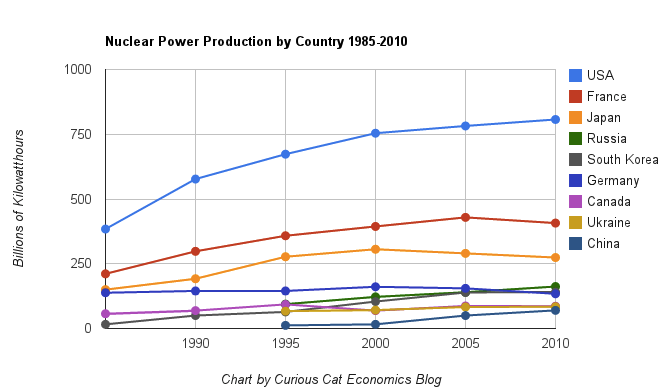
  • Nuclear Power Generation by Country from 1985-2010

    chart of nuclear power generation by the largest producing countries from 1985 to 2010The chart shows the top nuclear power producing countries from 1985 to 2010. The chart created by Curious Cat Investing and Economics Blog may be used with attribution. Data from US Department of Energy.

    ___________________

    Nuclear power provided 14% of the world’s electricity in 2010. Wind power capacity increased 233% Worldwide from 2005 2010, to a total of 2.5% of global electricity needs. Nuclear power generation declined by .72% for the same period.

    Burning coal was responsible for 41% of electricity generation in 2010. Burning natural gas accounted for 21% and hydroelectric generation accounted for 15%.

    Japan just announced that they have closed their last operating nuclear power plant. They have no nuclear power plant generating electricity for the first time in more than 40 years. It will be interesting to see how low their actual generation totals fall this year. They plan to re-open some of the plants but it is a political issue that is far from settled.

    Globally nuclear power production increased 84% from 1985 to 2010. This is a very low percentage. Global output over that period increased much more than that, as did global electricity use. The share of electricity production provided by nuclear power peaked at about 17% for much of the 1990s.

    Related: Nuclear Power Production Globally from 1985 to 2009Oil Production by Country 1999-2009Top 10 Countries for Manufacturing Production from 1980 to 2010: China, USA, Japan, Germany…Japan to Add Personal Solar SubsidiesNuclear Energy Institute (statistics)

    Another view of data on nuclear power shows which of the leading nuclear producing countries have the largest percentages of their electrical generating capacity provided by nuclear power plants (as of 2009). France has 75% of all electricity generated from nuclear power. Ukraine had the second largest percentage at 49%, then Sweden at 37% and South Korea at 35%. Japan is at 28% compared to 20% for the USA. Russia was at 18% and China was at just 2%.

  • Curious Cat Investing, Economics and Personal Finance Carnival #30

    Welcome to the Curious Cat Investing, Economics and Personal Finance Carnival: find useful recent personal finance, investing and economics blog posts and articles. This carnival is different than other carnivals: I select posts from what I read (instead of posting those that submit to the carnival as many carnivals do). If you would like to host the carnival add a comment below.

    • Hospital of Cards by Andrew Foy, MD – “For some perspective on the magnitude of the healthcare bubble consider that from 1990 to 2007 the cost of all items, as measured by the Bureau of Labor Statistics (BLS), rose by 159 percent while housing rose 163 percent and medical care rose a staggering 216 percent. A recent study by the Kaiser Family Foundation found that between 1999 and 2011, health-insurance premiums increased 168 percent while workers’ total earnings increased only 50 percent. Over that same time period, government spending on healthcare increased 240 percent while GDP increased 62 percent. The BLS reported that over the last 50 years, the percent of workers employed in private-sector healthcare has gone from 3 percent to over 11 percent and employment has continued to grow throughout the current recession.”
    • Apple’s Earning are Again Great, Significantly Exceeding High Expectations by John Hunter – Apple posted quarterly quarterly net profit of $11.6 billion (an increase of 94% in net income)… Apple’s Gross margin was 47.4% (the best ever) compared to 41.4% in the year-ago quarter. International sales accounted for 64% of the quarter’s revenue…
    • Demand for Rental Units Could Disrupt Fed by Kathleen Madigan – “The supply among rental housing is the tightest in more than a decade as only 8.8% of units were vacant in the first quarter. And given the steep fall in homeownership rates in the U.S., the demand for rental units is the highest in 15 years.”
    • 5 Reasons Why Dividend Investing Rocks – “Dividend investors always look for high and sustainable dividend growth and any stock that decides to slow that down or even stop growing the dividend entirely raises red flags.”
    • (more…)

  • Apple’s Earning are Again Great, Significantly Exceeding High Expectations

    Apple posted quarterly revenue of $39.2 billion and quarterly net profit of $11.6 billion, or $12.30 per share (an increase of 94% in net income). These results compare to revenue of $24.7 billion and net profit of $6.0 billion, or $6.40 per diluted share, for the same quarter in 2011. Apple’s Gross margin was 47.4% (the best ever) compared to 41.4% in the year-ago quarter. International sales accounted for 64% of the quarter’s revenue.

    Apple sold 35.1 million iPhones in the quarter, 88% unit growth over the year-ago quarter. Apple sold 11.8 million iPads during the quarter, a 151% unit increase over the year-ago quarter. And they sold 4 million Macs during the quarter, a 7% unit increase over the year-ago quarter. Apple sold 7.7 million iPods, a 15% unit decline from the year-ago quarter.

    “Our record March quarter results drove $14 billion in cash flow from operations,” said Peter Oppenheimer, Apple’s CFO. “Looking ahead to the third fiscal quarter, we expect revenue of about $34 billion and diluted earnings per share of about $8.68.” Don’t be surprised to see Apple significantly beat these numbers, they usually provide “estimates” that are far bellow what results turn out to be.

    Apple built their cash stockpile to over $110 billion. Even paying the dividend that they have announced, they are going to be building their cash stockpile going forward without some amazingly large purchases. The announced dividend will cost Apple about $10 billion annually. I wish Apple would increase the dividend. They have also announced a plan to repurchase about $10 billion in stock starting in about 6 months. That would be a huge commitment for most companies, for Apple it seems to be about 2 months of cash the business will generate. I worry they will make foolish purchases just because having that much sitting in the bank makes it so easy.

    The results are again fantastic. Apple’s stock price, relative to earnings, continues to be very reasonable (even cheap). Increases in the stock price have been more than outpaced by profit growth. It does seems profit growth has to slow, and likely dramatically (of course it seemed incredibly unreasonable to expect increases of even 33% of what Apple has done in the last 3 years). The stock price is not expensive, even if earnings growth collapsed, which it isn’t expected to do in the next year. On fundamental factors the stock remains very attractive.

    The biggest risk is that when so much has gone so right for Apple for so long aren’t they poised to suffer some major setbacks? I can accept the case for a dramatic slowing in earning for the iPhone, which is their primary driver of earnings. It is hardly certain but there is this potential. I don’t foresee significant actual declines (earning less in 2013 than 2012, for example). But even assuming no growth in iPhone profits from 2013 to 2016 at this price Apple seems to be a good investment (and few expect no growth for iPhone earning for that period). iPhone sales now account for 58% of Apple’s revenue; three years ago, they totaled 27% of revenue.

    Other areas should be strong in 2012, 2013 and beyond: iPads, Macs, iTunes and App sales. And everyone is expecting some huge new product or products. The leading candidate is a new Apple TV that actually makes a big move into the market. The stock price doesn’t even need some big new product but if it comes that is just more reason to be positive on Apple as an investment.

    I don’t see any signs of troubles brewing. The only reason to be nervous is that it seems crazy that such extraordinary success on such a huge scale can continue. That can explain being nervous but it doesn’t justify missing out on this attractive investment.

    Related: Apple’s Impossibly Good QuarterThe Economy is Weak and Prospects May be Grim, But Many Companies Have Rosy Prospects (Sept 2011)Leadership quotes from Steve JobsIntel Reports Their Best Quarter Ever (March 2010)12 stocks for 10 years portfolio

  • Retirement Planning – Looking at Assets

    The basics of retirement planning are not tricky. Save 10-15% of your income for about 40 years working career (likely over 15%, if you don’t have some pension or social security – with some pension around 10+% may be enough depending on lots of factors). That should get you in the ballpark of what you need to retire.

    Of course the details are much much more complicated. But without understanding any of the details you can do what is the minimum you need to do – save 10% for retirement of all your income. See my retirement investing related posts for more details. Only if you actually understand all the details and have a good explanation for exactly why your financial situation allows less than 10% of income to be saved for retirement every year after age 25 should feel comfortable doing so.

    There is value in the simple rules, when you know they are vast oversimplifications. I am amazed how many professionals don’t understand how oversimplified the rules of thumb are.

    Here is one thing I see ignored nearly universally. I am sure some professions don’t but most do. If you have retirement assest such as a pension or social security (something that functions as an annuity, or an actually annuity) that is often a hugely important part of your retirement portfolio. Yet many don’t consider this when setting asset allocations in retirement. That is a mistake, in my opinion.

    A reliable annuity is most like a bond (for asset allocation purposes). Lets look at an example for if you have $1,500 a month from a pension or social security and $500,000 in other financial assets. $1,500 * 12 gives $18,000 in annual income.

    To get $18,000 in income from an bond/CD… yielding 3% you need $600,000. That means, at 3%, $600,000 yields $18,000 a year.

    Ignoring this financial asset worth the equivalent of $600,000 when considering how to invest you $500,000 is a big mistake. Granted, I believe the advice is often too biased toward bonds in the first place (so reducing that allocation sounds good to me). To me it doesn’t make sense to invest that $500,000 the same way as someone else that didn’t have that $18,000 annuity is a mistake.

    I also don’t think it makes sense to just say well I have $1,100,000 and I want to be %50 in bonds and 50% in stocks so I have “$600,000 in bonds now” (not really after all…) so the $500,000 should all be in stocks. Ignoring the annuity value is a mistake but I don’t think it is as simple as just treating it as though it were the equivalent amount actually invested.

    Related: Immediate AnnuitiesManaging Retirement Investment RisksHow to Protect Your Financial HealthMany Retirees Face Prospect of Outliving Savings

    (more…)

  • Reconsidering Tesco as an Investment

    Tesco is in my 12 stocks for 10 years portfolio. One of the big reasons I bought is management’s commitment to using good management practices, in particular lean thinking (based on Toyota’s management principles). These principles include: investing in the long term, customer focus, respect for employees.

    With those practices in place and the good international expansion potential (including the USA) the opportunities are good (thus I liked the investment). Short term hiccups don’t really bother me. I would rather avoid them but I can accept them. The think that worries me about Tesco is I am becoming less and less convinced they are committed to lean management principles. Instead they seem to just be practicing the same lame management that so many companies employ. They can still be successful that way but the lost value to shareholders is great and makes me very close to deciding to eliminate my investment. I already sold half of the position, last year.

    I now live in Malaysia and the Tesco’s here are horrible. There is no evidence of customer focus. They have lousy “fresh” (often not) vegetables. It is very easy to be sloppy as you expand. They obviously are not concerned enough to practice lean thinking in Malaysia. That is a concern. But large organizations often struggle to manage themselves competently and one small area ignoring lean thinking principles isn’t enough to say Tesco is ignoring them completely. More and more evidence is pointing to Tesco being sloppy and ignore lean thnking, however.

    The main current financial problems are in the home market issues not directly related to lean thinking. Those I could easily chose to wether, if I believe the company is committed to smart lean management principle, but I am not any longer (sadly). For me, I need to see more evidence of commitment to lean principles or I will likely sell out my investment.

    Another problem I have is Amazon was my other retail investment and I have significant valuation concerns – I am closer to selling more than buying more (I have sold some). I have long been looking at Costco – I would have been much better off buying it over Tesco 🙁 I am still considering it (I would love to buy Costco, it is just a valuation concern that holds me back, the company and the future prospects look great).

    I lost no faith in Toyota (another stock in my sleep well portfolio) during the recent struggles. There were some slip-ups. Toyota’s responses were great – just as I would expect. Mainly the stories were greatly overblown.

    Related: Tesco: Consistent Earnings Growth at Attractive PriceApple’s Impossibly Good QuarterTaking a Look at Some Dividend Aristocrats

  • Curious Cat Investing, Economics and Personal Finance Carnival #29

    Welcome to the Curious Cat Investing, Economics and Personal Finance Carnival. The carnival is published twice each month with links to new, related, interesting content online.

    • For Capitalism to Survive, Crime Must Not Pay by Bruce Judson – “Justice must be blind so that both parties — whether weak or powerful — can assume that an agreement between them will be equally enforced by the courts.

      There is a second, perhaps even more fundamental, reason that equal justice is essential for capitalism to work. When unequal justice prevails, the party that does not need to follow the law has a distinct competitive advantage. A corporation that knowingly breaks the law will find ways to profit through illegal means that are not available to competitors. As a consequence, the competitive playing field is biased toward the company that does not need to follow the rules.” (the crony capitalism that has grown in the last few decades in the USA is poisoning the country with a failure to justly prosecute those that break laws if they are rich and connected to the other powerful cronies. This is a serious problem. – John).

    • Don’t Expect to Spend Over 4% of Your Retirement Investment Assets Annually by John Hunter – “This is likely one of the top 5 most important things to know about saving for retirement (and just 10% of the population got the answer right). You need to know that you can safely spend 5%, or likely less, of your investment assets safely in retirement (without dramatically eating into your principle.”
    • What America Pays In Taxes – In 2011 the USA government collected $1,100 billion in personal income taxes, $741 billion in payroll taxes (social security and medicare) [this should be a hint that look only at income taxes paid it might be very misleading – John], $200 billion in corporate taxes, $10 billion in estate and gifts taxes and $268 billion in other taxes (customs duties, excise taxes on products such as gasoline…).
    • Value Investing is Not Necessarily Buy and Hold Investing by Shailesh Kumar – “Value investors choose to buy a stock when it is cheaper than the intrinsic value of the stock and sell it when it becomes more expensive.”
    • (more…)