Blog

  • I Strongly Support Elizabeth Warren and the Consumer Financial Protection Bureau

    I strongly support Elizabeth Warren and strongly support her for to head the Consumer Financial Protection Bureau. She would do a great deal to improve the economy of the USA. And she would do a great deal to improve the life of tens or hundreds of millions of people. We have allowed a few people to bribe our elected officials to distort markets to damage hundreds of millions and provide huge gains for a few. We need to support capitalism not crooked elites breaking capitalism to favor their allies at the expense of the economy and those who want to benefit from free markets. It is very difficult to impede the greed fueled distortions that politicians put in place to break free markets and provide huge benefits to those who pay them. Elizabeth Warren is one of the few that is knowledgeable and skillful enough to reduce the damage those people cause the economy and everyone else.

    Why I Support Elizabeth Warren and the CFPB

    To simplify, government’s retreat from principled and thoughtful regulation licensed investment banks, credit agencies, insurance companies, and Wall Street gurus to put greed above reason. We permitted them to persuade ordinary citizens (and pension funds and homeowners) that securitized instruments, of similar efficacy to carney-sold patent medicines, were worth buying. We also allowed them to sell the idea that wishing could repeal the law that what goes up must come down.

    Nobody is entirely innocent; money’s promise is for most of us a siren’s call. And, as a nation, we’ve willfully scanted education in civic and financial literacy in schools at all levels. So guilt is not worth focusing on. We need instead a future practice of clear rules and tough oversight. And we need to remind ourselves that Adam Smith’s concept of an invisible hand did not contemplate that hand’s picking the pockets of the people whose individual decisions and actions, if the market works perfectly, let supply match demand.

    There are few political appointments I care much about. They normally are so co-opted even if they have good ideas they can’t get anything done. Don Berwick is a great person to have lead health care reform. The system is so messed up I am skeptical he can actually get much done, but I also strongly support him.

    Elizabeth Warren is excellent and wise enough to actually accomplish things even with those who will attempt to thwart and improvements in the financial system that move forward capitalism at the expense of a few nobles that are protected by political allies. I have no doubt those in power will still thwart most efforts to stop politically sanctioned distortion of markets to enrich a few people that then pay a portion of their gains to the politicians that let them ruin free markets for their own huge personal gains.

    Very few political appointees make much difference. If Elizabeth Warren gets this position she will have a good chance and making a huge difference o the quality of life for hundreds of millions of people and the economy overall. That is true even though she will have to continually fight those politicians seeking to protect the anti-competitive benefits they have lavished upon those that pay them to enact policies that benefit them at the expense of everyone else.

    Related: If you Can’t Explain it, You Can’t Sell ItMiddle Class Families from 1970-2005 (webcast of Elizabeth Warren)What the Financial Sector Did to UsPoliticians Again Raising Taxes On Your Children
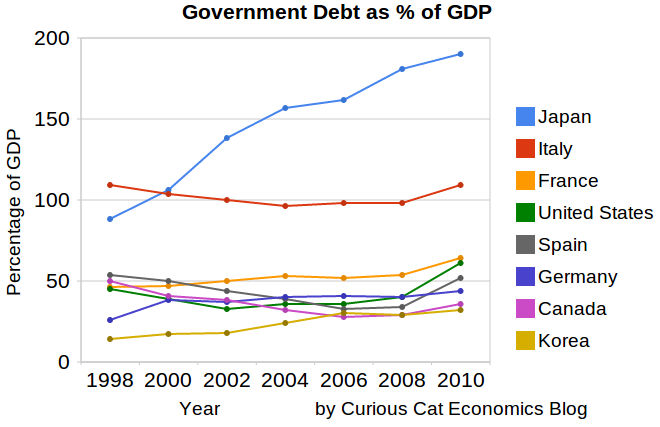
  • Government Debt as Percent of GDP 1998-2010 for OECD

    This chart shows government debt as a percent of GDP based on OECD data. The chart is limited to central government debt issuance and excludes therefore state and local government debt and social security funds.

    Economic data is always a bit tricky to understand. It makes some sense that excluding social security would reduce the USA debt percentage a bit. But these debt as a percentage of GDP are lower than other sources show. There are obviously many tricks that can be used to hide debt and my guess is the main thing going on with this data is OECD intentionally trying to make things look as good as possible.

    Still looking at historical trends in data is useful. And I believe looking at data from various sources is wise. There has been a dramatic increase from 2008-2010. The USA is up from 41% of GDP to 61%. Spain is up from 34% to 52% (but given all the concern with Spain this doesn’t seem to indicate the real debt problems they have.

    Japan and France don’t have 2010 data, so I used a rough estimate of my own based on 2009 data. Greece has been over 100% since 1998 and now stands at 148%, 2nd worst (to Japan) for any OECD country (Europe, North America, Japan and Korea), Italy is 3rd. Ireland is at 61% (up from 28% in 2008). The UK is at 86%, up from 61%.

    Related: Government Debt as Percentage of GDP 1990-2009: USA, Japan, Germany, China… (based on IMF data)Government Debt as Percentage of GDP 1990-2008Government Debt Compared to GDP 1990-2007Top 15 Manufacturing Countries in 2009

  • USA Added 244,000 Jobs in April

    Nonfarm payroll employment rose by 244,000 in April, and the unemployment rate edged up to 9.0% (from 8.8%) as the labor force grew slightly, the U.S. Bureau of Labor Statistics reported today. Also the number of jobs added is taken from the household survey while the unemployment rate is taken from the business payroll survey (they often have slightly different readings month to month). I, and many others, suspected the 8.8% figure might have been a bit low (and frankly the 9% figure may as well). In April of 2010 the unemployment rate was at 9.9%.

    The change in total nonfarm payroll employment for February was revised from +194,000 to +235,000, and the change for March was revised from +216,000 to +221,000. Bringing the total jobs added with this report to 290,000 (244,000 + 41,000 + 5,000) – which is a very good result. Now if we can keep this up for a year that would be great. Overall this provides very encouraging news on the job front.

    The number of unemployed persons stands at 13.7 million, up a little in April. Unemployment rates for several groups stood at: adult men 8.8%, adult women 7.9%, teenagers 24.9%, whites 8.0%, blacks 16.1%, Hispanics 11.8% and for Asians was 6.4%.

    In another positive sign, the number of long-term unemployed (those jobless for 27 weeks and over) declined by 283,000 to 5.8 million; their share of unemployment declined to 43.4%. This is still a serious problem, but at least it is improving a bit.

    The civilian labor force participation rate was 64.2% for the fourth consecutive month. The employment-population ratio, at 58.4%, changed little in April.

    The private sector added 268,000 jobs. Employment rose in a number of service-providing industries, manufacturing, and mining. Since a recent low in February 2010, total payroll employment has grown by 1.8 million. Private sector employment has increased by 2.1 million over the same period.

    Manufacturing employment rose by 29,000 in April. Since reaching an employment low in December 2009, manufacturing has added 250,000 jobs, including 141,000 in 2011. This is more great news. There has been real strength in manufacturing. Manufacturing is a real source of strength and if it can continue to be strong that will be very good news.

    Related: USA Adds 216,00 Jobs in March and the Unemployment Rate Stands at 8.8%USA Added 290,000 Jobs In April 2010Unemployment Rate Increased to 8.9% in April 2009USA Unemployment Rate Rises to 8.1%, Highest Level Since 1983
    (more…)

  • Amazon Keeps Spending, Sales Growing But Not Income

    I think Amazon is a great company and Jeff Bezos is a great leader. I sold the stock I had in Amazon hoping that prices would fall and I could buy it back (I sold a small portion held in my 12 stock for 10 year portfolio). So far that hasn’t worked. The latest earnings from Amazon were more of the same. Very good revenue growth (up 38% to $9.86 billion). Very large increases in spending. And bad earnings news (net income down 33% year over year). I think this is due to smart choices by Amazon (I would be a bit more focused on current earnings but I understand the vision of Bezos and it is very wise and support it).

    Normally the stock market punishes this type of pattern. Even Google, that has a similar pattern (but with much better earnings growth), has a stock price that has been held back much more. This quarter investors again punished Google for good earning growth but also high expense growth. Amazon avoided that response, even with shrinking earnings and guidance of lower earnings. Jeff Bezos wrote about these decisions to invest in increasing expenses in Amazon’s shareholder letter

    The advances in data management developed by Amazon engineers have been the starting point for the architectures underneath the cloud storage and data management services offered by Amazon Web Services (AWS). For example, our Simple Storage Service, Elastic Block Store, and SimpleDB all derive their basic architecture from unique Amazon technologies.

    All the effort we put into technology might not matter that much if we kept technology off to the side in some sort of R&D department, but we don’t take that approach. Technology infuses all of our teams, all of our processes, our decision-making, and our approach to innovation in each of our businesses. It is deeply integrated into everything we do.

    And we like it that way. Invention is in our DNA and technology is the fundamental tool we wield to evolve and improve every aspect of the experience we provide our customers. We still have a lot to learn, and I expect and hope we’ll continue to have so much fun learning it. I take great pride in being part of this team.

    Operating cash flow increased 9% to $3.03 billion for the trailing twelve months, compared with $2.78billion for the trailing twelve months ended March 31, 2010. Free cash flow decreased 18% to $1.90 billion for the trailing twelve months, compared with $2.32 billion for the trailing twelve months ended March 31, 2010.

    Operating income was $322 million in the first quarter, compared with $394 million in first quarter 2010. Net income decreased 33% to $201 million in the first quarter, or $0.44 per diluted share, compared with net income of $299 million, or $0.66 per diluted share, in first quarter 2010.

    I continue to think Amazon is being a bad corporate citizen by fighting efforts to have Amazon play its proper role in the collection of sales tax. Ethics mean doing the right thing even if it costs you something personally. Amazon continues to act as an organization that fights what is right for society for their own greedy reasons. This is the worst behavior Bezos continues to push and does indicated a refusal to accept the responsibilities of participation in a society. Overall I believe Bezos does many great things but this disrespect for our society is a serious ethical problem.

    Related: Amazon Soars on Good Earnings and Projected Sales (Oct 2009)12 Stocks for 10 Years: Feb 2011 UpdateAnother Great Quarter for Amazon (July 2007)Amazon’s Bezos on Lean Thinking

  • Personal Finance Basics: Long Term Disability Insurance

    Most people know living without health insurance is very risky (and shouldn’t be done). But people are much less aware of the importance of long term disability insurance. The census bureau estimates that you have a 20% chance you will be disabled in your lifetime. A disability can decrease your earning power and also can increase your expenses (to cope with your disability). In my opinion your emergency fund is best used for short term disability insurance.

    One of the most important things you can do is be sure you have disability coverage. In the USA about 50% of the jobs provide coverage. If your job does not you should get insurance yourself. Many companies may not pay for disability insurance but may allow you to pay for it (this often can be the best option as the company can gain a better price than individuals but you have to check out the details). Also social security includes some disability insurance coverage but it is very limited. Relying on social security alone is not wise. For one thing it does not protect you from being unable to do your current job but will only pay benefits if you are unfit to do any job.

    There are numerous factors to consider for disability insurance. Normally a long term disability insurance policy will pay 50-60% of your salary (be sure to check and see, and check if there is any cap). The terms of the policy will also determine how long you will be paid, being paid until at least 65 is what I would suggest – but some only pay for a limited number of years.

    Often policies will offer pro-rated benefits if you earning power is reduced by a disability but you are still able to earn something. So you may have a policy that pay 60% of your original salary but if you make 50% of your previous salary then the payout is reduce to say 20%. So if you originally made $80,000 and now, due to a disability (not just losing your job), you could no longer do your job but could do one that paid less – say $40,000. You would then get your new salary of $40,000 + $16,000 in disability payments or $56,000.

    Another detail you should check is whether the payments you will receive are indexed to inflation. In addition, make sure the policy is guaranteed renewable. You also want to buy from a reputable insurance company (check AM Best, Moody’s, Weiss rating agencies). It doesn’t help to have a guaranteed renewable policy if the insurance company goes out of business.

    Another thing to consider is buying additional disability coverage. For example, if your company provides a 60% coverage policy it is often possible to purchase addition coverage (to provide additional benefits of 10% or 20% or more of your current salary).

    A rough guide is disability insurance will cost 1-2% of the income replaced. For example, a policy replacing $50,000 per year of annual salary would cost about $1,000 per year. Of course, the older or sicker you are the higher the cost. Premiums are based on risk factors, so if you have health risks that will cost more. And, as age is a significant disability factor, the older you are the higher the cost will be.

    Remember if you have disability insurance through work, and lose you job you need to get your own disability insurance. This is yet another reason to have an adequate emergency fund.

    Related: Personal Finance Basics: Long-term Care InsurancePersonal Finance Basics: Health InsuranceHow to Protect Your Financial HealthLife Happens: disability insurance

  • Inflation Shows Up in Huge Commodity Price Increases

    Gold and Silver at up dramatically in the last year. Food prices are up dramatically.

    The World Bank Development Prospects Group shows food price changes Q1 2010 to Q1 2011

    Increase
    Maize (corn) 74%
    Wheat 69%
    Soybeans 36%
    Beef 36%
    Rice -2%

    If food is 10% of your expenses and food overall has inflation of 30% that only increases your expenses 3%. If food is 50% of your income and goes up 30% that increases your expenses 15%. In the USA people spend about 10% disposable income on food (much of that though is really processing the food not the raw material). Spending in Japan on food is 19%, France 16%, China 33% and India 46%. 50% if what most of the people in the world spend. Those people are poor and don’t have the resources to pay more. This is why food prices are so critical. Governments fall from such rises in basic food prices. Also remember even in a country like the USA, where the average is 10% nearly 30% of people spend over 20% of disposable income on food. There are large variances not only between countries but within countries.

    What matter most is local food prices, but global food prices impact the prices in countries. Though many governments subsidize food prices – when food costs more than 30% of people’s income I think not doing so (when prices rise dramatically) would be crazy. When food costs 5% the government really doesn’t need to be involved.

    Inflation is a serious threat to economies in the next few years. Food inflation for non-rich countries is a huge problem now.

    Related: Food and Energy Costs July 2008Food Price Inflation is Quite HighYou Can Help Reduce Extreme PovertyCreating a World Without PovertyEthanol: Science Based Solution or Special Interest Welfare

    Food Price Watch by the World Bank
    (more…)

  • Google’s Earnings Grow 17%, but Investors Unhappy

    Google again had some pretty spectacular earnings. Google reported revenues of $8.58 billion for the quarter ended March 31, 2011, an increase of 27% compared to the first quarter of 2010. GAAP net income in the first quarter of 2011 was $2.30 billion, compared to $1.96 billion in the first quarter of 2010. Non-GAAP net income in the first quarter of 2011 was $2.64 billion, compared to $2.18 billion in the first quarter of 2010.

    Operating expenses, other than cost of revenues (which are essentially just a revenue split with sites showing Google ads), were $2.84 billion in the first quarter of 2011, or 33% of revenues, compared to $1.84 billion in the first quarter of 2010, or 27% of revenues. The growth in expenses and reduction in the profit margin is the biggest concern for invests and why Google’s stock is down 6% today.

    GAAP operating income in the first quarter of 2011 was $2.80 billion, or 33% of revenues. This compares to GAAP operating income of $2.49 billion, or 37% of revenues, in the first quarter of 2010. Non-GAAP operating income in the first quarter of 2011 was $3.23 billion, or 38% of revenues. This compares to non-GAAP operating income of $2.78 billion, or 41% of revenues, in the first quarter of 2010.

    Google-owned sites generated revenues of $5.88 billion, or 69% of total revenues, in the first quarter of 2011. This represents a 32% increase over first quarter 2010 revenues of $4.44 billion. Google ads on other companies web sites grew at a 19% rate. Revenues from outside of the United States totaled $4.57 billion, representing 53% of total revenues in the first quarter of 2011, compared to 52% in the fourth quarter of 2010 and 53% in the first quarter of 2010.

    From 2006 to 2010 Google’s revenue grew at a 29% annual rate, as did net income. The price of the stock was $460 on December 31, 2006. For 2006 per share earnings were $9.94. At the end of 2010 Google sold at $594 and in 2010 earnings per share were $26.31. Today the price is $535. Yes it is likely earnings will not grow at a 29% annual rate over the next 5 years (and this quarter they grew at 17% – so slower than the previous 4 years). 17% is hardly a bad performance.
    (more…)

  • Banks Hoping they Paid Politicians Enough to Protect Billions in Excessive Fees

    USA consumers pay huge fees on debit cards not found in most other rich countries. Other countries provide debit cards with much cheaper fees than USA banks mandate now given their anti-competitive oligopolistic pricing power. I haven’t seen anyone (that isn’t in the pay of banks) arguing for keeping excessive fees in place. But there are lots of people being paid by the banks (including most likely, “your” representative).

    Banks want a favor — at your expense

    The big banks are pressing Congress for a favor that will cost the average American household $230 a year. The bankers argue that the favor is needed to support small community banks. But since the lion’s share of the favor will be collected by just four banks, it might be cheaper to subsidize community banks with a check direct from the Treasury.

    David Frum, special assistant to President George Bush, is exactly right.

    Banks charge an average of about 1% on debit card transactions. In Australia, where swipe fees are regulated, banks charge half as much — and still earn a profit.

    [banks] are lobbying hard to repeal the cap on debit card fees in advance of the July date when Dodd-Frank goes into effect… Congress is not swayed by arguments. It is swayed by clout — and on this issue, it is the banks who have the clout.

    Based on that experiment, economist Robert Shapiro of Sonecon estimates that about 56% of the value of reduced swipe fees will reach the final consumer. That’s the basis for his calculation of savings of $230 per household. That’s also the basis for his further calculation that reduced swipe fees will translate into a one-time gain of 250,000 new jobs.
    The new Republican House majority appropriately mistrusts government regulation. But if the financial crisis taught us anything, it should have taught that financial regulation is different from other forms of regulation. Invisible charges imposed by a financial cartel is not my idea of a free market.

    The caps were part of the huge bailout taxpayers gave banks and were meant to be a partial watering down of a few of the smaller favors their bought and paid for politicians had given them over the years (as “punishment” for their misdeeds).
    (more…)

  • The USA Can’t Afford to Pay for the Current Health Care System

    The very frustrating aspect of the broken health care system in the USA is that it has been an enormous problem for decades. It isn’t that we have just discovered we have a fatally poor health care system in the last few years. The broken system has been obvious for decades and keeps getting worse. Thankfully in the last few years more and more of those with clout in the current economic system are standing up to demand improvement.

    Costs need to be removed from the system. Hundreds of billions a years should easily be removable by reducing paperwork and reducing waste in the system. As you say some reduction will also have to come in limiting spending that is being done now for worthwhile and worthless procedures. That should also easily save hundreds of billions a year. However in the decades of allowing this broken system to get worse and worse, it is not at all certain that merely taking $500 billion a year out of the costs will be enough.

    It might well require eliminating even more medical work and reducing the income of those that are taking from the system now. My guess is the most logical places for reducing income come from massively overpriced drugs, overpaid specialists, overpaid executives in insurance companies. I suppose some might think nurses should be paid less, that isn’t my belief, but we will see what happens.

    As sensible management of the system is adopted, over time, increasing the saving from eliminating waste should grow. Unfortunately we have wasted decades and so counting on us acting responsibly and adopting a focus on eliminating waste can’t be expected until we show a good 10-15 years of systemic effort on that front.

    In response to: Paying for health care

    Related: USA Spends Record $2.5 Trillion, $8,086 per person 17.6% of GDP on Health Care in 2009articles on improving the health care system in the USABroken Health Care System: Self-Employed InsuranceHealth Insurers Propose Pricing and Coverage Without Respect to Health

  • Apartment Vacancies Fall to Lowest in 3 Years in the USA

    Apartment Vacancies in U.S. Fall to Lowest in Almost Three Years

    The vacancy rate declined to 6.2 percent from 8 percent a year earlier and 6.6 percent in the fourth quarter of 2010, the New York-based research firm said in a report today. The rate was the lowest since it reached 6.1 percent in the second quarter of 2008.

    Effective rents, or what tenants actually pay, increased in 75 of the 82 markets Reis tracks, to an average $991 a month from $967 a year earlier and $986 in the fourth quarter. Landlords’ asking rents also climbed, to $1,047 from $1,027 a year earlier and $1,043 in the previous quarter, according to the report.

    San Jose, California, had the most growth in effective rents during the past year, with 5.2 percent, followed by suburban Virginia and New York City, according to Reis. Effective rents declined 1.5 percent in Las Vegas during the year and grew the least in Orlando, Florida; and Colorado Springs, Colorado.

    Rents have been slowly recovering the last year, after the economic shocks of the credit crisis. People, moved back into parents house and more people started sharing apartments and houses in the last few years as people where thrown out of jobs due to the after effects of the financial actions by large financial institutions. Slowly the economy has been recovering and jobs have been slowly growing and as a result the rental market has been strengthening .

    Also the decline in construction the last few years has decreased the normal addition to supply. At the same time the population has continued growing. Some areas of the country seem to still have a large overcapacity in housing but areas that are adding jobs (such as Northern Virginia and New York City) are seeing increasing rents.

    I have 2 properties for rent in Arlington, Virginia.

    Related: Landlords See Increase in Apartment Rentals (July 2010)USA Housing Inventory Puts Pressure on Prices (Sep 2010)Apartment Rents Rise, Slightly, for First Time in 5 Quarters (Apr 2010)It’s Now a Renter’s Market (Apr 2009)Housing Rents Falling in the USA (Feb 2009)