Blog

  • Executives Again Treating Corporate Treasuries as Their Money

    A huge problem with current practices at American companies is that senior executives believe they personally are due what the company earns. The repeated ethical lapses perpetrated by the senior executives and supported by their well paid board continues to undermine the economy of the country.

    Two events last week illustrate the level of disconnection with reality the current crop of ethically challenged senior executives.

    First, we have the senior executives at the too big to fail financial institutions that did fail and were bailed out by taxpayers. We all know the economic calamity caused by these executives, throwing millions of people out of work, adding huge burdens to already overburdened future taxpayers with the huge spending governments engaged in, in order to successfully avoid what would have been a depression. Fewer people realize the government has been systemically transferring money to these large, too big to fail financial institution from millions of savers with policies directly providing billions in profits to all the large financial institutions that had failed.

    So what did the senior executives that failed as spectacularly as anyone has ever failed economically in history do last week? They paid themselves tens of millions of dollars, paid for by all those who have received artificially lowered rates (through action by the Federal Reserve in order to save the economy and reward their member banks) on their savings which provided billions in profit to the failed large financial institutions. Just like 5 years ago, as they were doing their best to take such detrimental actions that would cause a depression (but for the government saving us from that outcome) they again use the excuse that they are just doing what all their colleagues are doing.

    The lack of honor of these men is amazing. And the lack of honor of those who continue to treat these people as anything but pariahs is amazing. That we continue to pursue policies that enable and enrich too big to fail financial companies on the backs of those that save and in so doing provide billions in profits for the executives to treat as their personal bank accounts is sad.

    The compatriots of those senior executives at Transocean showed the same disregard for honor, accuracy and truth. First, who is Transocean?

    A presidential commission concluded that the explosion [in the Gulf of Mexico last year] had been caused by cost-cutting and directly blamed Transocean, BP and Halliburton for the disaster.

    So with what was one of the worst (if not the worst) economic safety failures ever and 11 deaths in the explosion, this is what Transocean senior executives say, in their SEC filings:

    “Notwithstanding the tragic loss of life in the Gulf of Mexico, we achieved an exemplary statistical safety record as measured by our total recordable incident rate and total potential severity rate,” the report says.

    “As measured by these standards, we recorded the best year in safety performance in our company’s history, which is a reflection on our commitment to achieving an incident free environment, all the time, everywhere,” it adds.
    (more…)

  • USA Adds 216,00 Jobs in March and the Unemployment Rate Stands at 8.8%

    Nonfarm payroll employment increased by 216,000 in March, and the unemployment rate stands at 8.8%, the U.S. Bureau of Labor Statistics reported today. Revisions for January and February were very small (adding 5,000 jobs to the January totals and 2,000 to February). Since a recent low in February 2010, total payroll employment has grown by 1.5 million.

    This is more good news though the economy needs to add jobs more quickly to make a significant dent in the jobs lost since the misdeeds of large financial institutions precipitated the credit crisis and threw so many people out of work.

    Job gains occurred in professional and business services, health care, leisure and hospitality, and mining. Employment in manufacturing continued to trend up.

    Household Survey Data

    The number of unemployed persons (13.5 million) and the unemployment rate (8.8%) changed little in March. Since November 2010, the jobless rate has declined 100 basis points. Among the major worker groups, the unemployment rates are, for adult men, 8.6%; adult women, 7.7%; and for teenagers 24.5%.

    The number of long-term unemployed (those jobless for 27 weeks or more) was 6.1 million in March; their share of the unemployed increased from 43.9 to 45.5% over the month. In November of 2010 they accounted for 41.9% of the unemployed. In March of 2010 there were 6.5 million, which was 44.1% of all unemployed.

    In March, the civilian labor force participation rate held at 64.2%, which was down from 64.9% in March of 2010, and 65.8% in April of 2009.

    Related: Another 663,000 Jobs Lost in March, 2009Global manufacturing employment data 1979-2007Unemployment Rate Increased to 8.9% (May 2009)USA Added 162,000 Jobs in March, 2010

    Establishment Survey Data
    (more…)

  • Top Countries For Renewable Energy Capacity

    I believe it is wise from an environmental and economic viewpoint to invest in renewable energy projects. I believe the costs of fossil fuel based energy will continue to increase. Renewable energy is continuing to improve and when considering the negative externalities caused by oil, gas and coal and the continuing improvement in wind, solar and geothermal generation investment in renewable energy are going to payoff well for countries.

    Top countries for installed renewable energy capacity
    Rank Country Capacity (GigaWatts)
    1 China 103.4
    2 USA 58.0
    3 Germany 48.9
    4 Spain 27.8
    5 Japan 26.0
    6 India 18.7
    7 Italy 16.7
    8 Brazil 13.8
    9 France 9.6

    The largest increases in renewable energy capacity by country from 2005 to 2010 are: China (up 106%), South Korea (up 88%), Turkey (up 85%), Germany (up 67%), Italy and Japan (up 45%). All the data is from the Pew Clean Engery Program report: Who’s Winning the Clean Energy Race? (pdf).

    In 2010, [China] accounted for almost 50 percent of global clean energy superpower. The nation’s all manufacturing of solar modules and wind ascendance has been steady and steep. In turbines. China’s installation of less than 1 GW of 2005, China attracted less than $3 billion worth of private investments in clean energy. In 2009, solar energy capacity demonstrates that most of its production is for export markets. In contrast, 17 GW of wind energy was installed in China in 2010 helping the nation move quickly toward its 2020 target for installing 150 GW of wind. In fact, China accounted for 47 percent of all wind energy investments globally, with $45 billion tallied. Similarly, China led the world in asset financing, with $47.3 billion in private investments directed toward installation of clean energy generating capacity.

    India is poised to take a leadership role in the solar sector, with a target of deploying 20 GW by 2020. In 2010, the country set about getting its National Solar Mission in place by permitting 0.5 GW worth of large solar thermal capacity and a modest 150 MW worth of photovoltaic (PV) solar.

    My guess is that the stimulus packages in several countries contributed greatly to the increases (notably Germany and Italy targeted green investments – as did China to some extent, in Wind Energy). Spain took a hit as debt levels caused the government to cut spending. I would imagine this is likely to happen in Italy (and was expected to happen in Germany – the extent of decreases is less certain after the earthquake in Japan).

    Related: Chart of oil consumption by country from 1990-2009Wind Power Capacity Up 170% Worldwide from 2005-2009Japan to Add Personal Solar Subsidies (2008)Chart of Top Nuclear Power Generating Countries from 1985 to 2009Wind Power has the Potential to Produce 20% of Electricity Supply by 2030

    (more…)

  • Earning More Money

    Earning more is an important and simple idea that is ignored far to often. Simple, doesn’t mean, easy, just easy to understand. This is something people should definitely consider in their personal financial planning.

    There is a important caveat to remember, people earning a lot of money often have large financial problems and go bankrupt. Earning more if you borrow more than you earn and rely on ever increasing earnings can make you even more venerable than those earning less. A significant factor is how likely you are to replace your current earning if you need to find a new job.

    There is also another concern to watch for – don’t become a slave to your desire to earn more. The reason to earn more is to improve your life long situation. If you sacrifice what you enjoy too much it becomes a bad trade off. Short term sacrifices may well be wise. But many people find themselves in decades long sacrifices to try and get ahead. This isn’t a good plan.

    Making money online can be enjoyable and rewarding. However, it isn’t easy. I am putting more effort into this area and will be doing a great deal more in the next year. We will see how successful I am.

    Related: Earn more money. It matters more than everything else combined.10 Jobs That Provide a Great Return on InvestmentEarn More Money to buy luxuries (don’t go into debt)High Expectations
    (more…)

  • Buffett Cautions Against Buying Long Term USD Bonds

    This is another article supporting my belief that long term bonds are not investments I want to take on now. The risks of inflation and low yields seem like a very bad combination.

    Buffett Says Avoid Long-Term Bonds Tied to Eroding Dollar, quoting Warren Buffett:

    “I would recommend against buying long-term fixed-dollar investments”

    “I would much rather own businesses,” he said. “It’s very easy to take away the value of fixed-dollar investments.”

    By “take away” he mean the government can undertake policies to “inflate” their way out of a budget mess. By undertaking policies that create inflation (drastically increasing the money supply, borrowing huge amounts of money, running huge trade deficits…) the country can devalue the currency, the US dollar in this case, and thus reduce the effective cost of the payments they have to make on long term bonds (because they pay back the loans with devalued, inflated, dollars). I believe he is right and long term USD bonds are a very risky (inflation risk) investing option today. Of course I have felt the same way for the last 5 years. I own very little in the way of bonds – I do own a bit of TIPS (Treasury Inflation-Protected Securities), in my 401(k) – but stopped allocating money to that class in the last year.

    Related: Bill Gross Warns Bond Investors (March 2010)Bond Yields Stay Very Low, Treasury Yields Drop Even MoreWho Will Buy All the USA’s Debt?

  • Consumer and Real Estate Loan Delinquency Rates 2000-2010

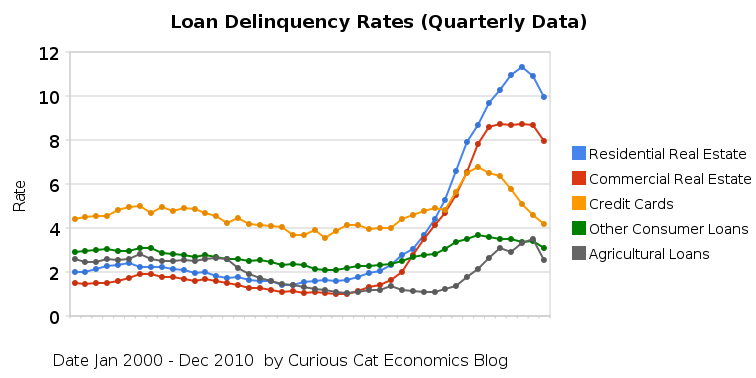
    The chart shows the total percent of delinquent loans by commercial banks in the USA.

    chart showing consumer and real estate loan delinquency rates from 2000 to 2010

    The second half of 2010 saw real estate, agricultural, credit card and other loan delinquencies decrease. The rates are still quite high but at least are moving in the right direction. Residential real estate delinquencies decreased 138 basis points in the second half of 2010, to 9.94%, which brought them to just below the rate at the end of 2009. In the second half of 2010, commercial real estate delinquencies decreased 77 basis points to 7.97% (which was also exactly 77 basis points less than at the end of 2009. Agricultural loan delinquencies decreased 76 basis points, to 2.55% (down 53 basis points from the end of 2009). Consumer loan delinquencies decreased, with credit card delinquencies down 90 basis points to 4.17% and other consumer loan delinquencies down 27 basis points to 3.1%. The credit card delinquency rate decreased a very impressive 219 basis points in 210.

    Related: Real Estate and Consumer Loan Delinquency Rates 2000 through June 2010Real Estate and Consumer Loan Delinquency Rates 1998-2009Bond Rates Remain Low, Little Change in Late 2009posts with charts showing economic data
    (more…)

  • Retirement: Roth IRA Earnings and Contribution Limits

    For 2010 and 2011, the most that an individual can contribute to a traditional IRA or Roth IRA generally is the smaller of: $5,000 ($6,000 if the individual is age 50 or older), or the individual’s taxable compensation for the year. You have until your taxes are due (April 15th, 2011) to add to your IRA for 2010.

    This is the most that can be contributed regardless of whether the contributions are to one or more traditional or Roth IRAs or whether all or part of the contributions are nondeductible. However, other factors may limit or eliminate the ability to contribute to an IRA as follows:

    • An individual who is age 70½ or older cannot make regular contributions to a traditional IRA (just to make things complicated you can add to a Roth IRA) for the year.
    • Contributions to a Roth IRA are limited based on income. The limits are based on modified adjusted gross income (which is before deductions are taken). The Roth IRA earnings limits for 2010 are:

    • Single filers: Up to $105,000; from $105,000 – $120,000 (a partial contribution is allowed)
    • Joint filers: Up to $167,000; from $167,000 – $177,000 (a partial contribution)

    For 2011 the earning limits increase to

    • Single filers: Up to $105,000; from $107,000 – $122,000 (a partial contribution is allowed)
    • Joint filers: Up to $167,000; from $169,000 – $179,000 (a partial contribution)

    More details from the IRS website and earning limits details.

    The income limits do not cap what you can add using a 401(k). So if you were planning on adding to a Roth IRA but cannot due to the income limits you may want to look into increasing your 401(k) contributions.

    Related: Add to Your Roth IRAAdd to Your 401(k) and IRA401(k)s are a Great Way to Save for Retirement

  • Nuclear Power Production by Country from 1985-2009

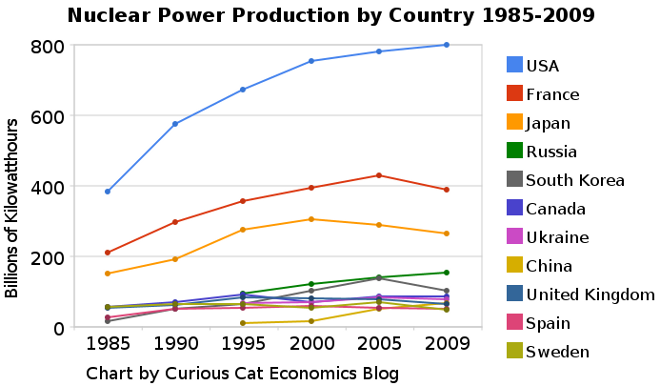
    chart of nuclear power production: 10 largest countries 1985-2009The chart shows the leading nuclear power producing countries from 1985-2009. The chart created by Curious Cat Investing and Economics Blog may be used with attribution. Data from US Department of Energy.
    ___________________

    Nuclear power provided 14% of the world’s electricity in 2009. Wind power capacity increased 170% Worldwide from 2005-2009, to a total of 2% of electricity used (38,025 Megawatts of capacity). The USA produced nearly twice as much electricity using nuclear power than any other country, which surprised me.

    Another view of data on nuclear power shows which of the leading nuclear producing countries have the largest percentages of their electrical generating capacity provided by nuclear power plants (as of 2009). France has 75% of all electricity generated from nuclear power. Ukraine had the second largest percentage at 49%, then Sweden at 37% and South Korea at 35%. Japan is at 28% compared to 20% for the USA (I am surprised these are so close _ would have thought France and Japan would be much closer). Russia is at 18% and China was at just 2%. As of January 2011, 29 countries worldwide are operating 442 nuclear reactors for electricity generation and 65 new nuclear plants are under construction in 15 countries. Source, Nuclear Energy Institute.

    From 1985 to 2009, USA production increased 108%, France 84% and Japan up 77%. South Korea is up 550% (from a very low starting point). Globally nuclear power production increased 80% from 1985 to 2009. From 2000-2009 production increased 5% in the USA and decreased by 1% in France and 13% in Japan. China was up 318% (from a very low level) from 2000-2009 (they did not have nuclear power capacity prior to 1995.

    The global capacity of nuclear power was scheduled to increase more rapidly in the future before the earthquake in Japan and the crisis at the Kashiwazaki-Kariwa Nuclear Power Plant. China was going to add a great deal of capacity and is likely to over the next few years (nuclear power plants take many year to bring online so those coming online in the next few years have already had hundreds of millions invested in building them). Several European countries have already announced temporary closing of some plants (especially some plants nearing the end of their originally scheduled lives – which those countries had been in the process of extending).

    As a comparison global oil production increased by 10.5% from 1999-2009, while nuclear global production increased by 5% from 2000-2009. From 1999-2009 USA oil production decreased 7%. Russia increased production 62% in the decade, moving it into first place ahead of Saudi Arabia that increased production 10%.

    Related: Oil Production by Country 1999-2009Oil Consumption by Country 1990-2009Japan to Add Personal Solar SubsidiesSolar Thermal in Desert, to Beat Coal by 2020

  • Dishonest and Dangerous State Budgets

    Bill Gates is really doing some great stuff the last few years. He takes a look at the enormous problem with state government’s failure do deal with the very long term health care failure in the USA (this has been going on for the last few decades) and the financial games them play. His Twitter quote is: Enron would blush at the financial untruth State governments engage in.

    I have written about these problems before, including in: USA State Governments Have $1,000,000,000,000 in Unfunded Retirement Obligations. One small (compared to the problem for the whole country) He notes is that California has a $62.5 billion health care liability and $3 billion set aside for it.

    We have been doing a very bad job of electing people to honest manage budgets. We, or our children and grandchildren are going to pay for those failures. The longer we fail to elect people that will deal with the real decisions that need to be made for government spending and taxing the greater those bills for our mistakes will be.

    Related: Are Municipal Bonds Safe?USA Heath Care System Needs ReformUSA Spends Record $2.5 Trillion, $8,086 per person 17.6% of GDP on Health Care in 2009The USA Pays Double for Worse Health ResultsThe Long-Term USA Federal Budget Outlook

  • Oil Production by Country 1999-2009

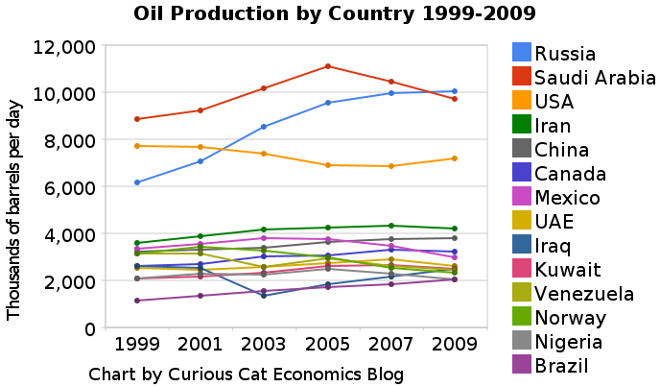
    The chart shows the oil production over the last decade by the top oil producing countries. Production totals include crude oil, shale oil, oil sands and NGLs (the liquid content of natural gas where this is recovered separately). Excludes liquid fuels from other sources such as biomass and coal derivatives.

    chart showing oil production by top producing countries (1999-2009)The chart shows the leading oil producing countries from 1999-2009. The chart created by Curious Cat Investing and Economics Blog may be used with attribution.

    ___________________
    The chart show 3 clear leaders in production Russia, Saudi Arabia and the USA (with the USA firmly in 3rd place). Those 3 were responsible for approximately a third of the total oil production in 2009. Russia greatly increased production. During the last decade world production increased from 72 million barrels a day to 80 million barrels a day. Russia accounted for 51% of the increase, close to 4 million barrels a day.

    The next 11 countries are pretty closely grouped, with slightly increasing production over the period as a group. Brazil, the last country with over 2 million barrels of production a day in 2009, has the largest percentage increase in the period, producing 79% more in 2009 than they did in 1999. Russia increase production 62% over the period. The other countries ranged from a 23% increase (Canada) to a 25% decrease (Norway). The USA increased production 7% and China increased production 18%. World production increased 11%.

    Last year I posted a chart showing oil consumption by the top oil consuming countries over the last 2 decades; showing all countries using over 2 million barrels of oil a day. The USA consumed 18.7 million barrels a day in 2009. Only China was also over 5 million barrels, using 8.2 million in 2009. Japan was next at 4.4 million.
    (more…)