Blog

  • Top 15 Manufacturing Countries in 2009

    China continues to grow manufacturing is output. In 2009, the USA, and most countries saw declines in manufacturing production. China, however, continued to grow. China is now finally approaching the level of manufacturing done in USA. The latest data again shows the USA is the largest manufacturer but China looks poised to take over the number one spot soon.
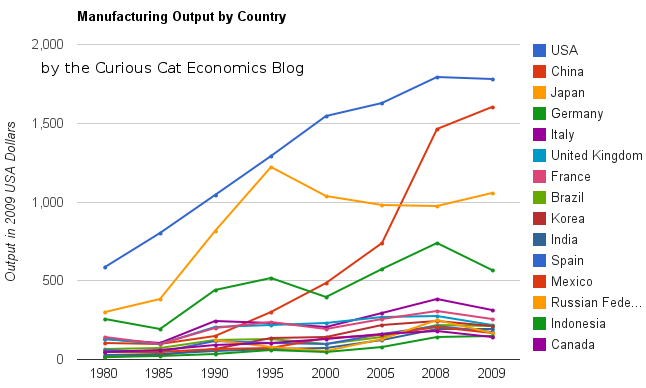
    chart of manufacturing production by leading manufacturing countries
    The chart showing manufacturing output by country was created by the Curious Cat Economics Blog based on UN data (in 2009 USA dollars). You may use the chart with attribution.

    The large decline in Germany was 23%. This was a 18% decline in Euro terms, and when you added the decline of the Euro the total USA dollar decline was 23%. Quite extraordinary. Most European countries were down over 15%. In fact, so extraordinary it makes me question the data. World economic data is useful and interesting but it isn’t perfect. USA manufacturing declined just .5%. China increased manufacturing production by 9%.

    The last 2 years, China has stopped separating out mining and utilities from manufacturing. The percentage of manufacturing (to manufacturing, mining and utilities) was 78% for 2005-2007 (I used 78% of the manufacturing, mining and utilities figure provided in the 2008 and 2009 data – but that could be wrong). The unadjusted 2009 China total was $2.05 trillion and for the USA the total manufacturing, mining and utilities was $2.33 trillion. In 2009, the manufacturing total was 76% of USA manufacturing, mining and utilities. The percentage varies significantly between countries (the Russian federation is about 55% and Japan about 91%) and various over time as a countries economy changes.

    The big, long term story remains the same. China has continued to grow manufacturing output tremendously. I see very little data to support the stories about manufacturing having to leave China to go elsewhere (especially when you look at the “lower wages” counties mentioned in news stories – they are not growing at any significant rate). The USA is still manufacturing a huge amount and that production has steadily grown over time.

    When you look back over the period from 1980 to today you can see

    1. The biggest story is the growth in Chinese manufacturing
    2. The USA started out the largest and has grown significantly
    3. Japan did very well from 1980 to 1995, and since they have struggled
    4. The USA, China, Japan are really far ahead of other countries in total manufacturing output, and Germany is solidly in 4th place.
    5. After that the countries are fairly closely grouped together. Though there are significant trends hidden by the scale of this graph, which I will explore in future posts. South Korea has growth significantly over this period, for example.
    6. The biggest macro trend that the data shows, but is not so visible in this chart (other than China’s growth), is the very strong performance of emerging markets (and in fact some counties have fully become manufacturing powerhouses during this period, most notably China but also, South Korea and Brazil). And I see that continuing going forward (though that is speculation).

    Two more interesting pieces of data. Italy is the 5th largest manufacturing country, I don’t think many people would guess that. Since 1980 Italy surpassed the UK and France but China rocketed passed them. And Indonesia has moved into 14th place, edging out Canada in 2009.

    I plan to take more time in 2011 to look at global manufacturing and other global economic data more closely and to write about it here.

    Related: Data on the Largest Manufacturing Countries in 2008Top 12 Manufacturing Countries in 2007Top 10 Manufacturing Countries 2006Leading global manufacturers in 2004

  • Giving More Than Money to Charity

    Often your non-monetary contributions to help can provide more benefit than just giving some money.

    There are many ways to help without writing a check. You can volunteer to help someone learn how to read or how to speak English. You can take on a little brother or sister and give them a positive role model. You can provide extra food from your garden to neighbors in need using Ampleharvest.org. You can volunteer at Hospice. Help build housing for those in need. Volunteer Match can help you find opportunities like these in your area.

    12 ways of giving — without reaching into your wallet

    Help the band play on with The Roots of Music. Have a musical instrument collecting dust in your closet or attic? Shake off the cobwebs and help the Saints go marchin’ in New Orleans.

    Baby a baby with A New Way of Life Reentry Project. Are your babies all grown up? Your lightly used car seats, strollers, baby clothes and toys can help a mom keep babies bouncing this holiday.

    Step into a sisterhood with Birthing Project USA. Help a new life enter the world by becoming a “sister friend” to a mother-to-be. Kathryn Hall-Trujillo, a 2010 CNN Hero, started Birthing Project USA to battle high infant-mortality rates. The initiative pairs soon-to-be moms with volunteer “sister friends.” These mentors, who provide one-on-one sisterly guidance and support through the pregnancy and first year of the baby’s life, have welcomed more than 12,000 babies into 94 communities so far.

    Sometimes it is far more convenient to give money to support a worthy charity. But if your financial situation makes that difficult there are many other options. And truthfully volunteering your time is often more rewarding to those you help and those who are doing the helping.

    Related: You Can Help Reduce Extreme PovertyMore Kiva Entrepreneur Loans: Kenya, Honduras, Armenia…Financial Thanksgiving

  • Are Municiple Bonds Safe?

    Municipal bonds seem safe. But the incredible long period of irresponsible spending and taking on long term liabilities (pensions, health care costs, infrastructure to maintain) and low taxes and selling off future income streams (to consume today) leaves those bonds with questionable financial backing in many locations. Municipal bond investments should be examined more closely today in light of the problems in the market.

    Video shows the State Budgets: The Day of Reckoning by 60 minutes.

    Wave of Muni Defaults to Spur Layoffs, Social Unrest: Whitney

    Responding to the uproar over her “60 Minutes” interview broadcast on CBS Sunday night, Whitney defended her prediction that at least 50 to 100 cities and towns could default on their debt as states and the federal government cut back on financial support.

    Muni experts, including an analyst from Standard & Poor’s, dismissed her predictions, saying the numbers don’t add up.

    “States clearly have been funding municipal governments—for now up to 40 percent of their total expenditures,” she explained. “As the states become more compromised from a fiscal standpoint, that funding is going to end.”

    Whitney added that it’s way too soon to see muni bonds as a buying opportunity. But she said that can change quickly.

    “When you start to see the first major defaults in this area [the states and cities], when you see more defaults and indiscriminate selling—if you do your research now and figure out who’s protected where and which revenues are protected, there will be great buying opportunities,” Whitney said.

    “People are complacent about these defaults. The news about all this isn’t out there yet,” Whitney went on to say. “And only when it is out there, then there will be a buying opportunity [for munis].”

    Related: USA State Governments Have $1,000,000,000,000 in Unfunded Retirement ObligationsNY State Raises Pension Age to Save $48 BillionWhat the Bailout and Stimulus Are and Are Notposts on bonds

  • Picking the Right Bank Can Eliminate ATM Fees

    Unfortunately large banks have a very strong tendency to try to take as much of your money as they can get away with. Rather than having to stay ultra-vigilante (as though I am in business with a thief that I have to watch ever minute or expect my money to be stolen) I would rather pick those I going into business with to avoid those seeking to rip me off. Credit unions are usually the best bet. Some credit unions join nationwide ATM networks, so if ATMs are important to you check this out before selecting a credit union.

    Hate ATM fees? Try these fee-friendly banks

    In fact, if you frequent an out-of-network ATM once a week, you could end up paying more than $200 in ATM fees a year.

    If you’re looking to avoid those fees, Ally, Charles Schwab (SCHW, Fortune 500) and USAA not only let all of their customers use out of network ATMs free of charge, but they also refund the fees that their customers are charged by other banks. State Farm Bank doesn’t charge you for going out of network and reimburses fees of up to $10 charged by other banks.

    In general, the best advice is to avoid large banks like you would someone with a dangerous communicable disease.

    BankSimple is a very promising new offering from Alex Payne, one of Twitter’s first employees and CTO of BankSimple, that promises “to simply put people first. Real customer service, no surprise fees, and a deep desire to help people is what makes BankSimple different.” Now the large banks are perfectly comfortable saying they try to help while trying to find any way possible to trick customers out of money. So Banksimple’s words don’t mean much. but I think there is a real chance they will be different. It is a great market to be in, huge amounts of money to be made and your competitors all treat customers egregiously poorly. That should give you a great opportunity to gain a huge market share.

    They are not yet open for business but it might open in early 2011. They are not actually going to be a bank, but instead provide the customer value and partner with existing banks (so we can deal with someone that isn’t trying to rip us off and they can let some bank deal with the administration of managing the money.

    Related: Worst Business Practices: Fees to Pay Your BillsCredit Card Regulation Has Reduced Abuse By BanksFDIC Study of Bank Overdraft FeesSneaky Fees

  • USA Unemployment Rate Rises to 9.8%

    The unemployment rate grew to 9.8% in November, and nonfarm payroll employment increased by 39,000 (less than the expected 150,000), the U.S. Bureau of Labor Statistics reported today. Temporary help services and health care continued to add jobs over the month, while employment fell in retail trade. The change in total nonfarm payroll employment for September was revised from -41,000 to -24,000, and the change for October was revised from +151,000 to +172,000.

    The unemployment rate has now remained above 9% for more consecutive months since data has been gathered since 1940.

    There are now 15.1 million unemployed in the USA. Among the major worker groups, the unemployment rates for adult men (10.0 %), adult women (8.4%), and teenagers (24.6%).

    The number of long-term unemployed (those jobless for 27 weeks and over) was little changed at 6.3 million and accounted for 41.9%. The number of persons employed part time for economic reasons (sometimes referred to as involuntary part-time workers) was little changed over the month at 9.0 million. These individuals were working part time because their hours had been cut back or because they were unable to find a full-time job.

    Among the marginally attached, there were 1.3 million discouraged workers in November, an increase of 421,000 from a year earlier. (The data are not seasonally adjusted.) Discouraged workers are persons not currently looking for work because they believe no jobs are available for them. The remaining 1.2 million persons marginally attached to the labor force had not searched for work in the 4 weeks preceding the survey for reasons such as school attendance or family responsibilities.

    Total nonfarm payroll employment changed little in November (+39,000). Job gains continued in temporary help services and in health care, while employment fell in retail trade. Since December 2009, total payroll employment has increased by an average of 86,000 per month.

    Within professional and business services, employment in temporary help services continued to increase in November (+40,000) and has risen by 494,000 since September 2009.

    Related: USA Economy Adds 151,000 Jobs in October and Revisions Add 110,000 MoreOver 500,000 Jobs Disappeared in November, 2008Manufacturing Employment Data – 1979 to 2007
    (more…)

  • Record USA Agricultural Exports Creates Some Strong Locations Economically

    Record U.S. Exports Reflect Midwest Boom With 3.7% Unemployment

    The agricultural Midwest — particularly North and South Dakota, Kansas and Nebraska — has been leading the U.S. economic recovery as its banks, businesses and households avoided the worst of the housing bubble’s collapse and the financial crisis that followed. Now the region is getting a further boost from record exports of commodities, driven by demand in China and Russia and a declining dollar. U.S. farm shipments next year may surpass the 2008 record of $115.3 billion, Joe Glauber, the U.S. Department of Agriculture’s chief economist, said last month.

    The U.S. dollar has declined 7.3 percent in the second half of the year as food prices surged after cold in China, drought in Russia and parts of Europe, and flooding in Canada damaged harvests. The spot price of corn has gained 46 percent since July 1, wheat is up 28 percent and soybeans have risen 25 percent, according to the USDA. The S&P GSCI Agriculture Index added 41 percent, compared with the 17 percent advance in the broader S&P GSCI Index of 24 commodities.

    Farmland values also are rising. Land prices in some areas of the Federal Reserve Bank of Kansas City’s district — which includes Kansas, Nebraska, Wyoming and parts of Missouri — increased as much as 12 percent in the third quarter from a year earlier, the biggest jump since the fourth quarter of 2008, the Fed bank said Nov. 12.

    While “the agricultural side of the Midwest is doing well,” the plains states “are very, very different than the industrial Midwest,” she said.

    Unemployment in Michigan is 13 percent, the second highest after Nevada at 14.4 percent. The jobless rate in the Detroit metro area has stalled above 13 percent for 21 months.

    There are reasons to believe this strength in commodities will continue. Though the global population is growing fairly slowly the increase in the global middle class is greatly increasing the demand for food and meat. To provide meat huge amounts of grains are used. When you add to it, crazy policies to promote ethanol the cost of food crops like corn have more pressure to increase. It is good to remember that the economy has many facets and parts of the economy are doing well (energy is also doing very well), thankfully. They help stabilize what could be an even worse overall economy.

    Related: USA Economy Adds 151,000 Jobs in October and Revisions Add 110,000 More3rd Quarter USA GDP Up 3% from 2009Real Estate, Consumer and Agricultural Loan Delinquency Rates 2000-2010Auto Manufacturing in 2009: USA 5.7 million, Japan 7.9 million, China 13.8 million

  • Consumer Debt Down, but Still Over $2.4 Tillion in the USA

    Consumers debt decreasing very slowly. In the 3rd quarter it decreased at an annual rate of 1.5%, after decreasing at a 3.25% rate in the second quarter. Revolving credit (credit card debt) decreased at an annual rate of 8.5% (compared to 9.5% in the second quarter), and nonrevolving credit (car loans…, not including mortgages) was up 2.5% (versus essentially unchanged).

    Revolving consumer debt now stands at $814 billion down $52 billion this year. That is on top of a $92 decline in 2009. Hopefully we can increase the size of the decrease going forward. As individuals we should aim to have no consumer debt and build up cash reserves instead (the way the debt figures are calculated though, even if you don’t really have any debt, say you pay off your credit card bill each month, I believe your balance is still seen as “debt”, it is credit extended to you).

    On September 30, 2010 total outstanding consumer debt was $2,411 billion (a decline of just $8 billion in the 3rd quarter, after a decline of $21 billion in the 2nd quarter). This still leaves over $8,000 in consumer debt for every person in the USA and $20,000 per family.

    Consumer debt grew by about $100 billion each year from 2004 through 2007. In 2009 consumer debt declined over $100 billion: from $2,561 billion to $2,449 billion. For the first 3 quarters of 2010 it has declined just $38 billion.

    The huge amount of outstanding consumer and government debt remains a burden for the economy. At least some progress is being made to decrease consumer debt. Credit card delinquency rates have actually been decreasing the last couple of year (from a high of 6.75% in the 2nd quarter of 2009 to 5% in the 2nd quarter of 2010 (I would guesstimate the average for the decade was 4.5%).

    Those living in USA have consumed far more than they have produced for decades. That is not sustainable. You don’t fix this problem by encouraging more spending and borrowing: either by the government or by consumers. The long term problem for the USA economy is that people have consuming more than they have been producing.

    We can’t afford to seek even more short term spending powered by more debt. Government debt has been exploding so unfortunately that problem has continued to get worse.

    Data from the federal reserve.

    Related: Consumers Continue to Slowly Reduce Their Debt LevelThe USA Economy Needs to Reduce Personal and Government DebtConsumer debt needs to decline much more.

  • Avoiding Withdrawing Retirement Savings Starts Early

    In the USA we fail to save nearly enough for retirement by and large. And fail to save emergency funds or prepare for economically difficult times. We by and large chose to spend today and hope tomorrow will be good rather than first establishing a good financial safety net before expanding spending.

    When people are debating withdrawing from their retirement account it is actually not the important decision it seems to be (normally). Normally the important decision was years before when they chose to take on consumer debt and not to build up an emergency fund. And when they failed to just build up saving beyond that which could be used for nice vacations, a new car, or to live on in economically challenging times.

    If someone had been saving 15% of their salary in retirement since they started working if they took an amount that left them at 10% that is hardly a horrible result. While someone that was already behind by say adding just 3% to retirement savings and they took out all of it that would be much worse.

    And we should remember even having a retirement account to withdraw from might put you ahead of nearly 50% of the population (and our state and federal governments, by the way). If you have to resort to withdrawing from your retirement account don’t think of that as the failure. The failure was most likely the lack of savings for years prior to that. And as soon as possible, re-fund your retirement account and build up a strong emergency fund, even if that means passing spending on things you want.

    Related: Retirement Savings Allocation for 2010401(k)s are a Great Way to Save for RetirementSave Some of Each Raise

  • USA Economy Adds 151,000 Jobs in October and Revisions Add 110,000 More

    Nonfarm payroll employment increased by 151,000 in October, and the unemployment rate was unchanged at 9.6%, the U.S. Bureau of Labor Statistics reported today. Since December 2009, nonfarm payroll employment has risen by 874,000.

    The BLS also increased previous estimates by 110,000 jobs in adjustments to August and September. The change in total nonfarm payroll employment for August was revised from -57,000 to -1,000, and the change for September was revised from -95,000 to -41,000.

    Adding 151,000 jobs last month (especially with a revision that adds 110,000to our previous estimates) is good news but not great news. We really need to be adding at least 250,000 and hopefully 400,000 for many months in a row. Both to keep up with population growth and restore some of the 8 million job losses from the credit crisis recession. The fears of a depression that some had a few years ago though are decreasing as we provide slow but real growth. However those gains are far from certain to continue, but overall things look much better than than did 2 years ago.

    In November of 2008 the economy lost over 500,000 Jobs and in October 2009 the unemployment Rate Reached 10.2%.

    The number of unemployed persons, at 14.8 million, was little changed in October. Among the major worker groups, the unemployment rate for adult men (9.7%), adult women (8.1%), teenagers (27.1%). The number of long-term unemployed (those jobless for 27 weeks and over) was about unchanged over the month at 6.2 million.

    Both the civilian labor force participation rate, at 64.5 percent, and the employment-population ratio, at 58.3 percent, edged down over the month.

    About 2.6 million persons were marginally attached to the labor force in October, up from 2.4 million a year earlier. (The data are not seasonally adjusted.) These individuals were not in the labor force, wanted and were available for work, and had looked for a job sometime in the prior 12 months. They were not counted as unemployed because they had not searched for work in the 4 weeks preceding the survey.
    (more…)

  • Google Finance Portfolio Charting

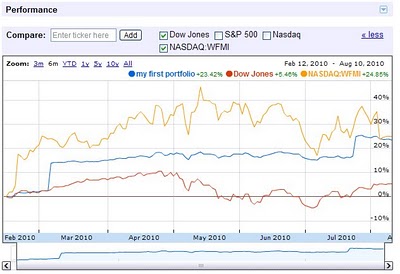
    investment portfolio charting from Google Finance
    Google finance has a nice new feature to let you chart your entire portfolio. You can then compare it to the S&P 500 or other stocks. This is a very nice feature. Yahoo Finance is about the only part of Yahoo I still use. I do use Google Finance some but they still fall short and I use Yahoo Finance much more. This feature will at least encourage me to put my portfolio in Google and start tracking it.

    It would be great if this could give you portfolio annual rates of return (including factoring in cash additions and withdraws and keeping track of sales over time to show a true view of the portfolio). It does look like it will factor in stock purchases and sales which is very nice. You can import csv files with transaction history – another nice feature.

    It also strikes me as a very smart move (as a Google stockholder that is nice to see) as advertising rates around investing are high. The more time Google can provide financial advertisers the more income they can make.

    Related: Lazy Portfolios Seven-year Winning StreakGoogle Posts Good Earning But Not Good Enough for Many (April 2010)Dollar Cost AveragingCurious Cat Investing Books