Blog

  • Greenspan Says Congress Should Let Tax Cuts Expire

    Alan Greenspan made several huge errors while chairman of the Federal Reserve. Failing to deal with the massive risk taking and fraud by the member banks of the Federal Reserve was one. And supporting tax cuts for a country that was hugely in debt (while current deficits were still huge was another. Yes anyone can claim (and he did) future surpluses, but there had yet to be a single year of surplus, and obviously we would have been in deficit even before the tax cuts put us much much further in debt, history has shown .

    But Greenspan said government estimates project more than enough surplus funds to pay off the debt and reduce taxes too.

    That is either amazingly bad economic forecasting or a lie. My guess is he knew this wasn’t true. Which would make it a lie. If he really was that out of touch with economic reality, we have to question why we ever thought he had insight into the economy.

    Greenspan Says Congress Should Let Tax Cuts Expire

    WOODRUFF: On those tax cuts, they are due to expire at the end of this year. Should they be extended? What should Congress do?

    GREENSPAN: I should say they should follow the law and let them lapse.

    WOODRUFF: Meaning what happens?

    GREENSPAN: Taxes go up. The problem is, unless we start to come to grips with this long-term outlook, we are going to have major problems. I think we misunderstand the momentum of this deficit going forward.

    Related: Estate Tax Repeal (2006)Charge My Government to My Kids (2007)USA Federal Debt Now $516,348 Per Household

    Accepting that, I don’t agree with those that vilify his performance. He was Fed chairman from 1987-2006. He made some very bad decisions that cost people dearly. But it isn’t very surprising someone in such power for so long would make some very bad and costly decisions. My guess is he caved to pressure from political allies that reminded him how the current President Bush’s father blamed Greenspan’s decisions for his losing the Presidency. And so Greenspan was trying to do what he could to do what the then President Bush wanted. Not a very honorable explanation but people often do not make the most honorable choices.

    In 2003 he publicly disagreed with the wisdom of additional cuts:

    Alan Greenspan, the Federal Reserve chairman, today rebutted many of President Bush’s arguments in favor of big new tax cuts, saying that the economy probably does not need any short-term stimulus and warning that budget deficits could spiral out of control.

    Politicians, eager to give favors, at the expense of the future, went ahead and passed more tax cuts – weakening the country for their (and their political allies) short term benefit.

    Related: Estate Tax Repeal (2006)Charge My Government to My Kids (2007)USA Federal Debt Now $516,348 Per Household

    Greenspan’s thoughts on the economy, from his July 16th 2010 interview:
    (more…)

  • 11 Stocks for 10 Years – July 2010 Update

    I created the 10 stocks for 10 years portfolio in April of 2005. The current marketocracy* calculated annualized rate or return (which excludes Tesco) is 4.2% (the S&P 500 annualized return for the period is 1.1%) – marketocracy subtracts the equivalent of 2% of assets annually to simulate management fees – as though the portfolio were a mutual fund – so without that (it is not like this portfolio takes much management), the return beats the S&P 500 annual return by about 5.1% (it would be a bit less with Tesco – maybe beating the S&P 500 by 4%).

    The current stocks, in order of return:

    Stock Current Return % of sleep well portfolio now % of the portfolio if I were buying today
    Amazon – AMZN 241% 9% 8%
    Google – GOOG 127% 16% 15%
    PetroChina – PTR 80% 9% 8%
    Templeton Dragon Fund – TDF 76% 10% 10%
    Templeton Emerging Market Fund – EMF 41% 5% 6%
    Cisco – CSCO 21% 7% 8%
    Danaher – DHR 9% 9% 10%
    Toyota – TM -3% 8% 10%
    Intel – INTC -6% 5% 8%
    Tesco – TSCDY -9%** 0%* 10%
    Pfizer – PFE -42% 4% 8%
    Dell -60% 3% 0%

    The current marketocracy results can be seen on the Sleep Well marketocracy portfolio page.

    Related: 12 Stocks for 10 Years – July 2009 UpdateRetirement Savings Allocation for 2010Investing, My Thoughts at the End of 2009posts on stocksinvesting books
    (more…)

  • Have We Lost Our Capitalist Heritage?

    I read various things stating that the USA is behaving in socialist (or similar ways). And there are often attempts to state that what the writer desires is capitalism and what they don’t like is an attack on motherhood, apple pie and capitalism.

    I’m not sure when or where those writers would say capitalism did exist. It is true we have corporations using their power (political power and market power [oligopolies, monopolies]) to serve their interests. This would not surprise Adam Smith at all, from the Wealth of Nations:

    People of the same trade seldom meet together, even for merriment and diversion, but the conversation ends in a conspiracy against the public, or in some contrivance to raise the prices/

    He knew that is what they would attempt to do and said they had to be regulated to allow capitalism to function (but many that say they want capitalism don’t want any regulation of the sort they don’t want). Some seem to agree that some regulation is needed but any regulation they don’t want is seen as “socialist” or “anti-capitalist” or… At least the Libertarians are very consistent about practically no regulation – I question that being capitalism, but at least I understand their position.

    Maybe the amount of direct cash payments and sheer amount of not very indirect subsidies (free money from the Fed, huge government contracts to political friends, tax breaks for big contributors [hedge fund managers, corporations using offshore tax havens…], quotas to aid political contributors) have been very high recently. But those changes are more a matter of degree than a qualitative change from the few years before that and few year before that and so on.

    I am not sure if people are thinking back to the days when we had large trusts as “capitalism”? Some people equate “capitalism” with essentially no government (no FDA, no SEC, no DoD, no FDIC, no EPA…) – so then maybe the wild west or Afghanistan today is capitalism. I don’t. I would say that we have been become less interested in maintaining a free market (allowing oligopolies and monopolies to exist and distort markets) and an excessive amount of letting those with gold pay politicians to get special deals lately (the last 20-30 years). But it is really just a matter of being worse in those areas not some huge qualitative change.

    We broke up trusts for awhile but lately have been supporting those with lots of clout using the clout to prevent competition.

    Of course perfect competition is not really reasonable to expect in many markets in the real world. But the aim of shooting toward open and competitive markets is just not something we seem to have paid much attention to for decades. I’m not sure when we did. And paying attention to sensible things like externalities is still very weak. Even in the trust busting era the actions (to move toward a more capitalist economy where markets could function more freely) were fought by many. And while the efforts made a huge difference, it isn’t as though they went to anything close to perfect competition.

    Countries like Hong Kong (questionably a “country”) and Singapore do lots of things that are nice capitalistic practices. But they have plenty of practices that are not very capitalistic. I’m not really sure what paragons of Capitalism those that appose regulating markets suggest as better models than the USA. Perhaps they believe the USA is the most capitalistic but it is still not capitalistic enough. A perfectly reasonable positions, I would think, but I am not sure if that is their belief or not.

    Related: Ignorance of CapitalismUSA Spent $2.2 Trillion, 16.2% of GDP, on Health Care in 2007

  • Intel Reports Their Best Quarter Ever

    Intel reports their best quarter ever.

    Revenue $10.8 billion
    Gross Margin 67%
    Net Income $2.9 billion

    Intel is one of the stocks in our 12 stocks for 10 years portfolio (and has been since 2005). Intel currently pays a dividend of about 3%. Intel’s gross margins continue to be amazing. 67% is just fantastic.

    Intel is only one company, but the earnings are good new for the economy (they indicate quite a large demand for the products that include Intel’s chips). We certainly can use good news on the economy. We need more good news and the key I believe, now, is adding jobs. Earnings have been good recently and this is one sign that high tech earnings continue to do well. Google announcing earnings on Thursday.

    The effective tax rate was 31%. Which is a good thing in my opinion. I don’t think it is a good thing when companies make billions of dollars and avoiding paying the taxes that allow society to function. I am all for making changes to reduce government spending, but I am not for individuals and companies avoiding paying their fair share.

    full press release

    Related: Amazon Soars on Good Earnings and Projected Sales (Oct 2009)Looking at Microsoft as an InvestmentGreat Google Earnings (April 2007)

  • You Can Help Reduce Extreme Poverty

    The Life You can Save

    But extreme poverty is not only having unsatisfied material needs…
    You have a pervading sense of shame and failure because you cannot provide for your children. Your poverty traps you and you lose hope of ever escaping from a life of hard work for which, at the end, you will have nothing to show beyond bare survival.
    The number of people currently living in such conditions is 1.4 billion. This is bad, but not as bad as things were in 1981, when there were 1.9 billion people living in extreme poverty. That was about 4 in every 10 people in the world, whereas now fewer than 1 in 4 are extremely poor.

    UNICEF, the United Nations International Children’s Emergency Fund, estimates that about 24,000 children die every day from preventable, poverty-related causes.

    Personal finance is not just about living within a budget and making sensible steps to make safe financial decisions (safe investment portfolio, proper insurance, adequate savings, emergency fund) it is also about using your finances appropriately for you. I believe strongly in helping those that have not been as lucky to have the opportunities I have economically.

    Some of my favorite ways to help reduce extreme poverty are Trickle Up, Kiva and using Global Giving to find small organizations (like the Anupshahar’s Girls School, Build Women’s Fair Trade Businesses, Profit for Poor Farmers, and Vegetable Gardens for India). I encourage you to join me: let me know if you contribute to Kiva and I will add your Kiva page to our list of Curious Cat Kivans. Also join the Curious Cats Kiva Lending Team (I am happy to say we have made over $7,500 in loans so far).

    If you like that webcast you will like The Girl Effect.

    Related: Creating a World Without PovertyFinancial Thanksgiving100th Micro Finance Entrepreneur Loan (I am not over 200) – 2006 Nobel Peace Prize to Founder of Micro-finance BankHigh School Team Project to Provide Clean Water

  • Country Travel Ideas That Don’t Require Huge Amounts of Cash

    Countries that can still be travelled on the cheap

    Indonesia has had a bad run of terrible press over the past few years. Between bombings and other strife it’s fallen off the to-do lists of many tourists. Their loss is our gain: the pristine beaches are still the drawcard and you can experience the same dirt-cheap living that has always been on offer.

    If you’re keen to surf or lie on the beach you’re all set to have an adventure for peanuts. As long as you steer clear of tourist-trap resorts, you’ll struggle to spend more than $23.50 a day. Nourish your inner cheapskate and buy souvenirs away from the tourist areas; head to the central market in Denpasar or Ubud’s Pasar Sukowati.

    Eastern Europe used to be dirt cheap back in the good old days of the Cold War. Now that peace has broken out, costs are on the up. Poland, though, is still at the inexpensive end: a daily budget of $29 will easily get you around the country.

    Poland is a nation that’s been run over so many times by invading forces that it’s become bulletproof. Now this EU member is on the rise, so get in quick before the prices go up for good. Rural towns are picturesque and cheap to visit; tiny towns like Krasnystaw in the Lubelskie region are a miser’s wonderland.

    If you’re looking for a scuba-diving destination where you can put your entire budget into going under, Honduras is the place to be. With sleeping budgets as low as $12 a night and meals available for even less you can really stretch out the funds.

    Sitting pretty next door to the Caribbean Sea, you’ll have plenty of time to count your pennies as you sun yourself on the golden beaches. The developers haven’t invaded quite yet, but you’d better get in quick, before the good old days slip into the past.

    After snorkelling and kayaking around Roatan’s West Beach, splurge on a visit to the Unesco-listed Archaeological Park of Copan; entry is $18.

    Related: Great Time for a VacationTravel guide booksTraveling To Avoid USA Health Care CostsTravel Photo blog

  • Would Your Spending Habits Change if You Had More Money

    photo of Swiftcurrent Lake waterfall

    Another blog asks: Does Income Change Who You Are as a Spender? or your Tastes?

    I would think in most cases more income should change your spending habits. Unless your tastes are so far below your income that additional income makes no difference then it should.

    I save money for retirement, emergency fund, an addition to my house… If I have get another $50,000 a year I can think of good ways to spend it (for me I would save lots of it, but I could also spend some). If now I think I can give $100 to some charity I might give $200 if I have a bunch more money. I buy Odwalla juice, which is pretty crazy expensive, but compared to my overall spending it doesn’t amount to much. But in my first few years of work life I wouldn’t have. I eat out a lot because I like that better than cooking. If I couldn’t afford it then I would eat out less.

    I would also “buy” more free time. I would take advantage of the extra cash to cut back at work so I had more time to spend however I wanted. And I would buy a Droid Incredible.

    I’d probably buy a solar energy system and battery backup if I had a ton of extra cash… I’d try some services to do things I would like to do but don’t have time for. I like photography and posting my photos online. But I am far behind and have a bunch I would like to do. If I had a bunch of extra cash I would pay someone to take my photos and post them how I want. I would buy a slide scanner and scan a bunch of my Dad’s old slides (or pay to have it done). If I had an fortune I would buy a place with indoor basketball court (or one that where I could build one) and fly first class or use Net Jets and travel a bunch more. Unfortunately I don’t foresee those things happening 🙁

    So yeah I would definitely change my spending habits. It isn’t really changing my tastes. I have the tastes now, I just figure given my financial situation it isn’t worth the money (and some I couldn’t even get people to lend me enough money to buy) for some things. But if I had a bunch more money I would buy them.

    A mistake many people make is increasing spending too much as income increases. I definitely suggest avoiding this risky behavior. It is fine to add some expenses but make sure you are adding to your retirement account, emergency fund, general savings with part of the raise. And it is risky to develop expensive tastes that you continue if you income declines (or lock into long term expenses – new car, mortgage…). So enjoy, but be careful.

    Photo by John Hunter, Swiftcurrent Lake trail in the Many Glaciers area of Glacier National Park.

    Related: Using Your Credit Card ProperlyTrying to Keep up with the JonesHow Rich Are You?

  • George Soros is Investing in Oil and Gas

    Where is George Soros investing? The SEC filings will tell you (as of March 31, 2010).

    The fund holds over $600 million of Petrobas (Brazil Oil and Gas) (the fund bought about 1.4 million shares of the ADR in the quarter), $300 million of Hess (sold about 900,000 shares), $280 in Suncor Engery (bought over 1.5 million shares), $220 million of Monsanto (sold almost 700,00 shares), $190 of Interoil (bought over 150,000 shares), $175 million of Direct TV (bought 1,000,000 shares), $175 million of Verizon (bought 800,000 shares), $150 million of Plains Exploration and Production (sold 1.7 million shares), $140 million of Best Buy (bought 300,00 shares), $130 million of Novagold (bought 15 million shares, bringing to the total to almost 19 million), $120 million of Emdeon (selling over 1 million), $110 million of JP Morgan Chase (nearly all bought in this quarter) and $90 million of Pfizer (sold over 600,000 shares – over half the position). The fund owns a good deal of gold shares including over $600 million in SPDR gold trust shares (all bought this quarter). The total value of the fund was $8.75 billion. The fund own numerous convertible bond issues in excess of $100 million.

    During the quarter the fund sold essentially all of Citigroup – over $300 million at the beginning of the quarter and nearly all of Ace Limited $75 million at the beginning of the quarter, and Lowes ($55 million). It sold 80% of Dana Holding ($60 million at the beginning of the quarter). It sold all of Bunge Limited – $66 million, and Terra Industries $100 million.

    I am also overweight in Oil and Gas (the last 2 years is the first time I ever have been). The fund owns $20 million of ATP Oil and Gas, a speculative pick that I also own (the fund added 150,000 shares during the quarter). It also owns over $20 million of Brigham Exploration (fund sold 550,000 shares) another small oil and gas stock that I bought this year. And it has a bit over $40 million in Apple, $60 million in Yahoo $5 million in Amazon.

    Related: Famous Stock Traders: Nicolas DarvasSoros on Financial Crisis and Markets11 Stocks for 10 Years, March 2010 UpdateTen Stocks To Avoid

  • USA Economy Lost 125,000 Jobs and Unemployment Rate Decreased to 9.5%

    Total nonfarm payroll employment declined by 125,000 in June, and the unemployment rate edged down to 9.5 percent, the U.S. Bureau of Labor Statistics reported today. The decline in payroll employment reflected a decrease (-225,000) in the number of temporary employees working on Census 2010. Private-sector payroll employment edged up by 83,000. I will be amazed if the unemployment rate is not higher 3 months from now. And I will be surprised if we don’t add over 400,000 jobs in the next 3 months.

    Both the number of unemployed persons, at 14.6 million, and the unemployment rate, at 9.5 percent, edged down in June. Among the major worker groups, the unemployment rate for adult women (7.8%) declined, while the rates for adult men (9.9%) and teenagers (25.7%) showed little or no change.

    In June, the number of long-term unemployed (those jobless for 27 weeks and over) was unchanged at 6.8 million. These individuals made up 45% of unemployed persons. The civilian labor force participation rate fell by 0.3 percentage point in June to 64.7%. The employment-population ratio, at 58.5%, edged down over the month.

    There were 1.2 million discouraged workers in June, up by 414,000 from a year earlier. (The data are not seasonally adjusted.) Discouraged workers are persons not currently looking for work because they believe no jobs are available for them.

    Total nonfarm payroll employment decreased by 125,000 in June, reflecting the departure of 225,000 temporary Census 2010 workers from federal government payrolls. Total private employment edged up over the month (+83,000). So far this year, private-sector employment has increased by 593,000 but in June was 7.9 million below its December 2007 level.

    Health care employment edged up in June (+9,000). Over the past 12 months, the industry has gained 217,000 jobs. Manufacturing employment continued to trend up over the month (+9,000). The industry has added 136,000 jobs since December 2009. Construction employment decreased by 22,000 in June, with the largest decline in nonresidential specialty trade contracting. On net, construction employment has shown little change over the last 4 months.

    Related: Unemployment Rate Drops to 9.7% But Job Gains DisappointUSA Added 290,000 Jobs In April 2010Unemployment Rate Reached 10.2% (Oct 2009)
    (more…)

  • Manufacturing Output as a Percent of GDP by Country

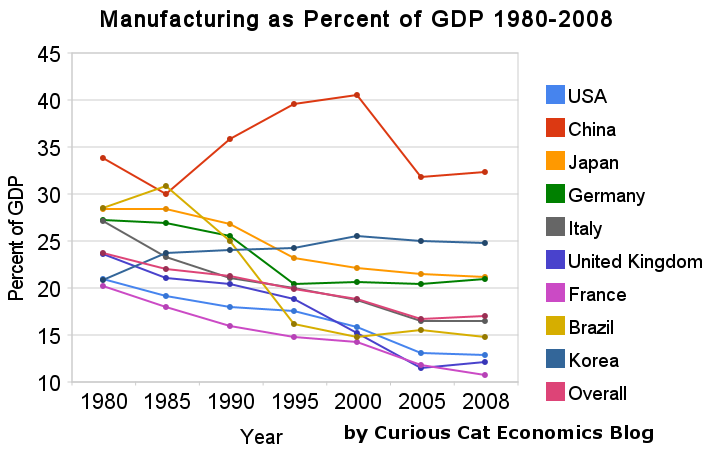
    In previous posts I have shown data for global manufacturing output by country. One of the things those posts have showed is that manufacturing output in China is growing tremendously, but it is also growing in the United States. The chart below shows manufacturing production by country as a percent of GDP. China dominates again, with over 30% of the GDP from manufacturing.

    chart of manufacturing output as percent of gdp by country 1980-2008

    Chart showing manufacturing output, as percent of GDP, by country was created by the Curious Cat Economics Blog based on UN data* (based on current USA dollars). You may use the chart with attribution.

    For the 14 biggest manufacturing countries in 2008, the overall manufacturing GDP percentage was 23.7% of GDP in 1980 and dropped to 17% in 2008. I left India (15% in 1980, 15% in 2008), Mexico (20%, 18%), Canada (17%, 13%), Spain (25%, 14%) and Russia (21% in 1990 [it was part of USSR in 1980], 15%) off the chart.

    Over the last few decades Korea, and to some extent China, are the only countries that have increased the percent of GDP from manufacturing. China has not only grown manufacturing activity tremendously but also other areas of the economy (construction, mining, information technology). The countries with the largest manufacturing portions of their economies in 2008 were: China 32%, South Korea 25%, Japan and Germany at 21%. The next highest is Mexico at 18% which declined slightly over the last 15 years (with NAFTA in place). Globally, while manufacturing has grown, other areas of economic activity have been growing faster than manufacturing.

    The manufacturing share of the USA economy dropped from 21% in 1980 to 18% in 1990, 16% in 2000 and 13% in 2008. Still as previous posts show the USA manufacturing output has grown substantially: over 300% since 1980, and 175% since 1990. The proportion of manufacturing output by the USA (for the top 14 manufacturers) has declined from 31% in 1980, 28% in 1990, 32% in 2000 to 24% in 2008. The proportion of USA manufacturing has declined from 33% in 1980, 29% in 1990, 36% in 2000 to 30% in 2008. While manufacturing output has grown in the USA it has done so more slowly than the economy overall.

    Related: The Relative Economic Position of the USA is Likely to DeclineManufacturing Data, Accuracy QuestionsTop 12 Manufacturing Countries in 2007Manufacturing Employment Data: 1979 to 2007USA Manufacturing Output Continues to Increase (over the long term)

    * I made edits to the 1980 Brazil manufacturing data and 1980, 1985 and 2008 China manufacturing data because the UN data only showed manufacturing data combined with mining and utility data. And I am using older UN data that had manufacturing separated from mining and utility figures for China in the other years.