Blog

  • Making Debt Holders into Unpaid Regulators

    The credit crisis has shown the lack of political (or regulatory) skill, ethics and character that the USA has now. The solutions are not simple. Some are obvious, like limiting leverage, not providing huge favors to those that pay politicians huge amounts of cash… While Canadian banking regulators actually did their jobs well it is hard to believe most any American regulators will do well given the last 20 years of failures. Raghuram Rajan provides some interesting thoughts on potential improvement in: Making Debt Holders into Watchdogs

    The type of risks that put banks in the greatest jeopardy – and led to the recent crisis – are called tail risks. They have a small probability of turning out badly but are extremely costly if they do. Banks took on two kinds of tail risks prior to the crisis. One was economywide default risk, the risk that a broad portfolio of assets, such as mortgages, would suffer deep losses. The other was liquidity risk, essentially the way they financed the first kind of risk.

    Some banks – such as Citibank, Lehman Brothers, and Royal Bank of Scotland – loaded up on both risks, holding enormous quantities of mortgage-backed securities on the asset side and paying for them with short maturity debt on the liability side. Why did they do it? The simple answer: It was very profitable, provided the tail events did not materialize. Think of insurers that write a lot of earthquake policies (another tail risk). If you didn’t know they were writing earthquake insurance and not setting aside reserves, you would think they were enormously profitable until there’s a quake. For banks, there was always the threat of a day of reckoning when liquidity dried up and defaults skyrocketed. But they set aside few reserves against that happening.

    Particularly worrisome, as my colleague Douglas Diamond and I have argued, is that once banks are leveraged enough that they will be severely distressed if economywide liquidity dries up, they double down on risky bets.

    Here’s the drill: To make it harder for tail-risk-taking banks to grow, all banks should be required to issue a minimum level of debt (say, 10% of assets) that is automatically impaired – either converted to equity or written down – if the bank suffers sufficient losses. This will quickly change debt holders’ views on risky expansion. Moreover, no financial institution should be allowed to hold this debt.

    Related: Why Congress Won’t Investigate Wall StreetScientists Say Biotechnology Seed Companies Prevent ResearchDrug Prices in the USA

  • Apartment Rents Rise, Slightly, for First Time in 5 Quarters

    Apartment Rents Rise as Sector Stabilizes

    Nationally, effective rents, which include concessions such as one month of free rent, rose 0.3% during the quarter compared with a 0.7% decline in the fourth quarter of last year and a 1.1% drop in the first quarter of 2009.

    enters are also staying put longer: the average renter now stays for 19 months, up from an average of 14 months, said Mr. Friedman, and despite low mortgage rates and greater home affordability, fewer renters are leaving to buy homes. “This is the first time in many, many years that it feels like even people who could afford to buy are making the investment decision not to,” Mr. Friedman said.

    Portland, Ore., posted the largest rent decline, at 0.7%, followed by Las Vegas, San Diego, and Southern California’s Inland Empire. Those three markets have all seen an uptick in home-buying activity, particularly among the low end from first-time buyers and investors.

    Colorado Springs had the largest rent increases, 2.5%, followed by Washington DC, 2% and San Antonio 1.5%. There is a very nice new online tool, Padmapper, for renters or landlords. It is a mashup on Google Maps of rental listings by location from Craigslist and other sources. Very good search options. Easy to use. Find more real estate links on the Curious Cat Cool Connections Directory.

    Related: It’s Now a Renter’s Market (April 2009)Housing Rents Falling in the USA (February 2009)Apartment-vacancy Rate is 7.8%, a 23-year High

  • Real Estate and Consumer Loan Delinquency Rates 1998-2009

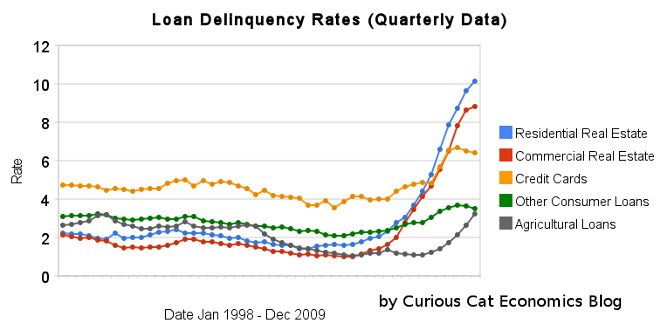
    The chart shows the total percent of delinquent loans by commercial banks in the USA.

    charts showing loan delinquency rates in the USA, 1998-2009

    That last half of 2009 saw real estate delinquencies continue to increase. Residential real estate delinquencies increased 143 basis points to 10.14% and commercial real estate delinquencies in 98 basis points to 8.81%. Agricultural loan delinquencies also increased (112 basis points) though to just 3.24%. Consumer loan delinquencies decreased with credit card delinquencies down 18 basis points to 6.4% and other consumer loan delinquencies down 19 basis points to 3.49%.

    Related: Loan Delinquency Rates Increased Dramatically in the 2nd QuarterBond Rates Remain Low, Little Change in Late 2009Government Debt as Percentage of GDP 1990-2008 – USA, Japan, Germany… posts with charts showing economic data
    (more…)

  • USA Added 162,000 Jobs in March

    Nonfarm payroll employment increased by 162,000 in March, and the unemployment rate held at 9.7%, based on U.S. Bureau of Labor Statistics surveys. Hiring for the census added 48,000 jobs in March, a large temporary increase, but less than expected amount, for the month. The change in total nonfarm payroll employment for January was revised from -26,000 to +14,000, and the change for February was revised from -36,000 to -14,000 together this results in an addition of 90,000 jobs.

    The 162,000 added jobs is the largest increase since March of 2007. It is a good start but the economy will have to continue to increase the number of job added each month to reduce unemployment. Population growth requires an addition of approximately 125,000 jobs a month. The current labor pool has been temporarily reduced by those who have dropped out of the labor market. As jobs return they will come back into the market.

    The economy has lost 8.2 million jobs since the recession started in December 2007. Now that was the bubble induced peak still, by the time the economy adds 8 million jobs many more jobs will be needed (since 125,000 additional jobs are needed each month). Still if we added 200,000 a month it would take 40 months to get back to the previous peak total. And by that time the economy would have accumulated another 9 million jobs needed (it would be about Dec 2013 = 6 * 12 months *125,000/month). While the bubble induced peak may well be a unrealistic target, the job market needs to add over 200,000 jobs a month to regain ground lost over the last several years.

    In March, the number of unemployed persons was little changed at 15.0 million, and the unemployment rate remained at 9.7%. The number of long-term unemployed (those jobless for 27 weeks and over) increased by 414,000 over the month to 6.5 million. In March, 44.1% of unemployed persons were jobless for 27 weeks or more. Both are all time highs.

    The civilian labor force participation rate (64.9%) and the employment-population ratio (58.6%) continued to edge up in March. The average length of unemployment rose to 31 weeks – the highest average ever (since 1948).
    Related: USA Unemployment Rate Remains at 9.7%663,000 Jobs Lost in March, 2009 in the USAAnother 450,000 Jobs Lost in June, 2009Manufacturing Employment Data – 1979 to 2007
    (more…)

  • Protect Yourself from 11 Car Dealer Tricks

    Top 11 dealer tricks

    2. The single-transaction strategy: Many people view buying a car as one transaction. It’s not, and dealers know this. It’s really three transactions rolled into one — the new-car price, the trade-in value and the financing. The dealer sees all three as ways to make money. Treat each as a separate transaction, and negotiate each one. If you get a new car for $200 over invoice but receive only $1,000 for a trade-in car that’s worth $2,500, you haven’t done as well as you could.

    3. The payment ploy: A dealer might say, “We can get you into this car for only $389 a month.” Probably true, but how? In some cases, the dealer may have factored in a large down payment or stretched the term of the loan to 60 or 72 months. Focus on the price of the car rather than the monthly payment. Never answer the question, “How much can you pay each month?” Stick to saying, “I can afford to pay X dollars for the car.”

    Some good advice. I bought my last car at CarMax which gave a good price and none of these tricks (I didn’t have a trade in – I donated it) and I paid cash. They offered a great deal on a Toyota Rav4 when I was looking. I believe, those that are interested in getting the very best deal and are skilled and able to defend themselves from the dealer can do better than CarMax. But I would bet most people would be much better off using CarMax.

    Related: Manufacturing Cars in the USAAvoiding Phone FeesActually Free Credit ReportHow to Use Your Credit Card Properly

  • Taxes per Person by Country

    From Greg Mankiw’s Blog

    Taxes/GDP x GDP/Person = Taxes/Person

    France .461 x 33,744 = $15,556

    Germany .406 x 34,219 = $13,893

    UK .390 x 35,165 = $13,714

    US .282 x 46,443 = $13,097

    Canada .334 x 38,290 = $12,789

    Italy .426 x 29,290 = $12,478

    Spain .373 x 29,527 = $11,014

    Japan .274 x 32,817 = $8,992

    The USA is the 2nd lowest for percent of GDP taxes 28.2% v 27.4% for Japan. But in taxes per person toward the middle of the pack. France which has 46% taxes/GDP totals $15,556 in tax per person compared to $13,097 for the USA.

    Related: Government Debt as Percentage of GDP 1990-2008 – USA, Japan, Germany…Oil Consumption by Country in 2007USA, China and Japan Lead Manufacturing Output in 2008Bigger Impact: 15 to 18 mpg or 50 to 100 mpg?

  • 50% of Commercial Real Estate Mortgages Will be Underwater

    Half of Commercial Mortgages to Be Underwater

    By the end of 2010, about half of all commercial real estate mortgages will be underwater, said Elizabeth Warren

    We now have 2,988 banks – mostly midsized, that have these dangerous concentrations in commercial real estate lending.” As a result, the economy will face another “very serious problem” that will have to be resolved over the next three years, she said, adding that things are unlikely to return to normalcy in 2010.

    Warren said it’s time for the government to “pull the plug” on mortgage lenders Fannie Mae and Freddie Mac. “I’m one of those people who never liked public-private partnership to begin with. I think what they did was use public when public was useful and private when private was useful,” she said. “And I think we’ve got to rethink that whole thing.”

    “There is no implicit guarantee anymore,” she added. “I don’t care how big you are, if you make serious enough mistakes, then your business can be entirely wiped out.”

    Financially literate people should know that the current commercial real estate market is in serious trouble. I still figure it will rebound well. I just want to wait and see how far prices fall and then try to buy when people are so frustrated they will sell at very low prices.

    Related: Commercial Real Estate Market Prospects Remain DimMortgage Delinquencies and Foreclosures Data Indicates 2010 Could Show ImprovementJumbo Loan Defaults Rise at Fast Pace (Feb 2009)

  • Bill Gross Warns Bond Investors

    Bill Gross Warning May Catch Bond Investors Off-Guard

    Pacific Investment Management Co.’s Gross, manager of the world’s biggest bond fund, said yesterday in an interview with Tom Keene on Bloomberg Radio that “bonds have seen their best days.” Pimco, which announced in December that it would offer stock funds, is advising investors to buy the debt of countries such as Germany and Canada that have low deficits and higher- yielding corporate securities.

    The prospect of a strengthening U.S. economy and rising interest rates makes an “argument to not own as many” bonds, Gross said in the interview.

    Treasuries have rallied for almost three decades, pushing the yield on the 10-year Treasury note from a high of 15.8 percent in September 1981 to 3.89 percent as of yesterday. The yield reached a record low of 2.03 percent in December 2008 during the height of the credit crunch.
    Excess borrowing in nations including the U.S., U.K. and Japan will eventually lead to inflation as governments sell record amounts of debt to finance surging deficits, Gross said.

    “People have been making money on fixed income for so long, people assume it’s going to continue when mathematically, it cannot,” said Eigen, whose fund is the third-best selling bond fund this year, according to Morningstar. “When people finally start to lose money in fixed-income, they won’t hesitate to pull money out very soon,” he said.

    John Hancock Funds President and Chief Executive Officer Keith Hartstein said retail investors are already late in reversing their rush into bond funds, repeating the perennial mistake of looking to past performance to make current allocation decisions.

    I agree bonds don’t look to be an appealing investment. They still may be a smart way to diversify your portfolio. I am investing some of my retirement plan in inflation adjusted bonds and continue to purchase them. My portfolio is already significantly under-weighted in bonds. I would not be buying them if it were not just to provide a small increasing of my bond holdings.

    Related: Municipal Bonds, After Tax Return10 Stocks for Income InvestorsBond Yields Show Dramatic Increase in Investor ConfidenceInvestors Sell TIPS as They Foresee Tame Inflation

  • How the New Health Care Law May Affect You

    10 Ways the New Healthcare Bill May Affect You by Katie Adams

    Starting this year, if you have an adult child who cannot get health insurance from his or her employer and is to some degree dependent on you financially, your child can stay on your insurance policy until he or she is 26 years old.

    Starting this fall, your health insurance company will no longer be allowed to “drop” you (cancel your policy) if you get sick.

    Starting this year your child (or children) cannot be denied coverage simply because they have a pre-existing health condition. Health insurance companies will also be barred from denying adults applying for coverage if they have a pre-existing condition, but not until 2014.

    If you currently have pre-existing conditions that have prevented you from being able to qualify for health insurance for at least six months you will have coverage options before 2014. Starting this fall, you will be able to purchase insurance through a state-run “high-risk pool”, which will cap your personal out-of-pocket expenses for healthcare. You will not be required to pay more than $5,950 of your own money for medical expenses; families will not have to pay any more than $11,900.

    Under the new law starting in 2014, you will have to purchase health insurance or risk being fined.

    Starting in 2018, if your combined family income exceeds $250,000 you are going to be taking less money home each pay period. That’s because you will have more money deducted from your paycheck to go toward increased Medicare payroll taxes. In addition to higher payroll taxes you will also have to pay 3.8% tax on any unearned income, which is currently tax-exempt.

    Related: How the health care bill could affect youAnswers About Health Care BillWhy the Health Care Bill May Eventually Curb Medical Costspost on health careUSA Consumers Paying Down DebtPersonal Finance Basics: Long-term Care Insurance

  • 11 Stocks for 10 Years – March 2010 Update

    I created the 10 stocks for 10 years portfolio in April of 2005. In order to track performance created a marketocracy portfolio but had to make some minor adjustments (and marketocracy doesn’t allow Tesco to be purchased, though it is easily available as an ADR to anyone in the USA to buy in real life – it is based in England). The current marketocracy calculated annualized rate or return (which excludes Tesco) is 6.2% (the S&P 500 annualized return for the period is 2.5%) – marketocracy subtracts the equivalent of 2% of assets annually to simulate management fees – as though the portfolio were a mutual fund – so without that the return is about 5.7% above the S&P 500 annually).

    The current stocks, in order of return:

    Stock Current Return % of sleep well portfolio now % of the portfolio if I were buying today
    Amazon – AMZN 248% 11% 8%
    Google – GOOG 152% 16% 15%
    PetroChina – PTR 87% 9% 9%
    Templeton Dragon Fund – TDF 80% 10% 10%
    Templeton Emerging Market Fund – EMF 40% 5% 6%
    Cisco – CSCO 38% 6% 8%
    Danaher – DHR 10% 9% 10%
    Toyota – TM 10% 8% 10%
    Intel – INTC 0% 4% 7%
    Tesco – TSCDY -10%* 0%* 10%
    Pfizer – PFE -34% 4% 8%
    Dell -56% 3% 0%

    The current marketocracy results can be seen on the Sleep Well portfolio page.

    Related: 12 Stocks for 10 Years – July 2009 UpdateInvesting, My Thoughts at the End of 2009posts on stocksinvesting books
    (more…)