Blog

  • How Apple Can Grow from $200 Billion to $300 Billion In Market Cap

    Apple currently has the 4th largest market capitalization for USA stocks, behind ExxonMobil (over $300 billion), Microsoft ($250 billion) and Wal-Mart and ahead of Berkshire Hathaway, General Electric, Procter & Gamble and Google ($180 billion). Eric Bleeker has a nice article on fool.com looking at how Apple can grow to a $300 Billion market capitalization.

    what needs to go right for Apple to become the largest technology company in the world? Simply put, it needs to become the Microsoft of mobile.

    In many ways, the mobile race is similar to the PC battle of the ‘80s. In one corner we have Apple, packaging its hardware and software in a limited number of systems. In the other corner, there’s Google (replacing Microsoft), licensing out software to any number of hardware vendors.

    Apple could actually learn from Microsoft. It needs to be more than just the best smartphone on the market right now. Microsoft never controlled the operating-system market because it was the best — it won because it locked users in, and most people essentially had to use its products. Microsoft has released some real clunkers over the years, but it took few hits from them. Likewise, even though Apple’s unparalleled in its commitment to quality-unlike a certain competitor we just discussed — with a price tag that implies sustainable long-run dominance, Apple needs a margin of safety to ensure that even with a hiccup or two, it will continue to rule the mobile world.

    The $300 billion question
    So it all boils down to one question: How well can Apple lock users into its ecosystem? As developers continue building apps at rates far in excess of competing platforms and more users synch their digital lives around iTunes, you can see Apple creating a platform that’s sustainable well beyond just the next upgrade. From there, no company possesses a virtuous circle like Apple. Higher iPhone market share begets high-margin sales of apps and media, as well as increased Mac sales. Given the size of the smartphone market, the margins Apple collects from each iPhone, and the boost to other Apple products, you can see a path to $300 billion forming.

    I missed out on investing in Apple. I came close to buying in, but didn’t quite do it – that was a big mistake. And I am still not buying now, which could be another mistake. We shall see. I am very comfortable owning Google. But I think Apple could well be good also. My 12 stocks for 10 years portfolio has Cisco, Intel and Amazon which I am happy with and Dell which has been a mistake.

    Related: Apple exceeded Google for the first time since Google went public (Aug 2008)Amazon Soars on Good Earnings and Projected SalesIt is Never to Late to InvestGreat Google Earnings (April 2007)

  • Paying Back Direct Cash from Taxpayers Does not Excuse Bank Misdeeds

    Many people are ignoring huge costs (to the economy) and benefits (to those financial companies that ruined so many people’s lives and severely damaged the economy. Paying back money the government paid you is not that same as being innocent. While several of the too big to fail banks have paid back the direct cash they were given that is not an indication they are now off the hook for their disastrous behavior.

    First we know that much of the money “sent to AIG” just went directly to Goldman Sachs and others. Those big banks had taken risks and the only way those risks paid off was with billions from taxpayers. Without that they would have been bankrupt. And then when they paid the money they received directly they still haven’t paid back the billions they got from taxpayers (via AIG). And this money was paid back at 100 cents on the dollar though those instruments were trading for much less in the market (the government certainly would have found a less costly solution but for ignorance or a desire to reward their former company and friends at Goldman Sachs.

    Second, rates have been kept artificially low, to among other things, allow the big banks to make tens of billions (and costing savers tens of billions). Those savers have not been reimbursed for the losses caused by the big banks.

    And third if I gamble with money from my company and win my bet on the Super Bowl and then put the money back, I am still not innocent. Just because many of the big banks have paid back the money they were given directly by taxpayers does not mean they didn’t get huge benefits from the government. Pretending they are not bad guys because after ruining the economy, costing millions of people their jobs and savings, getting many benefits from the government, they then pay back the direct cash payments is not accurate.

    Response to: The New Bank Tax

    Related: Elizabeth Warren Webcast On Failure to Fix the SystemThe Best Way to Rob a Bank is as An Executive at OneFailure to Regulate Financial Markets Leads to Predictable ConsequencesJim Rogers on the Financial Market MessCongress Eases Bank Laws (1999)

  • Curious Cat Investing and Economics Carnival #7

    Welcome to the Curious Cat Investing and Economics Carnival: we highlight interesting recent personal finance, investing and economics blog posts.

    • The 4% rule and other fallacies of retirement planning – “I might try a 5% withdrawal rate, which according to the Trinity study, would give me an 80% chance of not outliving my money. As time goes on, I’ll adjust up or down depending on what life and the market throws at me.”
    • The lesson of the Greek crisis: Every government cheats and no one wants to know by James Jubak – “The IMF projects that U.S. net debt as a percentage of GDP will be 66.8% in 2010, more than twice that for Canada, and gross debt will be 93.6% of GDP, still almost 14 percentage points above Canada’s.”
    • Renting 101: What You Should Know Before You Sign by Austin Morgan – “Renter’s insurance helps protect the items in your apartment in case of theft or damage. The renter’s insurance will also cover you in case a visitor in your apartment gets injured or their items get damaged.”
    • In the USA 43% Have Less Than $10,000 in Retirement Savings by John Hunter – “if you plan ahead you have a long time for compounding to work in your favor. Unfortunately most people continue to fail to make even the most minimal efforts to save for retirement”
    • The US Has A Spending Problem, China Has A Savings Problem – “Back in 2005 the savings rate in the US dropped to below 1%. That’s sad considering up until the mid 80s we were always above 5% and crested 10% a few times… Our savings rate is currently just under 5%… The savings rate in China is something like 30%; and this number has grown in recent years, “
    • When will the Fed raise interest rates? by Olivier Coibion and Yuriy Gorodnichenko – “given current information and barring political or populist pressures, one can reasonably expect the Federal Reserve to start raising interest rates toward the end of this year in its attempt to balance the risks of higher inflation against prolonging the current economic downturn.”
    • (more…)

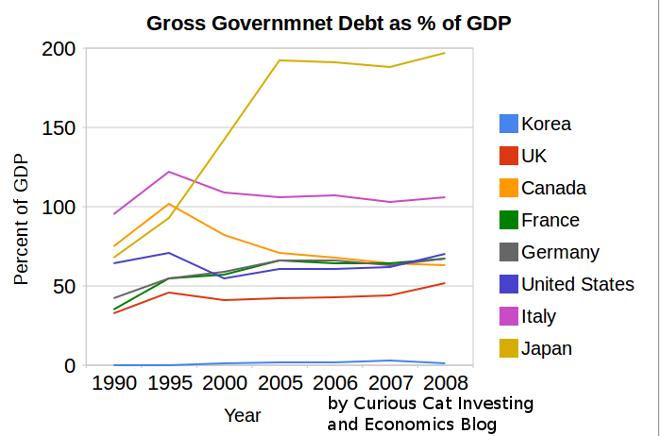
  • Government Debt as Percentage of GDP 1990-2008 – USA, Japan, Germany…

    Recently Greece and the huge USA federal deficits have highlighted the problem of excessive government debt. The above chart shows gross government debt by country from the IMF.

    Korea has essentially no gross government debt (under 2% of GDP for the entire period). At the other end of the spectrum Japan has seen gross government debt rise to 197% (Japan’s 2008 figure is an IMF estimate). The IMF did not have data for Greece (which would likely look very bad) or China (which I would think would be very low – maybe even negative – the government having more assets than debt).

    The USA debt stood at 64% in 1990, 71% in 1995, 55% in 2000, 61% in 2005 and 70% in 2008. Most countries are expected to see significant increases in 2009. The IMF sees the USA going to 85% in 2009 and 100% in 2012. They see Germany at 79% in 2009 and 90% in 2012. They See the UK at 69% in 2009 and 94% in 2012. They see Japan at 237% in 2012.

    Government debt as percentage GDP 1990-2008The chart shows gross government debt as percentage GDP 1990-2008. By Curious Cat Investing and Economics Blog, Creative Commons Attribution.

    ___________________________

    The data here is very similar to the OECD data I provided earlier, Government Debt Compared to GDP 1990 to 2007, though with some notable differences. In the OECD data was still in the best shape, but is seen as having 29% debt to GDP in 2007. The IMF data attempts to avoid issues where some countries have debt of non-federal governments that are hidden when looking just at federal government debt.

    Data source: IMF data (for some countries the data is also from that site but at different urls).

    Related: The Long-Term USA Federal Budget OutlookUSA, China and Japan Lead Manufacturing Output in 2008Oil Consumption by Country in 2007Saving Spurts as Spending Slashed

  • In the USA 43% Have Less Than $10,000 in Retirement Savings

    There are several personal finance basics that everyone must account for. Retirement requires the most planning and accumulating the largest amount of money. Luckily if you plan ahead you have a long time for compounding to work in your favor. Unfortunately most people continue to fail to make even the most minimal efforts to save for retirement: 43% have less than $10k for retirement

    The percentage of workers who said they have less than $10,000 in savings grew to 43% in 2010, from 39% in 2009, according to the Employee Benefit Research Institute’s annual Retirement Confidence Survey. That excludes the value of primary homes and defined-benefit pension plans.

    Fewer workers report that they and/or their spouse have saved for retirement (69%, down from 75% in 2009 and 72% in 2008. Moreover, fewer workers say that they and/or their spouse are currently saving for retirement (60%, down from 65 percent in 2009).

    27% say they have less than $1,000 in savings (up from 20% in 2009).

    46% report they and/or their spouse have tried to calculate how much money they will need to have saved for a comfortable retirement by the time they retire.

    What is a very rough estimate of what you need? Well obviously factors like a pension, social security payments, age at retirement, home ownership, health insurance, marital status… make a huge difference in the total amount needed. But something in the neighborhood of 15-25 times your desired retirement income is in the ballpark of what most experts recommend. So if you want $50,000 in income you need $750,000 – $1,250,000. Obviously that is difficult to save over a short period of time. The key to saving for retirement is a consistent, long term saving program.

    Related: Retirement Savings Survey Results (2007)How Much Will I Need to Save for Retirement?Personal Finance Basics: Long-term Care Insurance

  • “What the Financial Sector Did to Us”

    Nobel Prize winning economist Joseph Stiglitz explores the current financial system and the damage done to the economy due to that system. As he states in the video the credit crisis is not something that happened to the financial institutions. The credit crisis caused recession is something the financial sector did to us.

    He covers the topics he discusses in the video in his new book: Freefall

    Related: There is No Invisible HandFailure to Regulate Financial Markets Leads to Predictable ConsequencesMarket Inefficiencies and Efficient Market TheoryCongress Eases Bank Laws (1999)Volcker on the Great Recession and Need for Reform

  • Where to Invest for Yield Today

    Yields are staying amazingly low today. Due to the credit crisis the federal reserve is shifting hundreds of billions of dollars from savers to bankers to allow banks to make up for losses they experienced (both in losses on bad loans and huge cash payments made to hundreds of executives over more than a decade). For that reason (and others) yields are extremely low now which is a great burden on those that saved and counted on reasonable investment yield.

    Don’t be fooled by apologist for those causing the credit crisis that try and excuse their behavior and act as those paying back the bailout payments means they paid back the favors they were given. They have received much more from the policies of the federal reserve that has taken hundreds of billions of dollars from savers and given it to bankers. It has the same effect as a direct tax on savers being paid to bankers.

    What is an investor/saver to do? James Jubak provides some excellent advice.

    How to maximize what your cash pays even when nothing is paying much of anything now

    A three month Treasury bill pays just 0.12%. A two-year note pays just 0.79%. Inflation may not be very high at an annual rate of 2.6% for headline inflation (and 1.6% minus volatile energy and food prices) but it’s enough to eat up all the interest from those investments and more. (TIPS, Treasury Inflation-Protected Securities will protect you from inflation but the yields are really low (1.43% for a 10-year TIPS at recent auction) and they only protect you from inflation and not rising interest rates. I-Bonds, a savings bond that pays an interest rate that combines a fixed component, currently 0.3%, with an inflation-adjusted variable rate, current 3.06%, offer a higher yield but since the variable rate is pegged to inflation and not interest rates, the yield on these bonds won’t necessarily go up if interest rates do. You also have to hold for at least 12 months. (After that and until you’ve held for 5 years you lose the last 3-months of interest when you sell.)

    You could lock your money up for decades and get 4.56% in a 30-year Treasury bond but 30 years is forever. And besides interest rates have to go up from today’s lows and that means bond prices will be coming down, probably fast enough to eat up all the interest that bond pays and more.

    Not if you remember that interest rates are going up in most of the world (except maybe Europe and Japan) quite dramatically over the next 12 months. A year from now, perhaps sooner, you’ll be able to get yields swell north of anything you can find now.

    That pretty much means that you’re guaranteed to lose money two ways by locking it up for the long term now.

    For the short term you need to put your cash into something that’s as safe as possible but that offers you as much income as possible—and that doesn’t lock up your money for very long.

    My choice dividend paying stocks—if they pay a high dividend, are extremely liquid, and are battle tested.

    Whether you agree with his suggestions in the article is up to you. But even if you don’t he provides a very good overview of the options and risks that you have to navigate now as an investor seeking investments that provide a decent yield. I agree with him that interest rates seem likely to rise, making bonds an investment I largely avoid now myself.

    Related: posts on financial literacyJubak Picks 10 Stocks for Income InvestorsS&P 500 Dividend Yield Tops Bond Yield: First Time Since 1958Bond Yields Show Dramatic Increase in Investor Confidence

  • USA Unemployment Rate Remains at 9.7%

    The slow recovery from the massive credit crisis caused recession remains underway. Nonfarm payroll employment declined 36,000 in February, and the unemployment rate held at 9.7%, the U.S. Bureau of Labor Statistics reported today. Employment fell in construction and information, while temporary help services added jobs. Severe winter weather in parts of the country may have affected, negatively, payroll employment and hours.

    In February, the number of unemployed persons, at 14.9 million, was essentially unchanged. Among the major worker groups, the unemployment rates for adult men (10.0%), adult women (8.0%), whites (8.8%), African-Americans (15.8%), Hispanics (12.4%), Asians was 8.4%, and teenagers (25.0%) showed little to no change in February.

    The number of long-term unemployed (those jobless for 27 weeks and over) was 6.1 million in February and has remained stable since December. About 4 in 10 unemployed persons have been unemployed for 27 weeks or more.

    In February, the civilian labor force participation rate (64.8%) and the employment-population ratio (58.5%) were little changed.

    The number of persons working part time for economic reasons (sometimes referred to as involuntary part-time workers) increased from 8.3 to 8.8 million in February, partially offsetting a large decrease in the prior month. These individuals were working part time because their hours had been cut back or because they were unable to find a full-time job.

    Since the start of the recession in December 2007, payroll employment has fallen by 8.4 million.
    Related: Unemployment Rate Reached 10.2%Another 450,000 Jobs Lost in June 2009Can unemployment claims predict the end of the American recession?
    (more…)

  • Buffett Calls on Bank CEOs and Boards to be Held Responsible

    In his most recent letter to shareholders Warren Buffett suggests that bank CEOs and board members be held accountable when the risks they take (and reward themselves obscenely for when they payoff) backfire:

    In my view a board of directors of a huge financial institution is derelict if it does not insist that its CEO bear full responsibility for risk control. If he’s incapable of handling that job, he should look for other employment. And if he fails at it – with the government thereupon required to step in with funds or guarantees –
    the financial consequences for him and his board should be severe.

    It has not been shareholders who have botched the operations of some of our country’s largest financial institutions. Yet they have borne the burden, with 90% or more of the value of their holdings wiped out in most cases of failure. Collectively, they have lost more than $500 billion in just the four largest financial fiascos of the
    last two years. To say these owners have been “bailed-out” is to make a mockery of the term.

    The CEOs and directors of the failed companies, however, have largely gone unscathed. Their fortunes may have been diminished by the disasters they oversaw, but they still live in grand style. It is the behavior of these CEOs and directors that needs to be changed: If their institutions and the country are harmed by their
    recklessness, they should pay a heavy price – one not reimbursable by the companies they’ve damaged nor by insurance. CEOs and, in many cases, directors have long benefitted from oversized financial carrots; some meaningful sticks now need to be part of their employment picture as well.

    The lack of accountability or ethics from those risking the economy so they can take huge payments (and paying off politicians to allow those risks) has hugely damaged the USA and the economic future of the country. The longer we allow such unethical leadership to continue to the more we will suffer. The current low interest paid to savers and the wealth thus transferred to the banks (who then pay themselves even more bonuses) are but one legacy of this economically devastating path.

    By the way, there is no way the bankers will actually be held accountable. The behavior of politicians we continually elect shows they will not do something that those giving them the huge amounts of cash don’t like. If we don’t like that we have to elect different people – maybe people that care about the country and have moral principles instead of those lacking such qualities, that we do elect.

    The politicians believe in holding those that don’t give them huge payments accountable for their actions. They just draw the line at holding people that they play golf with accountable.

    Related: CEOs Plundering Corporate CoffersCredit Crisis the Result of Planned Looting of the World EconomyThe Best Way to Rob a Bank is as An Executive at OneFed Continues Wall Street WelfarePolitical Favors for Rich DonorsWhy Pay Taxes or be Honest

  • Credit Card Issuers Still Seeking to Take Your Money

    The government has stopped some of the worst abuses by credit card issuers however, those financial institutions are not without ways of continuing to take advantage of customers, Credit-Card Fees: the New Traps

    Customers can only exceed their credit limit if they agree ahead of time to pay a penalty fee. And unless a cardholder misses payments for more than 60 days, interest-rate increases will affect only new purchases, not existing balances. Banning these and other profitable tactics is expected to cost the card industry at least $12 billion a year in lost revenue

    Banks already are reaping more fees on overseas transactions. Not only are they raising foreign-exchange transaction fees—the cost customers pay for purchases made in foreign currencies—but they are expanding the definition of what qualifies as a foreign transaction.

    In the past, people who made online purchases from foreign merchants, or who traveled to a country where the purchases are often in U.S. dollars such as the Bahamas, were generally immune from paying such fees. But Citi and Bank of America recently imposed their 3% foreign-transaction fees on all foreign transactions—even if that purchase is charged in U.S. dollars. Discover Financial Services also began charging a new 2% for foreign purchases last year.

    And there are ways to avoid annual fees. Citigroup is alerting some customers that it is assessing a $60 annual fee on their cards. The cure for that is simple. If you spend $2,400 on the card in a 12-month period, the bank will refund the fee.

    I’ll tell you a better way to avoid the abusive fees. Don’t deal with the large banks that the government bailed out. My credit union offers a credit card with no annual fee without any minimum spending requirements, and many others do as well.

    Related: How to avoid getting ripped off by credit card companiesMore Outrageous Credit Card FeesSneaky Credit Card FeesUSA Consumers Paying Down Debt