Blog

  • If you Can’t Explain it, You Can’t Sell It

    Over the last few years Elizabeth Warren has become one of my favorite leaders. She is a leader in economic thought, ethical society and the law (she is a law professor at Harvard Law School). Far too many on Wall Street, Washington and in C-suites are leading us down a very bad path. She is a voice we need to heed.

    If you can’t explain it, you can’t sell it

    “We need a new model: If you can’t explain it, you can’t sell it,”

    The 1966 high school debate champion of Oklahoma may get what she wants. The House of Representatives will vote in December on her idea. She suggested a Financial Product Safety Commission in a 2007 article in the magazine Democracy [Unsafe at Any Rate]. President Barack Obama proposed it to Congress in June as the Consumer Financial Protection Agency.

    Warren won’t discuss whether she may be a candidate to lead the authority, which would have the power to regulate $13.7 trillion of debt products. A Warren nomination would tell banks that Obama is determined to force reduced checking-account fees and limit lender claims in mortgage advertising, among other measures the industry opposes, said Thomas Cooley, dean of New York University’s Stern School of Business.

    In her role overseeing the TARP, Warren has been critical of the administration, accusing the Treasury Department of undervaluing the stock warrants that were supposed to compensate taxpayers when banks repay their bailouts. A lack of transparency about how TARP functions “erodes the very confidence” it was to restore, her committee said in a report.

    I hope she can take her attempts to reduce political favors being granted huge financial institutions and those institution be forced to follow sensible rules to protect individuals and our economy. With a few more people like there we will have a much better chance of a positive economic future.

    Related: Bogle on the Retirement CrisisBankruptcies Among Seniors SoaringDon’t Let the Credit Card Companies Play You for a Foolhttp://investing.curiouscatblog.net/2009/04/08/the-best-way-to-rob-a-bank-is-as-an-executive-at-one/
  • Monkey Economics

    Scientist Monkeys Around With The Economy

    Sure enough, when they trained a low-ranking monkey to open the container, just as any technical college advertisement will tell you, the new skills translated into a higher income. Roughly an hour after she’d open the container for everyone, she was getting groomed a lot more, as much as a high-ranking monkey, and she no longer had to do hardly any grooming herself. But that was not the most spectacular finding.

    Dr. NOE: So what then did, is we got a second low-ranking female, trained her to open a second container with apples in it, and then we saw that the value of the first provider dropped, more or less, to the half of what she had before. So now we had a competition between two animals. Both of them could provide this good, these apples, and so the value of the first one dropped down again. And of the second one who was very low at the beginning of the experiment, she went up. And they ended up both in the middle, so to speak.

    BLUMBERG: So when there was a monkey monopoly on the skill, the monkeys paid one price. But when it became a duopoly, the price fell to an equilibrium point, about half of what it had been. And this all happened despite the fact that we’re talking about monkeys here. Monkeys can’t do math…

    Very cool.

    Related: Eric Schmidt on Google, Education and EconomicsToo Big to FailExpectations

  • Roubini Doesn’t See Jobs Rebounding Until Late 2010

    The Worst is yet to Come: Unemployed Americans Should Hunker Down for More Job Losses by Nouriel Roubini

    Conditions in the U.S. labor markets are awful and worsening. While the official unemployment rate is already 10.2% and another 200,000 jobs were lost in October, when you include discouraged workers and partially employed workers the figure is a whopping 17.5%.

    While losing 200,000 jobs per month is better than the 700,000 jobs lost in January, current job losses still average more than the per month rate of 150,000 during the last recession.

    Also, remember: The last recession ended in November 2001, but job losses continued for more than a year and half until June of 2003; ditto for the 1990-91 recession.

    So we can expect that job losses will continue until the end of 2010 at the earliest.

    There’s really just one hope for our leaders to turn things around: a bold prescription that increases the fiscal stimulus with another round of labor-intensive, shovel-ready infrastructure projects, helps fiscally strapped state and local governments and provides a temporary tax credit to the private sector to hire more workers.

    Based on my best judgment, it is most likely that the unemployment rate will peak close to 11% and will remain at a very high level for two years or more.

    Roubini has predicted negative economic results and been right for the last few years. I am uncertain about with the short term economic outlook. I can certainly imagine the slow job recovery he predicts will happen. I am hopeful we will see jobs increasing before that but the news in the last few months has not made that prospect seem more likely. And the long term outlook is getting worse with the huge government debt being added as a burden for the future economy.

    Related: Nouriel Roubini Believes Stock Market has Risen too Far, too FastUnemployment Rate Reached 10.2%Why the Dollar is Falling

  • Up to $6,500 Credit to Reduce Your Energy Bills

    The Federal Weatherization Assistance Program has been around for decades and funding has been increased as part of the stimulus bills. This type of spending is better than much of what government does. It actually invests in something with positive externalities. It targets spending to those that need help (instead of say those that pay politicians to give their companies huge payoffs and then pay themselves tens of millions in bonuses).

    The Depart of Energy provides funding, but the states run their own programs and set rules for issues such as eligibility. They also select service providers, which are usually nonprofit agencies that serve families in their communities, and review their performance for quality. In many states the stimulus funds have increased the maximum funds have increased to $6,500 per household, from $3,000.

    The weatherization program targets low-income families: those who make $44,000 per year for a family of four (except for $55,140 for Alaska and $50,720 for Hawaii).

    The program provides funds for those with low-income for the like of: insulation, air sealing and at times furnace repair and replacement. Taking advantage of this program can help you reduce your energy bills and reduce the amount of energy we use and pollution created. And it employs people to carry out these activities.

    The Weatherization Assistance Program invests in making homes more energy efficient, reducing heating bills by an average of 32% and overall energy bills by hundreds of dollars per year.

    Weatherization is also often a very good idea without any government support. If you are eligible for some help, definitely take a look at whether it makes sense for you. And even if you are not, it is a good idea to look into saving on your energy costs.

    Related: Oil Consumption by Country in 2007Japan to Add Personal Solar Subsidiespersonal finance tipsKodak Debuts Printers With Inexpensive CartridgesPersonal Finance Basics: Dollar Cost Averaging
    (more…)

  • Financial Transactions Tax to Pay Off Wall Street Welfare Debt

    Is it cynical to think that politicians want to provide payments from the treasury to those that paid the politicians? More cynical to think the politicians that created huge Wall Street Welfare payments won’t actually do anything except talk about how they think it is bad that those they paid billions to are buying new mansions and yachts? More cynical to think they will continue to provide huge amounts of nearly free cash for those that paid them to speculate with? More cynical to think if any of those speculators lose money they will give them more welfare? More cynical to think those bought and paid for politicians won’t actually take any steps to tax or curtail speculation? I think maybe I am cynical about Washington doing anything other than talk about how they don’t want to provide huge amounts of cash to Wall Street all the while giving their Wall Street friends huge amounts of cash that will be paid back by our grandchildren.

    Wouldn’t it be nice if the politicians actually took actions to fund a partial payback of the hundreds of billions (or maybe trillions) of bailout dollars by taxing financial speculation? I doubt it will happen. But maybe I am too cynical. Maybe politicians will not just do what they have been paid to do. But it seems the best predictor of what congress will do is based on what they are paid to do, based on their past and current behavior. Now what congress will say is very different. those paying Congressmen might not love it if the congressmen call them names but through a few billion more and they are happy to be called names while given the cash to buy new jets and sports teams and parties for their daughters.

    Making Wall Street pay by Dean Baker

    We can raise large amounts of money by taxing the speculation of the Wall Street high-flyers while barely affecting the sort of financial dealings that most of us do in our daily lives.

    The logic of a financial transactions tax is simple. It would impose a modest fee on trades of stocks, futures, credit default swaps and other financial instruments. For example, the UK puts a 0.25% tax on the sale or purchase of shares of stock. This has very little impact on people who buy stock with the intent of holding it for a long period of time.

    We can raise more than $140bn a year taxing financial transactions, an amount equal to 1% of GDP.

    Since the financial sector is the source of the country’s current economic and budget problems it also makes sense to have this sector bear the brunt of any new taxes that may be needed. The economic collapse caused by Wall Street’s irrational exuberance has led to a huge increase in the country debt burden. It seems only fair that Wall Street bear the brunt of the clean-up costs. A financial transactions tax is the way to make sure that this happens.

    (more…)

  • Economic Measurement Issues Arising from Globalization

    One challenge of understanding the state of the economy is we don’t have clear measures. We attempt to gather accurate data but there is quite a bit of inaccuracy in the data (both from preliminary estimates – before all the data is in, which can take months, or longer – and just plain items we have to estimate no matter how long we have).

    Related: Manufacturing Data – Accuracy QuestionsWhy China’s Economic Data is QuestionableWhat Do Unemployment Statistics Mean?Manufacturing Jobs Data: USA and ChinaThe Long-Term USA Federal Budget OutlookIs China’s Recovery for Real?

    Economists Seek to Fix a Defect in Data That Overstates the Nation’s Vigor

    The federal agencies that compile the nation’s statistics increasingly acknowledge that they lack the detailed data needed to calculate the impact of imported goods and services as imports rise from an insignificant 5 percent of all economic activity 35 years ago to more than 12 percent today, not counting petroleum. As a result, many imports are valued as if they were made in the United States and therefore higher in price than their imported counterparts.

    The problem is particularly acute in manufacturing. Imported components constitute an ever greater share of the computers, autos, appliances and other finished merchandise that roll off assembly lines in the United States – and an ever greater share of all of the nation’s imports.

    The stated goal, among those at the conference, is to repair the statistics, but that requires several years, lots of money (from Congress) to gather more information about what companies are doing, and whole new procedures for measuring imports. Much of the conference was devoted to an analysis of the gap between existing data and reality, and ways to close that gap.

    The Measurement Issues Arising from the Growth of Globalization conference has thankfully provided open access to papers from the conference including:
    Offshoring Bias: The Effect of Import Price Mismeasurement on Manufacturing Productivity (more…)

  • 30 Year Fixed Rate Mortgage Rates Remain Low

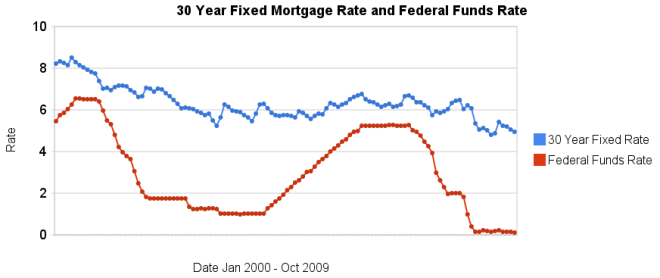
    30 year fixed mortgage rates have declined a bit over the last few months and remain at very low levels.

    30 year fixed mortgage rate chart 2000-2009

    The poor economy, Unemployment Rate Reached 10.2%, has the Fed continuing massive intervention into the economy. The Fed is keeping the fed funds rate at close to 0% (.12% in October). They also continue to hold massive amounts of long term government and mortgage debt (in order to suppress interest rates on long term bonds – by reducing the supply of such bonds in the market).

    I can’t see how lending US dollars, over the long term, at 5%, makes any sense. I would much rather borrow at those rates than lend. If you have not refinanced yet, doing so now may well make sense. And if you are looking at a new real estate purchase, financing a 30 year mortgage sure is attractive at rates close to 5%.

    Related: historical comparison of 30 year fixed mortgage rates and the federal funds rateLowest 30 Year Fixed Mortgage Rates in 37 YearsJumbo v. Regular Fixed Mortgage Rates: by Credit ScoreWhat are mortgage definitionsIgnorance of Many Mortgage Holders

    For more data, see graphs of the federal funds rate versus mortgage rates for 1980-1999. Source data: federal funds rates30 year mortgage rates

  • Consumer Debt Down Over $100 Billion So Far in 2009

    One of the few good recent results of the economy has been a continuous decline in consumer debt. Consumer debt fell for the 8th consecutive month, for the first time, in September, declining by $15 billion.

    Consumer debt grew by about $100 each year from 2004 through 2007. In 2008 it increased $40 billion. In 2009 it has fallen over $100 billion so far: from $2,559 billion to $2,456 billion. This still leaves over $8,000 in consumer debt for every person in the USA and $20,000 per family.

    The huge amount of outstanding consumer and government debt remains a burden for the economy. At least some progress is being made to decrease consumer debt.

    Those living in USA have consumed far more than they have produced for decades. That is not sustainable. You don’t fix this problem by encouraging more spending and borrowing: either by the government or by consumers. The long term problem for the USA economy is that people have consuming more than they have been producing.

    The solution to this problem is to stop spending beyond your means by even increasing levels of personal and government debt. Thankfully over the last year at least consumer debt has been declining. Government debt has been exploding so unfortunately that problem has continued to get worse.

    As we know, interest rates have fallen a great deal over the last few years. the federal funds rate sits at essentially 0% and money market funds now yield under 1%. However, credit card accounts that are charging interest increase to an interest rate of 14.9% from 13.6% in the 3rd quarter of 2008. In 2004 the credit card interest rate was 13.2%, 2005 – 14.6%, 2006 – 14.7%, 2007 – 14.7%, 2008 – 13.6%. All credit card balances should be paid off every month to avoid these excessive interest rates.

    Data from the federal reserve and census bureau.

    Related: Consumer Debt Declined a Record $21.5 Billion in JulyThe USA Economy Needs to Reduce Personal and Government DebtLet the Good Times Roll (using Credit)

  • Unemployment Rate Reached 10.2%

    The unemployment rate rose from 9.8 to 10.2% in October, and nonfarm
    payroll employment continued to decline (down another 190,000 jobs), the U.S. Bureau of Labor Statistics reported today. The largest job losses over the month were in construction, manufacturing, and retail trade.

    In October, the number of unemployed persons increased by 558,000 to 15.7
    million. The unemployment rate rose to 10.2%, the highest rate since April 1983. Since the start of the recession in December 2007, the number of unemployed persons has risen by 8.2 million, and the unemployment rate has grown by 530 basis points.

    Among the major worker groups, the unemployment rates for adult men (10.7%) rose in October. The jobless rates for adult women (8.1 percent), teenagers (27.6%), African-Americans (15.7%), and Hispanics (13.1%) were little changed over the month.

    The number of long-term unemployed (those jobless for 27 weeks and over) was little changed over the month at 5.6 million. In October, 35.6% of
    unemployed persons were long-term unemployed.

    The civilian labor force participation rate was little changed over the month
    at 65.1%. The employment-population ratio continued to decline in
    October, falling to 58.5%.

    The number of persons working part time for economic reasons (sometimes referred to as involuntary part-time workers) was little changed in October at 9.3 million. These individuals were working part time because their hours had been cut back or because they were unable to find a full-time job.

    Related: Unemployment Rate Rises to 8.1%, Highest Level Since 1983 (March 2009)posts on employmentUSA Unemployment Rate Jumps to 9.4%Unemployment Rate Increases to 9.7%
    (more…)

  • Apartment-vacancy Rate is 7.8%, a 23-year High

    Landlords Offer Incentives to Stay Put

    In the third quarter, the national apartment-vacancy rate hit 7.8%, a 23-year high, according to Reis Inc., which tracks vacancies and rents in the top 79 markets.

    One problem for landlords is that existing tenants can easily check the Web to see what deals new tenants are being offered. And new tenants are getting incentives like a waived pet deposit or two months’ free rent.

    Apartment landlords say that one benefit of the bad market is that it has practically halted new construction. New completions are expected to be 98,000 next year and 109,000 in 2011, compared with 188,000 last year and 204,000 this year, according to Green Street Advisors Inc.

    But when loss rates are taken into account—the removal of units because of obsolescence—the actual addition will be immaterial. That means that when the economy rebounds, the supply will be tight, increasing landlord profits.

    Related: Apartment Vacancy at 22-Year High in USA (July 2009)Articles on Real Estate InvestingIt’s Now a Renter’s MarketHousing Rents Falling in the USA