Blog

  • Curious Cat Tax Proposals

    We have tax plans from the major USA Presidential candidates. I don’t like any of them, though I actually like Ted Cruz’s plan more than the others, but it has a huge problem. His plan doesn’t fund the government he wants, not even just as poorly as we have been doing. He would increase the debt substantially.

    My plan would have 3 parts. I like a flat tax, I doubt it will ever happen, but if we could get one I would be happy. Cruz proposes that (at 10%). I am fine with his proposal to eliminate all deductions but mortgage interest and charity. I would definitely tweak that some – no more than $50,000 in mortgage interest deduction a year and the same for charity. Basically subsidizing it a bit for the non-rich is fine. Subsidizing these for the rich seems silly so I would cap the deductions in some way. I also wouldn’t mind an almost flat tax, say 12% up to $200,000 and 15% after that (or some such rates).

    Cruz’s rate is far too low given the government he wants. The government budget is largely: Social Security, Medicare and Military. Then you also have debt payment which have to be paid. Those 4 things are over 80% of the spending. All the other things are just in the last 20%, you can cut some of that but realistically you can’t cut much (in percentage terms – you can cut hundreds of billions theoretically but it is unlikely and even if you did it isn’t a huge change).

    We are piling on more debt than we should. Therefore we should increase revenue, not reduce it. But if we can’t increase it (for political reasons) we definitely should not reduce it until we have shown that we have cut spending below revenue for 2 full years. After that, great, then decrease rates.

    view of the White House, Washington DC
    The White House, Washington DC by John Hunter. See more of my photos of Washington DC.

    The VAT tax on businesses replacing the corporate tax system is in Cruz’s plan and this is the best option for corporate taxes in my opinion. Another decent option is just to pass through all the earnings to the owners (I first heard this proposal from my Economics professor in College) and tax them on the earnings.

    Increasing the giveaways to trust-fund baby as Cruz and Trump propose is the single worst tax policy change that can be made. I have explained previously how bad an idea this is: The estate tax is the most capitalist tax that exists. The trust-fund-baby favors should be reduced not increased. I would roll back to the Reagan Administration policy on estate tax rates.


    (more…)

  • Buybacks, Giveaways to Executives and Non-GAAP Earnings

    Alphabet (Google) writes how they purchased 3.2 million shares this quarter in their earnings release:

    In Q1 2016, we repurchased 3.2 million shares of Alphabet Class C capital stock for an aggregate amount of $2.3 billion, of which $2.1 billion was paid during the quarter. The total remaining authorization for future repurchases is approximately $1.4 billion. The authorization has no expiration date.

    And they tout non-GAAP earnings, while of course reporting the GAAP earnings as required. One of the things executives like about non-GAAP earnings is they pretend the stock they give away to themselves doesn’t have a cost to shareholders. When you call attention to spending over $2 billion in the quarter to buy back 3.2 million shares it seems silly to then claim that the stock you gave away shouldn’t be considered as an expense.

    How can you pay over $2 billion just to get back the stock you gave away and also pretend that money is not really a cost? And on top of that you promote the buyback as evidence that the stock is really worth more than you paid (after all why would you pay more than it is worth). But when you give the stock away to yourself that shouldn’t be seen as a cost? It is amazing they can do this and think they are not doing anything wrong.

    And where does Google stand compared to last year for outstanding shares? 689,498,000 last year compared to 699,311,000 now. So nearly 10,000,000 more shares outstanding, even after they bought back 3.2 million this quarter. In the previous quarter there where 697,025,000 shares outstanding. All these figures are weighted-average diluted share balances for the entire quarter.

    Google CEO, Sundar Pichai, got a $100 million stock award in 2015 (before being promoted to CEO). After the promotion he will be taking an additional “$209 million in stock granted every other year (he has to stay at Google for four years after each grant to cash them out).” He was granted $335 million in stock in 2014 and $78 million in 2013. You can see how quickly the executives paying themselves this well (this is 1 executive, a highly ranked one but still just 1) can dilute stockholders positions even with multi billion dollar buybacks in a quarter.

    You don’t hear companies promoting how much dilution they are imposing on shareholders in order to provide windfalls for executives. I wonder why? No I don’t. I do wonder why reporters promote the buybacks and ignore the fact that the dilution is so extreme that it even overwhelms billions of dollars in buybacks.

    Alphabet reported $6.02 a share in earnings and $7.50 a share in non-GAAP “earnings” for the latest quarter.

    As I have said before I believe Google’s ability to extract enormous profit from their search dominance (as well as YouTube and adwords) makes it a very compelling long term investment. It would be better if the executives were not allowed to take such huge slices from the cash flow Google generates. But it is able to sustain those raids on stockholder equity and still be a good investment and appears likely to be able to continue to do so. Though I think they would be better off reducing the amount executives take going forward.

    Related: Google Diluted Shareholder Equity by 1% a year (2009-2013)Executives Again Treating Corporate Treasuries as Their Money (2011)Another Year of CEO’s Taking Hugely Excessive Pay (2009)

  • LendingClub Filters, Selecting Loans and Automated Investing

    This post continues our series on peer-to-peer lending (and LendingClub): Peer to Peer Portfolio Returns and The Decline in Returns as Loans Age, Investing in Peer to Peer Loans. LendingClub, and other peer-to-peer lenders let you use filters to find loans that meet your criteria. So if you chose to take more, or less, risk you can use filters to find loans fitting your preferences. Those filters can also be applied to automate your lending.

    There are resources online to help you understand the past results of various investing strategies (returns based on various filters). Some filter are just a trade-off of risk for return. You can invest in grade A (a LendingClub defined category) loans that have the lowest risk, and the lowest interest rates and historical returns. Or you can increase your risk and get loans with higher interest rates and also higher historical returns (after factoring in defaults).

    historical chart of returns by grade at Lending club
    Description of chart: This chart shows the historical performance by grade for all issued loans.

    This chart includes all loans that were issued 18 months or more before the last day of the most recently completed quarter. The historical returns data in the chart is updated monthly.

    Adjusted Net Annualized Return (“Adjusted NAR”) is a cumulative, annualized measure of the return on all of the money invested in loans over the life of those loans, with an adjustment for estimated future losses.

    LendingClub lets you set filters to use to automatically invest in new loans as funds are available to invest (either you adding in new money or receiving payments on existing loans). This is a nice feature, there are items you can’t filter on however, such as job title. And also you can’t make trade-offs, say given x, y and z strong points and a nice interest rate in this loan I will accept a bit lower value on another factor.

    So I find I have to be a bit less forgiving on the filter criteria and then manually make some judgements on other loans. For me I add a bit higher risk on my manual selections. I would imagine most people don’t bother with this, just using filters to do all the investing for them. And I think that is fine.

    Practically what I do so that I can make some selections manually is to set the criteria to only be 98% invested. This will cause it to automatically invest any amount over 2% that is not invested. You can set this to whatever level you want and also is how you can make payments to yourself. I will say I think one of the lamest “features” of LendingClub is that is has no ability to send you regular monthly checks. So you have to manually deal with it.

    It should be simple for them to let you set a value like send me $200 on the 15th of each month. And then it manages the re-investments knowing that and your outstanding loans. But they still don’t offer that feature.

    As I said one of the factors in setting filters is managing risk v. reward but the other is really about weaknesses in the algorithm setting rates. You can just see it as risk-reward trade-off but I think it is more sensible to see 2 different things. The algorithm weaknesses are factors that will fluctuate over time as the algorithm and underwriting standards are improved. For example, loans in California had worse returns (according to every site I found accessing past results). There is no reason for this to be true. If a person with the exactly same profile is riskier in California that should be reflected in higher rates and thus bring the return into balance. My guess is this type of factor will be eliminated over time. But if not, or until it is, fixed filtering out loans to California makes sense.

    Once you set your filter criteria then you select what balance you want between A, B, C, D, E and FG loans. I set mine to

    A 2%
    B 16%
    C 50%
    D 20%
    E 10%

    I actually have a bit over 1% in FG (but I select those myself). In 2015 the makeup of the loans given by LendingClub was A 17%, B 26%, C 28%, D 15%, E 10%, F and G 4%.

    Related: Where to Invest for Yield Today (2010)Default Rates on Loans by Credit ScoreInvesting in Stocks That Have Raised Dividends ConsistentlyInvestment Risk Matters Most as Part of a Portfolio, Rather than in Isolation

    Sadly Lending Club uses fragile coding practices that result in sections of the site not working sometimes. Using existing filters often fails for me – the code just does nothing (it doesn’t even bother to provide feedback to the user on what it is failing to do). Using fragile coding practices sadly is common for web sites with large budgets. Instead of using reliable code they seems to get infatuated with cute design ideas and don’t bother much making the code reliable. You can code the cute design ideas reliably but often they obviously are not concerned with the robustness of the code.

  • The 20 Most Valuable Companies in the World – February 2016

    The 20 publicly traded companies with the largest market capitalizations. Since my October 2015 list of the 20 most valuable stocks many of the market caps have declined significantly.

    Company Country Market Capitalization
    1 Apple USA $541 billion
    2 Alphabet (GOOGL) USA $496 billion
    3 Microsoft USA $412 billion
    4 Exxon Mobil USA $341 billion
    5 Berkshire Hathaway USA $329 billion
    6 Facebook USA $311 billion
    7 GE USA $300 billion
    8 Johnson & Johnson USA $296 billion
    9 Amazon USA $262 billion
    10 Wells Fargo USA $245 billion

    Apple lost $131 billion in market cap since my October post. Alphabet (Google) lost just $1 billion in market cap, and for a short time moved past Apple into the top stop. Facebook achieved a rare increase during this period, gaining $16 billion and moving up 1 spot on the list. All the top 10 most valuable companies are based in the USA once again.

    The next ten most valuable companies:

    Company Country Market Capitalization
    11 Nestle Switzerland $226 billion
    12 Roche Switzerland $226 billion
    13 China Mobile China $219 billion
    14 Walmart USA $216 billion
    15 JPMorgan Chase USA $214 billion
    16 Procter & Gamble USA $211 billion
    17 Verizon USA $209 billion
    18 Industrial & Commercial Bank of China China $206 billion*
    19 Novartis Switzerland $195 billion
    20 Petro China China $191 billion

    Market capitalization shown are of the close of business February 26th, as shown on Google Finance.

    The 11th to 20th most valuable companies includes 4 USA companies, 3 Chinese companies and 3 Swiss companies. Toyota fell from 20th to 25th and was replaced in the top 20 by Verizon, which resulted in the USA gaining 1 company and costing Japan their only company in the top 20. Pfizer also dropped out and was replaced by Walmart.

    The total value of the top 20 decreased by $189 billion since my October post: from $6.054 trillion to $5.865 trillion. Since my October 2014 post of the 20 most valuable companies in the world the total value of the top 20 companies has risen from $5.722 trillion to $5.865 trillion, an increase of $143 billion. The companies making up the top 20 has changed in each period.

    Related: Global Stock Market Capitalization from 2000 to 2012Stock Market Capitalization by Country from 1990 to 2010Historical Stock Returns

    A few other companies of interest (based on their market capitalization):
    (more…)

  • Business Taxes

    A business must pay several types of taxes (this posts is focused on the USA). Tax rules often change and keeping up with the rules can be a challenge. Which is why most of us, even small businesses, rely on accountants.

    Three tax important to pay attention to 2016 to are:

    Payroll taxes

    Failure to file accurate payroll taxes or late payments can result in heavy penalties. For deposits that are made a week late, the tax penalty can go up to five percent of the past due amount. Usually the amount of penalty is measured using calendar days beginning with the due date of the tax deposit. The three penalties (failure to pay, failure to file, and failure to deposit) can add up to 33 percent penalties + interest 16 days past the due date.

    Payroll taxes are a huge portion of most people’s pay and those that claim some people don’t pay any tax just pretend paying this tax (which is the highest tax most workers pay) isn’t paying tax. The tax rate is 45.3% (7.65% paid by the employer and 7.65% paid by the employee. For the very wealthy this tax isn’t a huge factor as it is only applied to earned income and earnings above $118,500 (indexed to inflation, so the level increases every year) are excluded. The 7.65% figure includes 1.45% for medicare, that has no income limit (so above $118,500 the employee and employer pay 1.45% – a total of 2.9%).

    Options like MasterTax tax compliance software are available for businesses to help comply with all the rules. Companies can rely on automated software that houses a rules-driven database (updated with the latest rules) with thresholds and frequencies across different jurisdictions. The benefit is a month-to-month actionable calendar that enables you to make timely payments at no extra cost and without requiring third-party support.

    Corporate taxes

    Different corporations have to pay a different percentage of corporate taxes, with penalties for late filing and errors in tax records. For example, a C corporation should file a tax return annually, and the filing deadline comes on the 15th day of the third month after the tax year ends. If the deadline is missed, the business faces a five percent penalty of the unpaid tax, and it goes up to 25 percent after the five month late.

    Some software provide free audit guidance from trained tax professionals to help you understand C-corporation corporate tax requirements. Businesses can also use these tools to file electronic returns and receive fast tax refunds. Some software have integrated notifications that inform you that the IRS has received your electronically filed tax return.

    Gross receipts taxes

    Some states impose gross receipts taxes on businesses like transportation companies. For example, a trucking company will have to pay a tax rate of 50 mills (or 5 cents, $0.05) based on gross receipts from baggage, passengers and freight transportation. Failure to file accurately will result in a five percent penalty per month.

    In a tax filing software, you can create a custom workflow for gross receipts taxes and keep track of deadlines to ensure you’re filing on time and avoiding late filing penalties.

    You will also likely have to withhold income tax from your employees and send that to the state and federal governments. In addition, if you are a retail outlet in many states you will have to collect and forward sales tax to the state (and sometimes local) government.

  • Find Help Paying for Prescription Drugs and Other Expenses

    BenefitsCheckUp is a free service of the National Council on Aging. Many adults over 55 need help paying for prescription drugs, health care, utilities, and other basic needs. There are over 2,000 federal, state and private benefits programs available to help those living in the USA. But many people don’t know these programs exist or how they can apply.

    BenefitsCheckUp asks a series of questions to help identify benefits that could save you money and cover the costs of everyday expenses in areas such as:

    • Medications
    • Food
    • Utilities
    • Legal
    • Health care
    • Housing
    • Taxes
    • Transportation
    • Employment Training

    While the National Council on Aging is focused on benefits for older people the service actually finds many sources that are not dependent on age.

    If you complete the overall questionnaire it is fairly long (about 30 questions) but still can be completed in 10 minutes. Also you can target your request (say to health care) and have a shorter questionnaire. They will provide links and contact information to various programs you may qualify for based on your answers.

    Related: Disability Insurance is Very ImportantPersonal Finance, Minimal BudgetingTruly Free Credit ReportManage Your Borrowing and Avoid Debt Negotiators

  • 10 Stocks for 10 Years – February 2016 Update

    It has been over 10 years since I originally posted my 10 stocks for 10 years portfolio. 7 of those 10 are still in my portfolio for the next 10 years.

    Since April of 2005, the portfolio Marketocracy calculated annualized rate or return is 7.1% (the S&P 500 annualized return for the period is 6.9%). Marketocracy subtracts the equivalent of 2% of assets annually to simulate management fees – as though the portfolio were a mutual fund. Without that fee, the return beats the S&P 500 annual return by about 220 basis points annually (9.1% to 6.9%).

    Since the last update, I have added Gilead to the portfolio. I also dropped PetroChina and Templeton Dragon fund (as I had mentioned I would do).

    The current stocks, in order of return:

    Stock Current Return % of sleep well portfolio now % of the portfolio if I were buying today
    Amazon – AMZN 736% 12% 9%
    Google – GOOG 400%* 21% 15%
    Danaher – DHR 129% 8% 8%
    Apple – AAPL 85% 17% 17%
    Toyota – TM 50% 8% 10%
    Intel – INTC 46% 7% 8%
    Pfizer – PFE 21% 6% 6%
    Cisco – CSCO 14% 3% 3%
    Abbvie – ABBV 1% 6% 8%
    Gilead – GILD -6% 6% 8%
    Cash 6% 8%

    The current marketocracy results can be seen on the Sleep Well marketocracy portfolio page.

    Related: 12 Stocks for 10 Years, Jan 2014 Update12 Stocks for 10 Years – 12 Stocks for 10 Years: January 2012 Update – October 2012 Update – 12 Stocks for 10 Years, Oct 2010 Update

    I make some adjustments to the stock holdings over time (selling of buying a bit of the stocks depending on large price movements – this rebalances and also lets me sell a bit if I think things are getting highly priced. So I have sold some Amazon and Google as they have increased greatly (and I have added to ABBV and GILD at nice prices). These purchases and sales are fairly small (resulting in an annual turnover rate under 2%).

    I would consider selling Cicso. I also would like to find a good natural resource stock or two if I can find good stocks. I do feel the portfolio is too concentrated in technology and medical stocks so I am would choose a stock with a different focus if it were close to as good as an alternative focused on technology or health care, but I will also buy great companies at good prices even if that results in a less diverse portfolio.

    I don’t try and sell significant portions of the portfolio and have a large cash balance to time the market. I will, however, sell some of the individual positions if I think the price is very high (or to rebalance the portfolio a bit).

    The market has gone down a fair amount recently and may go down more. It may be in that downdraft I will find a nice candidate to add at an attractive price.

    If you wonder why the Apple return isn’t higher, I debated adding it at the outset but decided against it. So I only started adding Apple in 2010 and added to that position over the next several years.

    * Marketocracy seems to have messed up the returns for Google (probably due to the split); this is sad as their purpose for me is to calculate returns, but my guess is between 350-450%

  • A Wise Way to Subsidize Electricity Rates

    When I lived in Malaysia I learned that the residential electricity rates were very low for the low levels of use and climbed fairly rapidly as you used a lot of electricity (say running your air conditioner a lot). I think this is a very good idea (especially for the not yet rich countries). In rich countries even most of the “poor” have high use of electricity and it isn’t a huge economic hardship to pay the costs.

    Effectively the rich end up subsidizing the low rates for the poor, which is a very sensible setup it seems to me. The market functions fairly well even though it is distorted a bit to let the poor (or anyone that uses very little electricity) to pay low rates.

    In a country like Malaysia as people become rich they may well decide to use a great deal of electricity for air conditioning (it is in the tropics). But their ancestors didn’t have that luxury and having that be costly seems sensible to me. Allowing the poor to have access to cheap electricity is a very good thing with many positive externalities. And subsidizing the rate seems to be a good idea to me.

    Often you get bad distortions in how markets work when you try to use things like subsidies (this post is expanded from a comment I made on Reddit discussing massive bad investments created by free electricity from the power company to city governments – including free electricity to their profit making enterprises, such as ice rinks in Puerto Rico).

    Johor Bahru central business district
    View of downtown Johor Bahru from my condo (a small view of Singapore visible is in the background)

    With the model of low residential rates for low usage you encourage people to use less electricity but you allow everyone to have access at a low cost (which is important in poor or medium income countries). And as people use more they have to pay higher rates (per kwh) and those rates allow the power company to make a profit and fund expansion. Often in developing countries the power company will be semi-private so the government is involved in providing capital and sharing in profits (as well as stockholders).

    The USA mainly uses central air conditioning everywhere. In Malaysia, and most of the world actually, normally they just have AC units in some of the rooms. In poor houses they may well have none. In middle class houses they may have a one or a couple rooms with AC units.

    Even in luxury condos (and houses) they will have some rooms without AC at all. I never saw a condo or house with AC for the kitchen or bathrooms. The design was definitely setup to use AC in fairly minimal ways. The hallways, stairways etc. for the “interior” of the high rise condos were also not air conditioned (they were open to the outside to get good air flow). Of course as more people become rich there is more and more use of AC.

    Related: Traveling for Health CareExpectationsLooking at the Malaysian Economy (2013)Pursuing a Growing Economy While Avoiding the Pitfalls That Befall to Many Middle Income CountriesSingapore and Iskandar MalaysiaLooking at GDP Growth Per Capita for Selected Countries from 1970 to 2010Malaysian Economy Continues to Expand, Budget Deficits Remain High (2012)Iskandar Malaysia Housing Real Estate Investment Considerations (2011)

  • 20 Most Popular Posts on Curious Cat Investing and Economics Blog in 2015

    The most popular posts on the Curious Cat Investing and Economics blog in 2014 (by page views).

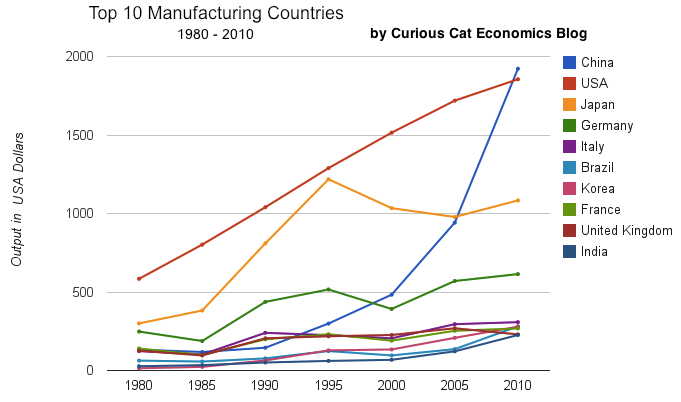
    1. Top 10 Countries for Manufacturing Production in 2010: China, USA, Japan, Germany… (posted in 2011)
    2. chart of output by top 10 manufacturing countries from 1980 to 2010
      chart of output by top 10 manufacturing countries from 1980 to 2010
    3. Manufacturing Output as a Percent of GDP by Country (1980 to 2008) (2010)
    4. Nuclear Power Generation by Country from 1985-2010 (2012)
    5. Government Debt as Percentage of GDP 1990-2009: USA, Japan, Germany, China… (2010)
    6. Stock Market Capitalization by Country from 1990 to 2010 (2012)
    7. Global Stock Market Capitalization from 2000 to 2012 (2013)
    8. The 20 Most Valuable Companies in the World – October 2015
    9. Manufacturing Output as Percent of GDP from 1980 to 2010 by Country (2012)
    10. USA Individual Earnings Levels: Top 1% $343,000, 5% $154,000, 10% $112,000, 25% $66,000 (2012)
    11. Manufacturing Output by Country 1999-2011: China, USA, Japan, Germany (2013)
    12. Chart of Largest Petroleum Consuming Countries from 1980 to 2010 (2011)
    13. The USA Doesn’t Understand that the 1950s and 1960s are Not a Reasonable Basis for Setting Expectations (2011)
    14. Oil Production by Country 1999-2009 (2011)
    15. Monopolies and Oligopolies do not a Free Market Make (2008)
    16. Investing in Peer to Peer Loans (2015)
    17. Cockroach Portfolio (2014)
    18. USA Health Care Spending 2013: $2.9 trillion $9,255 per person and 17.4% of GDP (2015) (
    19. Long Term View of Manufacturing Employment in the USA (2012)
    20. Solar Energy Capacity by Country (2015)
    21. Chart of Global Wind Energy Capacity by Country 2005 to 2013 (2014)
    22. As with my other blogs the most popular posts show that old posts stay popular for a long time. Number of top 20 posts by year of publication:

      2015: 4
      2014: 2
      2013: 2
      2012: 5
      2011: 4
      2010: 2

      2008: 1

      Related: 20 Most Popular Posts on the Curious Cat Investing and Economics Blog in 201420 Most Popular Post on Curious Cat Science and Engineering Blog in 201410 Most Popular Posts on the Curious Cat Management Blog in 2014Most Popular Posts on the Curious Cat Management Comments BlogMost Popular Posts on the Curious Cat Comments Blog

  • Beginners Guide to Investing in Historical Documents

    Today there are more ways to invest your money than ever before. Alternative investments can help provide counterweights to more common investments.

    Historical documents are important pieces of cultural memorabilia that are sought after by personal collectors, museums and universities. Given the prestige of the collectors, historical documents can go for top dollar. In one recent example, Bill Gates purchased the Codex Leicester for over $30 million.

    Historical documents can be a great addition to any portfolio, but one word of caution: authenticity is critical. Far too many investors have been bamboozled by counterfeit documents. Raab Collection, an internationally recognized proprietor of historical documents, stresses the importance of due diligence. When they help clients such as the Library of Congress build their collections, every step possible is taken to authenticate a document before striking a deal.

    Here are four other factors that should be considered before making your first historical document investment:

    Plan for Preservation

    The older historical documents get the more valuable they become – as long as they are properly preserved. The condition of the document is second only to authenticity when it comes to value.

    Before you take ownership of a historical document, it’s a good idea to have a plan in place for how the document will be stored. Documents should be kept in waterproof, airtight containers that protect the fibers from the elements. UV radiation can also degrade paper overtime, which is why storing historic documents out of direct sunlight is always advised.

    Protecting Your Investment

    Unlike stocks and mutual funds, physical assets can be destroyed or stolen. Historical documents have to be treated like fine art. They should be insured and some form of theft protection should be put in place. Documents can be stored in a fireproof lockbox and/or stored in a bank safe under lock and key.

    Get Documents Appraised

    Professional appraisals are important for historical collectables. An appraisal will give you an official estimate of the value, which can be used for securing insurance. Appraisals also give you a better idea of an acceptable price when it comes time to sell off your investment.

    Keep Track of the Market and Trends

    You won’t be checking stats daily like the stock market, but keeping up with historical document sales is needed to ensure you make the best decisions for your investment. After all, making money on investments hinges on knowing when to buy and when to sell. Knowing what’s happening in the market will help you determine when the time is ripe to sell or whether you should hold onto your asset a little longer. Demand for historical documents tends to be higher than supply, but catching things right when interest is trending upward can help you make the most profit possible.

    Historical and autographed documents have always been popular collectibles, but now more people are beginning to realize their investment potential. Every year countless documents are sold privately and at auction for thousands and even millions of dollars. Investors that seek professional guidance before buying and take care to preserve their asset will be able to grow their portfolio or retirement nest egg by simply holding on to a piece of history.

    In general alternative investments (historical documents, art, coins, collectibles etc.) should make up a small portion, under 5%, of an investment portfolio. Another investment that isn’t quite normal, but isn’t really considered a normal investment either is peer to peer loans. We have written about peer to peer loans several times on this blog recently, I would consider under 5% for peer to peer loans acceptable but would consider that part of the bond portion of a portfolio.