Blog

  • Curious Cat Investing and Economics Carnival #3

    Welcome to the Curious Cat Investing and Economics Carnival, we hope you enjoy the following posts we share here.

    • Warren Buffet On An Investment News Channel by Robin Bal – “I could see that the mere mention of a time scale like three to five years had derailed the interviewer’s thought process. Coming as she did from a world where three to five hours or at most three to five days is the standard unit of time, the idea of an investor talking in years seemed to have thrown a spanner in her works.”
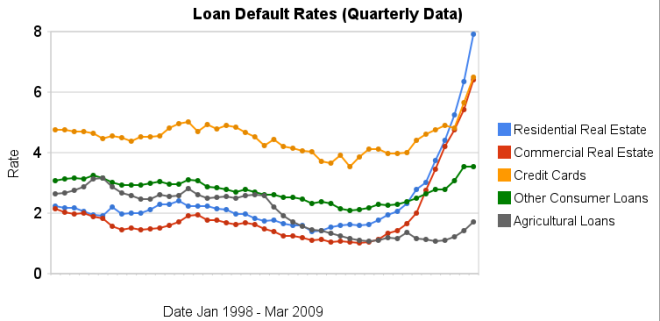
    • Loan Default Rates: 1998-2009 by John Hunter – “In the 4th quarter of 2007 residential real estate default rates were 3.02% by the 4th quarter of 2008 they were 6.34% and in the 1st quarter of this year they were 7.91%”
    • Key Factors Affecting Long-Term Growth in Federal Spending by Douglas Elmendorf – “Two factors underlie the projected increase in federal spending on Medicare, Medicaid, and Social Security as a share of GDP: rapid growth in health care costs and an aging population.”
    • Will the Chinese Keep Saving? by Rachel Ziemba – “Should export-oriented ‘surplus’ countries like China keep saving and keep trying to export demand, the reduction in imbalances could actually exacerbate the global economic contraction or contribute to a more sluggish recovery. “
    • Use Your Health Insurance! by David Weliver – “So if you’re worried about losing your job (and insurance) or anticipate making a life change that will leave you uninsured, get in to see a doctor while you are still covered.”
    • Where is the externality here? by Matt Nolan – “They are paid less because their marginal product is lower, and they are willing to be paid less because the benefit they receive from consuming alcohol is sufficient compensation – this is a completely internalised decision for the drinker isn’t it, so where is the social cost.”
    • Quibbles With Quants – “What the models failed to capture was that humans don’t behave in simple, predictable and uncorrelated ways. It’s impossible to overstate the importance of the way these models cope with correlation of peoples’ psychology. To sum it up: they don’t. Let me know if that’s too complex an analysis for the mathematical masters of the universe.”
    • Goldman’s Back, and Why We Should Be Worried by Robert Reich – “The decision to bail out AIG resulted in a $13 billion giveaway to Goldman because Goldman was an AIG counterparty. Indeed, Goldman executives and alumni have played crucial roles in guiding the Wall Street bailout from the start. So the fact that Goldman has reverted to its old ways in the market suggests it has every reason to believe it can revert to its old ways in politics, should its market strategies backfire once again — leaving the rest of us once again to pick up the pieces.”
  • Bad Math, Bad Statistics

    Here is a good blog post showing one great feature of the blogosphere (that term seems to have fallen out of use hasn’t it): interaction. It also shows that you have to think critically. You can’t just accept what you read (you never can, but that is even more true with blogs than it is with newspapers that at least have some standards normally). I tend to agree with this posts look at the data, though I have not examined the issue closely.

    Bad Math, Bad Statistics: Trying to get a blogger to admit a mistake

    So what’s wrong with this picture? If you guessed, “he’s comparing a gross value with per capita value” you win a cookie. US population is increasing all the time, and therefore, even if per capita incomes have dropped, that doesn’t mean total income hasn’t. So if you multiply those figures by the population and then compare them, you get this (source):

    1981: 229465714 * 8476.0 = 1.944 trillion
    1992: 255029699 * 14847.0 = 3.786 trillion (94% gain)
    2005: 292892127 * 25036.0 = 7.332 trillion (93.6% gain)

    Er, doesn’t look like a lag to me. In fact, it looks like it’s doubling every 12-13 years just as much as GDP is. I also looked up total income statistics for the US, and found the following figures (source). (Note these figures are different. More on that later.)

    1981: $2,580,600,000 (2.58 / 3.1 = 83% of GDP)
    1992: $5,349,384,000 (more than double!) (5.34 / 6.2 = 86% of GDP)
    2005: $10,252,973,000 (another double!) (10.25 / 12.4 = 82% of GDP)

    Anyway it is a much more interesting argument than I would hear when I listened to TV “pundits” years ago spout meaningless talking points at each other. Granted they argument is not going to be studied as a wonderful example of how we should debate. Still it is much above what passes for debate from our politicians (yes this is more a sad commentary on how failed our politicians are than a statement of how marvelous the argument on the GDP issue is between the two bloggers).

    Here is a math question for you, what has a bigger impact moving from 15 to 18 mpg or 50 to 100 mpg?

    Related: Government Debt as a Percentage of GDPUSA Consumers Paying Down DebtIs Productivity Growth Bad?Americans are Drowning in Debt

  • Loan Default Rates: 1998-2009

    chart of loan default rates 1998 to 2009Chart showing loan default rates for real estate, consumer and agricultural loans for 1998 to 2009 by the Curious Cat Investing Economics Blog, Creative Commons Attribution, data from the Federal Reserve.
    As you can see real estate default rates exploded in 2008. In the 4th quarter of 2007 residential default rates were 3.02% by the 4th quarter of 2008 they were 6.34% and in the 1st quarter of this year they were 7.91% (471 basis points above the 4th quarter of 2007). Commercial real estate default rates were at 2.74 in the 4th quarter of 2007, 5.43% in the fourth quarter of 2008 and 6.5% in the 1st quarter of 2009 (a 366 basis point increase).

    Credit card default rates were much higher for the last 10 years (the 4-5% range while real estate hovered above or below 2%). In the last 2 quarters it has increased sharply. From 4.8% in the 3rd quarter 2008 to 5.66% in the 4th and 6.5% in the 1st quarter of 2009. The default rate on other consumer loans are up but nowhere near the amounts of real estate or credit cards.

    Agricultural loan default rates are actually about as low now as they have every been 1.71%. That is up a bit from the 1.06% low the default rate hit in the 1st quarter of 2009 but actually lower than it was for half of the last decade (the last 5 years it has been lower but prior to that it was higher – in fact with higher default rates than either real estate loan category).

    Data from the Federal Reserve

    Related: Mortgage Rates: 6 Month and 5 Year ChartsJumbo Loan Defaults Rise at Fast PaceContinued Large Spreads Between Corporate and Government Bond YieldsNearly 10% of Mortgages Delinquent or in Foreclosure

  • The Formula That Killed Wall Street

    The Formula That Killed Wall Street

    For five years, Li’s formula, known as a Gaussian copula function, looked like an unambiguously positive breakthrough, a piece of financial technology that allowed hugely complex risks to be modeled with more ease and accuracy than ever before. With his brilliant spark of mathematical legerdemain, Li made it possible for traders to sell vast quantities of new securities, expanding financial markets to unimaginable levels.

    His method was adopted by everybody from bond investors and Wall Street banks to ratings agencies and regulators. And it became so deeply entrenched—and was making people so much money—that warnings about its limitations were largely ignored.

    Then the model fell apart. Cracks started appearing early on, when financial markets began behaving in ways that users of Li’s formula hadn’t expected. The cracks became full-fledged canyons in 2008—when ruptures in the financial system’s foundation swallowed up trillions of dollars and put the survival of the global banking system in serious peril.

    Very nice article on the dangers of financial markets to those that believe that math can provide all the answers. Math can help find opportunities. However markets have physical, psychological and regulatory limitations. And markets frequently experience huge panics or manias. People continue to fail to model that properly.

    Related: All Models Are Wrong But Some Are UsefulLeverage, Complex Deals and ManiaFinancial Markets with Robert ShillerFinancial Market MeltdownFailure to Regulate Financial Markets Leads to Predictable Consequences

  • Economists Raise Projections for Second Half of 2009

    Economists are raising projections for the USA economy in the second half of 2009. The predictions are still for an anemic economy growing at just 1.5% and with unemployment reaching 10.1%. Still I think if we achieve that we should feel lucky. Economists Raise U.S. Outlook as Recession Fades

    Growth will average 1.5 percent in the July-to-December period, compared with last month’s 1.2 percent projection, according to the median of 57 forecasts in the survey taken from July 2 to July 8. The jobless rate will exceed 10 percent early next year and average 9.8 percent for 2010.

    The economy probably shrank at a 1.8 percent rate from April to June, the latest survey showed, less than economists forecast last month. The U.S. will return to growth in the current quarter and expand 2.1 percent next year.

    A separate report from the Commerce Department today showed the trade deficit unexpectedly narrowed in May as exports jumped while imports of crude oil and auto parts slid. The gap between imports and exports decreased 9.8 percent to $26 billion, the smallest since November 1999, from $28.8 billion in April.

    Unemployment will rise to 10.1 percent in the first quarter of 2010 from 9.5 percent last month, already the highest since August 1983, the survey of economists showed.

    The trade deficit is still far to large. And the to move the economy in the right direction we need to continue reducing personal debt (and start reducing government debt).

    Related: First Quarter GDP 2009 down 6.1%When Will the Recession Be Over?Warren Buffett Webcast on the Credit Crisis

  • Managing Retirement Investment Risks

    The Society for Actuaries has published a good resource: Managing post-retirement risks.

    Experts disagree about when annuitization is a good strategy. Disadvantages include losing control of assets, costs, and inability to leave money to one’s heirs. Annuities without inflation protection are only partial protection against living “too long.”

    Many investors try to own some assets whose value may grow in times of inflation. However, this sometimes will trade inflation risk for investment risk.
    Common stocks have outperformed inflation in the long run, but are
    poor short-term hedges. The historically higher returns from stocks
    are not guaranteed and may vary greatly during retirement years.

    Retirement planning should not rely heavily on income from a bridge job. Many retirees welcome the chance to change careers and move into an area with less pay but more job satisfaction, or with fewer demands on their time and energy.

    Terminating employment before age 65 may make it difficult to find a source of affordable health insurance before Medicare is available.

    Insurance for long-term care covers disabilities so severe that assistance is needed with daily activities such as bathing, dressing and eating. Some policies require a nursing home stay; others do not. The cost of long-term care insurance is much less if purchased at younger ages, well before anticipated need.

    The full document is well worth reading.

    Related: Many Retirees Face Prospect of Outliving SavingsHow to Protect Your Financial HealthFinancial Planning Made Easypersonal finance tips

  • 30 Year Mortgage Rate and Federal Funds Rate Chart

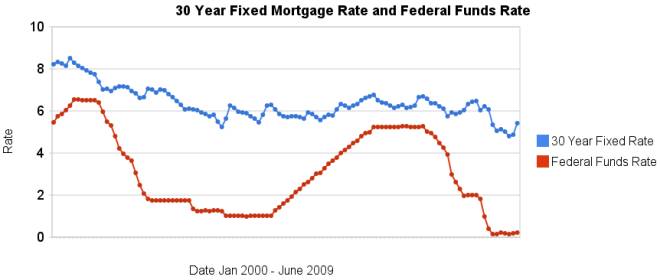
    Once again the data shows that the 30 year fixed mortgage rates are not directly related to federal funds rates. In June the fed funds rate increased 3 basis points, 30 year mortgage rates increased 56 basis points. Since January the fed funds rate is up 6 basis points is up while 30 year mortgage rates are up 36 basis points. Home prices have continued to fall even with the very low mortgage rates.

    30 year fixed mortgage rates and the federal funds rate 2000-2009

    Related: Mortgage Rates: 6 Month and 5 Year Chartshistorical comparison of 30 year fixed mortgage rates and the federal funds rateposts on financial literacyGM and Citigroup Replaced by Cisco and Travelers in the DowJumbo v. Regular Fixed Mortgage Rates: by Credit Score

    For more data, see graphs of the federal funds rate versus mortgage rates for 1980-1999. Source data: federal funds rates30 year mortgage rates

  • U.S. Job Report Suggests that Green Shoots are Mostly Yellow Weeds

    U.S. Job Report Suggests that Green Shoots are Mostly Yellow Weeds by Nouriel Roubini

    The June employment report suggests that the alleged ‘green shoots’ are mostly yellow weeds that may eventually turn into brown manure. The employment report shows that conditions in the labor market continue to be extremely weak, with job losses in June of over 460,000. With the current rate of job losses, it is very clear that the unemployment rate could reach 10 percent by later this summer, around August or September, and will be closer to 10.5 percent if not 11 percent by year-end. I expect the unemployment rate is going to peak at around 11 percent at some point in 2010, well above historical standards for even severe recessions.

    It’s clear that even if the recession were to be over anytime soon – and it’s not going to be over before the end of the year – job losses are going to continue for at least another year and a half. Historically, during the last two recessions, job losses continued for at least a year and a half after the recession was over.

    The latest figures – published this week – on mortgage delinquencies and foreclosures suggest a spike not only in subprime and near-prime delinquencies, but now also on prime mortgages. So the problems of the economy are significantly affecting the banking system.

    So the outlook for the US and global economy remains extremely weak ahead. The recent rally in global equities, commodities and credit may soon fizzle out as an onslaught of worse- than-expected macro, earnings and financial news take a toll on this rally, which has gotten way ahead of improvement in actual macro data.

    Certainly this is not a forecast that will make people happy. I agree that the expectations for a nice quick recovery have become too optimistic. I am far from certain what lies ahead but the second half of 2009 does not look to be very strong. It is still a time to be cautious.

    Related: Jim Rogers on the Financial Market Mess (Oct 2008)Beware of the Sucker’s RallyUSA Consumers Paying Down DebtInvesting quotations

  • Another Wave of Foreclosures Loom

    Another wave of foreclosures is poised to strike

    loan defaults are up sharply. And with many government and banks’ self-imposed foreclosure moratoriums expiring, the biggest lenders indicate that they are likely to move more aggressively to clear up a backlog of troubled mortgages.

    Mark Zandi of Moody’s Economy.com estimates that 15.4 million homeowners — or about 1 in 5 of those with first mortgages — owe more on their homes than they are worth.

    Government and company reports show that the number of completed foreclosures nationwide slowed sharply late last year and into early this year, largely because of various moratoriums in effect during much of the first quarter.

    But anecdotal reports indicate that foreclosure sales have started to climb again in the second quarter. And the pipeline is clearly getting fuller. In the first quarter, some 1.8 million homeowners nationwide fell behind on their loans by 60 to 90 days, a 15% increase from the prior quarter, according to Moody’s Economy.com. The research firm said that loan defaults rose sharply as well, to 844,000 in the first three months of this year.

    Even as defaults among subprime borrowers have trended lower this year, newly initiated foreclosures involving prime mortgage loans saw a significant increase in the first quarter, jumping 21.5% from the fourth quarter, according to a government report of loan data from national banks and federally regulated thrifts.

    This is more bad news for the economy. As I have been saying the economy is still in serious trouble. Cleaning up the damage caused by living beyond our means for decades does not get cleaned up quickly. This are actually going as well as could be hoped for, I think. We need to hope the remainder of this year sees the economy stabilize and then hope 2010 brings some good news.

    Related: Nearly 10% of Mortgages Delinquent or in ForeclosureOver Half of 2008 Foreclosures From Just 35 CountiesHow Much Worse Can the Mortgage Crisis Get? (March 2008)Mortgage Rates Falling on Fed Housing Focus

  • Peter Schiff Answers Redditers Questions

    Peter Schiff answers economic questions from Reddit users (see part 2). See our Economics and Investing Reddit. He made the point that inflation will be a serious problem. He also recommended several books, including: Economics in One Simple Lesson by Henry Hazlit and The Biggest Con: How the Government is Fleecing You by his father. He is an opinionated economist. I certainly do not agree with everything he says but I think he is worth listening to. As an investor I believe it is important to seek out unconventional opinions and find worthwhile unconventional opinions that can help you beat the market.

    Related: Skeptics Think Big Banks Should Not be Bailed OutInflation is a Real ThreatLet the Good Times Roll (using Credit)Dell, Reddit and Customer Focus