Blog

  • Default Rates on Loans by Credit Score

    Credit scores are far from a great measure of whether a person is a great credit risk for a specific loan, in my opinion. However, they are very widely used and therefor, very important. They also are somewhat useful. And lenders don’t base judgement solely on credit scores, they consider many other factors, if they have any sense at all.

    Credit scores range from 300 to 850. They are calculated by various credit reporting organizations, including FICO. They factor in payment history, percent of outstanding credit available that is used, credit report checks, length of outstanding credit accounts, etc..

    Metlife report on consumers and credit scores provides some interesting data.

    Credit score range Default rate*
    740-850 .4%
    680-739 2.8%
    620-679 7.5%
    550-619 17%
    300-459 33.8%

    * Default rate in this case means, 90 days past due. MetLife got this data from the Consumer Financial Health Study dataset**.

    Peer to peer lending platform, Lending Club, limits loans to those with a minimum credit score of 660 (remember there are multiple organizations that provide credit scores, this minimum is based on Lending Club’s score). In general I see scores above 700 in A and B loans, scores from 650-700 in C and D loans. Remember the credit score is not the only factor setting the rate (you will see scores above 700 in the C loans sometimes, etc.). Credit scores provide some insight but are just 1 factor in approving loans or setting rates (an important one but not a completely dominant one).

    About 38% of people have credit scores from 750-850. Another 37% from 600-749 and about 25% from 350-599.
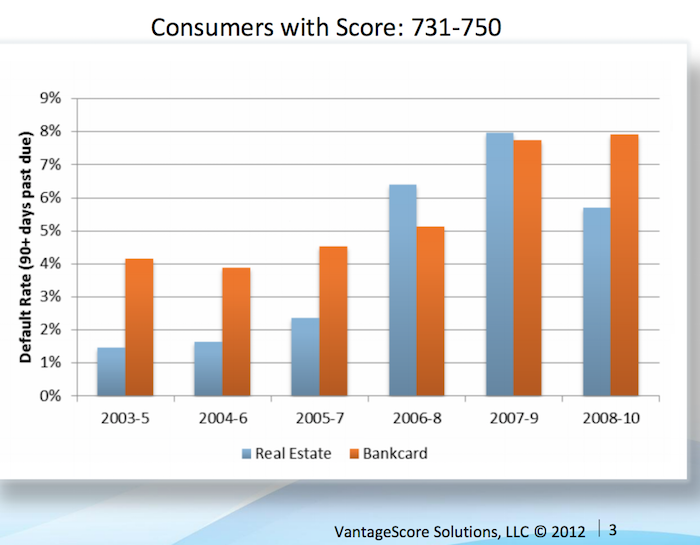
    chart of Default rate by credit score (731-750) from 2003 to 2010
    via online Vantage Score presentation

    Vantage Score decided to make their score range go up to 1000, not the standard 850. Maybe a 750 score for them is comparable to 680? They say super-prime is 900+ (750-850 on more common scale), prime is 701-900 (680-739), near-prime 641-700 (620-679), subprime 501-640 (550-619). Anyway that chart shows the changing default rates from 2003 to 2010 by type of loan.

    This Federal Reserve report on meeting between Federal Reserve Board staff and Fair Isaac Corporation (FICO) 20 June 2013 has some interesting material.

    For guidance, the following table generally matches a borrower’s odds-of-default with the corresponding FICO 8 score (calculated on performance from Oct 2008 – Oct 2010). Of course, the range of scores and odds-of-default [the data is related to mortgages] will vary with each model as creditors develop and validate their own credit scoring models.

    Odds-of Default
       
    FICO 8 Score
       
    percent of population**
    5:1 610 9%
    10:1 645 9%
    20:1 685 6%
    30:1 705 6%
    40:1 720 6%
    50:1 735 9%
    100:1 770 30%

    As you can see at a 610 level, 20 loans out of 100 defaulted. At 685 just 5 in 100 defaulted and at 770 just 1 in 100 did.

    ** I had to adjust this, because the report didn’t report it in this form, so it a very approximate measure (I made estimates for something like scores from 735 to 769 etc.). Again this is data from the Oct 2008 – Oct 2010 period. The rest of the population (about 25%) would have scores below 610.

    Related: The Impact of Credit Scores and Jumbo Size on Mortgage Rates (2009)Your FICO credit score explained$2,540,000,000,000 in USA Consumer Debt

    This page references a Fed report (that I can’t find) that found the following default rates on new loans for the two years after origination, 2000-2002:

    Credit score range Default rate*
    under 520 41%
    520-559 28%
    560-599 23%
    600-639 16%
    640-679 9%
    680-719 4.4%
    over 720 <1%

    ***

    The Consumer Financial Health Study respondents were asked to self-assess their credit quality and for permission to pull their actual credit scores.8 Forty-five percent of survey participants granted permission, yielding an “opt-in” sample size of 3,215. We appended two objective measures of creditworthiness to the dataset: Experian provided VantageScore 3.0 credit scores, and LexisNexis Risk Solutions provided RiskView scores. VantageScore is a generic credit scoring model that was created by the three major credit bureaus (Equifax, Experian and TransUnion) and, in addition to tradeline data, includes rent, utility and cell phone payment data when it is available in consumer credit files.
  • Out of Pocket “Maximum” – Understanding USA Health Care Costs

    Health insurance options are confusing for those of us in the USA (those outside the USA are free of the frustrations of USA health care system). One of the features of a health insurance plan in the USA is the out-of-pocket “maximum.”

    Now if you think you understand english you might think this is the maximum you have to pay out of your pocket. If you understand how horrible the USA health care system is and how nothing is easy, you probably suspect it isn’t a maximum at all. I find myself thinking that I don’t really understand what this seemingly simple value actually means, so I decided to research it and write this blog post.

    First of all you have to pay the monthly premiums (assuming your employer doesn’t pay them for you), probably a few hundred or more dollars every month. Then the coverage likely has a deductible maximum for the year.

    For this example, for 1 person the insurance costs $300/month with a yearly deductible maximum of $5,000. And the insurance plan says there is an out-of-pocket “maximum” of $6,500. Well 12 *$300 + $5,000 = $8,600. So, as you can probably guess, out-of-pocket “maximum” doesn’t actually mean the maximum out of your pocket. In fact the $8,600 is excluded from the out-of-pocket maximum calculation altogether.

    So, you then might think ok, my actual out-of-pocket maximum (the most I will have to pay all year for health care) is $8,600 + $6,500 = $15,100. But that isn’t right either.

    First, this is only for covered medical expenses, uncovered medical expenses are not included. This makes some sense, certainly, but in your planning, you can’t think your health care costs are capped at $15,100. Especially since in the USA lots of health care will be uncovered (dental care is often excluded, mental health care may well be limited, certain types of treatment may not be covered, prescription glasses, non-prescription drugs, addiction treatment…).

    Remember, USA health care coverage isn’t even just limited by the type of care. For example, even if fixing your injured leg is covered, if you don’t do it using exactly the right places (where your health plan covers the cost), it may be considered to be uncovered care. In general, emergency care is more flexible for what is covered, but the horror stories of dealing with health insurers refusal to pay for provided health care adds risk to any health care someone gets in the USA.

    Here is a good explanation of out-of-pocket cost questions (in this quote looking at out of network costs): “Out of Pocket Maximum” and health insurance plan terminology and calculation?

    (more…)

  • Peer to Peer Portfolio Returns and The Decline in Returns as Loans Age

    This is a continuation of my previous post: Investing in Peer to Peer Loans

    LendingClub suggest a minimum of 100 loans (of equal size) to escape the risk of your luck with individual loans causing very bad results. Based on this diversity the odds of avoiding a loss have been very good (though that obviously isn’t a guarantee of future performance), quote from their website (Nov 2015):

    With just $2,500 you can spread your investment across 100 Notes. 99.9% of investors that own 100+ Notes of relatively equal size have seen positive returns.

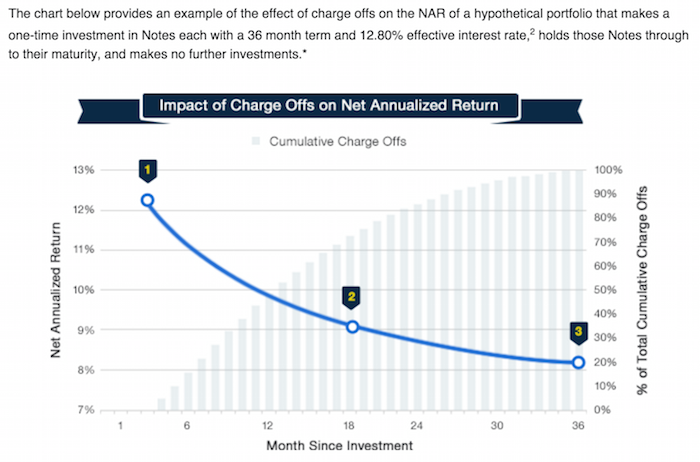
    chart of expected returns

    This chart, from LendingClub, shows a theoretical (not based on past performance) result. The basic idea is that as the portfolio ages, more loans will default and thus the portfolio return will decline. This contrasts with other investments (such as stocks) that will show fluctuating returns going up and down (over somewhat dramatically) over time.

    For portfolios of personal loans diversity is very important to avoid the risk of getting a few loans that default destroying your portfolio return. For portfolios with fewer than 100 notes the negative returns are expected in 12.8% of the cases (obviously this is a factor of the total loans – with 99 loans it would be much less likely to be negative, with 5 it would be much more likely). I would say targeting at least 250 loans with none over .5% would be better than aiming at just 100 loans with none over 1% of portfolio.

    There are several very useful sites that examine the past results of Lending Club loans and provide some suggestions for good filters to use in selecting loans. Good filters really amount to finding cases where Lending Club doesn’t do the greatest job of underwriting. So for example many say exclude loans from California to increase your portfolio return. While this may well be due to California loans being riskier really underwriting should take care of that by balancing out the risk v. return (so charging higher rates and/or being more stringent about taking such loans.

    So I would expect Lending Club to adjust underwriting to take these results into account and thus make the filters go out of date. Of course this over simplifies things quite a bit. But the basic idea is that much of the value of filters is to take advantage of underwriting weaknesses.

    chart of LendingClub returns as portfolio ages historically

    This chart (for 36 month loans) is an extremely important one for investors in peer to peer loans. It shows the returns over the life of portfolios as the portfolio ages. And this chart (for LendingClub) shows the results for portfolios of loans issued each year. This is a critical tool to help keep track to see if underwriting quality is slipping.

    (more…)

  • Investing in Peer to Peer Loans

    Peer to peer lending has grown dramatically the last few years in the USA. The largest platforms are Lending Club (you get a $25 bonus if you sign up with this link – I don’t think I get anything?) and Prosper. I finally tried out Lending Club starting about 6 months ago. The idea is very simple, you buy fractional portions of personal loans. The loans are largely to consolidate debts and also for things such as a home improvement, major purchase, health care, etc.).

    With each loan you may lend as little as $25. Lending Club (and Prosper) deal with all the underwriting, collecting payments etc.. Lending Club takes 1% of payments as a fee charged to the lenders (they also take fees from the borrowers).

    Borrowers can make prepayments without penalty. Lending Club waives the 1% fee on prepayments made in the first year. This may seem a minor point, and it is really, but a bit less minor than I would have guessed. I have had 2% of loans prepaid with only an average of 3 months holding time so far – much higher than I would have guessed.

    On each loan you receive the payments (less a 1% fee to Lending Club) as they are made each month. Those payments include principle and interest.

    historical chart of returns by grade at Lending club
    This chart shows the historical performance by grade for all issued loans that were issued 18 months or more before the last day of the most recently completed quarter. Adjusted Net Annualized Return (“Adjusted NAR”) is a cumulative, annualized measure of the return on all of the money invested in loans over the life of those loans, with an adjustment for estimated future losses. From LendingClub web site Nov 2015, see their site for updated data.

    Lending Club provides you a calculated interest rate based on your actual portfolio. This is nice but it is a bit overstated in that they calculate the rate based only on invested funds. So funds that are not allocated to a loan (while they earn no interest) are not factored in to your return (though they actually reduce your return). And even once funds are allocated the actual loan can take quite some time to be issued. Some are issued within a day but also I have had many take weeks to issue (and some will fail to issue after weeks of sitting idle). I wouldn’t be surprised if Lending Club doesn’t start considering funds invested until the loan is issued (which again would inflate your reported return compared to a real return), but I am not sure how Lending Club factors it in.

    (more…)

  • Employment Increased in the USA by 271,000 in October (230,000 average gains in the last 12 months)

    Total nonfarm payroll employment increased by 271,000 in October, and the unemployment rate was essentially unchanged at 5.0%. Over the prior 12 months, employment growth had averaged 230,000 per month – which is quite an excellent result. We are still recovering from the job losses suffered during the great recession but even considering that the results are excellent.

    As my recent post noted, adding 50,000 jobs a month is the new 150,000 in the USA due to demographic changes. That means job gains in the last year have added about 180,000 jobs per month above the 50,000 needed to accommodate growth due to demographic changes (a larger population of adults.

    The change in total nonfarm payroll employment for August was revised from +136,000 to +153,000, and the change for September was revised from +142,000 to +137,000. With these revisions, employment gains in August and September combined were 12,000 more than previously reported.

    Household Survey Data

    Both the unemployment rate (5.0%) and the number of unemployed persons (7.9 million) were essentially unchanged in October. Over the past 12 months, the unemployment rate dropped by 70 basis (from 5.7%) and 1.1 million fewer people are listed as unemployed.

    Among the major worker groups, the unemployment rates for adult men (4.7%), adult women (4.5%), teenagers (15.9%), whites (4.4%), blacks (9.2%), Asians (3.5%), and Hispanics (6.3%) showed little or no change in October.

    The number of long-term unemployed (those jobless for 27 weeks or more) was essentially unchanged at 2.1 million in October and has shown little change since June. These individuals accounted for 26.8% of the unemployed in October.

    (more…)

  • The 20 Companies With the Largest Market Capitalizations in the World – Oct 2015

    The 20 publicly traded companies with the largest market capitalizations. Since my June list of the top 20 stocks many of the market caps have declined slightly.

    Company Country Market Capitalization
    1 Apple USA $672 billion
    2 Google USA $497 billion
    3 Microsoft USA $426 billion
    4 Exxon Mobil USA $342 billion
    5 Berkshire Hathaway USA $340 billion
    6 GE USA $296 billion
    7 Facebook USA $295 billion
    8 Amazon USA $294 billion
    9 Wells Fargo USA $282 billion
    10 Johnson & Johnson USA $281 billion

    Google and Amazon were star performers in the last 4 months with Google up $127 billion and Amazon increasing $96 billion moving Amazon from outside the top 20 into 8th place. Facebook increased in value by $64 billion and moved from the 18th largest market cap to 7th. The China market declined quite rapidly since June and the largest Chinese companies saw significant drops in market cap.

    Industrial & Commercial Bank of China and China Mobile dropped from the top 10 (replaced by Facebook and Amazon). That results in USA companies holding the top 10 spots (the next 5 are either Chinese or Swiss).

    The next ten most valuable companies:

    Company Country Market Capitalization
    11 Industrial & Commercial Bank of China China $250 billion*
    12 China Mobile China $247 billion
    13 Novartis Switzerland $243 billion
    14 Petro China China $241 billion
    15 Nestle Switzerland $241 billion
    16 JPMorgan Chase USA $241 billion
    17 Hoffmann-La Roche Switzerland $231 billion
    18 Pfizer USA $214 billion
    19 Toyota Japan $211 billion
    20 Procter & Gamble USA $210 billion

    Market capitalization shown are of the close of business October 30th, as shown on Google Finance.

    The 11th to 20th most valuable companies includes 3 Chinese companies, 3 USA companies, 3 Swiss companies and 1 Japanese company. Alibaba, Tencent, China Construction Bank and Walmart dropped out of the top 20 (replaced by Amazon, Pfizer, Proctor & Gamble and Toyota). Alibaba remained above $200 in market cap making it the only company worth more than 200 billion that missed the cut. In the top 20 the USA gained 2 spots, China lost 3 and Japan gained 1.

    The total value of the top 20 has barely changed since my June post on the top 20 most valuable companies in the world: from $6.046 trillion to $6.054 trillion. Since my October 2014 post of the 20 most valuable companies in the world the total value of the top 20 companies has risen from $5.722 trillion to $6.054 trillion, an increase of $332 billion. Several companies have been replaced in the last year to create the current top 20 list.

    Related: Global Stock Market Capitalization from 2000 to 2012Stock Market Capitalization by Country from 1990 to 2010Historical Stock Returns

    A few other companies of interest (based on their market capitalization):
    (more…)

  • Nomadic Businesses in the Internet Age

    Once upon a time in a land not so far away, if you wanted to start a business, you had to choose a city in which to settle–not just for the business but for yourself. A lot of thought went into figuring out where to set up your new company’s home base. Delaware and Nevada, for example, have been popular choices because of its business friendly regulations and corporate tax laws. Once you got your central location up and running you could think about expanding to multiple locations or turning your company into a franchise.

    Those days are over. Sure, there are some who prefer to build businesses traditionally, but today thanks to advancements in technology and the rise of the internet and the ability to receive and send money online, even internationally, people can start a company anywhere and operate it from anywhere else (provided local incorporation laws do not require a specific length of time spent on site).

    Migrants have long moved to a new country for work, and then transferred funds home. This has been nearly completely those migrating from poor countries (or poor areas in the countries) to rich countries. Now individuals from rich countries are taking advantage of low cost countries to lower their living expenses while running most of your day to day from…just about anywhere.

    Businesses Can’t Really Be Nomadic, Can They?
    It’s true: not every business is suited to a nomadic lifestyle. Independent retail shops, for example: though it is possible to oversee basic operations from wherever you are, until you have a full support staff you are going to be needed onsite. Local service businesses that specialize in trades like contracting, plumbing, electrics, etc. Those are difficult to operate via telecommute. Most other companies, however, can be adapted to a global marketplace and base of operations fairly easily.

    I traveled for 4 years in SE Asia while operating my business. During that time my brother took a year to travel around the world with his family while running his business. He visited clients during his travels which took him through Brazil, Turkey, South Africa, India, Singapore, Australia and more. We met up for a week in Bali. There are challenges but there are great rewards also for businesses that allow you to travel while you work.

    Rice field filled with water
    Rice field opposite our bungalow in Ubud, Bali.

    Which Businesses Are Best Suited to the Nomadic Lifestyle?
    As previously stated, if you work hard enough at building your company and support team, you can run just about any sort of business from anywhere. That said, there are some companies and business types that lend themselves more easily to the nomadic lifestyle.

    Chris Guillebeau covers a few of these businesses and the entrepreneurs who started them in his book, The $100 Startup. One entrepreneur, for example, runs a linguistics and translation business internationally. He loves languages and loves teaching so he moves from country to country, learning the local languages and then teaching them to tourists and expatriates who choose to move there. Guillebeau himself has turned his book into a tour, a conference (The World Domination Summit) and a series of Unconventional Guides. He travels all over the world and writes from wherever he happens to be at the time.

    (more…)

  • In the USA More Education is Highly Correlated with More Wealth

    This chart shows that the percentage of millionaire families by highest education level is dramatically different by education level. The data is looking at USA family income for household headed by a person over 40. For high school dropouts, fewer than 1% are millionaires; all families it is about 5%; high school graduates about 6%; 4 year college degree about 22% and graduate or professional degree about 38%.

    Chart of wealth by education level in the USA
    Interesting chart based on Federal Reserve data (via the Wall Street Journal)

    While the costs of higher education in the USA have become crazy the evidence still suggests education is highly correlated to income. Numerous studies still show that the investment in education pays a high return. Of course, simple correlation isn’t sufficient to make that judgement but in other studies they have attempted to use more accurate measures of the value of education to life long earnings.

    Related: The Time to Payback the Investment in a College Education in the USA Today is Nearly as Low as Ever, SurprisinglyLooking at the Value of Different College DegreesEngineering Graduates Earned a Return on Their Investment In Education of 21%

    The blog post with the chart, Why Wealth Inequality Is Way More Complicated Than Just Rich and Poor has other very interesting data. Go read the full post.

    Average isn’t a very good measure for economic wealth data, is is skewed horribly by the extremely wealthy, median isn’t a perfect measure but it is much better. The post includes a chart of average wealth by age which is interesting though I think the $ amounts are largely worthless (due to average being so pointless). The interesting point is there is a pretty straight line climb to a maximum at 62 and then a decline that is about as rapid as the climb in wealth.

    That decline is slow for a bit, dropping, but slowly until about 70 when it drops fairly quickly. It isn’t an amazing result but still interesting. It would be nice to see this with median levels and then averaged over a 20 year period. The chart they show tells the results for some point in time (it isn’t indicated) but doesn’t give you an idea if this is a consistent result over time or something special about the measurement at the time.

    They also do have a chart showing absolute wealth data as median and average to show how distorted an average is. For example, median wealth for whites 55-64 and above 65 is about $280,000 and the average for both is about $1,000,000.

    Related: Highest Paying Fields at Mid Career in USA: Engineering, Science and MathWealthiest 1% Continue Dramatic Gains Compared to Everyone ElseCorrelation is Not Causation: “Fat is Catching” Theory Exposed

  • Using Customer Data To Grow Your Business

    Finding new business and retaining existing customers is needed to sustain and grow a business. Gathering good customer data is important to helping increase sales.

    Gathering customer data

    Collecting customer data requires some effort- but it doesn’t have to be expensive. Here are some great sources you can use to collect data:

    • Website Analytics: Your website may be the most common way customers interact with your business. Google Analytics, Piwik and other web site tracking software can provide a tremendous amount of detail about your website results. You can see which pages of your website generate the most traffic and can adjust your site’s design based on data to build your customer traffic.
    • One of the most important measures of customer experience is repeat business. Gathering data on customer retention is a valuable measure of how successful the business is at meeting and exceeding customer expectations. In order to help improve that performance one valuable tool is to ask the simple question: “What one thing could we do better?” The questions is simple; creating a management system that takes that data and uses it to continually improve your value to customers is not nearly so easy.
    • Gathering data on the experience your customers have is also important. There are many obvious frustration points customers face that any business should be able to identify. How easily can someone find an email address to contact your company? How quickly are matters resolved by email? Do you force customers to fight their way through phone menus instead of letting them talk to a person? How many customers hang up while being forced to waste their time fighting through your companies phone system? This is just a few examples, getting 10 such ideas for your company shouldn’t be hard.

      Many companies instead of having measures customers care about, only have measures accountants care about – such as how much your phone center costs to run. That is fine, but you likely will waste most of your time worrying about collecting customer data if your organization isn’t interested about what the customer experiences. Those companies just are interested in taking as much money from customers as they can without concern for customers. In that case don’t bother pretending you care about customers, it is just a waste of time. Instead just focus on what your business model is and hope no company comes along that has a business model to treat customers well.

    • Surveys can collect data from customers but the danger of relying on expressed desires rather than actions must always be remembered. SurveyMonkey is an easy to use tool that makes this process simple. You can create a short survey for free, then place the survey link on your website.
    • Ad Responses: Online ads allow companies to easily collect data on customer responses. You can run several types of online ads, and see which ad generates the most clicks to your company website.

    Use all of these tools to gather useful data while always remembering that customer data is only a proxy for understanding customers, and there is a gap between what is measured and reality.

    Storing customer data

    Because you use this data to meet your customer’s needs, the information is extremely valuable. Many businesses use internet security software to protect customer data. Every week it seems there is another high profile leak of customer data from hacked company servers. It is very important to isolate sensitive data and use cloud security system to reduce the risk of data loss.

    Personas
    Many companies use personas to target different customer segments they aim to capture. A business can use customer data to create an ideal customer ideal customer for specific products or services. And personas can help you target your web site to meet the differing needs of various target customers.

    Using data to improve your organization’s performance is powerful. But the power is mainly from designing a management system that uses that data effectively. That is much harder than collecting data in the first place. Our management blog discusses how to use data to manage most effectively.

  • USA T-Bills Sold by Treasury with 0% Rate for First Time Ever

    European government debt has been sold at negative interest rates recently. The United States Treasury has now come as close to that as possible with 0% 3 month T-bills in the latest auction.

    The incredible policies that have created such loose credit has the world so flooded with money searching for somewhere to go that 0% is seen as attractive. This excess cash is dangerous. It is a condition that makes bubbles inflate.

    Low interest rates are good for businesses seeking capital to invest. These super low rates for so long are almost certainly creating much more debt for no good purpose. And likely even very bad purposes since cash is so cheap.

    One thing I didn’t realize until last month was that while the USA Federal Reserve stopped pouring additional capital into the markets by buying billions of dollars in government every month they are not taking the interest and maturing securities and reducing the massive balance sheet they have. They are actually reinvesting the interest (so in fact increasing the debt load they carry) and buying more debt anytime debt instruments they hold come due.

    The Fed should stop buying even more debt than they already hold. They should not reinvest income they receive. They should reduce their balance sheet by at least $1,500,000,000,000 before they consider buying new debt.

    Unless the failure to address too-big-to-fail actions (and systems that allow such action) results in another great depression threat. And if that happens again they should not take action until people responsible are sitting in jail without the possibly of bail. The last bailout just resulted in transferring billions of dollars from retires and other savers to the pockets of those creating the crisis. Doing that again when we knew that was fairly likely without changing the practices of the too-big-to-fail banks. But I would guess we will just bail them out while they sit in one of the many castles their actions at the too-big-to-fail banks bought them and big showered with more cash in the bailout from the next crisis.

    How to invest in these difficult times is not an easy question to answer. I would put more money in stocks for yield (real estate investment trusts, drug companies, dividend aristocrats), I would also keep cash even if it yields 0% and actually a new category for me – peer to peer lending (which I will write about soon). Recently many dividend stocks have been sold off quite a bit (and then on top of that drug stocks sold off) so they are a much better buy today than 4 months ago. Still nothing is easy in what I see as a market with much more risk than normal.

    I am almost never a fan of long term debt. I would avoid it nearly completely today (if not completely). For people that are retired and living off their dividends and interest I may have some long term debt but I would have much more in cash and short term assets (even with the very low yields). Peer to peer lending has risks but given what the fed has done to savers I would take that risk to get the larger yields. The main risk I worry about is the underwriting risk – the economic risks are fairly well known, but it is very hard to tell if the lender starts doing a poor job of underwriting.

    Related: The Fed Should Raise the Fed Funds RateToo-Big-to-Fail Bank Created Great Recession Cost Average USA Households $50,000 to $120,000Buffett Calls on Bank CEOs and Boards to be Held ResponsibleHistorical Stock Returns