Blog

  • Let the Good Times Roll (using Credit)

    Continuation of: USA Manufacturing is Healthy

    The real problem with the USA economy is that a country cannot live beyond its means forever. Those living in USA have consumed far more than they have produced for decades. That is not sustainable. The living beyond our means is mainly due to massively increased consumption, not shrinking output (in manufacturing or service). One, of many examples, of the increased consumption is average square footage of single-family homes in the USA: 1950 – 983; 1970 – 1,500; 1990 – 2,080; 2004 – 2,349.

    In case it isn’t totally obvious to you. You don’t fix this problem by encouraging more spending and borrowing: either by the government or by consumers. The long term problem for the USA economy is that people have consuming more than they have been producing. Personally, as this continues you reach a point where getting another credit card does not work. The same holds true for the collective health of a country. A country cannot solve the problem of having bills come due from decades of living beyond its means by charging more so that they can continue to live beyond their means.

    Where the USA is in the continuum, is hard for me to judge. For the sack of illustration, lets say a consumer can get to 10 cards before they finally fail. If the consumer reaches the limit on 2 credit cards they have the choice to continue to the party by getting another credit card. Or they have the choice of addressing the situation they have gotten themselves into. If they decide to become responsible they have a challenge but one they can endure with some hardships.

    If they press on to 5 credit cards and then max them out they come to the same decision. Dig themselves deeper in debt to avoid the problem today or live up their past behavior and become responsible. The work they have ahead of themselves is much more challenging than if they had started working on the problem when they only had 2 cards.

    If they press on to 9 cards and now have the decision again. The effort to find a solution may be almost impossible. Borrow more to pay for past mistakes while maintaining some expenditures may be possible (but they will have to live on less than they earn). By the time you are this far down the failed path you have so much going to pay for your past bills you can’t spend even close to what you currently earn on current expenses. Letting yourself get to this point is very bad. And most likely as a person you will go bankrupt.
    (more…)

  • USA Manufacturing Output Continues to Increase (over the long term)

    When looking at the long term data, USA manufacturing output continues to increase. For decades people have been repeating the claim that the manufacturing base is eroding. It has not been true. I realize the economy is on weak ground today, I am not talking about that, I am looking at the long term trends.

    The USA manufactures more than anyone else – by far. The percentage of total global manufacturing is the same today it was two decades ago (and further back as well). For decades people have been saying the USA has lost the manufacturing base – it just is not true. No matter how many times they say it does not make it true. It is true since 2000 the USA increase in manufacturing output (note not a decrease) has not kept pace with global grown in manufacturing output (global output in that period is up 47% and the USA is up 19% – Japan is down 10% for that period).

    I would guess 20 years from today the USA will have a lower percentage of worldwide manufacturing. But I don’t see any reason believe the USA will see a decline in total manufacturing output. I just think the rest of the world is likely to grow manufacturing output more rapidly.

    Looking at a year or even 2 or 3 years of manufacturing output data leaves a great deal of room to see trends where really just random variation exists. Even for longer periods trends are hard to project into the future.

    Conventional wisdom is correct about China growing manufacturing output tremendously. China has grown from 4% of the output of the largest manufacturing companies in 1990 to manufacturing 16% of the total output in China today. That 12% had to come from other’s shares. And given all you hear from the general press, financial press, politicians, commentators… you would think the USA must have much less than China today, so may 10% and maybe they had 20% in 1990. When actually in 1990 the USA had 28% and in 2007 they had 27%.

    Manufacturing jobs are not moving oversees. Manufacturing jobs are decreasing everywhere.
    (more…)

  • Dazzling Diversification

    Diversification overrated? Not a chance [the broken link has been removed] by Jason Zweig

    A diversified portfolio always has, and always will, underperform the hottest investment of the moment.

    For anyone with a sustainable ability to identify the hottest investment of the moment, diversification is a mistake. But if you really believe you’ve got that ability, you’re not just mistaken. You need to be hauled off in a straitjacket to the Institute for the Treatment of Investment Insanity.

    Exactly right. As we posted previously Warren Buffett’s diversification thoughts are similar

    If you are a professional and have confidence, then I would advocate lots of concentration. For everyone else, if it’s not your game, participate in total diversification. The economy will do fine over time. Make sure you don’t buy at the wrong price or the wrong time. That’s what most people should do, buy a cheap index fund and slowly dollar cost average into it.

    You have to remember when Warren Buffett says “professional and have confidence” he doesn’t really mean just what those words say. He mean if you are Charlie Munger, George Soros, Jimmy Rodgers and maybe 10 other people alive today (maybe I am too restrictive, maybe he would include 50 more people alive today, but I doubt it).

    Related: Dilbert on Investinginvestment risksCurious Cat Investing and Economics Search Engine

  • Feds Rethink Rules on Retirement Savings – They Shouldn’t

    Feds Rethink Rules on Retirement Savings

    Amid growing concern over the stock market’s severe drop, government officials are considering last-minute relief from rules requiring millions of Americans who are 70½ or older to withdraw money from their retirement accounts.

    Among the possible changes: allowing taxpayers to delay taking required withdrawals from their individual retirement accounts, 401(k) plans and other similar accounts this year — or at least reducing the amount that must be withdrawn. Also under consideration are various ways to provide tax relief for people who already have made their required withdrawals for this year.

    This is silly. Everyone in the situation of having to make a withdrawal has know about the requirement for years. My guess is this has been the law for over 20 years. Yes, the stock market is down. Yes, being forced to sell now would be bad. And how does providing “tax relief” to those who already made required withdrawals make any sense? Why not just have the treasury send checks to every American, who had a loss on an investment this year, equal to the amount of their loss? (By the way this is sarcasm – they should not really do that). These people have lost any sense of what investing, planning, responsibly… are.

    First, knowing you have required withdrawals from your IRA, you should not hold those assets in stock (I suppose you could have significant cash assets outside your IRA and chose to just use the next option). Second, you can buy the stock outside your IRA at the same minute you sell them in the IRA. What is the big deal: the cost should be about $20 in stock commission for each stock – you save that much each time you fill up your gas tank lately (compared to prices this summer). All that not having to withdraw funds does is let those wealthy enough not to need a small amount of their IRA or 401(k) savings by the time they are 70 1/2 to keep deferring taxes on their investment gains.

    The amount of the distribution is based on the market value of the taxpayer’s account as of the last day of the previous year.

    Therein lies one of the major problems. This year’s distributions are based on Dec. 31, 2007, levels — a time when market prices generally were far above today’s deeply depressed values. As a result, “millions of Americans are forced to withdraw larger-than-anticipated amounts from already-depleted retirement funds,” says David Certner, legislative policy director at AARP, an advocacy group that represents nearly 40 million older Americans.

    What kind of 1984 newspeak is this? I mean this is absolutely ridicules. You have to withdraw the exact amount you knew on January 1st 2008. Nothing about that has changed in almost a year. How can the Wall Street Journal report this without pointing out the completely false claim.
    (more…)

  • Financial Thanksgiving

    photo of Frew Wube in Ethiopia

    For me, giving back to others is part of my personal financial plan. As I have said most people that are actually able to read this are financially much better off than billions of other people today. At least they have the potential to be if they don’t chose to live beyond their means. Here are some of the ways I give back to others.

    Kiva is a wonderful organization and particularly well suited to discuss because they do a great job of using the internet to make the experience rewarding for people looking to help – as I have mentioned before: Using Capitalism to Make a Better World. One of my goals for this blog is to increase the number of readers participating in Kiva – see current Curious Cat Kivans. I have also created a lending team on Kiva. Kiva added a feature that allows people to connect online. When you make a loan you may link you loan to a group.

    I actually give more to Trickle Up (even though I write about Kiva much more). I have been giving to them for a long time. They appeal to my same desire to help people help themselves. I believe in the power of capitalism and people to provide long term increases in standards of living. I love the idea of providing support that grows over time. I like investing and reaping the rewards myself later (with investment I make for myself). But I also like to do that with my gifts. I would like to be able to provide opportunities to many people and have many of them take advantage of that to build a better life for themselves, their families and their children.

    The photo shows Frew Wube, Haimanot and Melkan (brother and two sisters), an entrepreneur that received a grant from Trickle up. Trickle Up provides grants to entrepreneur, similar to micro loans, except the entrepreneur does not have to pay back the grant. They are able to use the full funds to invest in their business and use all the income they are able to generate to increase their standard of living and re-invest in the business.

    Haimanot and Melkan quickly learned the ropes of the job and started working with their brother in the business. Soon, the two girls managed the clothing business on their own, and Frew began to think about other income-generating opportunities.

    “I also save every month,” says Frew, who has over $40 stored in a cooperative savings fund. The capital he has saved with other people in his group is used to provide loans to group members at a low interest rate. Frew, now able to access credit thanks to his Trickle Up clothing business, has taken progressively larger loans from the group, including his latest loan of $300 to start a candle business.

    (more…)

  • More on Failed Executives

    Citigroup Saw No Red Flags Even as It Made Bolder Bets

    But many Citigroup insiders say the bank’s risk managers never investigated deeply enough. Because of longstanding ties that clouded their judgment, the very people charged with overseeing deal makers eager to increase short-term earnings – and executives’ multimillion-dollar bonuses – failed to rein them in, these insiders say.

    Citigroup’s stock has plummeted to its lowest price in more than a decade, closing Friday at $3.77. At that price the company is worth just $20.5 billion, down from $244 billion two years ago. Waves of layoffs have accompanied that slide, with about 75,000 jobs already gone or set to disappear from a work force that numbered about 375,000 a year ago.

    “They pushed to get earnings, but in doing so, they took on more risk than they probably should have if they are going to be, in the end, a bank subject to regulatory controls,” said Roy Smith, a professor at the Stern School of Business at New York University. “Safe and soundness has to be no less important than growth and profits but that was subordinated by these guys.”

    It is sad to see the same story repeated over and over. Give people the change for obscene bonuses. They make up claims that they are making lots of money to get bonuses but actually set the company to go bankrupt. They take huge bonuses because of course they are so smart and successful. The company fails and they say the market is to blame (it isn’t that they are really not that smart and of course they deserve the obscene bonuses they took before the collapse – or even after the collapse). They feel no shame for the horrible mess they leave in their wake that they would paid more than a king’s ransom to manage. They will be on to similar schemes in a few years.

    If you are a bank you make money by borrowing for less than you lend. If you are a speculator then you try to out bet the other speculators. Nothing wrong with either choice to me. When you want to say you are a bank but you want to make most of your money from speculating their is a problem. Investment banks used to also make huge amounts from fees they would charge (they still do but not enough to offset the huge speculative losses).
    (more…)

  • Personal Saving and Personal Debt in the USA

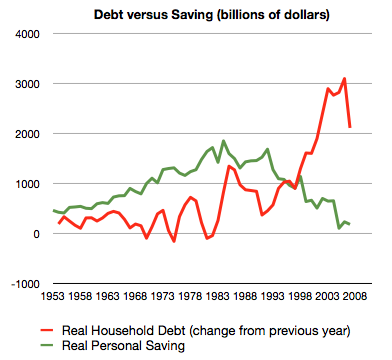
    graph of saving and debt

    The whole sorry mess in one picture (including chart) by Philip Brewer

    Take a gander at that graph. The green line is personal savings. The Bureau of Economic Analysis calculates that. It’s just income minus spending–the obvious way of figuring saving. The red line is debt. The Federal Reserve calculates that value. The value on the graph is the change from the previous year–that is, it shows each year’s new debt, just like the green line shows each year’s saving. Both values are adjusted for inflation–the graph is in billions of (year 2000) dollars.

    Starting back in about 2005, the American consumer reached the point that they could no longer service ever-increasing amounts of debt. That led to the housing bubble popping. The result is what you can see in the last datapoint on the graph–less new borrowing in 2007.

    Related: $2,540,000,000,000 in USA Consumer DebtAmericans are Drowning in Debtsave an emergency fundFinancial Illiteracy Credit Trapposts on saving money

  • How to Thrive When this Bear Market Ends

    How to thrive when this bear dies by Jim Jubak

    Believe it or not, someday, almost certainly within the next 12 months, the bear market will be over. Then investors will have an opportunity to rebuild their wealth if stocks come roaring back, as they typically do.

    In the case of the 2000-02 bear, the initial rush after the end of the bear delivered a huge share of the 101% gain for the bull market that ran from October 2002 through October 2007. In the 16 months from the Oct. 9, 2002, low through Feb. 9, 2004, the S&P 500 gained 47%. The gains from the remaining years of the “great” bull market of the “Oughts” were rather anemic: just 9% in 2004, 3% in 2005 and 14% in 2006.

    If I’m right about the arrival of a secular bear, emerging economies and their stock markets will deliver higher returns, despite relatively slow growth, than the even more slowly growing developed economies. If I’m wrong about the secular bear, emerging economies will still deliver stronger growth than the world’s developed economies. Under either scenario, investors want to increase their exposure to the world’s emerging economies, which deliver more performance bang for less risk than most investors think.

    Jim Jubak is one of my favorite investing writers. He can of course be wrong but he provides worthwhile insight, backed with research, and specific suggestions. I am also positive on the outlook for stocks (though what the next year or so hold I am less certain) and on emerging markets.

    Related: Why Investing is Safer OverseasRodgers on the US and Chinese EconomiesBeating the MarketThe Growing Size of non-USA EconomiesWarren Buffett’s 2004Annual Report

  • S&P 500 Dividend Yield Tops Bond Yield: First Time Since 1958

    S&P 500 Payout Tops Bond Yield, a First Since 1958 (site broke the link, so I removed it):

    U.S. stocks’ dividend yields were lower than the yield on 10-year Treasury notes for half a century. Not any more. Dividends paid by Standard & Poor’s 500 Index companies in the past 12 months amounted to 3.51 percent of the benchmark’s closing value yesterday. In early trading today, the 10-year yield fell as low as 3.42 percent.

    Treasuries routinely had higher yields than stocks before 1958, according to Bernstein. When this relationship came to an end, yields were near their current levels. The S&P 500 dividend yield fell 0.58 percentage point, to 3.24 percent, in the third quarter of 1958. The 10-year yield rose about the same amount, 0.6 point, to 3.80 percent.

    Two explanations later emerged for the reversal, he wrote. One held that the economy’s recovery from the 1957-58 recession showed “investors could finally put to rest the widely held expectation of an imminent return to the Great Depression.” The second was the increasing popularity of investing in growth stocks, or shares of companies whose sales and earnings rose at a relatively fast pace. Because of their expansion, the companies often paid below-average dividends.

    Reversal of Fortunes Between Stocks and Bonds

    Even more telling was the relative movements in stock and bond yields over the years. Bernstein calculates that from 1954 to 1969 — while inflation was relatively low and stable — bond and stock yields moved mostly in tandem. But from 1970 to 1999 — the Great Inflation — bond and stock yields moved inversely. From 2000 on, bond and stock yields have been back in sync.

    Arnott takes it a step further. “In a world of deleveraging, both for the financial services arena and for the economy at large, growth is less certain,” he says. “And with the economy eroding sharply, so is inflation. If stocks don’t deliver nominal growth in dividends and earnings, then their yield ‘must’ exceed the Treasury yield, in order to give us any sort of risk premium.”

    Related: Corporate and Government Bond Rates GraphHighest Possible Returnsposts on interest ratesinvesting strategy

  • Redesigning the Global Finance System

    Redesigning global finance

    International finance cannot just be “fixed”, because the system is a tug-of-war between the global capital markets and national sovereignty. As cross-border financial flows have expanded and big financial institutions have far outgrown their domestic markets, finance has become one of the most globalised parts of the world economy. At the same time, finance is inherently unstable, so the state has to play a big role in making it safer by lending in a crisis in return for regulation and oversight.

    The challenges are difficult. I am not confident the current leadership (if their is leadership globally) is capable of making the difficult decisions. There are not easy answers though their are some pretty basic principles people should agree on (excessive leverage is dangerous, massive positions that endanger entire economies are dangerous…). But how to deal with those issues is not easy.

    Related: Leverage, Complex Deals and ManiaTreasury Now (1987) Favors Creation of Huge BanksMonopolies and Oligopolies do not a Free Market MakeNegligent Watchmen