Blog

  • 30 Year Mortgage Rate and Federal Funds Rate Chart

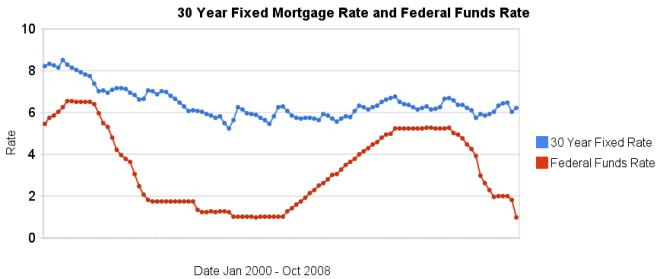
    More dramatic evidence that changing in the federal funds rate do not lead to similar changes in 30 year fixed mortgage rates. It is true the last few months are very unusual times for the credit market. However, the current lack of correlation is not the exception, the graph clearly shows there is very little correlation between changes in the two interest rates.

    30 year fixed mortgage rates and the federal funds rate 2000-2008

    Related: historical comparison of 30 year fixed mortgage rates and the federal funds rateAffect of Fed Funds Rates Changes on Mortgage Ratesposts on financial literacyJumbo v. Regular Fixed Mortgage Rates: by Credit Score

    For more data, see graphs of the federal funds rate versus mortgage rates for 1980-1999. Source data: federal funds rates30 year mortgage rates

  • Corrupt Officials Have Fled China With As Much As $100 billion

    As many as 10,000 corrupt government officials have fled China with $100 billion.

    he joins as many as 10,000 corrupt Chinese officials who have fled the country over the past decade, taking as much as $100 billion of public funds with them, according to an estimate by Li Chengyan, head of Peking University’s Anticorruption Research Institute.

    More unexpected, however, was the heavy press coverage that Yang’s walkabout attracted in a country where the government is generally reluctant to wash its dirty linens in public. That suggests that “the government is sending a signal” that it regards “the number of officials fleeing as a very important problem which needs to be solved,” says Mao Zhaohui, director of anticorruption studies at Beijing’s Renmin University.

    Corruption is pervasive at almost every level of the government, and it is a major factor eroding faith in the ruling Communist Party. Earlier this year, after thousands of schoolchildren died in the Sichuan earthquake, the Internet was ablaze with accusations that local officials had taken bribes to approve substandard materials for school construction.

    Chinese President Hu Jintao has repeatedly declared that the fight against fraud is a top government priority and courts have handed down heavy sentences against prominent offenders. Last year, the former head of the Chinese Food and Drug Administration, Zheng Xiaoyu, was executed after being found guilty of taking bribes to approve thousands of new drugs.

    China has many strong winds for economic growth. Corruption is an anchor holding back their progress.

    Related: Capitalism in ChinaNot Understanding CapitalismOil Consumption by CountryData on Leading Manufacturing CountriesCurious Cat Economics Search Engine

  • JPMorgan Chase Freezes Mortgage Foreclosures

    JPMorgan Chase Freezes Foreclosures

    For the next 90 days, JPMorgan will not place any new homes into foreclosure. The banking behemoth, which acquired troubled lender Washington Mutual on Sept. 25, says it hopes to modify terms for 400,000 homeowners, accounting for $70 billion in loans. Among the steps it is taking: eliminating toxic “pay option” loans, offering new loan terms to homeowners before they default

    According to the most recent data compiled by the Hope Now Alliance of lenders, counselers, and other industry players, lenders started the foreclosure process on 565,000 homeowners in this year’s third quarter. Some 265,000 homes were actually foreclosed on, nearly twice the number from the third quarter of 2007. Moreover, more than 2.2 million homeowners are more than 60 days delinquent in their mortgage payments, also a near doubling from last year.

    FDIC Chairman, Sheila Bair, has been encouraging banks to take such action and instituted such action on the mortgages the FDIC acquired when they took over Indymac – Loan Modification Program for Distressed Indymac Mortgage Loans

    IndyMac Federal Bank, FSB (“Indymac Federal”) will implement a new program to systematically modify troubled mortgages. The program is designed to achieve affordable and sustainable mortgage payments for borrowers and increase the value of distressed mortgages by rehabilitating them into performing loans. This in turn will maximize value for the FDIC, as well as improve returns to the creditors of the former IndyMac Bank and to investors in those mortgages.

    Related: Ignorance of Many Mortgage Holders (July 2007)Foreclosure Filings Continue to RiseHistorical 30 Year Fixed Mortgage RatesHomes Entering Foreclosure at Record (Sep 2007)2nd Largest Bank Failure in USA History
  • Scott Adams on Investing

    In his blog Scott Adams, author of Dilbert, provides often quite intelligent and interesting thoughts. In a recent post he wrote on investing and Diversification:

    When I first started making serious Dilbert money, I let experts manage half of it, and I managed the rest, as a hedge against both the experts and myself. The experts invested in Enron, Worldcom, and a number of other companies that promptly exploded. The experts reduced their portion of my money by about a third over five years. (The experts work for one of the most respected financial institutions on Earth, by the way.) My own investments did better, precisely because they were more diversified. So now I handle my own investments, probably incompetently.

    I didn’t own much in the way of stocks for the past several years, thanks to not using professional advisors. A big chunk of my money has been in California Municipal bonds of various types, and all are insured.

    In order to diversify more, I started migrating money over to the stock market during this recent plunge. The market could go a lot lower still, but this is either the beginning of the end of the United States as we know it, in which case it doesn’t matter how I invested, or it is a once-in-a-lifetime stock buying opportunity. It was an easy decision.

    Related: Stock Market DeclineWarren Buffett on DiversificationInvestment Allocations Make A Big Difference

    Dilbert comic on investors
  • National Debt Down Almost $1 Billion Yesterday

    The USA national debt decreased almost $1 billion yesterday. If it decreased by $1 billion dollars a day in just 10,526 days the USA government would be out of debt. That is just under 29 years, that doesn’t seem so bad. Unfortunately the decrease yesterday is not likely the start of a new trend (it is just daily variation).

    In the last month the debt is up over $580 Billion. At that rate, well lets just say if that rate continued long we would be in even more serious trouble than we have been placed in by the amazingly irresponsible behavior of the politicians increasing taxes on our grandchildren (with massive spending they chose to fund by huge tax increases on our grandchildren) have been doing the last 5 years. In the last year they have spent $1.46 Trillion more than they paid for (which will have to be paid for by future taxes – although the recent decision to purchase $125 billion in bank stocks perhaps opens another option for the the government to start buying companies and use profits they make to pay off the debt they are taking on).

    The current debt stands at $10,525,823,144,117. That is a bit over $10.5 Trillion.

    Related: True Level of USA Federal DeficitUSA Federal Debt Now $516,348 Per HouseholdWashington Paying Out Money it Doesn’t Have

  • Treasury Bought $125B in Bank Stocks

    On Tuesday the United States Treasury department purchased $125 billion of bank stocks becoming one of the largest stockholders in the world instantly.

    $25 billion was invested in Citigroup, JPMorgan Chase and Wells Fargo.

    $15 billion was invested in Bank of America and $10 billion in Merrill Lynch (which is being acquired by Bank of America).

    $10 billion was invested in Goldman Sachs and Morgan Stanley. And the treasury department invested $3 billion in Bank of New York Mellon $2 billion in State Street.

    Related: Goldman Sachs Rakes In Profit in Credit Crisis (Nov 2007)Warren Buffett Webcast on the Credit CrisisRodgers on the US and Chinese Economies (Feb 2008)Credit Crisis

  • Personal Finance Basics: Long-term Care Insurance

    Long term care insurance is an important part of a personal financial portfolio. It provides insurance for for expenses beyond medical and nursing care for chronic illnesses (assisted living expenses). So while looking at your personal finance insurance needs (health insurance, disability insurance, automobile insurance, homeowners [or rental] insurance [with personal liability insurance – or separate personal liability insurance] and life insurance don’t forget to consider long term care insurance.

    Can You Afford Long-Term-Care Insurance?

    Long-term care is likely to be most Americans’ greatest expense of all in retirement. A private room in a nursing home costs $76,460 annually on average, or $209 a day, and Medicare typically won’t cover it.

    AARP estimates that a 65-year-old in good health can expect to pay between $2,000 and $3,000 a year for a policy that covers nursing-home and home care.

    “About 70 percent of individuals over age 65 will require at least some type of long-term care services during their lifetime. Over 40 percent will need care in a nursing home for some period of time.” – National Clearinghouse for Long-Term Care Information

    Advice on buying long term care insurance from AARP, the Department of Health and Human Services and Consumer Reports.
    (more…)

  • Farmer in Chief

    Farmer in Chief by Michael Pollan

    After cars, the food system uses more fossil fuel than any other sector of the economy — 19 percent. And while the experts disagree about the exact amount, the way we feed ourselves contributes more greenhouse gases to the atmosphere than anything else we do — as much as 37 percent, according to one study.

    Spending on health care has risen from 5 percent of national income in 1960 to 16 percent today, putting a significant drag on the economy. The goal of ensuring the health of all Americans depends on getting those costs under control. There are several reasons health care has gotten so expensive, but one of the biggest, and perhaps most tractable, is the cost to the system of preventable chronic diseases. Four of the top 10 killers in America today are chronic diseases linked to diet: heart disease, stroke, Type 2 diabetes and cancer.

    You cannot expect to reform the health care system, much less expand coverage, without confronting the public-health catastrophe that is the modern American diet.

    It must be recognized that the current food system — characterized by monocultures of corn and soy in the field and cheap calories of fat, sugar and feedlot meat on the table — is not simply the product of the free market. Rather, it is the product of a specific set of government policies that sponsored a shift from solar (and human) energy on the farm to fossil-fuel energy.

    Read the full, long, interesting article. I have discussed both the failed special interest focused federal spending on farmers and the failed health care system.

    Related: Farming Without Subsidies in New ZealandEat food. Not too much. Mostly plants.International Health Care System PerformanceUSA Paying More for Health Care

  • Greenspan Says He Was Wrong On Regulation

    Greenspan Says He Was Wrong On Regulation

    Greenspan alternately defended his legacy and acknowledged mistakes. Waxman asked whether the former chairman was wrong to consistently oppose regulating the multitrillion dollar derivative market that has contributed to the financial crisis. “Well, partially,” said Greenspan, before stressing the difference between credit-default swaps and other types of derivatives.

    Even Greenspan seemed genuinely perplexed yesterday by all that had happened, hard-pressed to explain how formerly fundamental truths about how markets work could have proved so wrong.

    “When bubbles cause huge problems is when they cause the financial sector to seize up,” said Frederic S. Mishkin, a Columbia University economist and, until recently, Fed governor. “The right way to deal with that kind of bubble is not with monetary policy,” but with bank supervision and other regulatory powers.

    While endorsing some expanded regulation yesterday, such as requiring the companies that combine large numbers of loans into securities to hold on to significant numbers of those securities, he also repeatedly retreated to his libertarian-leaning roots, and warned of the dangers of overreacting.

    “I made a mistake,” Greenspan said, “in presuming that the self-interests of organizations, specifically banks and others, were such as that they were best capable of protecting their own shareholders and their equity in the firms.”

    The key is to strive for properly functioning markets. Unfortunately that does not mean allowing those that give large payments to politicians to foist huge risks on the economy by exempting themselves from sensible regulation. I guess some people get confused that the benefits of “free markets” are not the same as standing back and allowing powerful interests to manipulate markets and risk economies. The benefits of a free market are provided to the economy when the market is free not when large, powerful organizations are allowed to exert undue influence on markets.

    I don’t really understand how people could think “free markets” are about letting special interests be free to manipulate markets. It is not really something that should be confusing to people that have thought enough to have an opinion on the benefits of free markets. The dangers of monopolies and business people conspiring to extract benefit (for those in the cartel, trust, conspiracy…) by manipulating the market was well know from the initial minds putting together capitalist theory. And the obvious method to allow the benefits of the free market to be maintained was regulation to prevent those that sought to manipulate the market for their benefit.

    And the dangers of overly leveraged financial institutions should be obvious to anyone with a modicum of understanding of financial history. Then make those overly leveraged financial institutions large (too be to fail) types and you really are asking for disaster. Add in a extremely large use of debt by the public and private sectors (living beyond your means). Then throw in encouraging reckless short term thinking by providing enormous cash bonuses for paper potential profits and you really have to wonder how anyone could think this was not a perfect design to assure a financial meltdown.

    Related: Too Big to Fail, Too Big to ExistFed to Loan AIG $85 Billion in Rescue2nd Largest Bank Failure in USA History

  • Treasury Now (1987) Favors Creation of Huge Banks

    Treasury Now Favors Creation of Huge Banks, New York Times, 1987:

    Top officials at the Treasury Department have concluded that the Government should encourage creation of very large banks that could better compete with financial institutions in Japan and Europe.

    The Treasury plan, which would permit the acquisition of banks by large industrial companies, was also endorsed by Alan Greenspan, in an interview before President Reagan nominated him this week to be chairman of the Federal Reserve Board.

    Mr. Gould acknowledged that any policy promoting the creation of very large financial institutions encounters deep-seated sentiments that date from the founding of the Republic. But he thinks the nomination of Mr. Greenspan could provide an important stimulus for change. Mr. Greenspan contends that many of the laws restricting commercial banks severely limit their ability to adapt to a changing marketplace.

    The Reagan Administration has met frustration in its efforts to lessen regulation of banking, largely because Paul A. Volcker, the current Federal Reserve chairman, has firmly opposed any move that would begin to break down the barriers that prohibit large nonbanking companies from owning banks. Mr. Volcker has also been rather grudging in his support of changes that would allow interstate banking and the underwriting of securities by banks.

    ”We have been the beneficiaries of living in a relatively insulated big economy, and only recently have we found out that the Japanese can make automobiles better than we do,” said Hans Angermueller, vice chairman of Citicorp. ”We are discovering that the same thing may apply in the financial services area, and to meet that challenge, we need to get leaner, meaner and stronger. We don’t do this by preserving the heartwarming idea that 14,000 banks are wonderful for our country.”

    The New York Times web archive is a great resource for viewing the historical trends to turn away form the capitalist ideas of free market competition and instead move toward large market dominating banks. You get the impression from people talking about “free markets” that they have never actually read Adam Smith, Ricardo, Mills…

    Related: Ignorance of What Capitalism IsNot Understanding CapitalismCanadian Banks Avoid Failures Common ElsewhereMonopolies and Oligopolies do not a Free Market MakeEstate Tax Repeal
    (more…)