Blog

  • Will Americans Actually Save and Worsen the Recession?

    Americans need to save much more money. This is true for people’s personal financial health. And it is true for the long term health of the economy. Of course the credit card immediate gratification culture doesn’t put much weight on those factors. And if Americans actually do reduce their consumption to save more that will harm the economy in the short term. But since those reading this are people (the economy can’t read) the smart thing for most readers is to save more to create a stronger financial future for themselves.

    Turmoil May Make Americans Savers, Worsening ‘Nasty’ Recession

    U.S. retail sales fell in September for the third straight month, the longest slump since the government began keeping records in 1992.

    From 1960 until 1990, households socked away an average of about 9 percent of their after-tax income, Commerce Department figures show. But Americans got out of the saving habit starting in the 1990s

    “Consumers are starting to realize that they’ve been living in a fantasy world,” says Lyle Gramley, a former Fed governor who is now senior economic adviser at Stanford Group Co. in Washington. “They will have to begin salting away money for retirement, their children’s education and other reasons.”

    Americans have a way to go to catch up with their counterparts in other countries. The 0.4 percent of disposable income that U.S. households saved last year compares with 10.9 percent for Germany and 3.1 percent for Japan

    Related: Americans are Drowning in DebtToo Much StuffFinancial Illiteracy Credit Trap

  • Discounted Corporate Bonds Failing to Find Buying Support

    ‘Armageddon’ Prices Fail to Lure Buyers Amid Selling

    Yields on corporate bonds show investors expect 5.6 percent of the market to go bust, the highest default rate since the Great Depression, according to Christopher Garman, chief executive officer of debt research firm Garman Research LLC in Orinda, California.

    The selling is being compounded by hedge funds and mutual funds dumping holdings to meet redemptions, which may push prices even lower, according to analysts at UBS AG.

    Corporate debt has been pressured by “incessant selling by hedge funds and leveraged institutions as they unwind,” Bill Gross, manager of the world’s biggest bond fund at Newport Beach, California-based Pacific Investment Management Co.

    Corporate bond prices plunged to 79.9 cents on the dollar on average from 94 cents at the end of August and 99 cents at the end of 2007, according to index data compiled by New York-based Merrill Lynch & Co.

    “The de-leveraging that we’re witnessing will probably continue,” said Paul Scanlon, team leader for U.S. high yield and bank loans at Boston-based Putnam Investments LLC, which manages $55 billion in fixed income. “My sense is that’s not turning around in the very near term.”

    I am not very familiar with the bond market but it does seem like the panic is in full swing but calling the bottom is always hard. I would guess the de-leveraging (and investors pulling money out of bond funds) could well lead things lower over the short term.

    Related: Corporate and Government Bond Rates GraphMunicipal Bonds After Tax Return

  • MicroFinance Currency Risk

    I have been curious how Kiva deals with currency risk. Kiva is a great resource for providing micro-lending and the opportunity to engage in choosing who you will lend to. But my transactions are all in US$ and the loans in the field are in the local currency. This creates an issue of what happens when currency values fluctuate. I asked a question on the Kiva LinkedIn group (an excerpt is shown here):

    A lender takes out a loan of $100 with 10 months to repay. If the loan is in the local currency, what if the value of that currency during the 10 months declines by 20%? Then the bank has received all their money back but they owe Kiva $100 but they only have $80 worth of the local currency (again ignore that the payments are made monthly – since it doesn’t effect the issue at hand – currency rates). Hows does Kiva deal with this currency risk? Do the local partner banks take the risk…?

    I was directed to a great slideshow showing Kiva’s lending policies. It turns out Kiva does have the local banks take the currency risk. So they have to pay back $100, if the local currency value is now $80, they would have a loss, of course the local currency value could also have risen, then the local bank has a gain.

    They have a chart showing the cost of capital to local Kiva lenders at 0-1% plus currency exchange risk (which they say some banks choose to hedge and others just take the risk), which is about the lowest cost of capital around. Kiva charges no interest on the loans to the local banks. The costs come from the requirements (the cost of adding a profile – the time of staff of the bank to add the information…) of using the Kiva website.

    Updates
    1) Kiva updated their policy to put any currency loss greater than 20% on the lenders (up to 20% losses are taken by the bank, above 20% are taken by those lending through Kiva). But the banks can chose to take the currency risk, which they could do to encourage lenders to select their loans to fund.
    2) They updated it again to make it a decision by the bank, which means often the lenders bear the risk (it is stated on each loan how the risk is assigned)

    Curious Cat Kiva connections: Curious Cats Kiva lending teamCurious Cat Kivans Funding Entrepreneurs in Nicaragua, Ghana, Viet Nam, Togo and TanzaniaKiva Fellows Blog: Nepalese Entrepreneur SuccessKiva related blog posts

  • Buy American Stocks. Buffett Is.

    Buy American. I Am. by Warren Buffett:

    The financial world is a mess, both in the United States and abroad. Its problems, moreover, have been leaking into the general economy, and the leaks are now turning into a gusher. In the near term, unemployment will rise, business activity will falter and headlines will continue to be scary.

    A simple rule dictates my buying: Be fearful when others are greedy, and be greedy when others are fearful. And most certainly, fear is now widespread, gripping even seasoned investors. To be sure, investors are right to be wary of highly leveraged entities or businesses in weak competitive positions. But fears regarding the long-term prosperity of the nation’s many sound companies make no sense.

    Let me be clear on one point: I can’t predict the short-term movements of the stock market. I haven’t the faintest idea as to whether stocks will be higher or lower a month — or a year — from now. What is likely, however, is that the market will move higher, perhaps substantially so, well before either sentiment or the economy turns up.

    Today people who hold cash equivalents feel comfortable. They shouldn’t. They have opted for a terrible long-term asset, one that pays virtually nothing and is certain to depreciate in value. Indeed, the policies that government will follow in its efforts to alleviate the current crisis will probably prove inflationary and therefore accelerate declines in the real value of cash accounts.

    Equities will almost certainly outperform cash over the next decade, probably by a substantial degree.

    Yet more great advice from Warren Buffett. I must admit I think buying stocks from the USA and elsewhere is wise, but there isn’t any reason to listen to me instead of him.

    Related: Financial Markets Continue Panicky BehaviorGreat Advice from Warren BuffettStock Market DeclineWarren Buffett’s 2004 Annual ReportDoes a Declining Stock Market Worry You?

  • Dream More, Work Less

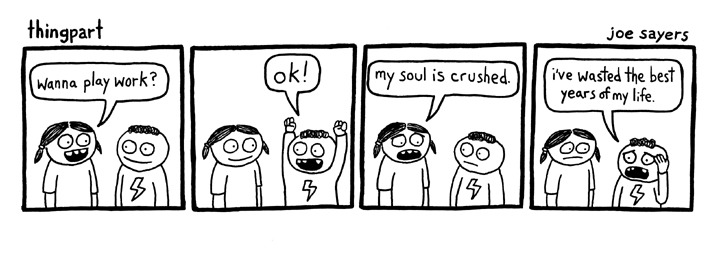
    comic - wanna play work

    Dream More, Work Less:

    I enjoy working. More specifically, I enjoy working inside my interests, anything that drives me toward a vision outside sitting behind a desk, fingers on keys for eight hours a day.In my mind I assemble new ways to do things; creating, crafting, improving, and collaborating. Until recently I was hung up on where to put that effort, managerial day-job or elsewhere?

    I want to be free to make my own decisions. I like the security of a corporate job, the health and financial benefits, but it IS a business. They’re in the market to make money. If that means cutting jobs and salary, that’s part of the equation.

    I want to do something that I’m responsible for; something I’ve poured my heart and soul into. As it happens, I don’t think my current day-job is that “something” which will help build those dreams…

    I like this post. For me personal finance is a subset of life. Like health and education, personal finance, can hamper or provide options to your life. You need to keep track of your finances and manage them but that is in order to provide yourself options to live the life you want. Don’t forget to decide what you want out of life. Then see how you can help make that happen based on finances or what steps you need to take to live your dreams in the future.

    comic: Wanna play work? – also see: Joy in Work

    Related: Medieval Peasants had More Vacation TimeSigns You Have a Great Job … or NotHow to Protect Your Financial HealthCredit Card TipsProvide a Helping Hand1,000 True Fans

  • FDIC Doubling Bank Fees to Pay for Increased Takeovers

    FDIC to double bank fees in face of $40bn loss

    The Federal Deposit Insurance Corporation yesterday proposed doubling the fees it charges US banks, as it warned that it faced about $40bn in losses from bank failures in the coming years.

    About 90 per cent of US banks will see their basic deposit insurance fees double in the first quarter of 2009, from between 5 cents and 7 cents for each $100 of deposits to between 12 cents and 14 cents, according to a plan laid out yesterday by the FDIC, a government-backed agency that insures consumer deposits up to $250,000. From the second quarter that range would widen to from 10 to 14 cents per $100.

    Banks with the riskiest profiles could end up paying fees as high as 77.5 cents for every $100 of insured deposits under the plan, compared with a maximum of 43 cents under the current structure.

    The FDIC insures bank deposits with fees charged to banks. The recent increase of the FDIC Limit to $250,000 seems to indicate that taxpayers will now pay for any costs for covering above $100,000 per account-holder (which I think is a mistake – the fund should be self supporting). But this increase in fees is to restore the fund to the minimum capital requirements of the insurance fund.

    Related: posts on bankingAvoid Getting Squeezed by Credit Card CompaniesWhere to Keep Your Emergency Funds?

  • Jim Rogers on the Financial Market Mess

    Jim Rogers webcast: Fannie Mac and Freddie Mac should not have been bailed out. Jim Rogers is one of the most successful investors in the last 50 years. He and George Soros (together with the Quantum Fund) and then separately along with Warren Buffett have made the most as investors (that I know of – I could easily be wrong).

    How you want to accept their opinions on the current crisis is up to you. I believe they are worth listening to – more than anyone else. That does not mean I believe they are totally right. To me the long term track record of each is very impressive. Especially Jim Rodgers and George Soros have been making big investment gains largely on macro economic predictions in the last 20 years.

    In The Dollar is Doomed (July 2008) Jim Rogers predicts the United States Federal Reserve is so badly run it will be gone in a decade or two. I disagree with that sentiment. He certainly has much more expertise than I do but in evaluating such a comment you need to look at what really matters to him. He doesn’t need the Federal Reserve to actually cease to exist to make profitable trades based on his prediction that the Federal Reserves policies are dooming the dollar.

    Another thing to note with Rogers and Soros is they will make strong statements and take huge positions but will change their mind when conditions change (often quickly). So you can’t assume what they said awhile back is still their belief today.

    Related: Jim Rogers: Why would anybody listen to Bernanke?investment booksRodgers on the US and Chinese EconomiesA Bull on China

  • 401(k)s are a Great Way to Save for Retirement

    401(k)s are a great way to save. Yes, today those that have been saving money have the disappointment of bad recent results. But that is a minor factor compared to the major problem: Americans not saving what they need to for retirement in 401(k)s, IRAs, even just emergency funds… Do not use the scary financial market performance recently as an excuse to avoid retirement savings (if you have actually been doing well).

    The importance of saving enough for retirement is actually increased by the recent results. You might have to re-evaluate your expectations and see whether you have been saving enough. I am actually considering increasing my contributions, mainly to take advantage of lower prices. But another benefit of doing so would be to add more to retirement savings, given me more safety in case long term results are not what I was hoping for.

    Now there can be some 401(k) plans that are less ideal. Limited investing options can make them less valuable. Those limited options could include the lack of good diverse choices, index funds, international, money market, real estate, short term bond funds… My real estate fund is down about 2% in the last year (unlike what some might think based on the media coverage of declining housing prices). And poor investing options could include diverse but not good options (options with high expenses… [ the article, see blow, mentions some with a 2% expense rate – that is horrible]).

    But those poor implementations of 401(K)s are not equivalent to making 401(k)s un-viable for saving. It might reduce the value of 401(k)s to some people (those will less good 401(k) plans). Or it might even make it so for people with bad 401(k) options that they should not save using it (or that they limit the amount in their 401k). I don’t know of such poor options, but it is theoretically possible.

    The tax deferral is a huge benefit. That benefit will only increase as tax rates rise (given the huge debt we have built up it is logical to believe taxes will go up to pay off spending today with the tax increases passed to the future to pay for our current spending).

    And if you get matching of 410(k) contributions that can often more than make up for other less than ideal aspects of a particular 401(k) option.

    Also once you leave a job you can roll the 401(k) assets into an IRA and invest in a huge variety of assets. So even if the 401k options are not great, it is normally wise to add to them and then just roll them into an IRA when you leave. If the plan is bad, also you can use an IRA for your first $5,000 in annual retirement savings and then add additional amounts in the 401k (if they are matching funds normally adding enough to get the matching is best).

    401(k)s, 403(b), IRAs… are still great tools for saving. The performance of financial markets recently have been poor. Accepting periods of poor performance is hard psychologically. But retirement accounts are still a excellent tool for saving for retirement. Using them correctly is important: allocating resources correctly, moving into safer asset allocations as one approaches and reaches retirement…
    (more…)
  • Crisis May Push USA Federal Deficit to Above $1 Trillion for 2009

    Cost of U.S. Crisis Action Grows, Along With Debt

    The global financial crisis is turning into a bigger drain on the U.S. federal budget than experts estimated two weeks ago, ballooning the deficit toward $2 trillion.

    The 2009 budget deficit could be close to $2 trillion, or 12.5 percent of gross domestic product, more than twice the record of 6 percent set in 1983, according to David Greenlaw, Morgan Stanley’s chief economist. Two weeks ago, budget analysts said the measures might push deficit to as much as $1.5 trillion.

    The financial health and earnings prospects of Fannie Mae and Freddie Mac — seized by the government on Sept. 7 to prevent them from failing — worsened in the second and third quarters, the companies’ government regulator said this week.

    On top of all that, budget watchdogs say the sheer size of the interventions is making Washington more profligate than usual. To attract votes in Congress, leaders added several costly items to the $700 billion rescue, including extensions of some tax credits and tax breaks for makers of wooden arrows and stock- car racetrack owners.

    Under normal circumstances, there would have been more resistance to such expenses, said Robert Bixby, executive director of the Concord Coalition, a non-partisan budget watchdog.

    The news sure is not yet getting better. And our failure to act responsibly in good times now seriously increase risk. Just as someone that lived far beyond their means, with excessive debt, debt on multiple credit cards… we have continually elected politicians that had our government live beyond our means for decades. And that means we don’t have the resources to pay for the measures we are talking. For now the world markets are willing to give the USA government more credit cards to finance more spending. But at some point that stops.

    At some point the loans have to be paid back. The only options are large reductions in spending, large increases in taxes or just printing more and more money people don’t want to pay off loans (which will cause massive inflation). There is also the possibility of growing our way out of the problems (the equivalent of yes, I have $40,000 in credit card debt but when I make $150,000 a year paying that off will be easy). To some extent this will happen (unless things get very very bad) but the level of economic growth needed is unlikely to fix the problem we make worse every year (as we fall further and further behind). We are now spending huge amounts to money we didn’t save in the good times. That means we are mortgaging even more of our future than we already had before this mess.

    Related: Financial Market MeltdownWarren Buffett Webcast on the Credit CrisisFDIC Limit Raised to $250,000Financial Markets Continue Panicky BehaviorUSA Federal Debt Now $516,348 Per Household

    Plan Pushed for Government to Buy Bank Stocks

    Bank nationalization would be a more extraordinary move for the US, but in a recent interview former FDIC Chairman William Isaac provided some rare insight into the matter. He said that during the Latin American debt crisis of the 1980s when major money center banks were facing possible loan payment defaults by sovereign governments, the US “had a contingency plan in place to nationalize [the banks].”

    (more…)

  • Soros on the Financial Market Collapse

    George Soros published his most recent book in May 2008 – The New Paradigm for Financial Markets: The Credit Crisis of 2008 and What It Means. Yesterday Bill Moyers Interviewed George Soros:

    Markets have the ability to adjust and they’re very flexible. There is this invisible hand. But it is also prone to be mistaken.

    This current economic disaster is self-generated. It was generated by the market itself, by getting too cocky, using leverage too much, too much credit. And it got excessive.

    The financial system is teetering on the edge of disaster. Hopefully, it will not go over the brink because it very rarely does. It only did in the 1930s. Since then, whenever you had a financial crisis, you were able to resolve it.

    the sort of period where America could actually, for instance, run ever increasing current account deficits. We could consume, at the end, six and a half percent more than we are producing. That has come to an end.

    Right now you already have 10 million homes where you have negative equity. And before you are over, it will be more than 20 million.

    Related: Soros Says Credit Crisis Will Worsen Before Improving (April 2008)Warren Buffett Webcast on the Credit CrisisRodgers on the US and Chinese Economies – – Personal Investment Failures