Tag: banking

  • Loan Default Rates: 1998-2009

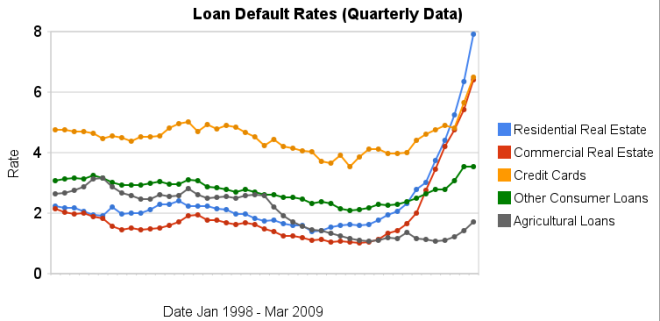
    chart of loan default rates 1998 to 2009Chart showing loan default rates for real estate, consumer and agricultural loans for 1998 to 2009 by the Curious Cat Investing Economics Blog, Creative Commons Attribution, data from the Federal Reserve.

    As you can see real estate default rates exploded in 2008. In the 4th quarter of 2007 residential default rates were 3.02% by the 4th quarter of 2008 they were 6.34% and in the 1st quarter of this year they were 7.91% (471 basis points above the 4th quarter of 2007). Commercial real estate default rates were at 2.74 in the 4th quarter of 2007, 5.43% in the fourth quarter of 2008 and 6.5% in the 1st quarter of 2009 (a 366 basis point increase).

    Credit card default rates were much higher for the last 10 years (the 4-5% range while real estate hovered above or below 2%). In the last 2 quarters it has increased sharply. From 4.8% in the 3rd quarter 2008 to 5.66% in the 4th and 6.5% in the 1st quarter of 2009. The default rate on other consumer loans are up but nowhere near the amounts of real estate or credit cards.

    Agricultural loan default rates are actually about as low now as they have every been 1.71%. That is up a bit from the 1.06% low the default rate hit in the 1st quarter of 2009 but actually lower than it was for half of the last decade (the last 5 years it has been lower but prior to that it was higher – in fact with higher default rates than either real estate loan category).

    Data from the Federal Reserve

    Related: Mortgage Rates: 6 Month and 5 Year ChartsJumbo Loan Defaults Rise at Fast PaceContinued Large Spreads Between Corporate and Government Bond YieldsNearly 10% of Mortgages Delinquent or in Foreclosure

  • Another Wave of Foreclosures Loom

    Another wave of foreclosures is poised to strike

    loan defaults are up sharply. And with many government and banks’ self-imposed foreclosure moratoriums expiring, the biggest lenders indicate that they are likely to move more aggressively to clear up a backlog of troubled mortgages.

    Mark Zandi of Moody’s Economy.com estimates that 15.4 million homeowners — or about 1 in 5 of those with first mortgages — owe more on their homes than they are worth.

    Government and company reports show that the number of completed foreclosures nationwide slowed sharply late last year and into early this year, largely because of various moratoriums in effect during much of the first quarter.

    But anecdotal reports indicate that foreclosure sales have started to climb again in the second quarter. And the pipeline is clearly getting fuller. In the first quarter, some 1.8 million homeowners nationwide fell behind on their loans by 60 to 90 days, a 15% increase from the prior quarter, according to Moody’s Economy.com. The research firm said that loan defaults rose sharply as well, to 844,000 in the first three months of this year.

    Even as defaults among subprime borrowers have trended lower this year, newly initiated foreclosures involving prime mortgage loans saw a significant increase in the first quarter, jumping 21.5% from the fourth quarter, according to a government report of loan data from national banks and federally regulated thrifts.

    This is more bad news for the economy. As I have been saying the economy is still in serious trouble. Cleaning up the damage caused by living beyond our means for decades does not get cleaned up quickly. This are actually going as well as could be hoped for, I think. We need to hope the remainder of this year sees the economy stabilize and then hope 2010 brings some good news.

    Related: Nearly 10% of Mortgages Delinquent or in ForeclosureOver Half of 2008 Foreclosures From Just 35 CountiesHow Much Worse Can the Mortgage Crisis Get? (March 2008)Mortgage Rates Falling on Fed Housing Focus

  • Canada’s Sound Regulation Resulted in a Sound Banking System Even During the Credit Crisis

    The IMF 2009 country report on Canada discusses there current economic condition. As part of that they explore the success Canada had in regulating their banking sector (which stands in stark contract to the catastrophic regulatory failures in the USA and Europe). And also provide ample evidence of that wise regulation did indeed prevent the financial crisis.

    Canada’s banking system has so far displayed remarkable stability amid the global turbulence, thanks in good part to strong supervision and regulation. The financial system has avoided systemic pressures: no financial institution has failed or required public capital injections (banks have raised capital in markets, albeit at elevated cost owing to higher global risk aversion). Key factors behind this relatively strong performance were:

    • Sound supervision and regulation: The 2008 FSSA Update found that the regulatory and supervisory framework meets best practice in many dimensions, including with regard to
      the revised Basel Core Principles for banking supervision.
    • Stringent capital requirements: Solvency standards apply to banks’ consolidated commercial and securities operations. Tier 1 capital generally significantly exceeds the required 7 percent target (which in turn exceeds the Basel Accord minimum of 4 percent). The leverage ratio is limited to 5 percent of total capital.
    • Low risk tolerance and conservative balance sheet structures: Banks have a profitable and stable domestic retail market, and (like their customers) exhibit low risk tolerance. Banks had smaller exposures to “toxic” structured assets and relied less on volatile wholesale funding than many international peers.
    • Conservative residential mortgage markets: Only 5 percent of mortgages are non- prime and only 25 percent are securitized (compared with 25 percent and 60 percent, respectively, in the United States). Almost half of residential loans are guaranteed, while the remaining have a loan-to-value ratio (LTV) below 80 percent—mortgages with LTV above this threshold must be insured for the full loan amount (rather than the portion above 80 percent LTV, as in the United States). Also mortgage interest is nondeductible, encouraging borrowers to repay quickly.
    • Regulation reviews: To keep pace with financial innovation, federal authorities review financial sector legislation every five years (Ontario has a similar process for securities market legislation).
    • Effective coordination between supervisory agencies: Officials meet regularly in the context of the Financial Institutions Supervisory Committee (FISC) and other fora to discuss issues and exchange information on financial stability matters.
    • Proactive response to financial strains: The authorities have expanded liquidity facilities, provided liability guarantees, and purchased mortgage-backed securities. In addition, several provinces now provide unlimited deposit insurance for provincially-regulated credit unions. The 2009 Budget further expands support to credit markets, while providing authority for public capital injections and other transactions to support financial stability.

    Related: Failure to Regulate Financial Markets Leads to Predictable ConsequencesSound Canadian Banking System2nd Largest Bank Failure in USA HistoryEasiest Countries for Doing Business 2008

  • Mortgage Rates: 6 Month and 5 Year Charts

    mortgage rate chart - late 2008 to May 2009Showing mortgage rates over the last 6 months. Red: 30 year fixed rate. Blue: 15 year fixed rate. Tan: 1 year adjustable rate.

    mortgage rate chart - May 2004 to May 2009Showing mortgage rates over the last 5 years. Red: 30 year fixed rate. Blue: 15 year fixed rate. Tan: 1 year adjustable rate. From Yahoo Finance, for conventional loans in Virginia.

    The 6 month chart shows that mortgage rates have been declining ever so slightly. Rates on a 1 year adjustable mortgage fell from 5.5 to 4% and have stayed near 4% for all of 2009. 30 and 15 year rates (15 year rates staying about 25 basis points cheaper) have declined from 6.5%, 6 months ago to about 5% at the start of the year and have moved around slightly since. This is while the yield 10 year government treasuries have been rising (normally 30 year fixed rate mortgages track moves in the 10 year government bond). The federal reserve has been buying bonds in order to push down the yield (and stimulate mortgage financing and other borrowing).

    Mortgage rates certainly could fall further but the current rates are extremely attractive and I just locked in a mortgage refinance for myself. I am getting a 20 year fixed rate mortgage; I didn’t want to extend the mortgage period by getting another 30 year fixed rate mortgage. For me, the risk of increasing rates outweigh the benefits of picking up a bit lower rate given the current economic conditions. But I can certainly understand the decision to hold out a bit longer in the hopes of getting a better rate. If I had to guess I would say rates will be lower during the next 3 months, but I am not confident enough to hold off, and so I decided to move now.

    Related: Mortgage Rates Falling on Fed Housing Focusposts on mortgages30 Year Fixed Mortgage Rates and the Fed Funds RateContinued Large Spreads Between Corporate and Government Bond YieldsLowest 30 Year Fixed Mortgage Rates in 37 Years

  • More Outrageous Credit Card Fees

    Sneaky changes to your credit cards

    Although banks are scooping up billions in bailout money or borrowing money from the Federal Reserve at as low as 0%, they aren’t passing on those savings to consumers. Credit card interest rates have increased for many major card issuers and even doubled or tripled for some consumers who pay their bills on time. Bank of America is raising interest rates on about 4 million customers with balances. Citigroup and Capital One have also jacked up rates.

    Credit card interest rates are typically pegged to the prime rate, which has fallen from 5.25% a year ago to 3.25% now. But the national average rate for credit cards has actually risen over that period, moving from 11.3% to 12.4%

    * The standard balance transfer fee has risen to 3%, and Bank of America recently joined Discover in increasing that fee to 4% on certain offers.

    * Cash advance fees had been 3%, but Bank of America now has 5% cash advance fees for money obtained through ATMs and at banks, and 4% fees on advances via direct deposit and checks.

    * Foreign transaction fees — charged when you make purchases in other countries or use foreign banks — are going up for many cardholders. Starting June 1, Bank of America will begin charging for a service it had previously provided free: Transactions made in U.S. dollars but processed through foreign banks (such as online purchases from overseas merchants using foreign banks) will be hit with 3% fees.

    The incredibly large fees are a good reason to not use your credit card for these activities. 5% to get money from an ATM. You have to be crazy to submit to such a fee. The banks continue to fight with the airlines for who can keep providing the most horrible customer service.

    Related: How to avoid getting ripped off by credit card companiesSneaky Credit Card FeesAvoid Getting Squeezed by Credit Card CompaniesIncredibly Bad Customer Service from Discover Cardmore posts on credit cards

  • Failure to Regulate Financial Markets Leads to Predictable Consequences

    It seems to me the situation that lead to the current economic problems are due to the overthrown of the Glass-Steagal and other long time sensible regulation put in place to restrict economy wide destruction caused by a few large financial firms (well, that plus incredibly poor management by people that paid themselves many times more than anyone else and other factors – huge consumer debt…). But the most significant systemic problem was failure to regulate even close to sensibly. I have several posts on this topic on previously: Congress Eases Bank Laws, 1999Treasury Now (1987) Favors Creation of Huge BanksCanadian Banks Avoid Failures Common Elsewhere and Greenspan Says He Was Wrong On Regulation.

    Capitalism requires sensible regulation. Regulation is not a friction on capitalism it is a necessary component. Poor regulation is a friction that is waste that should be excised. Unfortunately that is a very challenging task and when you allow those with the most gold to set the rules it is no surprise you have them saying they should not be regulated but should be protected. The failure of financial regulations do show the very obvious problem we have currently of those that donate huge amounts to politicians are granted favors that are paid for by the economy overall.

    The widespread failure to regulate financial markets recently is almost certain to lead to this exact type of situation every time. Companies will over-leverage, take huge risks, take huge pay while times are good and just go bankrupt when times are bad. Think about how a bank makes money. They charge fees for things like: writing a loan, overdraft charges on your account, arranging financing (loan or stock sale)… They charge more for in interest than they pay. Some money there but really they are doing nothing special so they should not be able to charge too much. Even the ridicules fees companies pay (often those in the companies have arrangements to get personal special deals – allocations of IPO’s, jobs later…) for arranging stock sales do not have a systemic risk. Those risks should be very easy to manage sensible.

    They speculate in currency markets, commodities markets, futures, derivatives… If you want a stable economy if you allow huge speculative investments to be assumed to such an extent they risk the economy you are in trouble. If you refused those risks to limited liability companies perhaps your limited regulation model might work. Where those profiting on products with negative economic externalities would personally go bankrupt prior to the losses becoming economically crippling. But I doubt even that would work. And we don’t have that now. We allow people to setup limited liability corporations, drain them of capital on speculation of potential value and then walk about with hundreds of millions of dollars if the company fails. And the negative externalities (due to huge leverage) are huge.

    Regulation seems the obvious solution. And it works when applied. It wasn’t until the USA decided to abandon the financial system regulation and enforcement that the problems became systemic. And see the current Canadian banking system for what happens, even while the world economy is collapsing if you required banks to remain banks instead of massively leveraged speculators paying huge bonus to the executives based on their claims of profitability.

    I agree trying to control risk is dangerous. There are however, very sensible measures to take. Do not allow huge financial companies to exist (we have laws on anti-trust, anti-competitive behavior…). Do not allow banks to speculate (more than a careful controlled regulated amount). Do not allow massive leverage of massive amounts of money. Do require audited financial records. Do require companies that want to speculate to be much smaller than regulated bank, and bank-like companies. Do elect politicians that will appose allowing companies to undertake systemic risks to the economy for short term financial gains.

    We continue to elect politicians that provide large favors to those giving them money at the expense and risk to the rest of us. Therefore we are bringing this upon ourselves. When we chose to stop supporting politicians that behave in that way then we will get different behavior. Until that point it will continue. We don’t seems to be in any mood to change what we have been doing.

    Comments on Note to Regulators: Beware the Montana Paradox

    Related: More on Failed Banking Executivesmore posts on regulation in capitalist economiesCredit Crisis the Result of Planned Looting of the World EconomyBad Behavior

  • Skeptics Think Big Banks Should Not be Bailed Out

    Let big banks fail, bailout skeptics say

    The Obama administration must break up the biggest financial firms if the nation is to return to economic health, three prominent bailout skeptics told a congressional panel Tuesday. Columbia University professor Joseph Stiglitz and MIT professor Simon Johnson warned the Joint Economic Committee of Congress that the current government policy of propping up troubled financial giants could impede an economic recovery.

    I must say this is the is how I feel, but I don’t have the time to research all the details – to know all the existing limitations for realistic solutions. But I can’t believe allowing huge, incredibly poorly run financial organizations to remain in place with the same bozos that have looted the treasuries of their companies and then taken huge handouts from the federal government, is good policy. It was a very bad idea to allow such anti-competitive large financial institutions to exist in the first place. Then the extremely bad behavior of thousands of people taking millions from those banks treasuries and imposing huge risks on the financial system certainly should result in government finally doing their job to prevent harm to the economic system.

    Hoenig said authorities must set up a procedure that would allow big nonbank financial firms to be temporarily taken over by the government. Regulators would then replace management, wipe out shareholders and seek to sell the cleansed institution back into private ownership. Stiglitz, formerly an aide in the Clinton administration [and Economics Nobel Prize winner], said the process of briefly taking over banks then selling them back to investors would be much less costly for taxpayers.

    This sounds like a much more sensible strategy to me. It is certainly much much better than increasing consolidation with moves like having huge financial firms buy other huge firms. Obviously I would not support the selling of pieces of the old broken institution to remaining large organizations. The anti-competitive market power must be sharply reduced.

    Related: Treasury Now (1987) Favors Creation of Huge Banksposts on the credit crisisLeverage, Complex Deals and ManiaCanadian Banks Avoided Failures Common ElsewhereThere is No Invisible Hand

  • The Best Way to Rob a Bank is as An Executive at One

    William Black wrote The Best Way to Rob a Bank Is to Own One: How Corporate Executives and Politicians Looted the S&L. I think he a bit off on the “owning one,” being the best way to loot. The looters are not owners, they are executives that loot from owners, taxpayers, customers… And those looters pay politicians a great deal of money to help them. He appeared on Bill Moneys Journal discussing the huge mess we know are in and how little is being done to hold those responsible for the enormous crisis created by them.

    Fraud is deceit. And the essence of fraud is, “I create trust in you, and then I betray that trust, and get you to give me something of value.” And as a result, there’s no more effective acid against trust than fraud, especially fraud by top elites, and that’s what we have.

    The FBI publicly warned, in September 2004 that there was an epidemic of mortgage fraud, that if it was allowed to continue it would produce a crisis at least as large as the Savings and Loan debacle. And that they were going to make sure that they didn’t let that happen. So what goes wrong? After 9/11, the attacks, the Justice Department transfers 500 white-collar specialists in the FBI to national terrorism. Well, we can all understand that. But then, the Bush administration refused to replace the missing 500 agents. So even today, again, as you say, this crisis is 1000 times worse, perhaps, certainly 100 times worse, than the Savings and Loan crisis. There are one-fifth as many FBI agents as worked the Savings and Loan crisis.

    Well, certainly in the financial sphere, I am. I think, first, the policies are substantively bad. Second, I think they completely lack integrity. Third, they violate the rule of law. This is being done just like Secretary Paulson did it. In violation of the law. We adopted a law after the Savings and Loan crisis, called the Prompt Corrective Action Law. And it requires them to close these institutions. And they’re refusing to obey the law.

    In the Savings and Loan debacle, we developed excellent ways for dealing with the frauds, and for dealing with the failed institutions. And for 15 years after the Savings and Loan crisis, didn’t matter which party was in power, the U.S. Treasury Secretary would fly over to Tokyo and tell the Japanese, “You ought to do things the way we did in the Savings and Loan crisis, because it worked really well. Instead you’re covering up the bank losses, because you know, you say you need confidence. And so, we have to lie to the people to create confidence. And it doesn’t work. You will cause your recession to continue and continue.”

    And their ideologies, which swept away regulation. So, in the example, regulation means that cheaters don’t prosper. So, instead of being bad for capitalism, it’s what saves capitalism. “Honest purveyors prosper” is what we want. And you need regulation and law enforcement to be able to do this. The tragedy of this crisis is it didn’t need to happen at all.

    Related: Fed Continues Wall Street WelfareCredit Crisis the Result of Planned Looting of the World EconomyLobbyists Keep Tax Off Billion Dollar Private Equities DealsPoll: 60% say Depression LikelyCanadian Banks Avoid Failures Common ElsewhereToo Big to FailWhy Pay Taxes or be Honest

  • A Banker Who Avoided Toxic Debt Bubble

    The Banker Who Said No

    n late 2006 he sold $74 million of preferred stock although he had no immediate use for the proceeds. He says he couldn’t resist the “stupidly mispriced” terms–as low as Libor plus 1.7 percentage points for 30 years. He wanted as much money available when the boom turned to bust. With the extra money the bank could pay off nearly all its depositors with capital on hand–nearly unheard of in the history of banking.

    Then came a shocker: Amid one of the most reckless lending sprees in history, regulators focused on the one bank that refused to play along. Beal’s moves confused and worried them, and so they began to probe him with questions. “What are you doing?” he recalls them asking. “You’re shrinking yet you’re raising capital?”

    Says Beal about the scrutiny, “I just didn’t fit into any box.” One regulator, the former head of the Texas Savings & Loan Department, Charles Danny Payne, says, “I was skeptical at first, but I’ve gained a lot of confidence over the years,” adding that Beal has an “uncanny ability to sniff out deals.”

    Next, the credit rating agencies started pestering him about his dwindling loan portfolio. They never downgraded him but scolded him for seeming not to have a “sustainable” business model. This while their colleagues were signing off on $32 billion of bum collateralized debt obligations issued by Merrill Lynch.

    He thinks the government is going to be “disappointed” by its various programs to revive lending. He says Treasury Secretary Timothy Geithner’s new plan to guarantee loans to buyers of toxic assets won’t lead to many sales because the problem isn’t liquidity but price. They are not low enough. Half the country’s banks–4,000 in all–would be bust, he says, if they marked their loans to what the loans would fetch in an auction. He says banks are fooling themselves by refusing to mark busted assets down.

    “Banks are on a prayer mission that somehow prices will come back and they won’t have to face reality,” Beal says. And that reality, according to Beal, is going to get a lot worse. “Unemployment is going over 10%, commercial real estate hasn’t even begun collapsing and corporate credit defaults are just getting started,” he says. His prediction: depression, without bread lines this time, thanks to the government safety net, but with equal cost to society.

    There are some (very few) who succeeded in not acting like lemmings. I wish someone would explain to me why people are worthy of millions in bonuses when they just do what every single other person in their position did that was also getting millions in bonuses. Obviously they were just practicing bankruptcy for profit (which worked out incredibly well for them) and still we seem to think the only solution is to support these moral bankrupt (and now commercially bankrupt) organizations and individuals.

    Related: What the Bailout and Stimulus Are and Are NotSound Canadian Banking SystemMore on Failed ExecutivesJim Rogers on the Financial Market Mess

  • Data Shows Subprime Mortgages Were Failing Years Before the Crisis Hit

    Here is a very interesting paper showing real analysis of the data to illustrate that the deteriorating condition of loans should have been caught by those financing such loans years before the mortgage crisis erupted. Understanding the Subprime Mortgage Crisis by Yuliya Demyanyk, Federal Reserve Bank of Cleveland and Otto Van Hemert, New York University.

    Using loan-level data, we analyze the quality of subprime mortgage loans by adjusting their performance for differences in borrower characteristics, loan characteristics, and macroeconomic conditions. We find that the quality of loans deteriorated for six consecutive years before the crisis and that securitizers were, to some extent, aware of it. We provide evidence that the rise and fall of the subprime mortgage market follows a classic lending boom-bust scenario, in which unsustainable growth leads to the collapse of the market. Problems could have been detected long before the crisis, but they were masked by high house price appreciation between 2003 and 2005.

    In many respects, the subprime market experienced a classic lending boom-bust scenario with rapid market growth, loosening underwriting standards, deteriorating loan performance, and decreasing risk premiums.30 Argentina in 1980, Chile in 1982, Sweden, Norway, and Finland in 1992, Mexico in 1994, Thailand, Indonesia, and Korea in 1997 all experienced the culmination of a boom-bust scenario, albeit in different economic settings.
    Were problems in the subprime mortgage market apparent before the actual crisis erupted in 2007? Our answer is yes, at least by the end of 2005. Using the data available only at the end of 2005, we show that the monotonic degradation of the subprime market was already apparent. Loan quality had been worsening for five years in a row at that point. Rapid appreciation in housing prices masked the deterioration in the subprime mortgage market and thus the true riskiness of subprime mortgage loans. When housing prices stopped climbing, the risk in the market became apparent.

    Related: Nearly 10% of Mortgages Delinquent or in ForeclosureHow Much Worse Can the Mortgage Crisis Get?Homes Entering Foreclosure at RecordArticles on Real Estate