Tag: bonds

  • Bond Yields Show Dramatic Increase in Investor Confidence

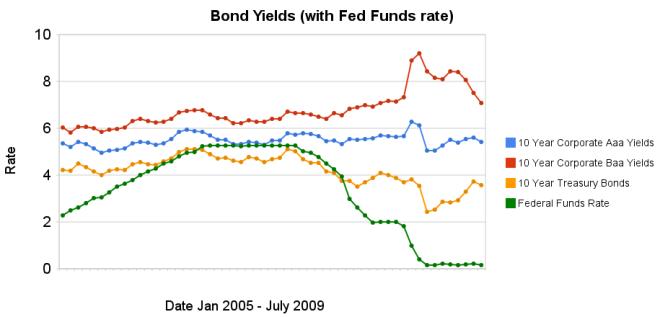
    graph of 10 year Aaa, Baa and corporate bond rates from 2005-2009Chart showing corporate and government bond yields by Curious Cat Investing Economics Blog, Creative Commons Attribution, data from the Federal Reserve.

    The changes in bond yields over the last 3 months months indicate a huge increase in investor confidence. The yield spread between corporate Baa 10 year bonds and 10 year treasury bonds increased 304 basis points from July 2008 to December 2008, indicating a huge swing in investor sentiment away from risk and to security (US government securities). From April 2009 to July 2009 the yield spread decreased by 213 basis points showing investors have moved away from government bonds and into Baa corporate bonds.

    From April to July 10 year corporate Aaa yields have stayed essentially unchanged (5.39% to 5.41% in July). Baa yields plunged from 8.39% to 7.09%. And 10 year government bond yields increased from 2.93% to 3.56%. federal funds rate remains under .25%.

    Investors are now willing to take risk on corporate defaults for a much lower premium (over government bond yields) than just a few months ago. This is a sign the credit crisis has eased quite dramatically, even though it is not yet over.

    Data from the federal reserve: corporate Aaacorporate Baaten year treasuryfed funds

    Related: Continued Large Spreads Between Corporate and Government Bond Yields (April 2009)Chart Shows Wild Swings in Bond Yields (Jan 2009)investing and economic charts

  • Mortgage Rates: 6 Month and 5 Year Charts

    mortgage rate chart - late 2008 to May 2009Showing mortgage rates over the last 6 months. Red: 30 year fixed rate. Blue: 15 year fixed rate. Tan: 1 year adjustable rate.

    mortgage rate chart - May 2004 to May 2009Showing mortgage rates over the last 5 years. Red: 30 year fixed rate. Blue: 15 year fixed rate. Tan: 1 year adjustable rate. From Yahoo Finance, for conventional loans in Virginia.
    The 6 month chart shows that mortgage rates have been declining ever so slightly. Rates on a 1 year adjustable mortgage fell from 5.5 to 4% and have stayed near 4% for all of 2009. 30 and 15 year rates (15 year rates staying about 25 basis points cheaper) have declined from 6.5%, 6 months ago to about 5% at the start of the year and have moved around slightly since. This is while the yield 10 year government treasuries have been rising (normally 30 year fixed rate mortgages track moves in the 10 year government bond). The federal reserve has been buying bonds in order to push down the yield (and stimulate mortgage financing and other borrowing).

    Mortgage rates certainly could fall further but the current rates are extremely attractive and I just locked in a mortgage refinance for myself. I am getting a 20 year fixed rate mortgage; I didn’t want to extend the mortgage period by getting another 30 year fixed rate mortgage. For me, the risk of increasing rates outweigh the benefits of picking up a bit lower rate given the current economic conditions. But I can certainly understand the decision to hold out a bit longer in the hopes of getting a better rate. If I had to guess I would say rates will be lower during the next 3 months, but I am not confident enough to hold off, and so I decided to move now.

    Related: Mortgage Rates Falling on Fed Housing Focusposts on mortgages30 Year Fixed Mortgage Rates and the Fed Funds RateContinued Large Spreads Between Corporate and Government Bond YieldsLowest 30 Year Fixed Mortgage Rates in 37 Years

  • Continued Large Spreads Between Corporate and Government Bond Yields

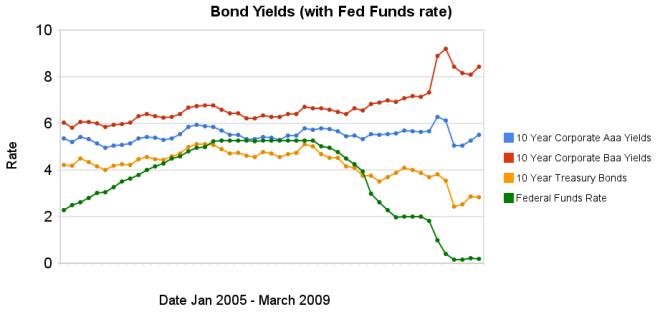
    graph of 10 year Aaa, Baa and corporate bond rates from 2005-2009Chart showing corporate and government bond yields by Curious Cat Investing Economics Blog, Creative Commons Attribution, data from the Federal Reserve.
    The federal funds rate remains under .25%. The large spread between government bonds and corporate bonds remains very large. In the last 3 months the yields on Aaa corporate bonds have increased 45 basis points, Baa corporate bond yields have decreased 1 basis points, while treasury bond yields have increased 40 basis points.

    The spread between 10 year Aaa corporate bond yields and 10 year government bond yields is now 268 basis points. In January, 2008 the spread was 159 points. The larger the spread the more people demand in interest, to compensate for the increased risk. The spread between government bonds and Baa corporate bonds decreased to a still very large 566 basis points, the spread was 280 basis point in January 2008, and 362 basis points in September 2008.

    Data from the federal reserve: corporate Aaacorporate Baaten year treasuryfed funds

    Related: Chart Shows Wild Swings in Bond YieldsFed to Start Buying Treasury Bonds TodayCorporate and Government Bond Rates Graph (Oct 2008)investing and economic charts

  • Fed to Start Buying Treasury Bonds Today

    Fed to start buying T-bonds today, hoping to move rates

    The Federal Reserve will try to get long-term interest rates moving down again when the central bank today launches its first purchases of Treasury bonds. The Fed triggered a stunning drop in Treasury bond yields on March 18 when policymakers surprised Wall Street by announcing a plan to buy up to $300 billion of Treasuries over the next six months.

    The yield on the 10-year T-note plunged to 2.53% on March 18 from 3% the previous day, the biggest one-day drop in decades. But since then, Treasury bond yields have been creeping higher. The 10-year T-note ended Tuesday at 2.65%. Conventional mortgage rates have flattened or inched up, although they remain historically low, in the range of 4.75% to 5%.

    On Tuesday the Treasury sold $40 billion of new two-year T-notes at a yield of 0.95%, which was lower than expected, indicating healthy investor demand. The government will auction $34 billion in five-year notes today and $24 billion in seven-year notes on Thursday. Against numbers like those in just one week, the Fed’s commitment to buy $300 billion of Treasuries over six months doesn’t look like much.

    there’s nothing to stop the Fed from suddenly announcing that its $300-billion commitment will get substantially bigger: The central bank can, in effect, print as much money as it wants to buy bonds — at least, until the day that global investors stop wanting dollars.

    The original announcement caused a dramatic move but since then yields have been drifting up, every day, including today. Rates are already very low. And the huge amount of increased federal borrowing is a potential serious problem for lowering rates. And potentially an even more serious problem is foreign investors deciding the yield does not provide a good investment given the risks of inflation (I know that is how I feel). It will be interesting to see what happens with rates.

    Related: Who Will Buy All the USA’s Debt?Lowest 30 Year Fixed Mortgage Rates in 37 Yearsmortgage terms

  • Who Will Buy All the USA’s Debt?

    Who Will Buy All the USA’s Debt? That is a question worth thinking about. The USA is a huge net borrower. The government can’t borrow from consumers because they are hugely in debt themselves. Over the last few decades huge investments from Japan, China and the Middle East in USA government debt have allowed the huge amount of federal debt to continue to grow rapidly. But who is going to buy the increasing amounts of debt; in the next few years, and the next few decades?

    China is right to have doubts about who will buy all America’s debt

    Chinese doubts about the value of US Treasury bonds highlight a crucial question: who will buy the estimated $2.7 trillion (£1.9 trillion) to $4.2 trillion of debt expected to be issued over the next two years?

    The other area of concern for China is the value of its Treasuries. Given the US borrowing requirement and its lax monetary policy, Treasury bond yields could well rise sharply, causing a corresponding price decline. If China’s holdings match Treasuries’ average 48-month duration, then a 5pc rise in yields, from 1.72pc on the 5-year note to 6.72pc, would lose China 17.5pc of its holdings’ value, or $119bn.

    Foreign buyers have absorbed a little over $200bn of Treasuries annually, a useful contribution to financing the $459bn 2008 deficit, but only a modest help towards the $1.35 trillion minimum average deficit forecast for 2009 and 2010.

    Unless that changes substantially, there will be $1 trillion annually to be raised by the Treasury from domestic sources, more than double the previous record from domestic and foreign sources together, plus whatever is needed to bail out the banks.

    Even if the US savings rate were to rise from zero to its long-term average of 8% of disposable personal income, that would create only an additional $830bn of savings — not enough to fund the domestic share of the deficit. Interest rates would probably have to rise substantially to pull in more foreign investors.

    Very true. Anyone buying government debt at these rates has reason to question the wisdom of doing so. Exporters to the USA have macro-economic reasons for buying debt (to keep the value of the dollar from collapsing) but the investing reasons for buying USA debt I find very questionable (I wouldn’t be buying it as an investment, if I were them).

    Related: Personal Saving and Personal Debt in the USAAmericans are Drowning in DebtUSA Federal Debt Now $516,348 Per HouseholdIs the USA Broke?

  • Chart Shows Wild Swings in Bond Yields

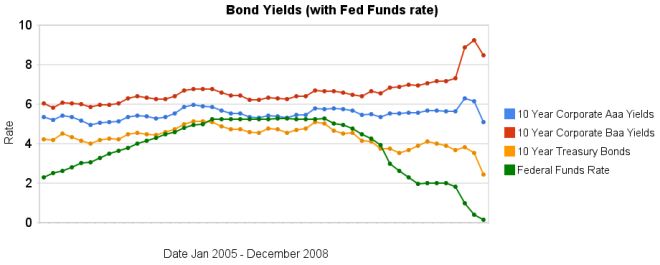
    graph of 10 year Aaa, Baa and corporate bond rates from 2008-2008

    The recent reactions to the credit and financial crisis have been dramatic. The federal funds rate has been reduced to almost 0. The increase in the spread between government bonds and corporate bonds has been dramatic also. In the last 3 months the yields on Baa corporate bonds have increased significantly while treasury bond yields have decreased significantly. Aaa bond yields have decreased but not dramatically (57 basis points), well at least not compared to the other swings.

    The spread between 10 year Aaa corporate bond yields and 10 year government bonds increased to 266 basis points. In January, 2008 the spread was 159 points. The larger the spread the more people demand in interest, to compensate for the increased risk. The spread between government bonds and Baa corporate bonds increased to 604 basis points, the spread was 280 basis point in January, and 362 basis points in September.

    When looking for why mortgage rates have fallen so far recently look at the 10 year treasury bond rate (which has fallen 127 basis points in the last 3 months). The rate is far more closely correlated to mortgage rates than the federal funds rate is.

    Data from the federal reserve – corporate Aaacorporate Baaten year treasuryfed funds

    Related: Corporate and Government Bond Rates Graph (Oct 2008)Corporate and Government Bond Yields 2005-2008 (April 2008) – 30 Year Fixed Mortgage Rates versus the Fed Funds Rateposts on interest ratesinvesting and economic charts

  • Dazzling Diversification

    Diversification overrated? Not a chance [the broken link has been removed] by Jason Zweig

    A diversified portfolio always has, and always will, underperform the hottest investment of the moment.

    For anyone with a sustainable ability to identify the hottest investment of the moment, diversification is a mistake. But if you really believe you’ve got that ability, you’re not just mistaken. You need to be hauled off in a straitjacket to the Institute for the Treatment of Investment Insanity.

    Exactly right. As we posted previously Warren Buffett’s diversification thoughts are similar

    If you are a professional and have confidence, then I would advocate lots of concentration. For everyone else, if it’s not your game, participate in total diversification. The economy will do fine over time. Make sure you don’t buy at the wrong price or the wrong time. That’s what most people should do, buy a cheap index fund and slowly dollar cost average into it.

    You have to remember when Warren Buffett says “professional and have confidence” he doesn’t really mean just what those words say. He mean if you are Charlie Munger, George Soros, Jimmy Rodgers and maybe 10 other people alive today (maybe I am too restrictive, maybe he would include 50 more people alive today, but I doubt it).

    Related: Dilbert on Investinginvestment risksCurious Cat Investing and Economics Search Engine

  • Scott Adams on Investing

    In his blog Scott Adams, author of Dilbert, provides often quite intelligent and interesting thoughts. In a recent post he wrote on investing and Diversification:

    When I first started making serious Dilbert money, I let experts manage half of it, and I managed the rest, as a hedge against both the experts and myself. The experts invested in Enron, Worldcom, and a number of other companies that promptly exploded. The experts reduced their portion of my money by about a third over five years. (The experts work for one of the most respected financial institutions on Earth, by the way.) My own investments did better, precisely because they were more diversified. So now I handle my own investments, probably incompetently.

    I didn’t own much in the way of stocks for the past several years, thanks to not using professional advisors. A big chunk of my money has been in California Municipal bonds of various types, and all are insured.

    In order to diversify more, I started migrating money over to the stock market during this recent plunge. The market could go a lot lower still, but this is either the beginning of the end of the United States as we know it, in which case it doesn’t matter how I invested, or it is a once-in-a-lifetime stock buying opportunity. It was an easy decision.

    Related: Stock Market DeclineWarren Buffett on DiversificationInvestment Allocations Make A Big Difference

    Dilbert comic on investors
  • Discounted Corporate Bonds Failing to Find Buying Support

    ‘Armageddon’ Prices Fail to Lure Buyers Amid Selling

    Yields on corporate bonds show investors expect 5.6 percent of the market to go bust, the highest default rate since the Great Depression, according to Christopher Garman, chief executive officer of debt research firm Garman Research LLC in Orinda, California.

    The selling is being compounded by hedge funds and mutual funds dumping holdings to meet redemptions, which may push prices even lower, according to analysts at UBS AG.

    Corporate debt has been pressured by “incessant selling by hedge funds and leveraged institutions as they unwind,” Bill Gross, manager of the world’s biggest bond fund at Newport Beach, California-based Pacific Investment Management Co.

    Corporate bond prices plunged to 79.9 cents on the dollar on average from 94 cents at the end of August and 99 cents at the end of 2007, according to index data compiled by New York-based Merrill Lynch & Co.

    “The de-leveraging that we’re witnessing will probably continue,” said Paul Scanlon, team leader for U.S. high yield and bank loans at Boston-based Putnam Investments LLC, which manages $55 billion in fixed income. “My sense is that’s not turning around in the very near term.”

    I am not very familiar with the bond market but it does seem like the panic is in full swing but calling the bottom is always hard. I would guess the de-leveraging (and investors pulling money out of bond funds) could well lead things lower over the short term.

    Related: Corporate and Government Bond Rates GraphMunicipal Bonds After Tax Return

  • Corporate and Government Bond Rates Graph

    graph of 10 year bond rates

    Over the last 3 months the yields on corporate bonds have increased while treasury bonds have decreased. The chart shows the move away from lower quality bonds to higher quality though probably not as dramatically as actually has taken place as it is just an average for each month (and in September the flight to quality became extreme at the end of the month). While the Fed did not announce a formal cut in the discount rate, the average rate for overnight loans from the Fed last month was 1.81%.

    The spread between 10 year Aaa corporate bond yields and 10 year government bonds increased to 196 basis points. In January, 2008 the spread was 159 points. The larger the spread the more people demand in interest, to compensate for the increased risk. The spread between government bonds and Baa corporate bonds increased to 362 basis points, the spread was 280 basis point in January. The rate on government bonds has barely change (decreasing from 3.74% in January to 3.69% now) so the change has nearly all been in increased corporate bond rates.

    Data from the federal reserve – corporate Aaacorporate Baaten year treasuryfed funds

    Related: Bond Yields 2005 to June 200830 Year Fixed Mortgage Rates versus the Fed Funds RateCurious Cat Investing and Economics Searchposts on interest rates