Tag: Canada

  • Stock Market Capitalization by Country from 2000 to 2016

    The total stock market capitalization by country gives some insight but it is also data that is a bit muddy. The data doesn’t tell you how the economies of the countries are doing as there is quite a bit of room for misinterpreting the data.

    Apple, Alphabet, Intel, 3M, Abbvie… all are included in the USA market capitalization but much of their sales, earnings and employment are overseas. And USA companies have done very well in global markets so the USA totals are not just an indication how the USA has performed but includes great gains made by profiting from global growth. Also you may be surprised to learn that 26% of USA equities are owned by investors outside the USA.
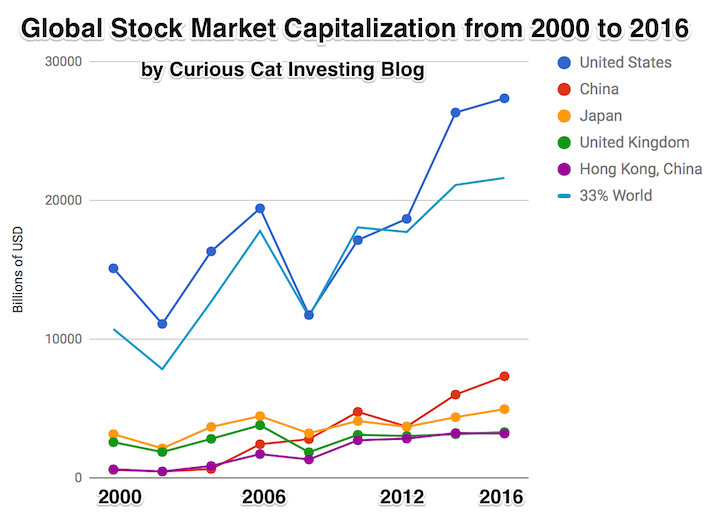
    chart of top 5 counties by stock market capitalization (2000 to 2016)
    The chart shows the top countries based on stock market capitalization, with data from 2000 to 2016. The chart was created by Curious Cat Investing and Economics Blog may be used with attribution. Data from the World Bank.

    It is important to keep in mind the data is shown in current USA dollars, so large swings in exchange rates can have a large impact.

    China’s performance has been remarkable. China also shows some of the challenges in collecting this data. I am fairly certain Alibaba (BABA), one of the 10 most valuable companies in the world and a Chinese company has the stock issued in the USA (even this is confusing as it is a complex arrangement but the only publicly traded stock is traded in the USA). And many other Chinese companies are traded this way and therefore are not included in the Chinese total value. In addition Hong Kong is part of China but also separate. The data is reported separately by the world bank and I include them that way in the charts.

    As with so much recent economic data China’s performance here is remarkable. China grew from 1.8% of world capitalization in 2000 to 6.9% in 2012 and 11.2% in 2016. Adding Hong Kong to China’s totals shows 3.7% in 2000 with growth to to 12.2% in 2012 and 16.2% in 2016. If you look at my post global stock market capitalization from 2000 to 2012 you will see significantly different historical data for Hong Kong. Collecting this data is much more complex than people realize and data determinations can change over the years resulting in changes in historical data.

    The chart shows the 1/3 of the total global market capitalization in order to have the chart display look better (and it also makes it easier to compare the USA performance to the total global performance). The USA market capitalization was at 46.9% of the global market cap in 2000 and fell to 31.6% in 2000 before rising to 42% in 2016. This shows that the USA has largely held its own globally as measured by market cap. This may not seem impressive but when you consider that China has grown from 3.7% to 16.2% you can see that for the market cap outside of China the USA has actually gained quite a bit of ground. This is the result of what I mentioned before – how well USA companies have done at capture global markets (especially in high technology areas with very high profits and therefore very high market caps).
    (more…)

  • Manufacturing Employment Data: USA, Japan, Germany, UK… 1990-2009

    I try to find global economic data on manufacturing and manufacturing jobs, but it isn’t easy. This is one of the areas I will be working on with the time I have freed up by moving to Malaysia (and taking a “sabbatical” [it isn’t really a sabbatical, I guess, just me studying and working on what I want to instead of what someone pays me to]).

    I found some interesting data from the USA census bureau on manufacturing employment in several countries (it would be interesting to see the data for more countries but for now I am limited to this data). Sadly they just use indexed data (I would rather see raw data). This data for example lets you see the changes in countries but I don’t see any way to compare the absolute values between countries – all you can compare is the changes between countries.

    The data is all indexed at 2002 = 100. Interestingly the USA has increased output per hour much more than any other country since 2002. The USA index stands at 146, the next highest is Sweden at 127 then the UK at 120. Italy is the only country tracked that fell since 2002, to 94. Japan (the 3rd largest manufacturer and 2nd largest of the countries include, China isn’t included) only increased to 113. Germany (4th and 3rd) increased to 111.

    The data also lets you look back from 1990 to 2002 and again the USA has increased productivity very well (2nd most) – the value in 1990 was 58. Sweden actually had the largest gain from 1990-2002, rising from 49. In 1990 Japan stood at 71 and Germany 70.

    (more…)

  • Government Debt as Percent of GDP 1998-2010 for OECD

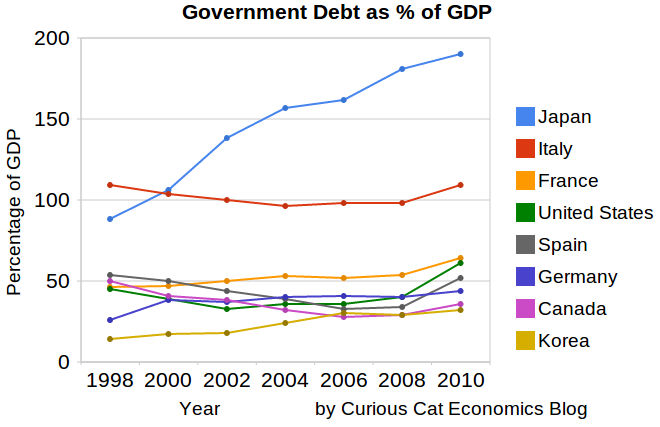
    This chart shows government debt as a percent of GDP based on OECD data. The chart is limited to central government debt issuance and excludes therefore state and local government debt and social security funds.

    Economic data is always a bit tricky to understand. It makes some sense that excluding social security would reduce the USA debt percentage a bit. But these debt as a percentage of GDP are lower than other sources show. There are obviously many tricks that can be used to hide debt and my guess is the main thing going on with this data is OECD intentionally trying to make things look as good as possible.

    Still looking at historical trends in data is useful. And I believe looking at data from various sources is wise. There has been a dramatic increase from 2008-2010. The USA is up from 41% of GDP to 61%. Spain is up from 34% to 52% (but given all the concern with Spain this doesn’t seem to indicate the real debt problems they have.

    Japan and France don’t have 2010 data, so I used a rough estimate of my own based on 2009 data. Greece has been over 100% since 1998 and now stands at 148%, 2nd worst (to Japan) for any OECD country (Europe, North America, Japan and Korea), Italy is 3rd. Ireland is at 61% (up from 28% in 2008). The UK is at 86%, up from 61%.

    Related: Government Debt as Percentage of GDP 1990-2009: USA, Japan, Germany, China… (based on IMF data)Government Debt as Percentage of GDP 1990-2008Government Debt Compared to GDP 1990-2007Top 15 Manufacturing Countries in 2009

  • Government Debt Compared to GDP 1990-2007

    Government debt as percent of GDP 1990-2007Chart showing government debt as a percentage of GDP by Curious Cat Investing Economics Blog, Creative Commons Attribution, data from OECD, Sept 2009.
                    

    For 2007 most countries slightly decreased their government debt to GDP ratio – as economic growth exceeded debt growth. The OECD is made up of countries in Europe and the USA, Japan, Korea, Australia, New Zealand and Canada. The overall OECD debt to GDP ratio decreased from 77% in 2005 to 75% in 2007. The USA moved in the opposite direction increasing from 62% to 63%: still remaining far below the OECD total. Most likely 2008, 2009 and 2010 will see both the USA and other OECD national dramatically increase the debt burden.

    Compared to the OECD countries the USA is actually better than average. The chart shows the percentage of GDP that government debt represents for various countries. The USA ended 2007 at 63% while the overall OECD total is 75%. In 1990 the USA was at 63% and the OECD was at 57%. Japan is the line way at the top with a 2007 total of 171% (that is a big problem for them). Korea is in the best shape at just a 29% total in 2007 but that is an increase from just 8% in 1990.

    Related: Government Debt as a Percentage of GDP Through 2006Oil Consumption by Country in 2007Federal Deficit To Double This YearPoliticians Again Raising Taxes On Your ChildrenTrue Level of USA Federal DeficitTop 12 Manufacturing Countries in 2007
    (more…)

  • Canada’s Sound Regulation Resulted in a Sound Banking System Even During the Credit Crisis

    The IMF 2009 country report on Canada discusses there current economic condition. As part of that they explore the success Canada had in regulating their banking sector (which stands in stark contract to the catastrophic regulatory failures in the USA and Europe). And also provide ample evidence of that wise regulation did indeed prevent the financial crisis.

    Canada’s banking system has so far displayed remarkable stability amid the global turbulence, thanks in good part to strong supervision and regulation. The financial system has avoided systemic pressures: no financial institution has failed or required public capital injections (banks have raised capital in markets, albeit at elevated cost owing to higher global risk aversion). Key factors behind this relatively strong performance were:

    • Sound supervision and regulation: The 2008 FSSA Update found that the regulatory and supervisory framework meets best practice in many dimensions, including with regard to
      the revised Basel Core Principles for banking supervision.
    • Stringent capital requirements: Solvency standards apply to banks’ consolidated commercial and securities operations. Tier 1 capital generally significantly exceeds the required 7 percent target (which in turn exceeds the Basel Accord minimum of 4 percent). The leverage ratio is limited to 5 percent of total capital.
    • Low risk tolerance and conservative balance sheet structures: Banks have a profitable and stable domestic retail market, and (like their customers) exhibit low risk tolerance. Banks had smaller exposures to “toxic” structured assets and relied less on volatile wholesale funding than many international peers.
    • Conservative residential mortgage markets: Only 5 percent of mortgages are non- prime and only 25 percent are securitized (compared with 25 percent and 60 percent, respectively, in the United States). Almost half of residential loans are guaranteed, while the remaining have a loan-to-value ratio (LTV) below 80 percent—mortgages with LTV above this threshold must be insured for the full loan amount (rather than the portion above 80 percent LTV, as in the United States). Also mortgage interest is nondeductible, encouraging borrowers to repay quickly.
    • Regulation reviews: To keep pace with financial innovation, federal authorities review financial sector legislation every five years (Ontario has a similar process for securities market legislation).
    • Effective coordination between supervisory agencies: Officials meet regularly in the context of the Financial Institutions Supervisory Committee (FISC) and other fora to discuss issues and exchange information on financial stability matters.
    • Proactive response to financial strains: The authorities have expanded liquidity facilities, provided liability guarantees, and purchased mortgage-backed securities. In addition, several provinces now provide unlimited deposit insurance for provincially-regulated credit unions. The 2009 Budget further expands support to credit markets, while providing authority for public capital injections and other transactions to support financial stability.

    Related: Failure to Regulate Financial Markets Leads to Predictable ConsequencesSound Canadian Banking System2nd Largest Bank Failure in USA HistoryEasiest Countries for Doing Business 2008

  • Government Debt as a Percentage of GDP

    Government debt as percent of GDPChart showing government debt as a percentage of GDP by Curious Cat Investing Economics Blog, Creative Commons Attribution, data from OECD, March 2009.

    The USA federal government debt is far too large, in my opinion. We have been raising taxes on future taxpayers for several decades, to finance our current spending. Within reason deficit spending is fine. What that reasonable level is however, is not easy to know. One big problem with the past few decades is that during very prosperous economic times we spent money that we didn’t have, choosing to raise taxes on the future (instead of either not spending as much or paying for what we were spending by raising taxes to pay for current spending).

    By not even paying for what we are spending when times were prosperous we put ourselves in a bad situation when we have poor economic conditions – like today. If we were responsible during good economic times (and at least paid for what we spent) we could have reduced our debt as a percentage of GDP. Even if we did not pay down debt, just by not increasing the outstanding debt while the economy grew the ratio of debt to GDP would decline. Then when times were bad, we could afford to run deficits and perhaps bring the debt level up to some reasonable level (maybe 40% of GDP – though it is hard to know what the target should be, 40% seems within the realm of reason to me, for now).

    There is at least one more point to remember, the figures in the chart are based on reported debt. The USA has huge liabilities that are not accounted for. So you must remember that the actually debt is much higher than reported in the official debt calculation.

    Now on to the good news. As bad as the USA has been at spending tomorrows increases in taxes today, compared to the OECD countries we are actually better than average. The OECD is made up of countries in Europe, the USA, Japan, Korea, Australia, New Zealand and Canada. The chart shows the percentage of GDP that government debt represents for various countries. The USA ended 2006 at 62% while the overall OECD total is 77%. In 1990 the USA was at 63% and the OECD was at 57%. Japan is the line way at the top with a 2006 total of 180% (that is a big problem for them). Korea is in the best shape at just a 28% total in 2006 but that is an increase from just 8% in 1990.

    Related: Federal Deficit To Double This YearPoliticians Again Raising Taxes On Your ChildrenTrue Level of USA Federal DeficitWho Will Buy All the USA’s Debt?Top 12 Manufacturing Countries in 2007Oil Consumption by Country
    (more…)

  • Sound Canadian Banking System

    Worthwhile Canadian Initiative by Fareed Zakaria

    Guess which country, alone in the industrialized world, has not faced a single bank failure, calls for bailouts or government intervention in the financial or mortgage sectors. Yup, it’s Canada. In 2008, the World Economic Forum ranked Canada’s banking system the healthiest in the world. America’s ranked 40th, Britain’s 44th.

    Canadian banks are typically leveraged at 18 to 1—compared with U.S. banks at 26 to 1 and European banks at a frightening 61 to 1.

    Canada has been remarkably responsible over the past decade or so. It has had 12 years of budget surpluses, and can now spend money to fuel a recovery from a strong position. The government has restructured the national pension system, placing it on a firm fiscal footing, unlike our own insolvent Social Security. Its health-care system is cheaper than America’s by far (accounting for 9.7 percent of GDP, versus 15.2 percent here), and yet does better on all major indexes. Life expectancy in Canada is 81 years, versus 78 in the United States; “healthy life expectancy” is 72 years, versus 69. American car companies have moved so many jobs to Canada to take advantage of lower health-care costs that since 2004, Ontario and not Michigan has been North America’s largest car-producing region.

    Related: Canadian Banks Avoid Failures Common ElsewhereInternational Health Care System PerformanceGreenspan Says He Was Wrong On Regulation