Tag: career

  • Survey Data on Boomers Experience with Working During Retirement

    A new study, Secure Retirement, New Expectations, New Rewards: Work in Retirement for Middle Income Boomers, explores how Boomers are blurring the lines between working for pay and retirement (as I have discussed in posts previously, phased retirement).

    From their report:

    Middle-income Boomers working in retirement describe an experience different than their work experience before retirement. Most Boomers look for more flexible work arrangements and scheduling, and many try new career paths in different industries. In addition, middle-income Boomers working in retirement find that they are highly satisfied with their work, even more so than they were with their work before officially “retiring.” In exchange for this flexibility and satisfaction, retired Boomers are willing to work for less money than they were making before retiring.

    The define middle income as income between $25,000 and $100,000 with less than $1 million in investable assets and boomers as those born between 1946 and 1964.

    Nearly 70% of retirees retired earlier than they planned to. Many did so due to health issues. Only 3% retired so they could travel more.

    48% of middle income boomer retirees wish they could work. For those wishing to, but unable to work: 73% cannot due to health, 17% can’t find a job and 10% must care for a loved one.

    Only two in ten (21%) nonretired Boomers would be willing to take a pay cut for their work in retirement, while more than half (53%) of currently employed retirees report making much less per hour in retirement.

    Nearly all (94%) nonretirees who plan to work in retirement would like some kind of special work arrangement, such as flex-time or telecommuting, but only about one third (37%) of currently employed retirees have such an arrangement.

    It seems to me, both employees and employers need to be more willing to adapt. Workers seem to be more willing, even though they claim they are not: this is mainly a revealed versus stated preference, they claim they won’t accept lower pay but as all those that do show, they really are willing to do so, they just prefer not to. This report is based on survey data which always has issue; nevertheless there are interesting results to consider.

    61% of middle income boomers who ware working say they do so because they want to work, not because they have to work.

    Of middle-income retirees who are currently working, nearly two-thirds (63%) took six months or less off between the start of their retirement and the start of their employment in retirement. In fact, more than one-third (35%) continued working immediately after they retired.

    Only 12% of working middle income boomer retirees work full time all year. 60% work part-time. 7% are seasonal while 16% are freelance and 4% are other. Of those identifying as non-retired 75% work full time while 17% are part-time.

    49% plan to work into their 70’s or until their health fails.

    51% are more satisfied with their post-retirement work than their pre-retirement work. 27% are equally satisfied with their jobs.

    As I have stated in previous posts I think a phased approach to retirement is the most sensible thing for society and for us as individuals. Employers need to provide workable options with part time work. The continued health care mess in the USA makes this more of a challenge than it should be. With USA health care being closely tied to employment and it costing twice as much as other rich countries (for no better results) it complicates finding workable solutions to employment. The tiny steps taken in the Affordable Care Act are not even 10% of magnitude of changes needed for the USA health care system.

    Related: Providing ways for those in their 60’s and 70’s (part time schedules etc.)Companies Keeping Older Workers as Economy Slows (2009)Keeping Older Workers Employed (2007)Retirement, Working Longer to Make Ends Meet

  • The Time to Payback the Investment in a College Education in the USA Today is Nearly as Low as Ever – Surprisingly

    While people question the value of a college degree a recent study by the New York Federal Reserve shows a degree is close to as valuable today as it has ever been. The costs to get that value have risen but even with the increased cost students earn on average a 15% annual rate of return on their investment.

    Of course, not every student will earn that, some will earn more and some less.

    The Value of a College Degree

    We estimate that the value of a college degree fell from about $120,000 in the early 1970s to about $80,000 in the early 1980s, before more than tripling to nearly $300,000 by the late 1990s, where it has remained, more or less, ever since. Despite drifting down somewhat in the aftermath of the Great Recession, the value of a bachelor’s degree has remained near its all-time high.

    The time required to recoup the costs of a bachelor’s degree has fallen substantially over time, from more than twenty years in the late 1970s and early 1980s to about ten years in 2013. So despite the challenges facing today’s college graduates, the value of a college degree has remained near its all-time high, while the time required to recoup the costs of the degree has remained near its all-time low.

    graph showing averthe years to recoup the cost of college decline from 30 to 10 from 1970 to 2010

    So a college education is a great investment for most people. This can create a problem however, when people then assume that all they need to do is go to college and they will do well no matter what. The same thing happens in other markets. Real estate has proven to be a great investment. that doesn’t mean every real estate investment is good. It doesn’t mean you can ignore the costs and risks of a particular investment. The same goes for stocks.

    (more…)

  • Global Workplace

    The world has become very interconnected. This is no surprise, the evidence is all around us and continues to increase. What this actually means though is more complex than it appears.

    One area this impacts greatly is the workplace. More and more people are working internationally. This continues to largely be either through large multinationals or cheap labor that is imported to do largely unskilled or minimally skilled labor.

    There is also a continuing increase in skilled and educated labor working overseas for other than huge multi-nationals. The infrastructure to support this is often not in place. The current structure (visas etc.) support the two modes mentioned above.

    But I see an increasing number of opportunities for countries that encourage entrepreneurship and high skill jobs. I relocated to Malaysia and in doing so did a bit of research. It is difficult to get a long term visa in most countries without a full time job (and given the complexity of hiring foreign workers this often means dealing with companies that do a lot of it – in the 2 categories mentioned above).

    Career prospects are enhanced with international experience. One way to get a jump start on your career is international education. This has been popular for a long time but is becoming more and more popular. Students studying in London can get the benefits of international experience (unless they are from England, obviously) and enjoy the great city of London and accessible travel to Europe.

    The importance is to truly gain an international perspective. Those in the USA have the greatest problem as knowledge workers in most other countries are much more aware of the global economy. Europe is an easy way to get started and is packed with lot of great schools and processes in place to make it easy to become a student.

    As I mentioned in a previous post, I believe the most important factor for a career is finding something you love to do, but within those possibilities it is nice to know the payoff of different college degrees.

    Those that see Asia as the economic engine for the next 50 years might well be tempted to look at attending school there. There are plenty of options though it may take a bit more work on your part to make it happen. I think attending at least some portion of college internationally is a great idea as is getting international work experience early in your career.

    Related: How to Balance the Benefits of Foreign Workers and the Potential Damage to Citizen’s Job ProspectsLeading Economic Freedom: Hong Kong, Singapore, New Zealand, Switzerland

  • How to Balance the Benefits of Foreign Workers and the Potential Damage to Citizen’s Job Prospects

    There have been quite a few complaints about companies hiring foreign nationals to work in the USA to save money (and costing citizens jobs or reducing their pay). The way the laws are now, companies are only suppose to hire people to work in the USA that can’t be met with USA workers. The whole process is filled with unclear borders however – it is a grey world, not black and white.

    I think one of the things I would do is to make it cost more to hire foreigners. Just slap on a tax of something like $10,000 per year for a visa. If what I decided was actually going to adopted I would need to do a lot more study, but I think something like that would help (maybe weight it by median pay – multiple that by 2, or something, for software developers…).

    It is a complex issue. In general I think reducing barriers to economic competition is good. But I do agree some make sense in the context we have. Given the way things are it may well make sense to take measures that maybe could be avoided with a completely overhauled economic and political system.

    I believe there are many good things to having highly skilled workers in your country. So if the problem was in recruiting them (which isn’t a problem in the USA right now) then a tax on the each visa wouldn’t be wise, but I think it might make sense now for the USA.

    I think overall the USA benefits tremendously from all the workers attracted from elsewhere. We are much better off leaving things as they are than overreacting the other way (and being too restrictive) – but I do believe it could be tweaked in ways that could help.

    Outsourcing Made by India Seen Hit by Immigration Law

    In June the U.S. Senate passed an immigration bill that allows more H-1Bs while also increasing their cost and barring some companies from placing holders of the visa with customers.

    Indians received more than half the 106,445 first-time H-1Bs issued in the year ending September 2011, according to a U.S. Department of Homeland Security report. The second-biggest recipient was China with 9.5 percent.

    While the legislation raises the annual H-1B cap to as much as 180,000 from 65,000, it increases visa costs five-fold for some companies to $10,000. It also bans larger employers with 15 percent or more of their U.S. workforce on such permits from sending H-1B staff to client’s sites.

    The aim is to balance the U.S. economy’s need to fill genuine skills gaps with protection for U.S. citizens from businesses that may use the guest-worker program to bring in cheaper labor

    Related: Relocating to Another CountryWorking as a Software DeveloperScience PhD Job Market in 2012Career Prospect for Engineers Continues to Look Positive

  • Career Flexibility

    I think we could use some innovation in our model of a career. I have thought retirement being largely binary was lame since I figured out that is mainly how it worked. You work 40 hours a week (1,800 – 2,000 hours a year) and then dropped to 0 hours, all year long, from them on.

    It seems to me more gradual retirement makes a huge amount of sense (for society, individuals and our economy). That model is available to people, for example those that can work as consultants (and some others) but we would benefit from more options.

    Why do we have to start work at 22 (or 18 or 26 or whenever) and then work 40 or so straight years and then retire? Why not gap years (or sabbaticals)? Also why can’t we just go part time if we want.

    The broken health care system in the USA really causes problems with options (being so tightly tied to full time work). But I have convinced employers to let me go part-time (while working in orgs that essentially have 0 part time workers). And I am now basically on gap year(s)/sabbatical now. It can be done, but it certainly isn’t encouraged. You have to go against the flow and if you worry about being a conventional hire you may be nervous.

    Related: Working Less: Better Lives and Less UnemploymentWhy don’t we take five years out of retirement and spread them throughout your working life?Retiring Overseas is an Appealing Option for Some RetireesLiving in Malaysia as an Expat67 Is The New 55

  • Looking at the Value of Different College Degrees

    Georgetown University Center on Education and the Workforce has produced a new report looking at the value of different college degrees in the USA. I have seen a great increase in discussions of the “bubble” in education. Those articles often say a college degree doesn’t assure the success it used to. The data I review seems to show extremely large benefits for those with a college degree (higher salaries but, much more importantly, in my opinion, they also have much lower unemployment rates).

    Those benefits are greatest for several majors including science, math and engineering. The problem I see is not so much that significant benefits are lacking for college degrees but the huge increases in costs of getting a degree are so large that for some majors the cost is just so large that even with the benefits it is arguable whether it is worth the cost (while a few decades ago the benefits were universal and so large the economic benefit was not debatable).

    The authors of the report found that all undergraduate majors are worthwhile, even taking into account the cost of college and lost earnings. However, the lifetime advantage ranges from $1,090,000 for Engineering majors to $241,000 for Education majors. As I have written frequently on the Curious Cat Science and Engineering blog, engineering degrees are very financially rewarding.

    The top 10 majors with the highest median earnings for new graduates are:

    • Petroleum Engineer ($120,000)
    • Pharmacy/pharmaceutical Sciences and Administration ($105,000)
    • Mathematics and Computer Sciences ($98,000)
    • Aerospace Engineering ($87,000)
    • Chemical Engineering ($86,000)
    • Electrical Engineering ($85,000)
    • Naval Architecture and Marine Engineering ($82,000)
    • Mechanical Engineering, Metallurgical Engineering and Mining and Mineral Engineering (each with median earnings of $80,000)
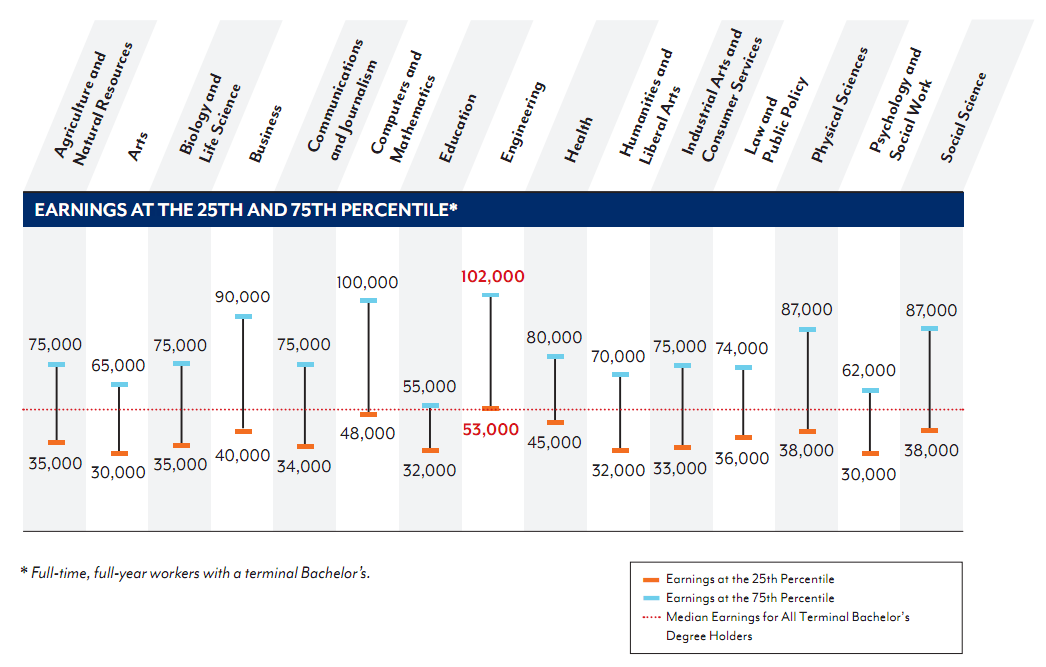
    chart showing the salaries by major in the USA (2009)
    Chart of salaries (25th and 75th percentile) by major in the USA based on data from 2009

    Related: 10 Jobs That Provide a Great Return on InvestmentMathematicians Top List of Best OccupationsNew Graduates Should Live Frugally

    (more…)

  • Earning More Money

    Earning more is an important and simple idea that is ignored far to often. Simple, doesn’t mean, easy, just easy to understand. This is something people should definitely consider in their personal financial planning.

    There is a important caveat to remember, people earning a lot of money often have large financial problems and go bankrupt. Earning more if you borrow more than you earn and rely on ever increasing earnings can make you even more venerable than those earning less. A significant factor is how likely you are to replace your current earning if you need to find a new job.

    There is also another concern to watch for – don’t become a slave to your desire to earn more. The reason to earn more is to improve your life long situation. If you sacrifice what you enjoy too much it becomes a bad trade off. Short term sacrifices may well be wise. But many people find themselves in decades long sacrifices to try and get ahead. This isn’t a good plan.

    Making money online can be enjoyable and rewarding. However, it isn’t easy. I am putting more effort into this area and will be doing a great deal more in the next year. We will see how successful I am.

    Related: Earn more money. It matters more than everything else combined.10 Jobs That Provide a Great Return on InvestmentEarn More Money to buy luxuries (don’t go into debt)High Expectations
    (more…)

  • 10 Jobs That Provide a Great Return on Investment

    10 Jobs With Great Return on Investment

    For those who feel pressure to make the most of their education, here are some careers that offer major bang for the buck.

    Radiation therapist

    Most common degree: Associate’s
    Median pay: $72,910

    Employment in the occupation is expected to grow by nearly a third between 2008 and 2018

    Dental hygienist

    Most common degree: Associate’s
    Median pay: $66,570
    It’s no surprise that the healthcare field is home to several careers that offer the best pay and opportunities for the education required, given that the healthcare industry has faced steady increases in demand despite the recession.

    Petroleum engineer

    Most common degree: Bachelor’s
    Median pay: $108,020
    When it comes to jobs for which the typical degree is a bachelor’s, only airline pilots earn more than petroleum engineers. For one thing, engineers’ salaries reflect the technical skills required, says Margaret Watson of the Society of Petroleum Engineers. But the salaries are also a result of supply and demand, as there are relatively few graduates in petroleum engineering—some enter the field with degrees in other engineering disciplines, as well—and demand is expected to increase as more engineers reach retirement age.

    Nuclear power reactor operator

    Most common training: Long-term, on-the-job training
    Median pay: $73,320
    Nuclear power reactor operators might start their careers as plant equipment operators while they become familiar with the operations. In fact, reactor operators need at least three years of experience working in a power plant—including at least one year in a nuclear plant. To earn the right to control the equipment as reactor operators, they must be licensed by the Nuclear Regulatory Commission. Employment of nuclear power reactors is expected to grow by 20 percent between 2008 and 2018.

    Follow the link for more of the top 10 job paths that payoff well. I certain don’t think it makes sense to pursue a career that doesn’t interest you just because it pays well. But if you are choosing among several careers that appeal to you, one factor worth considering are the employment prospects in the careers.

    Related: Engineering Majors Hold 8 of Top 10 Highest Paid MajorsThe Declining Value of a college degreeManufacturing Jobs Data: USA and ChinaMedieval Peasants had More Vacation Time

  • U.S. Job Report Suggests that Green Shoots are Mostly Yellow Weeds

    U.S. Job Report Suggests that Green Shoots are Mostly Yellow Weeds by Nouriel Roubini

    The June employment report suggests that the alleged ‘green shoots’ are mostly yellow weeds that may eventually turn into brown manure. The employment report shows that conditions in the labor market continue to be extremely weak, with job losses in June of over 460,000. With the current rate of job losses, it is very clear that the unemployment rate could reach 10 percent by later this summer, around August or September, and will be closer to 10.5 percent if not 11 percent by year-end. I expect the unemployment rate is going to peak at around 11 percent at some point in 2010, well above historical standards for even severe recessions.

    It’s clear that even if the recession were to be over anytime soon – and it’s not going to be over before the end of the year – job losses are going to continue for at least another year and a half. Historically, during the last two recessions, job losses continued for at least a year and a half after the recession was over.

    The latest figures – published this week – on mortgage delinquencies and foreclosures suggest a spike not only in subprime and near-prime delinquencies, but now also on prime mortgages. So the problems of the economy are significantly affecting the banking system.

    So the outlook for the US and global economy remains extremely weak ahead. The recent rally in global equities, commodities and credit may soon fizzle out as an onslaught of worse- than-expected macro, earnings and financial news take a toll on this rally, which has gotten way ahead of improvement in actual macro data.

    Certainly this is not a forecast that will make people happy. I agree that the expectations for a nice quick recovery have become too optimistic. I am far from certain what lies ahead but the second half of 2009 does not look to be very strong. It is still a time to be cautious.

    Related: Jim Rogers on the Financial Market Mess (Oct 2008)Beware of the Sucker’s RallyUSA Consumers Paying Down DebtInvesting quotations

  • Companies Keeping Older Workers as Economy Slows

    This Time, Old Hands Are Keeping Their Jobs

    Figures from the Bureau of Labor Statistics tell the tale: The number of people aged 55 and up with jobs actually rose nearly 900,000 from the start of the recession, in December 2007, through last year. By comparison, people aged 25 to 54 lost nearly 2.9 million jobs. The share of older Americans who have jobs has risen during the recession, while the share of younger Americans with jobs has plunged.

    That’s a big change from the last serious recession, in 1990-91, when older workers, especially in manufacturing, were hard-hit. Today’s pattern is closer to that of the mild 2001 recession, when older workers did reasonably well.

    Boeing’s buyouts in the 1990s encouraged workers near retirement to jump ship. “We’ve learned from that,” says Hartnett. While Boeing says it doesn’t look at age in making cuts, it and others want to save the most productive workers—often employees whom companies have invested in most and who have “demonstrated track records,” says Chicago lawyer Gerald L. Maatman Jr., who recently advised 10 companies on downsizing. Such workers “tend to be more experienced and are often older.”

    Related: Keeping Older WorkersOur Only Hope: Retiring LaterFocus on Customers and EmployeesPeople are Our Most Important Asset