Tag: Cool

  • Solar Power Market Solutions For Hundreds of Millions Without Electricity

    400 million people in India and 1.2 billion people worldwide do not have electric power at home. Mera Gao Power provides a wonderful market solution. Mera Gao Power can install solar power systems at a low cost that can be paid back in just 2 years by charging only 50 cents a month to users (for 7 hours of electricity a day). So they provide funding (through investors and grants) and recoup the investment quickly by providing a valuable service at a price users can afford.

    Four solar panels are sufficient to power an entire village of 100 households with quality light and mobile charging. These panels are installed on the roofs of existing households, thus eliminating the need for land. Since power is generated during the day and used at night they use batteries to store the power.

    By utilizing LED lights, MGP’s micro grid design is ultra energy efficient. This is the key to reducing power generation and storage equipment. Each household is provided with two or four LED lights.

    Mera Gao Power received funding from USAID Development Innovation Ventures. The video presents their innovation for a village-level solar micro grid to electrify rural Uttar Pradesh for a White House meeting.

    Related: Appropriate Technology: Solar Water Heaters in Poor Cairo NeighborhoodsTop Countries For Renewable Energy CapacityWater Pump Merry-go-RoundLetting Children Learn, Hole in the Wall ComputersHomemade Windmills for ElectricityWater and Electricity for All

  • Google Finance Portfolio Charting

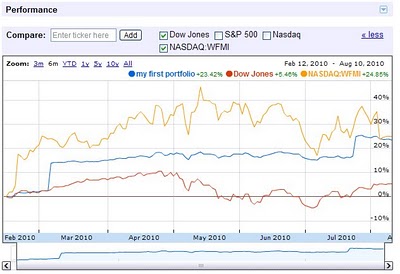
    investment portfolio charting from Google Finance
    Google finance has a nice new feature to let you chart your entire portfolio. You can then compare it to the S&P 500 or other stocks. This is a very nice feature. Yahoo Finance is about the only part of Yahoo I still use. I do use Google Finance some but they still fall short and I use Yahoo Finance much more. This feature will at least encourage me to put my portfolio in Google and start tracking it.

    It would be great if this could give you portfolio annual rates of return (including factoring in cash additions and withdraws and keeping track of sales over time to show a true view of the portfolio). It does look like it will factor in stock purchases and sales which is very nice. You can import csv files with transaction history – another nice feature.

    It also strikes me as a very smart move (as a Google stockholder that is nice to see) as advertising rates around investing are high. The more time Google can provide financial advertisers the more income they can make.

    Related: Lazy Portfolios Seven-year Winning StreakGoogle Posts Good Earning But Not Good Enough for Many (April 2010)Dollar Cost AveragingCurious Cat Investing Books

  • Kiva: 58 months; $153,090,650 Lent; 99% repayment

    Some fast facts on the Kiva micro-lending site:

    • 58 months old
    • $153,090,650 raised
    • 99% repayment rate
    • 395,427 entrepreneurs funded
    • 742,717 Kiva lenders
    • 201 countries
    • Curious Cats Lending Team: – 8 members, 193 loans totaling $7,950

    Add to those numbers by joining Kiva today or lending more money today. Let me know and we will add you to the Curious Cat Kivan page.

    Related: Provide a Helping Hand Using KivaFunding Entrepreneurs in Nicaragua, Ghana, Viet Nam, Togo and TanzaniaCreating a World Without Poverty

  • Hans Rosling Data on Economic Development and Health Results

    Hans Rosling uses his fascinating data-bubble software to burst myths about the developing world. Look for new analysis on China and the post-bailout world, mixed with classic data shows.

    “The worldview students have corresponds to reality the year their teachers were born”

    The software he uses, the very cool Gapminder world, developed by his son and bought by Google is available online.

    He also correctly congratulates the USA for providing free data it has collected worldwide, for decades, on world health. And correctly criticizes the World Bank for selling the data they compile using taxpayer funds.

    Related: Data Visualization Health Care ExampleEconomic Measurement Issues Arising from GlobalizationMillennium Development GoalsGovernment Debt Compared to GDP 1990-2007

  • Monkey Economics

    Scientist Monkeys Around With The Economy

    Sure enough, when they trained a low-ranking monkey to open the container, just as any technical college advertisement will tell you, the new skills translated into a higher income. Roughly an hour after she’d open the container for everyone, she was getting groomed a lot more, as much as a high-ranking monkey, and she no longer had to do hardly any grooming herself. But that was not the most spectacular finding.

    Dr. NOE: So what then did, is we got a second low-ranking female, trained her to open a second container with apples in it, and then we saw that the value of the first provider dropped, more or less, to the half of what she had before. So now we had a competition between two animals. Both of them could provide this good, these apples, and so the value of the first one dropped down again. And of the second one who was very low at the beginning of the experiment, she went up. And they ended up both in the middle, so to speak.

    BLUMBERG: So when there was a monkey monopoly on the skill, the monkeys paid one price. But when it became a duopoly, the price fell to an equilibrium point, about half of what it had been. And this all happened despite the fact that we’re talking about monkeys here. Monkeys can’t do math…

    Very cool.

    Related: Eric Schmidt on Google, Education and EconomicsToo Big to FailExpectations

  • 12 Stocks for 10 Years – July 2009 Update

    I originally setup the 10 stocks for 10 years portfolio in April of 2005. In order to track performance created a marketocracy portfolio but had to make some minor adjustments (and marketocracy doesn’t allow Tesco to be purchased, though it is easily available as an ADR to anyone in the USA to buy in real life – it is based in England). The current marketocracy calculated annualized rate or return (which excludes Tesco) is 3.5% (the S&P 500 annualized return for the period is -1.7%) – marketocracy subtracts the equivalent of 2% of assets annually to simulate management fees – as though the portfolio were a mutual fund – so without that the return is about 5.5%).

    The current stocks, in order of return:

    Stock Current Return % of sleep well portfolio now % of the portfolio if I were buying today
    Amazon – AMZN 136% 9% 9%
    Google – GOOG 105% 15% 13%
    Templeton Dragon Fund – TDF 80% 11% 11%
    PetroChina – PTR 78% 11% 10%
    Templeton Emerging Market Fund – EMF 28% 5% 6%
    Cisco – CSCO 15% 6% 8%
    Toyota – TM 7% 9% 11%
    Danaher – DHR -14% 6% 9%
    Tesco – TSCDY -14%* 0%* 10%
    Intel – INTC -15% 4% 6%
    Pfizer – PFE -38% 5% 7%
    Dell -60% 4% 0%

    The portfolio is beating the S&P 500 by 5.2% annually (which is actually quite good. Also it is a bit confused due to to Tesco not being included. View the current marketocracy Sleep Well portfolio page.

    Related: 12 Stocks for 10 Years Update – June 2008posts on stocksinvesting books
    (more…)

  • 1,000 True Fans

    1,000 True Fans by Kevin Kelly

    The long tail is famously good news for two classes of people; a few lucky aggregators, such as Amazon and Netflix, and 6 billion consumers. Of those two, I think consumers earn the greater reward from the wealth hidden in infinite niches.

    But the long tail is a decidedly mixed blessing for creators. Individual artists, producers, inventors and makers are overlooked in the equation. The long tail does not raise the sales of creators much, but it does add massive competition and endless downward pressure on prices.

    Assume conservatively that your True Fans will each spend one day’s wages per year in support of what you do. That “one-day-wage” is an average, because of course your truest fans will spend a lot more than that. Let’s peg that per diem each True Fan spends at $100 per year. If you have 1,000 fans that sums up to $100,000 per year, which minus some modest expenses, is a living for most folks.

    I am suggesting there is a home for creatives in between poverty and stardom. Somewhere lower than stratospheric bestsellerdom, but higher than the obscurity of the long tail.

    Another interesting idea from Kevin Kelly. I like real life examples of applying economic and financial thinking, which I think his post does well. We have more options that just working for some organization. I have a bit of work to do to gain myself 1,000 fans and quite a bit more to get to 1,000 true fans. But I am making some progress in that direction.

    Related: Who Influences Your ThinkingStreet Use with Kevin KellySigns You Have a Great Job… or NotCurious Cat Investing Search