Tag: credit crisis

  • Elizabeth Warren Webcast On Failure to Fix the System

    Elizabeth Warren is the single person I most trust with understanding the problems of our current credit crisis and those who perpetuate the climate that created the crisis. Unfortunately those paying politicians are winning in their attempts to retain the current broken model. We can only hope we start implementing policies Elizabeth Warren supports – all of which seem sensible to me (except I am skeptical on her executive pay idea until I hear the specifics).

    She is completely right that the congress giving hundreds of billions of dollars to those that give Congressmen big donations is wrong. Something needs to be done. Unfortunately it looks like the taxpayers are again looking to re-elect politicians writing rules to help those that pay the congressmen well (one of the problems is there is little alternative – often both the Democrat and Republican candidates will both provide favors to those giving them the largest bribes/donations – but you get the government you deserve and we don’t seem to deserve a very good one). We suffer now from the result of them doing so the last 20 years. Wall Street has a winning model and betting against their ability to turn Washington into a way for them to mint money and be favored by Washington rule making is probably a losing bet. If Wall Street wins the cost will again be in the Trillions for the damage caused to the economy.

    Related: If you Can’t Explain it, You Can’t Sell ItJim Rogers on the Financial Market MessMisuse of Statistics – Mania in Financial MarketsSkeptics Think Big Banks Should Not be Bailed Out
  • Volcker on the Great Recession and Need for Reform

    America Must ‘Reassert Stability and Leadership’

    SPIEGEL: Can the current situation be compared with the Great Depression?

    Volcker: I remember there were people, beggars and tramps as we called them, who wanted to be fed. So it’s true, today we also have people who are relying on food stamps and other payments but we are a long way from the Great Depression. We are in a serious, great recession. Today we have 10 percent unemployment, but at that time it was more like 20 or 25 percent. That’s a big difference. You had mass unemployment.

    SPIEGEL: Are you sure? The Wall Street businesses are doing well. The big bonuses are back.

    Volcker: It’s amazing how quickly some people want to forget about the trouble and go back to business as usual. We face a real challenge in dealing with that feeling that the crisis is over. The need for reform is obviously not over. It’s hard to deny that we need some forward looking financial reform.

    SPIEGEL: But the American government seems to have lost some eagerness in setting a tougher regime of rules and regulations to control Wall Street. Everything is being watered down. Why?

    Volcker: I will do the best I can to fight any tendency to water it down. What we need is broad international consensus to make things happen.

    I am surprised how many people are trying to compare the economic situation today (often using unemployment rates) and say we are in nearly as bad a situation as the great depression. The economy is certainly struggling, great recession, is a good term for it, I think. But taking the high measures of unemployment and underemployment today and comparing it to unemployment in the 1930’s is not comparing like numbers. The employment situation is bad now. It was much worse in the great depression. As intended, support systems like unemployment pay, FDIC, food stamps… have worked to reduce the depth of the recession.

    He is right that we need serious reform to the deregulation that allowed the credit crisis to explode the economy.

    Related: Volcker: Economic Decline Faster Now Than Any Time He RemembersThe Economy is in Serious Trouble (Nov 2008)Unemployment Rate Reached 10.2%Canada’s Sound Regulation Resulted in a Sound Banking System Even During the Credit Crisis

  • Unemployment Rate Increases to 9.7%

    The unemployment rate in the USA continued the climb toward 10% in August in the aftermath of the credit crisis. Nonfarm payroll employment decline in August, by 216,000 more jobs, and the unemployment rate rose to 9.7%, the U.S. Bureau of Labor Statistics reported today. Since December 2007, employment has fallen by 6.9 million jobs.

    In August, the number of unemployed persons increased by 466,000 to 14.9
    million, and the unemployment rate rose to 9.7%. The unemployment rates for adult men (10.1%), whites (8.9%), and Hispanics (13.0%) rose in August. The jobless rates for adult women (7.6%), teenagers (25.5%), and blacks (15.1%) were little changed over the month.

    The civilian labor force participation rate remained at 65.5% in August. The employment-population ratio, at 59.2%, edged down over the month and has declined by 3.5 percentage points since the recession began in December 2007.

    In August, the number of persons working part time for economic reasons was little changed at 9.1 million. These individuals indicated that they were working part time because their hours had been cut back or because they were unable to find a full-time job.

    In August, manufacturing employment continued to trend downward, with a decline of 63,000. The pace of job loss has slowed throughout manufacturing in recent months. Employment in health care continued to rise in August (28,000), with gains in ambulatory care and in nursing and residential care. Health care has added 544,000 jobs since the start of the recession.

    In August, the average workweek for production and nonsupervisory
    workers on private nonfarm payrolls was unchanged at 33.1 hours.
    The manufacturing workweek and factory overtime also showed no
    change over the month (at 39.8 hours and 2.9 hours, respectively).

    Related: Unemployment Rate Drops Slightly to 9.4%posts on employmentMay 2009 Unemployment Rate Jumps to 9.4%California Unemployment Rate Climbs to 10.5 Percent (March 2009)

  • Buffett on Need to Reduce Government Deficits

    The Greenback Effect by Warren Buffett

    The United States economy is now out of the emergency room and appears to be on a slow path to recovery.

    Because of this gigantic deficit, our country’s “net debt” (that is, the amount held publicly) is mushrooming. During this fiscal year, it will increase more than one percentage point per month, climbing to about 56 percent of G.D.P. from 41 percent. Admittedly, other countries, like Japan and Italy, have far higher ratios and no one can know the precise level of net debt to G.D.P.

    Legislators will correctly perceive that either raising taxes or cutting expenditures will threaten their re-election. To avoid this fate, they can opt for high rates of inflation, which never require a recorded vote and cannot be attributed to a specific action that any elected official takes.

    Our immediate problem is to get our country back on its feet and flourishing — “whatever it takes” still makes sense. Once recovery is gained, however, Congress must end the rise in the debt-to-G.D.P. ratio and keep our growth in obligations in line with our growth in resources.

    Unchecked carbon emissions will likely cause icebergs to melt. Unchecked greenback emissions will certainly cause the purchasing power of currency to melt. The dollar’s destiny lies with Congress.

    Related: Warren Buffett Webcast on the Credit CrisisThe Long-Term USA Federal Budget OutlookBerkshire Hathaway Annual Meeting 2008Federal Reserve to Buy $1.2 Trillion in Bonds, Mortgage-Backed Securities

  • Commercial Real Estate Market Still Slumping

    Fed Focusing on Real-Estate Recession as Bernanke Convenes FOMC

    The collapse in commercial real estate is preventing Federal Reserve Chairman Ben S. Bernanke from declaring the economy and financial markets are healed. Property values have fallen 35 percent since October 2007, according to Moody’s Investors Service.

    Commercial property is “certainly going to be a significant drag” on growth, said Dean Maki, a former Fed researcher who is now chief U.S. economist in New York at Barclays Capital Inc., the investment-banking division of London-based Barclays Plc. “The bigger risk from it would be if it causes unexpected losses to financial firms that lead to another financial crisis.”

    Any sales of mortgage-backed bonds would be the first new issues in the $700 billion U.S. market for commercial-mortgage- backed securities since it was shut down by the credit freeze in 2008. About $3 billion are in the pipeline, and the success of these sales may foster as much as $25 billion in total deals in the next six months

    Forty-seven percent of loans at the 7,000-plus smaller U.S. lenders are in commercial real estate, compared with 17 percent for the biggest banks…

    Related: Data Shows Subprime Mortgages Were Failing Years Before the Crisis HitHome Values and Rental RatesRecord Home Price Declines (Sep 2008)

  • Bond Yields Show Dramatic Increase in Investor Confidence

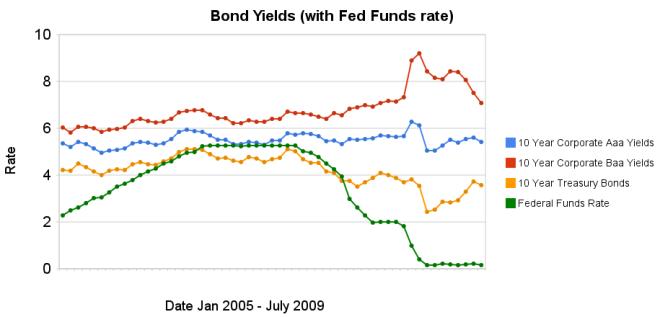
    graph of 10 year Aaa, Baa and corporate bond rates from 2005-2009Chart showing corporate and government bond yields by Curious Cat Investing Economics Blog, Creative Commons Attribution, data from the Federal Reserve.
    The changes in bond yields over the last 3 months months indicate a huge increase in investor confidence. The yield spread between corporate Baa 10 year bonds and 10 year treasury bonds increased 304 basis points from July 2008 to December 2008, indicating a huge swing in investor sentiment away from risk and to security (US government securities). From April 2009 to July 2009 the yield spread decreased by 213 basis points showing investors have moved away from government bonds and into Baa corporate bonds.

    From April to July 10 year corporate Aaa yields have stayed essentially unchanged (5.39% to 5.41% in July). Baa yields plunged from 8.39% to 7.09%. And 10 year government bond yields increased from 2.93% to 3.56%. federal funds rate remains under .25%.

    Investors are now willing to take risk on corporate defaults for a much lower premium (over government bond yields) than just a few months ago. This is a sign the credit crisis has eased quite dramatically, even though it is not yet over.

    Data from the federal reserve: corporate Aaacorporate Baaten year treasuryfed funds

    Related: Continued Large Spreads Between Corporate and Government Bond Yields (April 2009)Chart Shows Wild Swings in Bond Yields (Jan 2009)investing and economic charts

  • Mobius Says Derivatives, Stimulus to Spark New Crisis

    Mobius Says Derivatives, Stimulus to Spark New Crisis

    A new financial crisis will develop from the failure to effectively regulate derivatives and the extra global liquidity from stimulus spending, Templeton Asset Management Ltd.’s Mark Mobius said.

    “Political pressure from investment banks and all the people that make money in derivatives” will prevent adequate regulation, said Mobius, who oversees $25 billion as executive chairman of Templeton in Singapore. “Definitely we’re going to have another crisis coming down,”

    A “very bad” crisis may emerge within five to seven years as stimulus money adds to financial volatility, Mobius said. Governments have pledged about $2 trillion in stimulus spending.

    “Banks have lobbied hard against any changes that would make them unable to take the kind of risks they took some time ago,” said Venkatraman Anantha-Nageswaran, global chief investment officer at Bank Julius Baer & Co. in Singapore. “Regulators are not winning the battle yet and I’m not sure if they are making a strong case yet for such changes.”

    Mobius also predicted a number of short, “dramatic” corrections in stock markets in the short term, saying that “a 15 to 20 percent correction is nothing when people are nervous.” Emerging-market stocks “aren’t expensive” and will continue to climb

    I share this concern for those we bailed out using the money we paid them to pay politicians for more favors. Those paying our politicians like very much paying themselves extremely well and then being bailed out by the taxpayers when their business fails. They are going to try to retain the system they have in place. And they are likely to win – politicians are more likely to provide favors to those giving them large amounts of money than they are to learn about proper management of an economy.

    Related: Congress Eases Bank Laws for Big Donors (1999)Lobbyists Keep Tax Off Billion Dollar Private Equities Deals and On For Our GrandchildrenGeneral Air Travel Taxes Subsidizing Private Plane AirportsCEOs Plundering Corporate Coffers

  • Loan Default Rates: 1998-2009

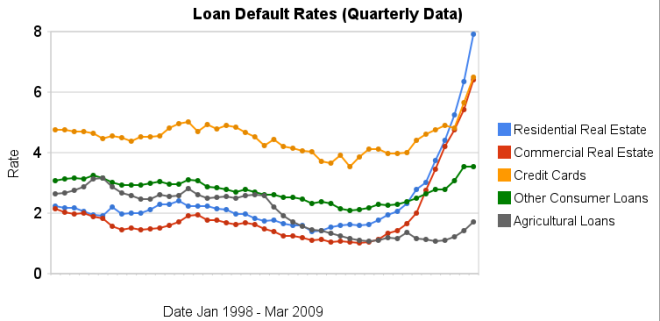
    chart of loan default rates 1998 to 2009Chart showing loan default rates for real estate, consumer and agricultural loans for 1998 to 2009 by the Curious Cat Investing Economics Blog, Creative Commons Attribution, data from the Federal Reserve.
    As you can see real estate default rates exploded in 2008. In the 4th quarter of 2007 residential default rates were 3.02% by the 4th quarter of 2008 they were 6.34% and in the 1st quarter of this year they were 7.91% (471 basis points above the 4th quarter of 2007). Commercial real estate default rates were at 2.74 in the 4th quarter of 2007, 5.43% in the fourth quarter of 2008 and 6.5% in the 1st quarter of 2009 (a 366 basis point increase).

    Credit card default rates were much higher for the last 10 years (the 4-5% range while real estate hovered above or below 2%). In the last 2 quarters it has increased sharply. From 4.8% in the 3rd quarter 2008 to 5.66% in the 4th and 6.5% in the 1st quarter of 2009. The default rate on other consumer loans are up but nowhere near the amounts of real estate or credit cards.

    Agricultural loan default rates are actually about as low now as they have every been 1.71%. That is up a bit from the 1.06% low the default rate hit in the 1st quarter of 2009 but actually lower than it was for half of the last decade (the last 5 years it has been lower but prior to that it was higher – in fact with higher default rates than either real estate loan category).

    Data from the Federal Reserve

    Related: Mortgage Rates: 6 Month and 5 Year ChartsJumbo Loan Defaults Rise at Fast PaceContinued Large Spreads Between Corporate and Government Bond YieldsNearly 10% of Mortgages Delinquent or in Foreclosure

  • Economists Raise Projections for Second Half of 2009

    Economists are raising projections for the USA economy in the second half of 2009. The predictions are still for an anemic economy growing at just 1.5% and with unemployment reaching 10.1%. Still I think if we achieve that we should feel lucky. Economists Raise U.S. Outlook as Recession Fades

    Growth will average 1.5 percent in the July-to-December period, compared with last month’s 1.2 percent projection, according to the median of 57 forecasts in the survey taken from July 2 to July 8. The jobless rate will exceed 10 percent early next year and average 9.8 percent for 2010.

    The economy probably shrank at a 1.8 percent rate from April to June, the latest survey showed, less than economists forecast last month. The U.S. will return to growth in the current quarter and expand 2.1 percent next year.

    A separate report from the Commerce Department today showed the trade deficit unexpectedly narrowed in May as exports jumped while imports of crude oil and auto parts slid. The gap between imports and exports decreased 9.8 percent to $26 billion, the smallest since November 1999, from $28.8 billion in April.

    Unemployment will rise to 10.1 percent in the first quarter of 2010 from 9.5 percent last month, already the highest since August 1983, the survey of economists showed.

    The trade deficit is still far to large. And the to move the economy in the right direction we need to continue reducing personal debt (and start reducing government debt).

    Related: First Quarter GDP 2009 down 6.1%When Will the Recession Be Over?Warren Buffett Webcast on the Credit Crisis

  • 30 Year Mortgage Rate and Federal Funds Rate Chart

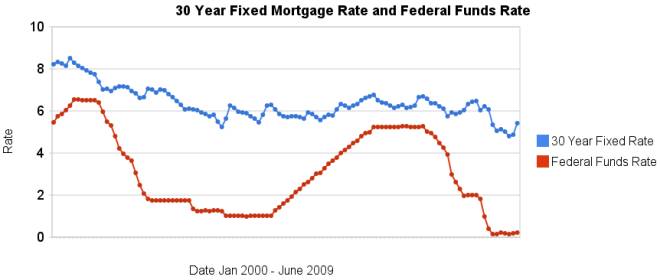
    Once again the data shows that the 30 year fixed mortgage rates are not directly related to federal funds rates. In June the fed funds rate increased 3 basis points, 30 year mortgage rates increased 56 basis points. Since January the fed funds rate is up 6 basis points is up while 30 year mortgage rates are up 36 basis points. Home prices have continued to fall even with the very low mortgage rates.

    30 year fixed mortgage rates and the federal funds rate 2000-2009

    Related: Mortgage Rates: 6 Month and 5 Year Chartshistorical comparison of 30 year fixed mortgage rates and the federal funds rateposts on financial literacyGM and Citigroup Replaced by Cisco and Travelers in the DowJumbo v. Regular Fixed Mortgage Rates: by Credit Score

    For more data, see graphs of the federal funds rate versus mortgage rates for 1980-1999. Source data: federal funds rates30 year mortgage rates