Tag: credit crisis

  • Low Mortgage Rates But High Eligibility Requirements

    Low Mortgage Rates a Mirage as Fees Climb, Eligibility Tightens

    The average rate on a 30-year fixed mortgage dropped to 5.07 percent for the week ending Feb. 26 from 6.63 percent for the one ending July 24

    “A score of 700 was once near perfect,” said Gwen Muse Evans, vice president of credit policy at Fannie Mae, the government-controlled company that helps set lending standards. “Today, a 700 performs more like a 660 did. We have updated our policy to take into account the drift in credit scores.”

    Consumer credit scores, called FICOs after creator Fair Isaac Corp., range from 300 to 850. The average FICO score on mortgages bought by Freddie Mac and Fannie Mae rose to 747.5 in the fourth quarter of last year from 722.3 in 2005, according to Inside Mortgage Finance.

    Accunet’s Wickert said that a 660 FICO score would have qualified most borrowers for loans with no upfront fees in the past. Now, someone trying to borrow $200,000 with a 660 score would have to pay a 2.8 percent fee, or $5,600, he said. Even someone with a 719 score would have to pay $1,750 in cash.

    The low mortgage rates are attractive but a decision to re-finance (or buy) must consider the long term implications. Also if you are re-financing to take advantage of the low rates consider a 20 year or 15 year loan if you are already well into your 30 year loan. A fixed rate loan is the most sensible option at this time.

    Related: Low Mortgage Rates Not Available to Everyone30 Year Fixed Mortgage Rates and the Fed Funds Rate ChartIgnorance of Many Mortgage HoldersFed Plans To Curb Mortgage ExcessesHow Not to Convert Home Equity

  • Jumbo Loan Defaults Rise at Fast Pace

    Jumbo Loan Defaults Rise at Fast Pace as Rich Suffer

    About 2.57 percent of prime borrowers who took out jumbo loans last year were at least 60 days delinquent

    2.57% of homeowners with jumbo mortgage are 60 days late, of those that just got loan last year! That is crazy. These kinds of figures are astounding to me. I am still (posted Feb 2007) amazed that 4.4% is the historic low for mortgages over a month late.

    About 1.92 percent of homeowners with 2008 mortgages backed by Fannie Mae and Freddie Mac fell at least 60 days behind, LPS Applied Analytics said. Jumbo loans are bigger than what the two government-controlled agencies buy or guarantee, and Obama’s plan focuses on shoring up mortgages eligible to be bought by Fannie and Freddie.

    The top five U.S. jumbo lenders — Chase Home Finance LLC, Bank of America Corp., Washington Mutual Inc., Wells Fargo & Co. and Citigroup Inc. — originated a combined $55.3 billion in jumbos in 2008. They lent just $4.3 billion of that during the last three months of the year, according to Inside Mortgage Finance.

    The national average for a 30-year fixed-rate jumbo mortgage was 6.57 percent this week compared with 5.34 percent for a conforming loan, according to White Plains, New York-based financial data provider BanxQuote.

    Related: The Impact of Credit Scores and Jumbo Size on Mortgage RatesLow Mortgage Rates Not Available to Everyone30 Year Fixed Mortgage Rates and the Fed Funds Rateposts about mortgages

  • What the Bailout and Stimulus Are and Are Not

    The huge banking bailouts and stimulus bill are meant to counter-balance the huge problems the economy is suffering through. The damage caused to the economy, is largely from unwise risks that were allowed by regulators and politicians that have not panned out and are now greatly damaging the economy. It is always easy for politicians to pay out money in an attempt to buy our way out of problems. That is what the stimulus and bailout bills are doing. They are yet again heaping huge debts on our children and grandchildren.

    The bailout and stimulus packages are not about preventing foolish risks to the economy by huge banks that would make the economy safer in the future. Those types of bills are very hard to pass as the politicians get great sums of money to allow people to risk the economy for their own benefit. The concept of the stimulus is not to fix the cause of the problem but do cope with the problem we are left with due to people that paid themselves huge amounts of money. Now the taxpayers get to fund the huge payouts wall street has given themselves.

    This is because they never actually provided the value they claimed. They merely created false returns to claim they provided a benefit to justify obscene pay (many of them truly didn’t understand this is what they were doing so beyond failing they were so incompetent [while accepting well over a million dollars a year] they didn’t even understand that the financial games they were playing were failing. It is hard to know what is worse, being so incompetent while claiming you deserve millions or knowing you are just paying yourself money based on false claims of value.

    Either way, the banks are left bankrupt – having worthless securities created by those paying themselves huge amounts of money. If the huge banks fail the financial system collapse creates huge problems – businesses that have operated for decades by borrowing some funds (responsibly) go bankrupt because no funds are available to lend them, etc..

    The stimulus is not about fixing the problems of the past it is about countering the huge decline from the bubble economy. That bubble economy was funded largely by claiming value where none existed thereby allowing people to spend huge amounts of money based on those faulty claims. How people are shocked that playing financial games doesn’t actually make hundreds of billions of dollars appear out of thin air is beyond me.
    (more…)

  • Volcker: Economic Decline Faster Now Than Any Time He Remembers

    Paul Volcker said some pretty alarming words recently. Volcker: Crisis May be Even Worse than Depression

    “I don’t remember any time, maybe even in the Great Depression, when things went down quite so fast, quite so uniformly around the world,” Volcker told a luncheon of economists and investors at Columbia University.

    He stressed the importance of preventing financial institutions large enough to pose a threat to the entire system from engaging in risky behavior such as running hedge funds or trading for its own accounts.

    He is certainly right on the second point. I must say the decline is bad. And the recent new on jobs and GDP have been bad. It doesn’t strike me as approaching the depression type problems but he didn’t say the economy was approaching a depression, just that the decline was steeper now, perhaps. When he says something like that it makes me at least want to pay a bit more attention to the economy.

    Related: Too Big to Fail, is Too BigTreasury Now (1987) Favors Creation of Huge BanksMonopolies and Oligopolies do not a Free Market Make

  • Sound Canadian Banking System

    Worthwhile Canadian Initiative by Fareed Zakaria

    Guess which country, alone in the industrialized world, has not faced a single bank failure, calls for bailouts or government intervention in the financial or mortgage sectors. Yup, it’s Canada. In 2008, the World Economic Forum ranked Canada’s banking system the healthiest in the world. America’s ranked 40th, Britain’s 44th.

    Canadian banks are typically leveraged at 18 to 1—compared with U.S. banks at 26 to 1 and European banks at a frightening 61 to 1.

    Canada has been remarkably responsible over the past decade or so. It has had 12 years of budget surpluses, and can now spend money to fuel a recovery from a strong position. The government has restructured the national pension system, placing it on a firm fiscal footing, unlike our own insolvent Social Security. Its health-care system is cheaper than America’s by far (accounting for 9.7 percent of GDP, versus 15.2 percent here), and yet does better on all major indexes. Life expectancy in Canada is 81 years, versus 78 in the United States; “healthy life expectancy” is 72 years, versus 69. American car companies have moved so many jobs to Canada to take advantage of lower health-care costs that since 2004, Ontario and not Michigan has been North America’s largest car-producing region.

    Related: Canadian Banks Avoid Failures Common ElsewhereInternational Health Care System PerformanceGreenspan Says He Was Wrong On Regulation

  • GDP Down 3.8%, Worst Since 1982

    GDP slides 3.8%, worst since 1982

    That was the steepest drop since a 6.4% decline in 1982, easily surpassing the downturns seen during the 1990-91 and 2001 recessions. It also provided the second consecutive drop in GDP, after the 0.5% drop in the third quarter of 2008.

    “All of this points towards real GDP declining faster in the first quarter than the fourth quarter,” Levy said. Another bad portent was a sharp decline in exports. U.S. sales to other countries had been strong in recent years, boosted by high demand overseas and the relatively low value of the dollar. But that situation reversed sharply in the last three months of 2008, with exports plummeting 19.7%.

    According to the International Monetary Fund, the decline in the U.S. is matched by other leading economies, which contracted about 5.5% in the fourth quarter of 2008.

    The decline was a bit less than anticipated but obviously shows an economy in serious trouble. U.S. GDP Falls At 3.8 Percent Pace In 4th Quarter

    The figure showed how rapidly the economy was contracting. In the previous quarter, the economy slipped 0.5 percent. For all of 2008, GDP rose 1.3 percent, the slowest growth since 2001, when the economy expanded 0.8 percent. In 2007, the GDP increased by 2 percent.

    The Commerce report showed consumer spending – which accounts for a whopping two-thirds of U.S. economic activity – fell another 3.5 percent in the fourth quarter after declining 3.8 percent in the third quarter. Spending on durable goods such as cars and furniture plunged 22.4 percent, the steepest decline since the first quarter of 1987.

    As I have been saying for awhile the economy is in trouble and 2009 looks to be difficult. We should be happy if a recovery is underway in the 4th quarter of 2009 and we have not too drastically increased the burden on the future to pay for current spending.

    Related: Financial Market Meltdown (Oct 2008)Cracks in US Economy? (Dec 2006)Fed Continues Wall Street WelfareForecasting Oil PricesCrisis May Push USA Federal Deficit to Above $1 Trillion for 2009

  • Our Capacity Remains Undiminished

    President Barack Obama’s Inaugural Address

    We remain the most prosperous, powerful nation on Earth. Our workers are no less productive than when this crisis began. Our minds are no less inventive, our goods and services no less needed than they were last week, or last month, or last year. Our capacity remains undiminished. But our time of standing pat, of protecting narrow interests and putting off unpleasant decisions — that time has surely passed. Starting today, we must pick ourselves up, dust ourselves off, and begin again the work of remaking America.

    That sounds nice I believe however, it is fairly irrelevant. Economic demand is what is down, not production capacity. We are “no less productive than when this crisis began.” Ok, that is probably true. So what. That implies that the crisis has something to do with productivity. If we say the color of our eyes is the same as when the crisis began it is obvious that is a non-sequitur. Well so is the quote by the new President, though that is less obvious.

    Our demand was definitely over stimulated using massive federal government budget deficits, massive trade deficits, massive amounts of consumer debt, massive amounts of unjustified mortgage debt and massive amounts of leverage. None of those things has anything to do with capacity in the implied sense – capacity to produce. They have to do with the capacity to consume. And while our capacity to consume has not declined. The funding that allows that consumption (foreign lending, high leverage, junk mortgages…) has decreased.
    (more…)

  • Stock Markets Down $30 Trillion for 2008

    $30.1 trillion in stock market valuation was wiped out last yearJournal of a Plague Year: Faith in Markets Cracks Under Losses:

    The price tag has been transcendent, too. Global stock markets lost about half of their value in 2008, or $30.1 trillion dollars. In the U.S., $7.2 trillion of shareholder value was wiped off the books, as the Standard & Poor’s 500 Index fell 39 percent through Dec. 30 and the Nasdaq Composite Index dropped 42 percent.

    Lehman Brothers Holdings Inc., with assets of $639 billion, filed the largest bankruptcy in U.S. history on Sept. 15. Its creditors may have lost as much $75 billion, the firm’s chief restructuring officer said.

    Bear Stearns Cos. was taken over by JPMorgan Chase & Co. in March after a funding crisis triggered by losses from subprime- mortgage investments. Merrill Lynch & Co., facing a crisis of its own, sold itself to Charlotte, North Carolina-based Bank of America Corp. And the last two major investment banks, Goldman Sachs Group Inc. and Morgan Stanley, converted to bank holding companies and got capital injections from the U.S. government.

    2008 was quite a memorable year in the markets. What the markets will do this year is hard to know. But the economy is likely to be very weak. Job losses will increase. If we are lucky the economy will be picking up by the end of the year. A huge problem is we have been living well beyond our means for decades. And now we are selling out even more of our children and grandchildren’s future to pay for the extravagance of those last few decades. How costly our credit-card-like financing of government bailouts is going to be is the most important issue I believe.

    There is nothing wrong with spending money you saved for a raining day when that day comes. There is a big problem (for your future) taking our more credit cards to spend money you didn’t bother to save. You might have to do so, but the costs you are heaping on your future is very high (and for the economy overall many of those costs will be borne by children not yet born).

    Related: The Economy is in Serious TroubleCrisis May Push USA Federal Deficit to Above $1 Trillion for 2009What Should You Do With Your Government “Stimulus” Check?Over 500,000 Jobs Disappeared in November

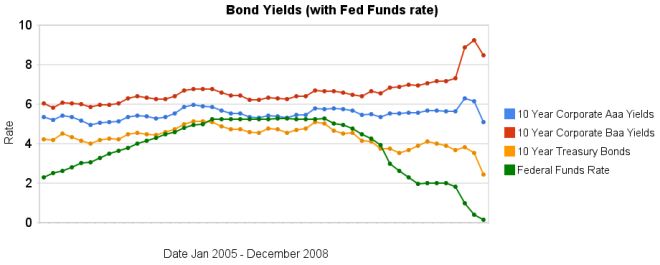
  • Chart Shows Wild Swings in Bond Yields

    graph of 10 year Aaa, Baa and corporate bond rates from 2008-2008

    The recent reactions to the credit and financial crisis have been dramatic. The federal funds rate has been reduced to almost 0. The increase in the spread between government bonds and corporate bonds has been dramatic also. In the last 3 months the yields on Baa corporate bonds have increased significantly while treasury bond yields have decreased significantly. Aaa bond yields have decreased but not dramatically (57 basis points), well at least not compared to the other swings.

    The spread between 10 year Aaa corporate bond yields and 10 year government bonds increased to 266 basis points. In January, 2008 the spread was 159 points. The larger the spread the more people demand in interest, to compensate for the increased risk. The spread between government bonds and Baa corporate bonds increased to 604 basis points, the spread was 280 basis point in January, and 362 basis points in September.

    When looking for why mortgage rates have fallen so far recently look at the 10 year treasury bond rate (which has fallen 127 basis points in the last 3 months). The rate is far more closely correlated to mortgage rates than the federal funds rate is.

    Data from the federal reserve – corporate Aaacorporate Baaten year treasuryfed funds

    Related: Corporate and Government Bond Rates Graph (Oct 2008)Corporate and Government Bond Yields 2005-2008 (April 2008) – 30 Year Fixed Mortgage Rates versus the Fed Funds Rateposts on interest ratesinvesting and economic charts

  • Looking at the Chicago School of Economics

    Here is an interesting article at Bloomberg looks at the Chicago school of economics: Friedman Would Be Roiled as Chicago Disciples Rue Repudiation by John Lippert

    At the University of Chicago, once ascendant free-market acolytes are finding themselves in an unusual role: They’re battling a wave of government intervention more sweeping than any since the Great Depression as the U.S. struggles with the worst recession in seven decades.

    By the end of November, the government had committed $8.5 trillion, or more than half the value of everything produced in the country in 2007, to save the financial system.

    Robert Lucas, a Chicago economist who won a Nobel in 1995 for a theory that argued against governments trying to fine-tune consumer demand, says deregulation may have gone too far. Depression-era laws that separated commercial and investment banks helped depositors decide if they wanted secure accounts or riskier investments. Today, without these distinctions, people can’t be sure if their investments, or those of their customers, are safe.

    “I’m changing my views on bank regulation every week,” Lucas, 71, says. “It was an area I saw as under control. Now I don’t believe that.” Lucas says he voted for Obama, the only Democrat besides Bill Clinton he’d supported in 44 years. He concluded the candidate was comfortable talking with professional economists.

    “The big event of the last 20 years is the success of free markets in India and China,” says McCloskey via telephone from South Africa, where she’s a visiting professor at the University of the Free State in Bloemfontein. “This is more important than any financial crisis and makes it really hard to argue for a return to central planning.”

    I believe capitalism is the best system for economic development. Unfortunately, as I have written before, too many decision makers don’t have the slightest clue about economics. They accept simplistic views just like scientifically illiterate people accept simplistic claims that have no merit.

    The basics are pretty easy. You want to use the market to guide the economy. You need to regulate in those areas the market alone is know to be weak (negative externalities – including pollution, risks to the public…) anti-market behavior (large players controlling markets for their own benefit, large players paying off politicians for benefits…) and systemic risks (“too big to fail“…). And practical consideration is more important that ideological purity.

    One of the most important consistent failures is the continued favoring of large entities that pay politicians large amounts of money. The continued creation of huge organizations that are anti-competitive by their nature and create systemic economic risk have not economic justification. The role of the government should be to enforce competitive markets not allow huge competitors to buyout other huge competitors so that they can further distort the market.

    Related: Ignorance of CapitalismMisuse of Statistics, Mania in Financial MarketsGreenspan Says He Was Wrong On RegulationLobbyists Keep Tax Off Billion Dollar Private Equities Deals and On For Our GrandchildrenTreasury Now (1987) Favors Creation of Huge Banks