Tag: credit score

  • Improvements to Credit Collection Requirements Have Had a Positive Impact

    Abuse of the credit system by 3rd party collection agencies (and credit reporting agencies) in the USA has been a long term problem.

    An attempt to partially address some of the abuses was a change in the required reporting practices that impacted collections accounts specifically, known as the National Consumer Assistance Plan (NCAP), which rolled into effect during the second half of 2017. The plan has many components, including: (1) a requirement for more frequent, detailed, and accurate reporting of collections accounts, including reflecting when those accounts have been paid; (2) a prohibition against reporting debts that did not arise from an agreement to pay, or from, medical collections less than 180 days old; (3) the removal of collections accounts that did not arise from a contract or agreement to pay; and (4) permission to report any account only when there is sufficient information to link the account with an individual’s credit files (requiring a name, address, and some other personally identifying information such as a Social Security number or date of birth).
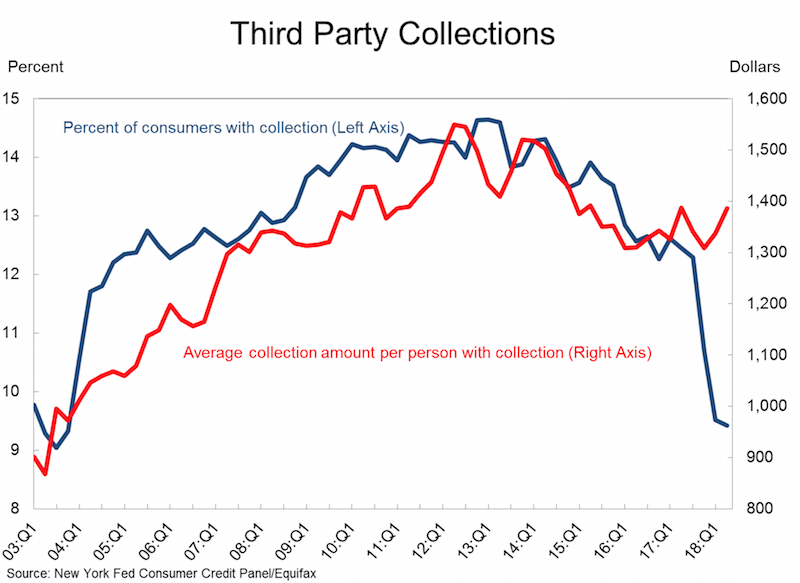
    chart showing the increase in 3rd party collections in the USA over the years and a sharp decrease after the steps to curb abuses

    All in all, the changes in credit reporting prompted by the National Consumer Assistance Plan have resulted in an $11 billion reduction in the collections accounts balances being reported on credit reports. A total of 8 million people had collections accounts completely removed from their credit report. However, collections accounts do indeed align with other negative events and the cleanup of collections accounts had the largest impact on the borrowers with the lowest scores.

    These borrowers will certainly benefit in the long run from the cleanup of their credit reports, since higher scores are associated with better access to credit, to the job market, and even to the rental housing market. But the immediate impact of the removal of collections will be muted for most of those affected (other items are also impacting their current credit score).

    In the longer-term there may be a rebound in collections account reporting because creditors will likely begin collecting the newly required personally identifying information as they adjust to this reporting change.

    This was a small good step in protecting consumers from the bad behavior of credit reporting companies and their customers. But much more must be done to protect us from having our financial lives negatively impacted by bad practices of the credit reporting companies.

    Related: Cleaning Up CollectionsAvoiding the Vicious Cycle of Credit ProblemsTruly Free Credit ReportUSA Household Debt Jumps to Record $13.15 Trillion
  • Protecting Your Privacy and Security

    Provide easy, new access to credit facilitates sales. For that reason businesses want such easy access maintained. They don’t want people unable to buy just because they don’t have the money.

    Financial institutions make a great deal of money providing easy access to credit. They don’t want to slow it down. While they do want to reduce fraud, they are perfectly happy to allow a fair amount of fraud while they can still make a lot of money.

    What this means is the financial system has less incentive to eliminate identity theft than the people that have to clean up after it happens to them. There should be better ways to make identity theft much more difficult.

    At a lessor level it should also be more difficult to steal one credit card (which also creates a big hassle for us, in trying to clean things up after fraud occurs). I suggested a way to make credit cards more secure and useful. When Apple Pay was announced I learned they are doing basically what I suggested.

    Apple Pay doesn’t share information that can be used to steal your credit card. Apple Pay gives the retailer a 1 time use code for that purchase. It can’t be used, even if someone steals it to use your credit card for more purchases. I also believe Apple Pay doesn’t share other details with the retailer, though maybe I am wrong – I think it is just like you giving them cash (they don’t have your name, address, phone number, etc.).

    Much of the information businesses share in the USA is considered private in Europe and companies are not allowed to share that personal information. This makes identity theft and invasions of your privacy more difficult. I wish the USA would move more in that direction.

    If you have details stolen (a wallet…) you can put a note with credit agencies that results in them be less free to make it easy for financial institutions to give credit without sensible protections against misuse. But you can’t do this just as a matter of course. I believe we should have the ability to protect ourselves from the massive headache caused by businesses providing credit in our name. But we don’t have such protection now, because of the big money in keeping credit super easy (and thus fraud fairly easy).

    Having to clean up after identity you may well have to hire someone to help clean up your credit report. To do so, look for credit repair companies with good reviews and a good reputation.

    I would imagine choosing to put in extra protections against identity theft would mean we would have less easy access to credit. For example, I wish I could say you cannot provide a new credit under my name that isn’t using my address on file and without confirmation from my email. Also you are required to send an email, send a text message and send a postal letter, and update my credit agency file (in a way I can view) one week before credit is allowed.

    There should also be options such as you must get a positive reply from me. A citizen choosing to have better protection against identity theft would give up immediate access to credit. But I would happily do so. I believe millions of others would too. And given how many people are victims every years, millions or hundreds of thousand a new customers for such a service would likely result.

  • Truly Free Credit Report

    You should review your credit reports annually (at least) to correct any errors. Also doing so can be a tool to help you spot identity theft.

    The real free credit report site (for those in the USA), annualcreditreport.com, is provided by government regulation (so those that don’t believe in regulation would maybe rather use one of the sites advertising “free” credit reports). But I suggest using the government provided reports and I would suggest spreading the requests out during the year (you get 3 a year, 1 from each of the nationwide consumer credit reporting companies).

    The site also has a large frequently asked question section including:

    How do I request a “fraud alert” be placed on my file?
    You have the right to ask that nationwide consumer credit reporting companies place “fraud alerts” in your file to let potential creditors and others know that you may be a victim of identity theft. A fraud alert can make it more difficult for someone to get credit in your name because it tells creditors to follow certain procedures to protect you. It also may delay your ability to obtain credit. You may place a fraud alert in your file by calling just one of the three nationwide consumer credit reporting companies. As soon as that agency processes your fraud alert, it will notify the other two, which then also must place fraud alerts in your file.

    Where can I find out more about credit reports, my rights as a consumer, the Fair Credit Reporting Act and the FACT Act?
    Please visit www.ftc.gov/credit

    Related: Credit Card TipsPersonal Finance Basics: Avoid DebtSave Some of Each RaisePersonal Finance Basics: Long Term Disability Insurance

  • The Impact of Credit Scores and Jumbo Size on Mortgage Rates

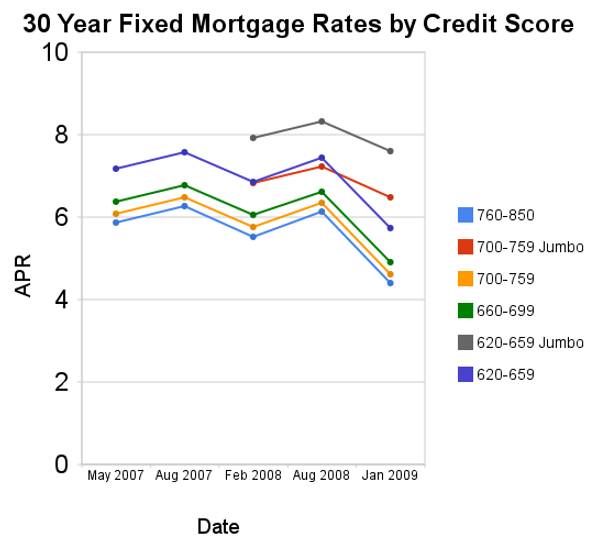
    Since August of 2008 conforming mortgage rates are have declined a huge amount. Jumbo rates have fallen a large amount also, but much less (for example for a credit score of 700-759 the jumbo rates declined 73 basis points while the conventional rate declined 172 basis points.

    chart of 30 year fixed mortgage rates by credit score from May 2007 to Jan 2009

    For scores above 620, the APRs above assume a mortgage with 1 point and 80% Loan-to-Value Ratio. For scores below 620, these APRs assume a mortgage with 0 points and 60 to 80% Loan-to-Value Ratio. You can see, with these conditions the rate difference between a credit score of 660 and 800 is not large (remember this is with 20% down-payment) and has not changed much (the difference between the rates if fairly consistent).

    Related: Low Mortgage Rates Not Available to Everyone30 Year Fixed Rate Mortgage Rate DataReal Free Credit Report (in USA)Jumbo Mortgage Shoppers Get Little Relief From Ratesposts on mortgages
    (more…)

  • Credit Card Companies Willing to Deal Over Debt

    I don’t believe you should carry credit card debt at all. See my tips on using credit cards effectively. And you should have an emergency fund to pay at least 6 months of expenses to tap before using credit card debt. But if you do have debt and you are in such a bad personal financial situation where you will not be able to pay back what you have borrowed this might be useful information: Credit Card Companies Willing to Deal Over Debt

    After helping to foster the explosive growth of consumer debt in recent years, credit card companies are realizing that some hard-pressed Americans will not be able to pay their bills as the economy deteriorates.

    So lenders and their collectors are rushing to round up what money they can before things get worse, even if that means forgiving part of some borrowers’ debts. Increasingly, they are stretching out payments and accepting dimes, if not pennies, on the dollar as payment in full.

    Lenders are not being charitable. They are simply trying to protect themselves. Banks and card companies are bracing for a wave of defaults on credit card debt in early 2009, and they are vying with each other to get paid first.

    Card companies will offer loan modifications only to people who meet certain criteria. Most customers must be delinquent for 90 days or longer. Other considerations include the borrower’s income, existing bank relationships and a credit record that suggests missing a payment is an exception rather than the rule.

    While a deal may help avoid credit card cancellation or bankruptcy, it will also lead to a sharp drop in the borrower’s credit score for as long as seven years, making it far more difficult and expensive to obtain new loans. The average consumer’s score will fall 70 to 130 points, on a scale where the strongest borrowers register 700 or more.

    This is only an option to minimize a big mistake that results in you finding your self in a very bad situation. The credit card companies are not charities or known for giving away money. They are only going to do this when they figure they won’t get the full amount they are owed and figure getting some is the best they can hope for.

    Related: Americans are Drowning in DebtFamilies Shouldn’t Finance Everyday Purchases on CreditDon’t Let the Credit Card Companies Play You for a FoolHidden Credit Card Fees

  • Jumbo v. Regular Fixed Mortgage Rates: by Credit Score

    Example 30 year mortgage rates (from myfico.com – see site for current rate estimates). Previous posts on this topic: Feb 2008August 2007May 2007. Since the last post both jumbo and conforming mortgages rates are up (and are up most for high credit scores).

    FICO score APR Aug 2008 APR Aug 2008 – jumbo APR Feb 2008 APR Feb 2008 – jumbo APR Aug 2007 APR May 2007
    760-850 6.12% 7.00% 5.53% 6.61% 6.27% 5.86%
    700-759 6.34% 7.22% 5.75% 6.83% 6.49% 6.08%
    660-699 6.62% 7.50% 6.04% 7.12% 6.77% 6.37%
    620-659 7.43% 8.31% 6.85% 7.93% 7.58% 7.18%
    580-619 9.45% 9.63% 9.22% 9.40% 9.32% 8.82%
    500-579 10.31% 10.49% 10.20% 10.37% 10.31% 9.68%

    For scores above 620, the APRs above assume a mortgage with 1.0 points and 80% Loan-to-Value Ratio. For scores below 620, these APRs assume a mortgage with 0 points and 60 to 80% Loan-to-Value Ratio.

    Since February the premium for jumbo loans has decreased to 88 basis points (from 108) for all credit scores above 620 (the combination of higher down payment and higher regular interest rates below 620 result in very little premium from Jumbo loans, under 20 basis points.

    Related: 30 Year Fixed Rate Mortgage Rate DataLearning About MortgagesHow Much Worse Can the Mortgage Crisis Get?Real Free Credit Report (in USA)

  • Mortgage Rates Rising

    The next shoe to drop in housing

    The national average rate on a 30-year fixed-rate mortgage was 5.96% Thursday, after jumping to 6.08% earlier this week, according to Bankrate.com. Rates on a 30-year fixed mortgage were about 5.90% a week ago. A borrower looking for a 5-year adjustable-rate mortgage would pay 5.71% today, up from around 5.03% a week ago.

    Fannie and Freddie are demanding higher credit scores and charging higher rates for those who don’t have them. Until recently, a borrower with a 620 score might pay the same as one with a 680 score, said Victoria Bingham, chief executive with Pacific Rim Mortgage in Tigard, Ore.

    But now that person might have to pay a half percentage point more. With today’s rates, that translates into 6.75% for a 30-year fixed-rate mortgage instead of 6.25%, or $74 more a month on a $225,000 loan, typical for her client base.

    Borrowers must also put more money down, especially if they don’t have stellar credit. For instance, those with down payments of less than 5% need a credit score of at least 680, said Steven Plaisance, executive vice president of Arvest Mortgage Co. in Tulsa, Ok. Previously, he could make loans to people without big down payments if they had other strong points, such as stable employment.

    Related: Federal Funds Rate and 30 Year Fixed Mortgage RateMortgage Payments by Credit Score (Aug 2007)learn about mortgage termsBeginning of the End of Housing Bubble?How Not to Convert Equity