Tag: credit

  • Improvements to Credit Collection Requirements Have Had a Positive Impact

    Abuse of the credit system by 3rd party collection agencies (and credit reporting agencies) in the USA has been a long term problem.

    An attempt to partially address some of the abuses was a change in the required reporting practices that impacted collections accounts specifically, known as the National Consumer Assistance Plan (NCAP), which rolled into effect during the second half of 2017. The plan has many components, including: (1) a requirement for more frequent, detailed, and accurate reporting of collections accounts, including reflecting when those accounts have been paid; (2) a prohibition against reporting debts that did not arise from an agreement to pay, or from, medical collections less than 180 days old; (3) the removal of collections accounts that did not arise from a contract or agreement to pay; and (4) permission to report any account only when there is sufficient information to link the account with an individual’s credit files (requiring a name, address, and some other personally identifying information such as a Social Security number or date of birth).
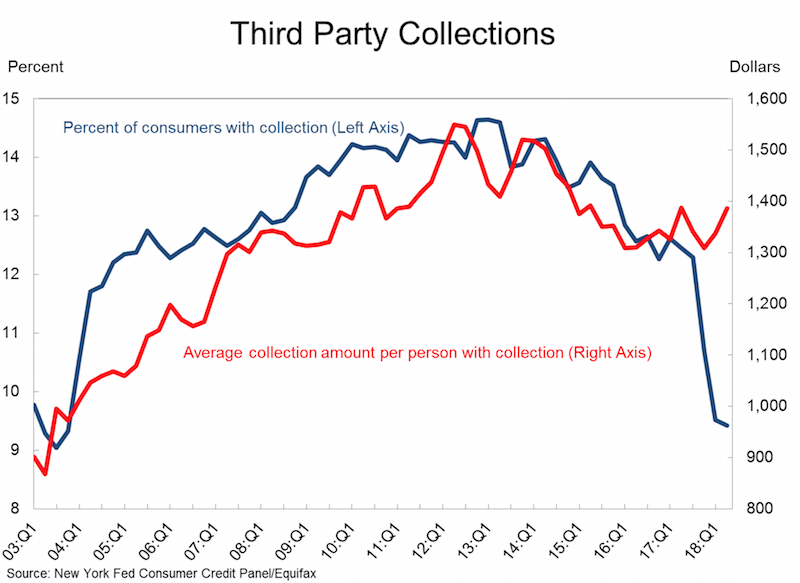
    chart showing the increase in 3rd party collections in the USA over the years and a sharp decrease after the steps to curb abuses

    All in all, the changes in credit reporting prompted by the National Consumer Assistance Plan have resulted in an $11 billion reduction in the collections accounts balances being reported on credit reports. A total of 8 million people had collections accounts completely removed from their credit report. However, collections accounts do indeed align with other negative events and the cleanup of collections accounts had the largest impact on the borrowers with the lowest scores.

    These borrowers will certainly benefit in the long run from the cleanup of their credit reports, since higher scores are associated with better access to credit, to the job market, and even to the rental housing market. But the immediate impact of the removal of collections will be muted for most of those affected (other items are also impacting their current credit score).

    In the longer-term there may be a rebound in collections account reporting because creditors will likely begin collecting the newly required personally identifying information as they adjust to this reporting change.

    This was a small good step in protecting consumers from the bad behavior of credit reporting companies and their customers. But much more must be done to protect us from having our financial lives negatively impacted by bad practices of the credit reporting companies.

    Related: Cleaning Up CollectionsAvoiding the Vicious Cycle of Credit ProblemsTruly Free Credit ReportUSA Household Debt Jumps to Record $13.15 Trillion
  • Delinquencies on Consumer Closed-end Installment Loans Fall to Record Low

    Delinquencies in closed-end loans fell slightly in the second quarter, driven by a drop in home equity loan delinquencies, according to results from the American Bankers Association’s Consumer Credit Delinquency Bulletin.

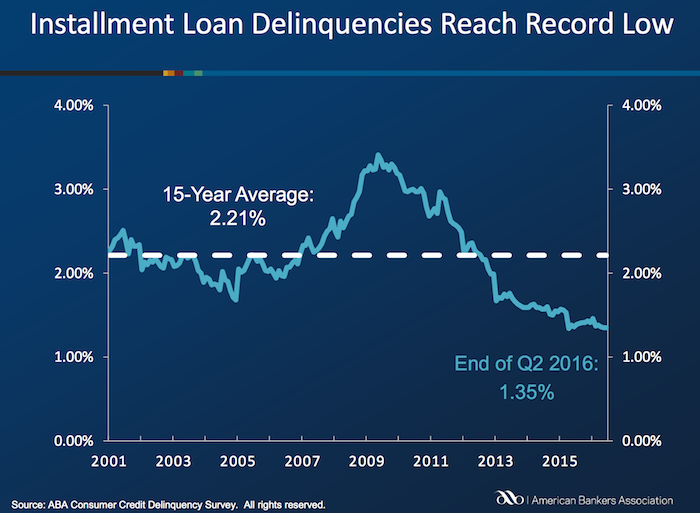
    The composite ratio, which tracks delinquencies in eight closed-end installment loan categories, fell 3 basis points to 1.35% of all accounts – a record low. This also marked the third year that delinquency rates were below the 15-year average of 2.21%. The ABA report defines a delinquency as a late payment that is 30 days or more overdue. This is good news but the personal financial health of consumers in the USA is still in need of significantly improvements to their balance sheets. Debt levels are still too high. Savings levels are still far to low.

    Home equity loan delinquencies fell 4 basis points to 2.70% of all accounts, which helped drive the composite ratio down. Other home related delinquencies increased slightly, with home equity line delinquencies rising 6 basis points to 1.21% of all accounts and property improvement loan delinquencies rising 2 basis points to 0.91% of all accounts. Home equity loan delinquencies dipped further below their 15-year average of 2.85%, while home equity line delinquencies remained just above their 15-year average of 1.15 percent.

    Chart of Installment loan delinquency rate in USA: 2000 to 2016

    Bank card delinquencies edged up 1 basis point to 2.48% of all accounts in the second quarter. They remain significantly below their 15-year average of 3.70 percent.

    The second quarter 2016 composite ratio is made up of the following eight closed-end loans. All figures are seasonally adjusted based upon the number of accounts.

    Closed-end loans
    Home equity loan delinquencies fell from 2.74% to 2.70%.
    Mobile home delinquencies fell from 3.41% to 3.17%.
    Personal loan delinquencies fell from 1.44% to 1.43%.
    Direct auto loan delinquencies rose from 0.81% to 0.82%.
    Indirect auto loan delinquencies rose from 1.45% to 1.56%.
    Marine loan delinquencies rose from 1.03% to 1.23%.
    Property improvement loan delinquencies rose from 0.89% to 0.91%.
    RV loan delinquencies rose from 0.92% to 0.96%.

    Open-end loans
    Bank card delinquencies rose from 2.47% to 2.48%.
    Home equity lines of credit delinquencies rose from 1.15% to 1.21%.
    Non-card revolving loan delinquencies rose from 1.57% to 1.65%.

    Related: Debt Collection Increasing Given Large Personal Debt Levels (2014)Consumer and Real Estate Loan Delinquency Rates from 2001 to 2011 in the USAGood News: Credit Card Delinquencies at 17 Year Low (2011)Real Estate and Consumer Loan Delinquency Rates 1998-2009The USA Economy Needs to Reduce Personal and Government Debt (2009)

    (more…)

  • Using Credit Appropriately is Important for a Successful Financial Life

    Credit is the ability to buy now and pay later. It takes credit to get an auto loan, a mortgage and other types of financing. Your credit score says a lot about your credit habits. This is a three-digit number ranging from 300 to 850, and it tells creditors how likely you are to pay your bills. The higher your credit score, the better your chances of getting approved for financing and the lower your interest rate will be.

    Credit has many benefits. Most people can’t pay cash for homes, college education or new cars. Without loans, buying a house or car would be impossible for many. And since it takes credit to build credit, many people apply for their first credit card in college to establish a credit history. A credit card also provides emergency funds when we’re short on cash.

    Although we use credit regularly as consumers, there are dangers associated with credit. We can avoid some of these problems with responsible use. But unfortunately, credit management education isn’t taught in high school, and many adults don’t learn about credit management until after they’ve made mistakes.

    Potential Dangers of Credit
    Credit puts a lot of things within our financial reach, so it’s easy to get in over our heads. We might not have enough in savings to purchase an electronic device or take a vacation, but with one quick application, we can get approved for financing and take advantage of life’s pleasures. There’s nothing wrong with getting a loan. But some people can’t stop using credit and they get into serious debt.

    Too much debt has a significant negative impact on your personal finances. Paying off that debt will reduce your available disposable income to build an emergency fund (if you haven’t done so already) or save for retirement a house or other large purchases.

    Of course, debt isn’t the only thing to be concerned with. Getting credit also means you’re vulnerable to identity theft. This is one of the fastest growing crimes in the U.S. And while some people think it can’t happen to them, no one is invincible.

    Keeping Your Credit Report Accurate
    Identity theft involves someone stealing your personal information and purchasing items in your name or opening new accounts in your name. It can drive down your credit score and take several months or years to fix. Identity theft often goes unnoticed because some people never monitor their personal credit reports or file credit disputes

    You might wonder, what is a credit dispute? As a consumer, you have the right to check your credit history and receive one free credit report from each of the bureaus annually. You are entitled to ask questions about anything included within your credit reports. 

    (more…)

  • Consumer and Real Estate Loan Delinquency Rates 2000-2010

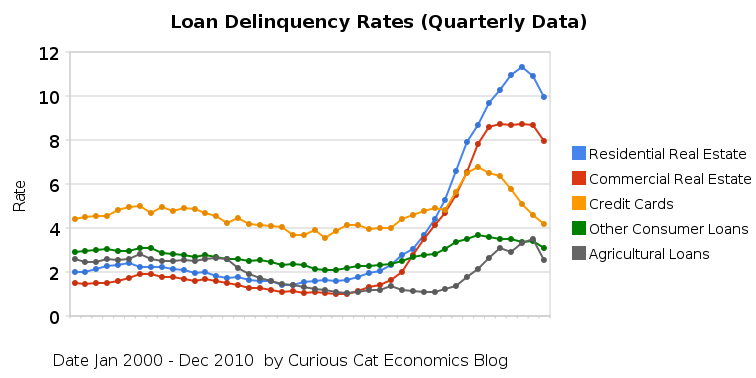
    The chart shows the total percent of delinquent loans by commercial banks in the USA.

    chart showing consumer and real estate loan delinquency rates from 2000 to 2010

    The second half of 2010 saw real estate, agricultural, credit card and other loan delinquencies decrease. The rates are still quite high but at least are moving in the right direction. Residential real estate delinquencies decreased 138 basis points in the second half of 2010, to 9.94%, which brought them to just below the rate at the end of 2009. In the second half of 2010, commercial real estate delinquencies decreased 77 basis points to 7.97% (which was also exactly 77 basis points less than at the end of 2009. Agricultural loan delinquencies decreased 76 basis points, to 2.55% (down 53 basis points from the end of 2009). Consumer loan delinquencies decreased, with credit card delinquencies down 90 basis points to 4.17% and other consumer loan delinquencies down 27 basis points to 3.1%. The credit card delinquency rate decreased a very impressive 219 basis points in 210.

    Related: Real Estate and Consumer Loan Delinquency Rates 2000 through June 2010Real Estate and Consumer Loan Delinquency Rates 1998-2009Bond Rates Remain Low, Little Change in Late 2009posts with charts showing economic data
    (more…)

  • Actually Free Credit Report

    Viewing your credit report is an important step to financial security. You should review your credit reports annually (at least) to correct and any errors. Also doing so can be a tool to help you spot identity theft.

    The real free credit report site, annualcreditreport.com, is provided by government regulation (so those that don’t believe in regulation would rather use one of the sites advertising “free” credit reports). But I suggest using the government provided reports and I would suggest spreading the requests out during the year (you get 3 a year, 1 from each of the nationwide consumer credit reporting companies).

    The site also has a large frequently asked question section including:

    How do I request a “fraud alert” be placed on my file?
    You have the right to ask that nationwide consumer credit reporting companies place “fraud alerts” in your file to let potential creditors and others know that you may be a victim of identity theft. A fraud alert can make it more difficult for someone to get credit in your name because it tells creditors to follow certain procedures to protect you. It also may delay your ability to obtain credit. You may place a fraud alert in your file by calling just one of the three nationwide consumer credit reporting companies. As soon as that agency processes your fraud alert, it will notify the other two, which then also must place fraud alerts in your file.

    Where can I find out more about credit reports, my rights as a consumer, the Fair Credit Reporting Act and the FACT Act?
    Please visit www.ftc.gov/credit

    Related: Credit Card TipsPersonal Finance Basics: Long-term Care InsuranceFinancial Planning Made Easy

  • Credit Card Charge-offs Increase to Over 7% of Accounts

    Punctual Payers Face Higher Rates From Card Companies

    His reward for paying on time was an interest rate increase to 19 percent from 12 percent.

    The average interest rate charged on credit-card balances decreased to 13.4 percent in November from 14.4 percent a year earlier, according to the Federal Reserve’s December G19 report, which tracks rates for credit-card accounts. The prime rate has decreased to 3.25 percent from 6 percent last February. Most variable credit-card rates are linked to the prime rate, which follows the federal funds rate.

    Rate changes announced by New York-based Citigroup Inc., the biggest U.S. credit-card issuer, American Express Co. and Charlotte, North Carolina-based Bank of America Corp. are intended to raise revenue, said Woolsey, who is based in Austin, Texas.

    Citigroup’s charge-off rates of loans increased by 88 percent, climbing to 7.81 percent in December from 4.16 percent a year earlier, according to data compiled by Bloomberg. Charge- offs are loans the banks don’t expect to be repaid. American Express’s charge-off rates more than doubled to 7.23 percent from 3.32 percent while Bank of America’s rates increased to 8.45 percent from 5.24 percent, a 61 percent jump.

    You can avoid worries about credit card companies increase your interest rates by taking sensible financial precautions and avoiding credit card debt.

    Related: posts on credit cardsDon’t Let the Credit Card Companies Play You for a FoolLegislation to Address the Worst Credit Card Fee AbuseIncredibly Bad Customer Service from Discover Card

  • Credit Card Companies Willing to Deal Over Debt

    I don’t believe you should carry credit card debt at all. See my tips on using credit cards effectively. And you should have an emergency fund to pay at least 6 months of expenses to tap before using credit card debt. But if you do have debt and you are in such a bad personal financial situation where you will not be able to pay back what you have borrowed this might be useful information: Credit Card Companies Willing to Deal Over Debt

    After helping to foster the explosive growth of consumer debt in recent years, credit card companies are realizing that some hard-pressed Americans will not be able to pay their bills as the economy deteriorates.

    So lenders and their collectors are rushing to round up what money they can before things get worse, even if that means forgiving part of some borrowers’ debts. Increasingly, they are stretching out payments and accepting dimes, if not pennies, on the dollar as payment in full.

    Lenders are not being charitable. They are simply trying to protect themselves. Banks and card companies are bracing for a wave of defaults on credit card debt in early 2009, and they are vying with each other to get paid first.

    Card companies will offer loan modifications only to people who meet certain criteria. Most customers must be delinquent for 90 days or longer. Other considerations include the borrower’s income, existing bank relationships and a credit record that suggests missing a payment is an exception rather than the rule.

    While a deal may help avoid credit card cancellation or bankruptcy, it will also lead to a sharp drop in the borrower’s credit score for as long as seven years, making it far more difficult and expensive to obtain new loans. The average consumer’s score will fall 70 to 130 points, on a scale where the strongest borrowers register 700 or more.

    This is only an option to minimize a big mistake that results in you finding your self in a very bad situation. The credit card companies are not charities or known for giving away money. They are only going to do this when they figure they won’t get the full amount they are owed and figure getting some is the best they can hope for.

    Related: Americans are Drowning in DebtFamilies Shouldn’t Finance Everyday Purchases on CreditDon’t Let the Credit Card Companies Play You for a FoolHidden Credit Card Fees

  • Soros on Financial Crisis and Markets

    The New Paradigm for Financial Markets is George Soros‘ newest book. Here is an interview with him in May of this year, on PBS, Financial World Shifts Gears Amid Economic Tumult, about the ideas in the book and the current crisis.

    JUDY WOODRUFF: How do you assess the strength of the financial system today?
    GEORGE SOROS: I think this is the most serious crisis of our lifetime. It’s not just a housing crisis, but a crisis of the financial system.

    GEORGE SOROS: The regulators have failed to regulate, and they really have to — they left it to the market. That was this market fundamentalist philosophy, that markets will take care of themselves.

    And I contend that there’s been what I call a super bubble that has been growing over the last 25 years at least, which basically consisted of an extension in credit, increasing use of leverage. That was the trend in reality.

    And the misconception that credit is that markets can be left to their own devices. Now, in fact, they are given to excesses, and occasionally they create crises, but each time the authorities intervene and bail out the failing institutions, provide fiscal stimulus, monetary stimulus.

    So it seems like the market corrects itself, but it’s actually the intervention of the authorities that saves the market.

    Related: Soros on the Financial Market CollapseJim Rogers on the Financial Market MessLeverage, Complex Deals and Mania

  • Credit Unions Slowly Fill Payday Lenders Void

    As I have mentioned previously credit unions do a much better job than any other financial category of providing customer value. Instead of trying to trick you and rip you off, credit unions often just provide services at a reasonable cost. What a sensible idea. Credit Unions Slowly Fill Void As Payday Lenders Leave D.C.

    In January, legislation went into effect capping interest rates in the District at 24 percent, effectively driving out the area’s payday lenders, whose business model is wedded to annualized rates of 300 percent and above. Credit unions are now slowly filling the void in small-dollar loans. At least half a dozen District institutions are attempting to reinvent the loans as a tool to help bring hard-pressed borrowers closer to financial health.

    The credit unions’ products vary, but generally they are loans of $300 to $1,000 with an annual percentage rate of up to 18 percent. Unlike payday loans, in which borrowers sign over part of their next paycheck for the cash advance, the credit unions’ new products have longer terms, from thirty days to a year.

    It is still an indication of bad personal finances to take the short term loan, but if that is the choice you make, paying a reasonable rate will greatly reduce the damage to your personal financial health.

    Related: personal loansOhio Acts to Protect Citizens from Payday Loan PracticesDragged Down by DebtDon’t Let the Credit Card Companies Play You for a FoolSneaky Fees

  • Student Credit Cards

    I posted before on how universities seek profits instead of helping students develop good financial literacy and habits. Here are some tips on how you should use your credit card. College Credit-Card Hustle

    Universities and their alumni associations have discovered an unlikely and disturbing source of revenue: Increasingly, they are selling students’ personal information to big credit-card companies eager for young customers.

    Using state public disclosure laws, Business Week has obtained more than two dozen confidential contracts between major schools and card-issuing banks keen to sign up undergraduates with mounting expenses for tuition, books, and travel. In some instances, universities and alumni groups receive larger payments from the banks if students use their school-branded cards more frequently.

    The growing financial alliance between schools and banks raises questions about whether universities are encouraging students to incur additional high-interest debt at a time when many young people graduate from college owing tens of thousands of dollars.

    Universities rarely negotiate favorable terms for their students, according to people familiar with the practice. On the contrary, some schools and booster groups entice undergraduates to sign up for cards with low initial interest rates that are soon replaced by steep double-digit rates.

    Schools (and if some try to play legal games about alumni associations being separate, I don’t accept that) should fully disclose exactly what they are doing. I know they can make all sorts of excuses about why being open and honest is not right for them. Well, I think it is easy to predict they will be selling out their students and hiding that fact (if they must be open about what they are doing they will avoid some of the most egregious behavior because they know there will be consequences if they obviously sell out students). And, now Business Week has evidence that many are.

    If a school is not open and honest about the deals they are making just assume they are selling out the students for their own gain. I can’t really see why we would want to support such behavior and I would encourage us not to.
    (more…)