Tag: economy

  • USA Apartment Market in 2011

    The national occupancy climbed 110 basis points during the year, and effective rents jumped 4.7% according MPF Research.

    Occupancy rates increased to 94.6% at the end of 2011, up from 93.5% a year ago and from 91.8% when the occupancy rates bottomed in late 2009.

    MPF Research predicts occupancy rates to increase another 50 basis points, and rents to rise 4.5%.

    Northern California’s apartment markets ranked as the nation’s rent growth leaders during calendar 2011, despite the fact that some weakness registered in the performances recorded in parts of the Pacific Northwest specifically during the fourth quarter. Year-over-year, effective rents for new leases jumped 14.6% in San Francisco, 12.3% in San Jose, and 9% in Oakland. With rents down 0.4%, Las Vegas was the nation’s only major apartment market that lost pricing power during calendar 2011.

    Rent Growth Leaders in Calendar 2011

    Rank Metro Area Annual Rent Growth
    1 San Francisco 14.6%
    2 San Jose 12.3%
    3 Oakland 9.0%
    4 Boston 8.3%
    5 New York 7.3%
    6 Austin 7.2%

    Related: Apartment Vacancies Fall to Lowest in 3 Years in the USA (April 2011)Top USA Markets for Buying Rental PropertyApartment Rents Rise, Slightly, for First Time in 5 QuartersIt’s Now a Renter’s Market

  • 243,000 Jobs Added in January Bring the USA Unemployment Rate Down to 8.3%

    Total nonfarm payroll employment rose by 243,000 in January, and the unemployment rate decreased to 8.3%, the United States Bureau of Labor Statistics reported today. Job growth was widespread in the private sector (which gained 257,000 jobs in the month), with large employment gains in professional and business services, leisure and hospitality, and manufacturing (which added an impressive 50,000 jobs). The change in total nonfarm payroll employment for November was revised from +100,000 to +157,000, and the change for December was revised from +200,000 to +203,000 which brings the total number of jobs gained with this report to 303,000, a very impressive figure.

    This employment news is really starting to add up to something good. And this is going on while everyone is worrying about the Euro imploding. Quite remarkable really. Avoiding a much worse result from the too big-to-fail-financial-firms credit crisis is surprising. We are not close to through the mess that we created, but that it hasn’t been much worse is fairly amazing. And that things are going so well now (even with large unemployment problems) is impressive. The huge government debt balances are a very large concern but it wouldn’t be surprising to have those same huge debts and much worse present day conditions (which would add to the debts).

    The unemployment rate declined to 8.3%; the rate has fallen by 80 basis point since August. The number of unemployed persons declined to 12.8 million in January. Among the major worker groups, the unemployment rates for adult men (7.7%) and blacks (13.6%) declined in January. The unemployment rates for adult women (7.7%), teenagers (23.2%), whites (7.4%), and Hispanics (10.5%) were little changed. The jobless rate for Asians was 6.7%.

    The number of long-term unemployed (those jobless for 27 weeks or more) was little changed at 5.5 million and accounted for 42.9% of the unemployed. Long term unemployment remains a big problem. With a few more months with such strong growth in jobs and that could start to change.

    After accounting for the annual adjustments to the population controls, the employment-population ratio (58.5%) rose in January, while the civilian labor force participation rate held at 63.7%.

    Professional and business services continued to add jobs in January (+70,000). About half of the increase occurred in employment services (+33,000). Job gains also occurred in accounting and bookkeeping (+13,000) and in architectural and engineering services (+7,000).

    Related: USA Adds 216,00 Jobs in March and the Unemployment Rate Stands at 8.8% (March 2011)USA Unemployment Rate Remains at 9.7% (Feb 2010)USA Unemployment Rate Rises to 8.1%, Highest Level Since 1983 (March 2009)

    (more…)

  • USA Spends $7,960 Compared to Around $3,800 for Other Rich Countries on Health Care with No Better Health Results

    The latest data from the commonwealth fund report confirms the status quo. The USA spends twice as much on their health care system for no better results. It is easier to argue the USA is below average in performance that leading. And for double the cost that is inexcusable.

    Globally the rich countries citizens are not tremendously happy with health care systems overall. It seems likely not only does the USA cost twice and much as it should and perform poorly compared to countries doing an excellent job but the USA performs that poorly compared to countries that themselves have quite a bit of improvement to make. Which makes the state of the USA system even worse.

    Data from the Commonwealth fund report published in 2011 with data for 2009, International Profiles of Health Care Systems, 2011:

    Table showing, percent of GDP spent and total spending per capita in USD on health care by country.

    Country 2007 Spending
       
    2009 Spending
    Australia 9.5% $3,128 8.7% $3,445
    Canada 9.8% $3,326 11.4% $4,363
    Germany 10.7% $3,287 11.6% $4,218
    Japan 8.5% $2,878
    New Zealand 9.0% $2,343 10.3% $2,983
    UK 8.3% $2,724 9.8% $3,487
    USA 16.0% $6,697 17.4% $7,960
    Survey of population, showing % that chose each statement (no data available for Japan)
    Australia Canada Germany New Zealand UK USA
    2007 – 2010 2007 – 2010 2007 – 2010 2007 – 2010 2007 – 2010 2007 – 2010
    Overall health system views
        Only minor changes needed, system works well 24 – 24 26 – 38 20 – 38 26 – 37 26 – 62 16 – 29
        Fundamental changes needed 55 – 55 60 – 51 51 – 48 56 – 51 57 – 34 48 – 41
        Rebuild completely 18 – 20 12 – 10 28 – 14 17 – 11 15 – 3 34 – 27
    Percent uninsured 0 – 0 0 – 0 <1 – 0 0 – 0 0 – 0 16 – 16

    Under currently law in the USA by 2020 the uninsured rate should decline to under 5% by 2020 (still far more than any rich country – nearly all of which are at 0%).

    On many performance measures in the report the USA is the worst performing system (in addition to costing twice as much). Such as Avoidable Deaths, 2006–07, the USA had 96 per 100,000, the next highest was the UK at 83, Australia was the lowest at 57. And Diabetes Lower Extremity Amputation Rates per 100,000 population, the USA had 36 the next highest was New Zealand at 12, the lowest was the UK at 9. For experiencing a medical, medication or lab test rrror in past 2 years, the USA was at 18%, next worst was Canada at 17%, best was UK at 8%. The USA was top performer in breast cancer five-year survival rate, 2002–2007. And sometimes the USA was in the middle, able to get same/next day appointment when sick: the USA was at 57%, New Zealand achieved 78% while Canada only reached 45%.

    It is possible to argue the USA provides mediocre results, which is consistent with most global health care performance measures. Unless you directly benefit from the current USA system it is hard to see how you can argue it is not the worst system of any rich country. Costing twice as much and achieving middling performance. All that doesn’t even factor in the cost in anguish and bankruptcies and restricting individual freedom (when you have to stay tied to a job you would rather leave, just because of health insurance) caused by the difficulty getting coverage and fighting with the insurance companies for payment and coverage for treatment expenses.

    Related: Measuring the Health of NationsUSA Paying More for Health CareTraveling for Health Careresources for improvement health system performance

  • Health Care in the USA Cost 17.9% of GDP, $2.6 Trillion, $8,402 per person in 2010

    Total health expenditures in the USA in 2010 reached $2.6 trillion, $8,402 per person or 17.9% percent of GDP. All these are all time highs. Every year, for decades, health care costs have taken a larger and larger portion of the economic value created in the USA. The costs have risen much more rapidly than the costs in the rest of world. This creates a burden that slows the USA economy – it acts as a friction dragging everything else down. We not only need to slow down how fast we are getting worse (which we have done the last 2 years) but actually start making up for all the ground lost in the last few decades. We haven’t even started on that. The amount of work to do in getting our health system back to mediocre and reasonably priced is enormous (currently we have mediocre performance and extremely highly priced – twice as costly as other rich countries).

    In 2009 the USA Spent Record $2.5 Trillion, $8,086 per person 17.6% of GDP on Medical Care.

    USA health care spending grew 3.9% in 2010 following an increase of 3.8% in 2009. While those are the two slowest rates of growth in the 51 year history of the National Health Expenditure Accounts, they still outpaced both inflation and GDP growth. So yet again the health system expenses are taking a bigger portion of overall spending.

    As a result of failing to address this issue for decades the problem is huge and will likely take decades to bring back just to a level where the burden on those in the USA, due to their broken health care system, is equal to the burden of other rich countries. Over 2 decades ago the failure in the health care system reached epidemic proportions but little has been done to deal with the systemic failures. Dr. Deming pointed to excessive health care cost, back then, as one of 7 deadly diseases facing American business. The fact that every year costs have increased more than GDP growth and outcome measures are no better than other rich countries shows the performance has been very poor. The disease is doing even more harm today.

    Related: USA Heath Care System Needs ReformUSA Spends Record $2.3 trillion ($7,681 Per Person) on Health Care in 2008Systemic Health Care Failure: Small Business CoverageMeasuring the Health of NationsHow to improve the health care system performanceManagement Improvement in HealthcareUSA Spent $2.2 Trillion, 16.2% of GDP, on Health Care in 2007

    (more…)

  • Looking at GDP Growth Per Capita for Selected Countries from 1970 to 2010

    I decided to take a look at some historical economic data to see if some of my beliefs were accurate (largely about how well Singapore has done) and learn a bit more while I was at it.

    GDP in USD for countries

    country
       
    1970**
       
    2010***
       
    % increase
    Korea 1,320 20,200 1,430
    China 325 4,280 1,217
    Singapore 4260 42,650 901
    Indonesia 460 2,960 543
    Brazil 1900 10,500 453
    Thailand 850 4,600 441
    Portugal 3,970 21,000 429
    Japan 9,000 42,300 370
    Malaysia 1,900 7,755 308
    Germany 11,550 40,500 251
    UK 10,400 36,300 249
    France 13,600 40,600 199
    Mexico 4,160 9,200 121
    Panama 3,480 7,700 121
    India 555 1,180 113
    USA 23,350 47,100 102
    South Africa 3,930 7,100 81
    Venezuela 8,280 9,770 18

    I just picked countries that interested me and seemed worth looking at. I looked for some around the starting position of Singapore and close to Singapore geographically. And looked at Panama as the closest match to Singapore (for Singapore’s main 1970 asset, convenient for shipping lanes, and very close for GDP per capita).

    Malaysia and Singapore were 1 country after independence (from 1963-1965).

    I can’t imagine more than a couple countries could reasonably be argued to have had better economic performance from 1970 to 2010 than Singapore (Korea? China? Who else?). Singapore had very little going for it in 1970. They had a good location for shipping and that is about it macro-economically. No natural resources. No huge storage of wealth. No preeminence in science, technology or business.

    It seems to me that Singapore actually did have 1 other thing. A government that was to preside over a fantastic economic growth success. You won’t find many textbooks talking about the way to economic success is a very well run government. And there is good reason for that, I believe. Relying on a very well run government will nearly always fail. In some ways Singapore was like Japan but with significantly more government influence on the way economic development played out.

    I was surprised how poorly the USA has faired. It isn’t so surprising that we lagged. People forget how rich the USA was in 1970. The USA is still very rich but bunched together with lots of other rich countries instead of way out ahead as they were in 1970. And in 1970 the lead was already contracting, for what it had been earlier. But even knowing the relative performance of the USA had lagged, I was surprised by how much it under-performed.

    I was also surprised with India. I knew they have done poorly but I didn’t realize it had been this poor. The failures to greatly improve infrastructure, education and the stifling effect of their bureaucracy have been causing them great harm. They have been doing some good things in the last 10 years especially but still have a long way to go. Their premier education is actually pretty decent. The problem is the other 90% of the education is often poor and many people (especially women) hardly have any education at all. It is very hard to get ahead when you fail to take advantage of the talents of so many of your people.

    Related: Singapore and Iskandar MalaysiaChart of Largest Petroleum Consuming Countries from 1980 to 2010Chart of Nuclear Power Production by Country from 1985-2009Top Countries For Renewable Energy Capacity

    (more…)

  • Curious Cat Investing, Economics and Personal Finance Carnival #23

    Welcome to the Curious Cat Investing, Economics and Personal Finance Carnival: find useful recent personal finance, investing and economics blog posts and articles. The carnival is published twice each month. This carnival is different than others in two significant ways. First, I select posts from the blogs I read (instead of just posting those that submit to the carnival). I think this provides readers a better selection of valuable material (many of the best blogs don’t take time to submit to carnivals). And second, I include articles when I think they are interesting. I figure the primary purpose is to provide links to good recent content, so just because something isn’t a blog post doesn’t exclude it from inclusion.

    • Recovering Adam Smith’s ethical economics – “He justified commercial society for its tremendous contribution to the prosperity, justice, and freedom of its members, and most particularly for the poor and powerless in society.” [This post covers a topic I think is very important and have written about several times – John]
    • A Man. A Van. A Surprising Business Plan. by Zoe Chace – “Adam had tricked out the van to be a mobile solution to Chinese bureaucracy. There are a couple of Mac laptops and a printer, plus an old couch, Christmas lights and bamboo mats. It’s as cozy as a dorm room. And confused visa applicants line up outside.” [wonderful – John]
    • Chart of Manufacturing Output from 2000 to 2010 by Country by John Hunter – “Europe has 4 countries in this list (if you exclude Russia) and they do not appear likely to do particularly well in the next decade, in my opinion. I would certainly expect Brazil, India, Korea and Indonesia to out produce Italy, France, UK and Spain in 2020. In 2010 the total was $976 billion by the European 4 to $961 billion by the non-European 4. In 2000 it was $718 billion for the European 4 to $343 billion (remember all the data is in 2010 USD).”
    • Ultimate Sustainable Dividend Portfolio – “I would expect the Ultimate Sustainable to do better in difficult times and worse in great times. Why? The USDP is a more stable portfolio that will fluctuate less over time…”
    • (more…)

  • USA Adds 200,000 Jobs in December, Unemployment Rate Falls to 8.5%

    Nonfarm payroll employment rose by 200,000 in December, and the unemployment rate declined to 8.5% (the lowest rate in 3 years), continuing a downward trend. The change in total nonfarm payroll employment for October was revised from +100,000 to +112,000, and the change for November was revised from +120,000 to +100,000 (which results in total increase of 192,000 with this report: 200,000 – 8,000 lost in revisions).

    The number of long-term unemployed (those jobless for 27 weeks or more) continues to be a big problem and was little changed at 5.6 million, accounted for 42.5% of the unemployed (quite a high percentage). While adding 192,000 is better than losing jobs or adding fewer, it is still not enough to make up for the credit crisis job losses. The economy needs to add 125,000 a month to keep up with population growth. Sustained gains over 230,000 month after month are needed to be what I would see as good, and really above 270,000 would be much better – but given the Eurozone problems, staying about 200,000 may really be good news.

    The civilian labor force participation rate (64.0%) and the employment-population ratio (58.5%) were both unchanged over the month.

    Over the past 12 months, nonfarm payroll employment has risen by 1.6 million. Employment in the private sector rose by 212,000 in December and by 1.9 million over the year. Government employment changed little over the month but fell by 280,000 over the year.

    Employment in transportation and warehousing rose sharply in December (+50,000). Almost all of the gain occurred in the couriers and messengers industry (+42,000); seasonal hiring was particularly strong in December.

    Retail trade continued to add jobs in December, with a gain of 28,000. Employment in the industry has increased by 240,000 over the past 12 months.

    In December, manufacturing employment expanded by 23,000, following 4 months of little change. Employment increased in December in transportation equipment (+9,000), fabricated metals (+6,000), and machinery (+5,000).

    Related: USA Unemployment Rate Rises to 9.8% (Nov 2010)USA Unemployment Rate Remains at 9.7% (March 2010)Over 500,000 Jobs Disappeared in November 2008

    (more…)

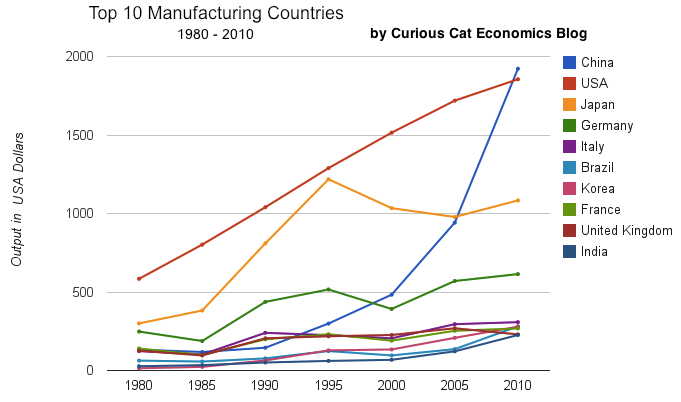
  • Top 10 Countries for Manufacturing Production in 2010: China, USA, Japan, Germany…

    chart of output by top 10 manufacturing countries from 1980 to 2010

    Chart of output by top 10 manufacturing countries from 1980 to 2010. The chart was created by the Curious Cat Economics Blog based on UN data. You may use the chart with attribution.


    China has finally actually taken the lead as the largest manufacturer in the world. Reading many news sources and blogs you may have thought the USA lost the lead a couple of decades ago, but you would be wrong. In 1995 it looked like Japan was poised to take the lead in manufacturing production, but they have slumped since then (still they are solidly the 3rd biggest manufacturer). China has been growing manufacturing output enormously for 20 years, and they have now taken the lead from the USA.

    As I have been saying for years the biggest economic story about manufacturing is the dramatic and long term increase of productive capacity in China. The next is the continuing global decline in manufacturing employment: increased productivity has seen production rise year after year and employment fall. What is the next most interesting stories is debatable: I would say the continuing failure to appreciate the continuing strong manufacturing production increases by the USA. Another candidate is the the decline in Japan. Another is the increase in several other counties: Korea, Brazil, India, Indonesia…

    Looking more closely at some of the long term data shows how much China stands out. From 1980 to 2010 China increased output 1345%. The total top 10 group increased output 302% (all data is in current USD so inflation accounts for most of the gain, 100 1980-USD equal 280 2010-USD). From 1995 to 2010 China increased output 543%. The group increased 64%. For 1980-2010, the results for the other 3 largest manufacturing countries are: USA up 218%, Japan up 261% and Germany up 148% (other countries doing very well are Korea up 1893% and India up 737%). Looking at the last half of that period, from 1995-2010 the: USA up 44%, Japan down 11% and Germany up 19%.

    One thing to remember about adjusting manufacturing data for inflation is that often the products created in later years are superior and cost less. So that a computer manufactured in 1990 which added $5,000 to the manufacturing total is far inferior to one in 2010 that added just $1,000. This point is mainly to say that while the increase in manufacturing in real (not inflated dollars) is not as high as it might seem the real value of manufacturing good did likely increase a great deal. But the economic data is based on price so manufacturing increases are reduced by cost decreases. Computers are the most obvious example, but it is also true with many other manufactured goods.

    You can that the other largest manufacturing countries fail to keep up with the increases of the entire group of the top 10. China’s gains are just too large for others to match. If you remove China’s results (just to compare how the non-China countries are doing) from 1980-2010 the increase was 216% (so compared to the other 9 top manufacturers over this period the USA was even and Japan better than the average and Germany was worse). And from 1995-2010 the top 9 group (top 10, less China) increased just 28%: so the USA beat while Japan and Germany did worse than the other 9 as a group.

    (more…)

  • Relocating to Another Country

    There is an increasing trend to move from the USA to another country to work and live. This is not surprising to me. Recently this has picked up quite a bit; I am surprised by the velocity at which this interest in moving (I figured it would be a long term mega trend but not so drastic, so quickly). Economic changes are often quite surprising in how rapidly they move forward.

    An interesting survey shows USA investors have become much more interested in relocating in the last two years (the data they show though has tremendous volatility over time, so I am not really sure this means much). I wonder how much of it can be explained by investors wanting to get a deep understanding of very promising markets. I wouldn’t image the actual number that do this is huge, but maybe the number considering it is significant. Billionaire investor, Jim Rodgers moved to Asia because he sees Asia as key to the future. One of the reasons I moved to Malaysia this year was to get a in depth understanding of what South East Asia is like (it is not a deciding reason, at all but maybe the 4th or 5th reason).

    I believe the globalization of the employment market is a long term trend that will continue – especially for “knowledge workers.” The USA rested on the post WW II economic domination for nearly 50 years. The policies also helped this continue: investing in science and engineering, favoring entrepreneurship… But other countries have realized the value of these things (and the USA is slipping – not investing nearly as much in science and engineering and favoring large corporations that give politicians large amounts of cash over innovation – see things like the incredibly outdated “intellectual property” system, SOPA, favoring huge financial institutions…

    The combination of long term policy weakness, the inevitable decline in the USA to world ratio of economic wealth, and the financial crisis caused by the policy weaknesses have seemingly greatly accelerated the trend. The next 2 or 3 years will determine if that is a permanent acceleration or if we go back to a slower pace – but on the same path. My guess is that we will stay on this path but the pace will not follow the level surveys might indicate (showing interest in such a big change is far different from actually moving).

    There don’t seem to be any decent estimates of Americans living abroad. The US State Department claims releasing their estimates would be a national security risk? And the Census bureau says it would cost too much to try. Wild guesses seem to be between 4 and 6 million.

    Related: I want out (subreddit)Why Investing is Safer OverseasUSA Heath Care System Needs ReformCopywrong

  • USA Unemployment Rate Drops to 8.6%

    The unemployment rate fell from 9.0% to 8.6% in November, however that is not an accurate representation of employment in the USA. The news is good, but very mildly good, while a decrease in the unemployment rate by 40 basis points would lead you to believe the improvement was dramatic. Nonfarm payroll employment rose by 120,000 which is about the number needed to keep up with population growth each month. Employment continued to trend up in retail trade, leisure and hospitality, professional and business services, and health care. Government employment continued to trend down.

    The change in total nonfarm payroll employment for September was revised from +158,000 to +210,000, and the change for October was revised from +80,000 to +100,000. This means this report shows an increase of 192,000 jobs which is pretty good news (especially for those that think the economy has been in a recession – it has not).

    One year ago the unemployment rate stood at 9.6%.

    The number of unemployed persons, at 13.3 million, was down by 594,000 in November. The labor force, which is the sum of the unemployed and employed, was down by a little more than half that amount. What this means is the reduction in the unemployment rate was largely due to the decrease in those actively looking for jobs.

    Among the major worker groups, the unemployment rate for adult men fell to 8.3% in November. The jobless rate rates for adult women (7.8%), teenagers (23.7%), African-Americans (15.5%), and Hispanics (11.4%) showed little or no change. The jobless rate for Asians was 6.5%.

    The number of long-term unemployed (those jobless for 27 weeks and over) was little changed at 5.7 million and accounted for 43.0% of the unemployed. This is one of the numbers that has to come down drastically for the job situation to really show good improvement.

    Related: Jobs News in the USA is not Good, Unemployment Remains at 9.1% (Aug 2011)USA Economy Adds 151,000 Jobs in October, Unemployment Rate Steady at 9.6% (Oct 2010)Unemployment Rate Reached 10.2% (Oct 2009)Over 500,000 Jobs Disappeared in November (2008)

    (more…)