Tag: educataion

  • The Time to Payback the Investment in a College Education in the USA Today is Nearly as Low as Ever – Surprisingly

    While people question the value of a college degree a recent study by the New York Federal Reserve shows a degree is close to as valuable today as it has ever been. The costs to get that value have risen but even with the increased cost students earn on average a 15% annual rate of return on their investment.

    Of course, not every student will earn that, some will earn more and some less.

    The Value of a College Degree

    We estimate that the value of a college degree fell from about $120,000 in the early 1970s to about $80,000 in the early 1980s, before more than tripling to nearly $300,000 by the late 1990s, where it has remained, more or less, ever since. Despite drifting down somewhat in the aftermath of the Great Recession, the value of a bachelor’s degree has remained near its all-time high.

    The time required to recoup the costs of a bachelor’s degree has fallen substantially over time, from more than twenty years in the late 1970s and early 1980s to about ten years in 2013. So despite the challenges facing today’s college graduates, the value of a college degree has remained near its all-time high, while the time required to recoup the costs of the degree has remained near its all-time low.

    graph showing averthe years to recoup the cost of college decline from 30 to 10 from 1970 to 2010

    So a college education is a great investment for most people. This can create a problem however, when people then assume that all they need to do is go to college and they will do well no matter what. The same thing happens in other markets. Real estate has proven to be a great investment. that doesn’t mean every real estate investment is good. It doesn’t mean you can ignore the costs and risks of a particular investment. The same goes for stocks.

    (more…)

  • Global Workplace

    The world has become very interconnected. This is no surprise, the evidence is all around us and continues to increase. What this actually means though is more complex than it appears.

    One area this impacts greatly is the workplace. More and more people are working internationally. This continues to largely be either through large multinationals or cheap labor that is imported to do largely unskilled or minimally skilled labor.

    There is also a continuing increase in skilled and educated labor working overseas for other than huge multi-nationals. The infrastructure to support this is often not in place. The current structure (visas etc.) support the two modes mentioned above.

    But I see an increasing number of opportunities for countries that encourage entrepreneurship and high skill jobs. I relocated to Malaysia and in doing so did a bit of research. It is difficult to get a long term visa in most countries without a full time job (and given the complexity of hiring foreign workers this often means dealing with companies that do a lot of it – in the 2 categories mentioned above).

    Career prospects are enhanced with international experience. One way to get a jump start on your career is international education. This has been popular for a long time but is becoming more and more popular. Students studying in London can get the benefits of international experience (unless they are from England, obviously) and enjoy the great city of London and accessible travel to Europe.

    The importance is to truly gain an international perspective. Those in the USA have the greatest problem as knowledge workers in most other countries are much more aware of the global economy. Europe is an easy way to get started and is packed with lot of great schools and processes in place to make it easy to become a student.

    As I mentioned in a previous post, I believe the most important factor for a career is finding something you love to do, but within those possibilities it is nice to know the payoff of different college degrees.

    Those that see Asia as the economic engine for the next 50 years might well be tempted to look at attending school there. There are plenty of options though it may take a bit more work on your part to make it happen. I think attending at least some portion of college internationally is a great idea as is getting international work experience early in your career.

    Related: How to Balance the Benefits of Foreign Workers and the Potential Damage to Citizen’s Job ProspectsLeading Economic Freedom: Hong Kong, Singapore, New Zealand, Switzerland

  • The Poor Paying for Vocational High School Education

    I find it disheartening that it is necessary to take out a loan to pay for vocational school after graduating from middle school (this is in Indonesia but the same thing happens all over in those countries that are not the most wealthy). Indonesia has been doing extremely well economically (which many people do not realize).

    The economic conditions are not good and they are earning just enough for the basic daily needs. Mukinah feel scared because of the cost of the vocational school for her daughter Kafita. Mukinah does not want her to quit school so she is applying for loans through the Student Loan program from Kiva. In the picture, Mukinah and Kafita, her daughter.

    Kafita already graduated from junior high school and wants to go to vocational school.

    So essentially she is paying for high school. I sure hope it is financially beneficial. This is the kind of investment in the economic development of a country that I wish governments could make. If not, I sure wish the super rich would give money to fund this kind of education instead of giving trust fund babies millions for conspicuous consumption.

    It is disgusting how spoiled brats are such vapid people that they do what they do, while so many hundred of millions of kids lives could be changed with the most wasteful spending these trust fund babies that our politicians keep giving massive tax breaks to. Our politicians should be ashamed of themselves. And so should the spoiled brats.

    (more…)

  • Simple Explanation of the Fractional Reserve Banking System

    The webcast is by the great Kahn Academy which produces simple educational content (like the above) on all sorts of topics. I find this too slow but I think it might be good for people that are not really sure how the banking system works. There is a group of people that are very apposed to fractional reserved banking, as a principle. I actually am fine with it, but it needs to be regulated much better than we have done.

    I suppose it might be true that our political leaders are much too subservient to those giving them lots of cash to regulate in a manner even close to acceptable: and therefore fractional reserve banking is dangerous. I am not sure that they are so hopeless that this is the case, though the more I see of how much they don’t know, and how often they seem to just vote based on what those giving them cash want it gets to be harder to believe they can be trusted to act close to properly (this is extremely sad). And it is mainly an indictment of ourselves: we keep putting people back in power that act mainly to reward those giving them cash and don’t seem interested in actually what is important for the long term interests of the country.

    I believe the FDIC actually does quite a good job of providing a solution to manage some issues with a fractional reserve banking system and people being able to rely on getting their money back.

    Related: Charlie Munger’s Thoughts on the Credit Crisis and RiskLeverage, Complex Deals and ManiaLobbyists Keep Tax Off Billion Dollar Private Equities Deals and On For Our Grandchildren

  • Looking at the Value of Different College Degrees

    Georgetown University Center on Education and the Workforce has produced a new report looking at the value of different college degrees in the USA. I have seen a great increase in discussions of the “bubble” in education. Those articles often say a college degree doesn’t assure the success it used to. The data I review seems to show extremely large benefits for those with a college degree (higher salaries but, much more importantly, in my opinion, they also have much lower unemployment rates).

    Those benefits are greatest for several majors including science, math and engineering. The problem I see is not so much that significant benefits are lacking for college degrees but the huge increases in costs of getting a degree are so large that for some majors the cost is just so large that even with the benefits it is arguable whether it is worth the cost (while a few decades ago the benefits were universal and so large the economic benefit was not debatable).

    The authors of the report found that all undergraduate majors are worthwhile, even taking into account the cost of college and lost earnings. However, the lifetime advantage ranges from $1,090,000 for Engineering majors to $241,000 for Education majors. As I have written frequently on the Curious Cat Science and Engineering blog, engineering degrees are very financially rewarding.

    The top 10 majors with the highest median earnings for new graduates are:

    • Petroleum Engineer ($120,000)
    • Pharmacy/pharmaceutical Sciences and Administration ($105,000)
    • Mathematics and Computer Sciences ($98,000)
    • Aerospace Engineering ($87,000)
    • Chemical Engineering ($86,000)
    • Electrical Engineering ($85,000)
    • Naval Architecture and Marine Engineering ($82,000)
    • Mechanical Engineering, Metallurgical Engineering and Mining and Mineral Engineering (each with median earnings of $80,000)
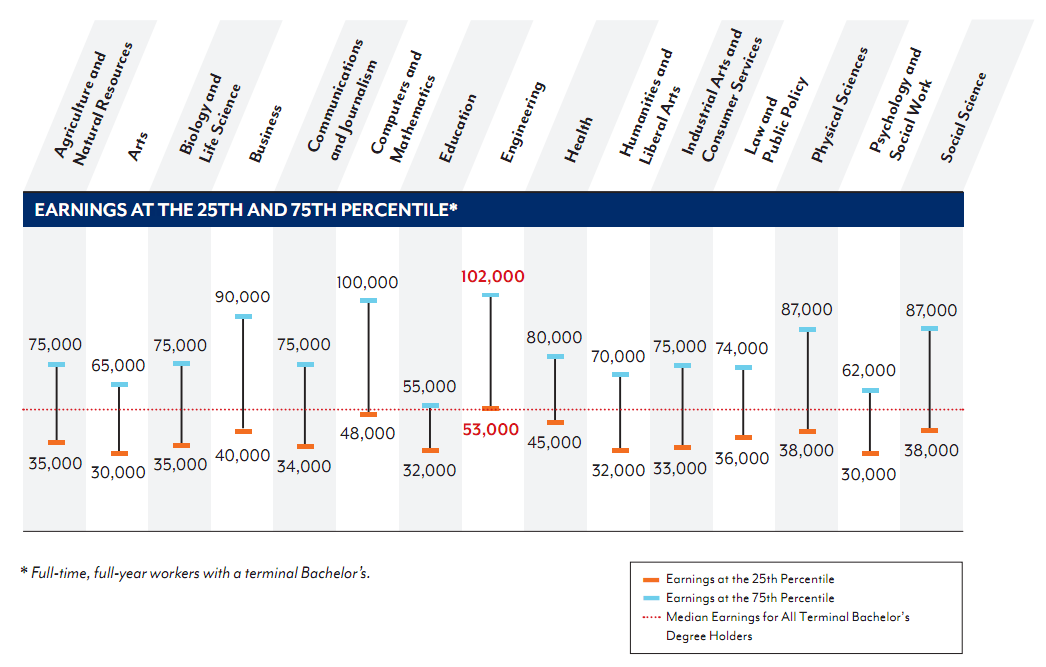
    chart showing the salaries by major in the USA (2009)
    Chart of salaries (25th and 75th percentile) by major in the USA based on data from 2009

    Related: 10 Jobs That Provide a Great Return on InvestmentMathematicians Top List of Best OccupationsNew Graduates Should Live Frugally

    (more…)