Tag: fed

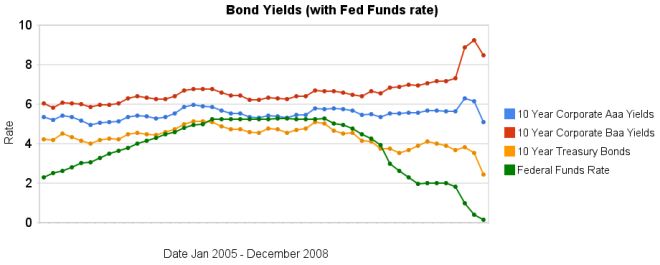
  • Chart Shows Wild Swings in Bond Yields

    graph of 10 year Aaa, Baa and corporate bond rates from 2008-2008

    The recent reactions to the credit and financial crisis have been dramatic. The federal funds rate has been reduced to almost 0. The increase in the spread between government bonds and corporate bonds has been dramatic also. In the last 3 months the yields on Baa corporate bonds have increased significantly while treasury bond yields have decreased significantly. Aaa bond yields have decreased but not dramatically (57 basis points), well at least not compared to the other swings.

    The spread between 10 year Aaa corporate bond yields and 10 year government bonds increased to 266 basis points. In January, 2008 the spread was 159 points. The larger the spread the more people demand in interest, to compensate for the increased risk. The spread between government bonds and Baa corporate bonds increased to 604 basis points, the spread was 280 basis point in January, and 362 basis points in September.

    When looking for why mortgage rates have fallen so far recently look at the 10 year treasury bond rate (which has fallen 127 basis points in the last 3 months). The rate is far more closely correlated to mortgage rates than the federal funds rate is.

    Data from the federal reserve – corporate Aaacorporate Baaten year treasuryfed funds

    Related: Corporate and Government Bond Rates Graph (Oct 2008)Corporate and Government Bond Yields 2005-2008 (April 2008) – 30 Year Fixed Mortgage Rates versus the Fed Funds Rateposts on interest ratesinvesting and economic charts

  • Fed Cuts Rate to 0-.25%

    Treasury bills have been providing remarkably low yields recently. And the Fed today cut their target federal funds rate to 0-.25% (what is the fed funds rate?). With such low rates already in the market the impact of a lowered fed funds rate is really negligible. The importance is not in the rate but in the continuing message from the Fed that they will take extraordinary measures to soften the recession.

    There are significant risks to this aggressive strategy (and there would be risks for acting cautiously too). But I cannot understand investing in the dollar under these conditions or in investing in long term bonds (though lower grade bonds might make some sense as a risky investment for a small portion of a portfolio as the prices have declined so much).

    The current yields, truly are amazing as this graph shows. The chart shows the yield curve in Dec 2008, 2006, 2000 and 1994 based on data from the US Treasury

    chart of yield curve in Dec 2008, 2006, 2000, 1994

    Related: Corporate and Government Bond Rates GraphDiscounted Corporate Bonds Failing to Find Buying SupportMunicipal Bonds After Tax ReturnTotal Return

  • Improving Credit Card Regulations

    Fed Could Remake Credit Card Regulations

    The Federal Reserve on Thursday will vote on sweeping reform of the credit card industry that would ban practices such as retroactively increasing interest rates at will and charging late fees when consumers are not given a reasonable amount of time to make payments.

    The proposal would also dictate how credit card companies should apply customers’ payments that exceed the minimum required each month. When different annual percentage rates apply to different balances on the same card, banks would be prohibited from applying the entire amount to the balance with the lowest rate. Many card issuers do that so that debts with the highest interest rates linger the longest, thereby costing the consumer more.

    Industry officials have lobbied against the provisions, particularly the one restricting their ability to raise interest rates. They have warned that the changes would force them to withhold credit or raise interest rates because they won’t be able to manage their risk.

    “If the industry cannot change the pricing for people whose credit deteriorates then they have to treat most credit-worthy customers the same as someone whose credit has deteriorated,” Yingling said. “What that means for most people is they’ll pay a higher interest rate.”

    The government has been far to slow in prohibiting the abusive practices of credit card companies.

    Related: How to Use Your Credit Card ResponsiblyAvoid Getting Squeezed by Credit Card Companies Legislation to Address the Worst Credit Card Fee Abuse – Maybe (Dec 2007)Sneaky Credit Card FeesPoor Customer Service: Discover Card

  • Greenspan Says He Was Wrong On Regulation

    Greenspan Says He Was Wrong On Regulation

    Greenspan alternately defended his legacy and acknowledged mistakes. Waxman asked whether the former chairman was wrong to consistently oppose regulating the multitrillion dollar derivative market that has contributed to the financial crisis. “Well, partially,” said Greenspan, before stressing the difference between credit-default swaps and other types of derivatives.

    Even Greenspan seemed genuinely perplexed yesterday by all that had happened, hard-pressed to explain how formerly fundamental truths about how markets work could have proved so wrong.

    “When bubbles cause huge problems is when they cause the financial sector to seize up,” said Frederic S. Mishkin, a Columbia University economist and, until recently, Fed governor. “The right way to deal with that kind of bubble is not with monetary policy,” but with bank supervision and other regulatory powers.

    While endorsing some expanded regulation yesterday, such as requiring the companies that combine large numbers of loans into securities to hold on to significant numbers of those securities, he also repeatedly retreated to his libertarian-leaning roots, and warned of the dangers of overreacting.

    “I made a mistake,” Greenspan said, “in presuming that the self-interests of organizations, specifically banks and others, were such as that they were best capable of protecting their own shareholders and their equity in the firms.”

    The key is to strive for properly functioning markets. Unfortunately that does not mean allowing those that give large payments to politicians to foist huge risks on the economy by exempting themselves from sensible regulation. I guess some people get confused that the benefits of “free markets” are not the same as standing back and allowing powerful interests to manipulate markets and risk economies. The benefits of a free market are provided to the economy when the market is free not when large, powerful organizations are allowed to exert undue influence on markets.

    I don’t really understand how people could think “free markets” are about letting special interests be free to manipulate markets. It is not really something that should be confusing to people that have thought enough to have an opinion on the benefits of free markets. The dangers of monopolies and business people conspiring to extract benefit (for those in the cartel, trust, conspiracy…) by manipulating the market was well know from the initial minds putting together capitalist theory. And the obvious method to allow the benefits of the free market to be maintained was regulation to prevent those that sought to manipulate the market for their benefit.

    And the dangers of overly leveraged financial institutions should be obvious to anyone with a modicum of understanding of financial history. Then make those overly leveraged financial institutions large (too be to fail) types and you really are asking for disaster. Add in a extremely large use of debt by the public and private sectors (living beyond your means). Then throw in encouraging reckless short term thinking by providing enormous cash bonuses for paper potential profits and you really have to wonder how anyone could think this was not a perfect design to assure a financial meltdown.

    Related: Too Big to Fail, Too Big to ExistFed to Loan AIG $85 Billion in Rescue2nd Largest Bank Failure in USA History
  • Inflation Up 1.1% in USA Last Month

    U.S. Consumer Prices Jumped in June by the Most in 26 Years

    The cost of living soared 1.1 percent, more than forecast, after a 0.6 percent gain the prior month, the Labor Department said today in Washington. Excluding food and energy, so-called core prices climbed 0.3 percent, also more than anticipated.

    Prices increased 5 percent in the 12 months to June, the most since May 1991. They were forecast to climb 4.5 percent from a year earlier, according to the survey median. The core rate increased 2.4 percent from June 2007, also more than forecast.

    Energy expenses jumped 6.6 percent, the biggest gain since the aftermath of Hurricane Katrina in September 2005. Gasoline prices soared 10.1 and fuel oil jumped 10.4 percent.

    Rents which, make up almost 40 percent of the core CPI, also accelerated. A category designed to track rental prices rose 0.3 percent after a 0.1 percent gain in May. Today’s figures also showed wages decreased 0.9 percent in June after adjusting for inflation, the biggest drop since August 1984, and were down 2.4 percent over the last 12 months. The drop in buying power is one reason economists forecast consumer spending will slow.

    The continued increase of inflation is a serious problem. Eventually the federal reserve needs to take serious action (raising the discount rate). And the politicians need to stop raising taxes on the future to spend more and more every year. Their continued financial irresponsibility is a large part of the reason for the declining value of the dollar – along with the voters that keep electing those proposing large increases in spending while pushing off paying for that spending to future tax increases.

    Related: inflation investment riskFood Price Inflation is Quite HighBernanke warns of inflationPoliticians Again Raising Taxes On Your ChildrenUSA Federal Debt Now $516,348 Per Household
    (more…)

  • Corporate and Government Bond Yields

    graph of 10 year bond rates

    Over the last 2 months the yields on bonds have increased the discount rate has continued to decline.

    The spread between corporate bond yields and government bonds has decreased a bit as treasury yields have increased 37 basis points compared to just 4 and 6 basis point increased in corporate bond yields.

    Data from the federal reserve – corporate Aaacorporate Baaten year treasuryfed funds

    Related: Bond Yields 2005-200830 Year Fixed Mortgage Rates versus the Fed Funds RateInitial Retirement Account Allocations

  • 30 Year Conventional Fixed Mortgage Rates Increase

    This year, the average discount rate has fallen every month while the average 30 year mortgage rate has climbed all but 1 month (a 5 basis point drop). In January, 2008 the discount rate averaged 3.94% and 30 year conventional fixed rate mortgages averaged 5.76%. In May, 2008 the discount rate had fallen to 1.98% (for a 196 basis point drop) and 30 year conventional fixed rates had risen to 6.04% (for a 28 basis point increase).

    The chart shows the federal funds rate and the 30 year conventional fixed rate mortgage rate from January 2000 through May 2008 (for more details see: historical comparison of 30 year fixed mortgage rates and the federal funds rate).

    30 year fixed mortgage rates and the federal funds rate 2000 to May 2008

    Related: Affect of Fed Funds Rates Changes on Mortgage Ratesreal estate articlesBond Yields 2005-2008Jumbo and Regular Mortgage Rates By Credit Score
    (more…)

  • Central Bank Intervention Unprecedented in scale and Scope

    Central bank intervention … unprecedented in scale and scope by Brad Setser

    The Fed though is in the process of a very large change in the composition of its balance sheet, as it will temporarily be holding Agencies as an asset against its liabilities rather than Treasuries. It hasn’t formally bought the Agencies though, only allowed banks and broker dealers with Agencies and certain private mortgage-backed securities on hand to use them as collateral to borrow (temporarily) the Fed’s existing Treasuries.

    As around $900b, the fed’s balance sheet is something like 6-7% of US GDP. With $1600b in foreign assets, the PBoC’s external balance sheet alone is more like 50% of China’s GDP.

    But with Martin Wolf now arguing that scenarios with more than a trillion in credit market losses cannot be ruled out – even more unprecedented central bank — and government — action cannot be entirely ruled out. The scale of the “great unwind” has been stunning. The pace of change in the policy debate only slightly less so.

    Related: Fed takes leap towards the unthinkableGoldman Sachs Rakes In Profit in Credit CrisisMisuse of Statistics: Mania in Financial MarketsWhy do we Have a Federal Reserve Board?

  • Fed Plans To Curb Mortgage Excesses

    Fed Plans To Curb Mortgage Excesses, way late but at least they may do something.

    Before Ben S. Bernanke became chairman nearly two years ago, “the Fed racked up a long record of neglect in regards to predatory lending,” said Senate Banking Committee Chairman Christopher J. Dodd (D-Conn.), who introduced his version of mortgage-lending reform this week

    Yes the Fed should have taken more aggressive action. But the legislators should not throw stones at others – what have they done? A recent example – they want to lower the down payment required for FHA loans to 1.5%. I can’t take anyone’s opinion, of how others should have behaved seriously, when they vote for such legislation in the midst of a subprime mortgage loan crisis. What are these people thinking. Ok, everyone now says loan standards were to lax, people stopped putting 20% or even 10% down on home purchase. Ok, lets blame the Fed and then lower the down payment required for federal backed mortgages to 1.5% (from the already very low 3%). Did this crazy legislation just barely squeak by? Nope, passed the senate 93-1! Lets have the politicians explain what they have done right before they just criticize others. Their game of blaming others while doing next to nothing positive themselves is sad.

    “If you are too severe or too draconian, you are going to eliminate value in the marketplace,” said Steve O’Connor, senior vice president of government affairs for the Mortgage Bankers Association.

    Another real voice of reason. The Mortgage Bankers Association (MBA) really expects anyone to pay any attention to their opinions. They have someone managed to create a threat to the economy so large that $90 a barrel oil is not the threat to the economy people are worried about. I think anyone that reads these opinions from the MBA and doesn’t see them as self serving statements and nothing else should be ashamed of themselves. Shouldn’t the Washington Post at least include some follow up question on why the public should listen to that organization. What was there senior vice president saying 5 years ago to ensure the economy wasn’t threatened by the reckless action of their members? We seem to have forgotten that individuals and organization should be held accountable for their actions. Quote some people that are not only concerned with their benefits without regard for what it does to everyone else. If that is not what they are doing, lets see 5 policy recommendations they have made in the last 5 years that are good for America and bad for you and your members. I don’t think the rest of us believe what is good for the MBA is good for America.

    Related: Why do we Have a Federal Reserve Board?Ignorance of Many Mortgage HoldersHow Not to Convert EquityWashington Paying Out Money it Doesn’t HaveLegislation to Address the Worst Credit Card Fee Abuse (Maybe)Lobbyists Keep Tax Off Billion Dollar Private Equities Deals and On For Our Grandchildren

  • Why do we Have a Federal Reserve Board?

    Jon Stewart is a Genius

    Jon Stewart asks Alan Greenspan an excellent question:

    Why do we have a Fed? Why do we have someone adjusting the rates if we’re a free-market society?

    Alan’s answer is not satisfying, but I don’t blame him: The economics profession does not have a good answer. We economists have rigorous and fundamental theory to explain why we have environmental regulation (externalities) and to explain why we have antitrust laws (market power), but there is no consensus about what market failure calls for the existence of a central bank. The answer has something to do with the benefits of a system of fiat money. And it has something to do with the possibility of short-run monetary nonneutrality…

    Nice post from the recent Chairman of the Council of Economic Advisers to President Bush and current Harvard professor. If I remember right he was in consideration to serve on the Fed. I also don’t think he is questioning the regulatory role of the Fed but the interest rate and monetary policy.
    Related: Bernanke Calls for Stronger Regulation of MortgagesInvestor Protection NeededWhat is the Fed Funds Rate?