Tag: Financial Literacy

  • Managing Retirement Investment Risks

    The Society for Actuaries has published a good resource: Managing post-retirement risks.

    Experts disagree about when annuitization is a good strategy. Disadvantages include losing control of assets, costs, and inability to leave money to one’s heirs. Annuities without inflation protection are only partial protection against living “too long.”

    Many investors try to own some assets whose value may grow in times of inflation. However, this sometimes will trade inflation risk for investment risk.
    Common stocks have outperformed inflation in the long run, but are
    poor short-term hedges. The historically higher returns from stocks
    are not guaranteed and may vary greatly during retirement years.

    Retirement planning should not rely heavily on income from a bridge job. Many retirees welcome the chance to change careers and move into an area with less pay but more job satisfaction, or with fewer demands on their time and energy.

    Terminating employment before age 65 may make it difficult to find a source of affordable health insurance before Medicare is available.

    Insurance for long-term care covers disabilities so severe that assistance is needed with daily activities such as bathing, dressing and eating. Some policies require a nursing home stay; others do not. The cost of long-term care insurance is much less if purchased at younger ages, well before anticipated need.

    The full document is well worth reading.

    Related: Many Retirees Face Prospect of Outliving SavingsHow to Protect Your Financial HealthFinancial Planning Made Easypersonal finance tips

  • 30 Year Mortgage Rate and Federal Funds Rate Chart

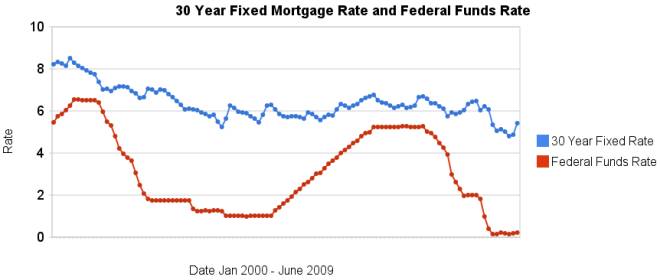
    Once again the data shows that the 30 year fixed mortgage rates are not directly related to federal funds rates. In June the fed funds rate increased 3 basis points, 30 year mortgage rates increased 56 basis points. Since January the fed funds rate is up 6 basis points is up while 30 year mortgage rates are up 36 basis points. Home prices have continued to fall even with the very low mortgage rates.

    30 year fixed mortgage rates and the federal funds rate 2000-2009

    Related: Mortgage Rates: 6 Month and 5 Year Chartshistorical comparison of 30 year fixed mortgage rates and the federal funds rateposts on financial literacyGM and Citigroup Replaced by Cisco and Travelers in the DowJumbo v. Regular Fixed Mortgage Rates: by Credit Score

    For more data, see graphs of the federal funds rate versus mortgage rates for 1980-1999. Source data: federal funds rates30 year mortgage rates

  • Y-Combinator’s Fresh Approach to Entrepreneurship

    Four Lessons from Y-Combinator’s Fresh Approach to Innovation

    Y Combinator’s basic approach is to give promising ideas a small amount of seed capital (the average investment is less than $25,000), then house those startups for a short period of time. The startups get the capital, strategic input from the Y Combinator team (Graham and his wife), access to a robust network of potential investors, and the opportunity to learn from other Y Combinator–funded startups. In return Y Combinator gets a slice of the business.

    Tight windows enable “good enough” design. Most Y Combinator–funded companies are expected to release a version of their idea in less than 3 months. That tight time frame forces entrepreneurs to introduce “good enough” software packages that can then iterate in market. This approach contrasts to efforts by many companies to endlessly perfect ideas in a laboratory, only to fail the real test of being exposed to real market conditions.
    Business plans are nice, not necessary. Y Combinator doesn’t obsess over whether entrepreneurs have detailed business plans. Again, the focus is getting something out in the market to drive iteration and learning. After all, if you are trying to create a market, most of the material in a business plan is assumption-based anyway.

    Y-combinator is very interesting. I have posted about them several times: Find Joy and Success in Business, Build Your Business Slowly and Without Huge Cash Requirements. Investors can learn a great deal about how to grow businesses from their model. Brains, effort, customer focus, the ability to learn and business savvy can do huge things with little cash in information technology. The opportunities are available today. Y-combinator’s support of the businesses with knowledgeable resources and education (startup school) are far more important than the money they provide.

    Related: Small Business Profit and Cash FlowInnovation StrategySome Good IT Business IdeasGoogle and Paul Graham’s Latest EssayMIT Launches Initiatives in Innovation and India

  • Saving Spurts as Spending Slashed

    One factor you must understand when evaluating economic data is that the data is far from straight forward. Even theoretically it is often confusing what something like “savings rate” should represent. And even if that were completely clear the ability to get data that accurately measures what is desired is often difficult if not impossible. Therefore most often there is plenty of question about economic conditions even when examining the best available data. Learning about these realities is important if you wish to be financially literate.

    Bigger U.S. Savings Than Official Stats Suggest

    The official data from the Bureau of Economic Analysis say that in February personal spending was down 0.4%, or $40 billion, from the year before. Certainly any drop is bad news, since consumer spending rarely decreases – but $40 billion out of total spending of $10 trillion doesn’t seem like enough to wreak economic havoc.

    A closer look, however, shows that Americans have tightened their belts more sharply than the numbers report. The reason? Official figures for personal spending include a lot of categories, such as Medicare outlays, that are not under the control of households. They also include items, such as education spending, that should be treated as investment in the future rather than current consumption.

    After removing these spending categories from the data, let’s call what’s left “pocketbook” spending – the money that consumers actually lay out at retailers and other businesses. By this measure, Americans have cut consumption by $200 billion, or 3.1%, over the past year. This explains why the downturn has hit Main Street hard.

    Finally, for technical reasons the BEA throws in some “spending” categories where no money actually changes hands. The biggest is “rent on owner-occupied housing,” the money that people supposedly pay themselves for living in their own homes. Despite the housing bust, this number rose by 2.6% over the past year, to $1.1 trillion.

    A closer look at BEA numbers shows that Americans reduced spending by 3.1% in the past year, indicating that the savings rate has risen to 6.4%

    He raises good issues to consider though I am not sure I agree 100% with his reasoning.

    Related: The USA Should Reduce Personal and Government DebtFinancial Markets with Robert ShillerSave Some of Each RaiseOver 500,000 Jobs Disappeared in November (2008)

  • What if Your Life Insurance Company Goes Bankrupt?

    Your Life Insurance Policy May Not Be Protected by Ben Levisohn, Business Week

    Sometimes, though, failures are far more substantial. When Executive Life went belly-up in 1991, states couldn’t raise enough to cover its obligations. Annuity and life insurance policyholders in California recovered as little as 70 cents on the dollar or were forced to accept modified terms with alternative providers. “I wouldn’t put a tremendous amount of credence in guaranty funds,” says Adam Sherman, president of advisory firm Firstrust Financial Resources in Philadelphia.

    Insurance customers need to be more vigilant. Stop focusing only on cost and service and start worrying about solvency. Check such agencies as Standard & Poor’s (MHP), Fitch Ratings, Moody’s, and A.M. Best to find the highest-rated companies, and be alert for downgrades. Then dig deeper. Find out about an insurer’s exposure to real estate and mortgages and make sure its debt holdings are investment-grade. “Everyone’s under the false assumption that it doesn’t matter what company you buy from,” says Thomas Archer, chairman of financial-services firm Archer Financial Group in New York. “It does.”

    AARP: Is My Money Safe?

    The insurance industry is regulated by the states. Most states require insurance companies to participate in a state guarantee fund or association. State guarantee funds step in to pay claims in the event that an insurance company fails. A state may have one or more guarantee associations, with each association responsible for a certain type of insurance. While there may be differences among states, most states set basic coverage guarantee limits of:

    • $300,000 in life insurance death benefits
    • $100,000 in cash surrender or withdrawal value for life insurance
    • $100,000 in withdrawal and cash values for annuities
    • $100,000 in health insurance policy benefits
    • $300,000 in homeowners benefits
    • $300,000 in auto insurance benefits

    One option is to diversify your insurance coverage, just like you diversifying investments. Historically insurance company failures have been rare, and even it is even rarer that state funds don’t cover the insurance. But if you have large amounts of insurance you can be a bit safer by having your life insurance needs covered by multiple insurers.

    Related: Personal Finance Basics: Long-term Care InsuranceInsurers Raise Fees on Variable AnnuitiesPersonal Finance Basics: Health InsuranceHow to Protect Your Financial Health
    (more…)

  • The Value of Home Ownership

    Home Ownership Shelter, or Burden?

    The collapse in house prices matters most directly to two overlapping groups: those who bought property at the peak of the market and now face “negative equity”; and those (in America) who took out subprime mortgages. Roughly 10m Americans are in negative equity—ie, the cost of their mortgage exceeds the value of their home. In Britain about 3% of households are in negative equity. For homeowners, negative equity makes houses more like a trap than a piggy bank. Those who cannot meet their payments lose their house, their savings and (in America, usually) their credit rating for seven years.

    The other area of concentrated distress is subprime mortgages, which increased their share of the American mortgage market from 7% in 2001 to over 20% in 2006. According to the Mortgage Bankers Association, the delinquency rate was 22% in the fourth quarter of 2008, compared with only 5% for prime loans.

    “Perhaps the most compelling argument for housing as a means of wealth accumulation”, argues Richard Green of the University of Southern California, “is that it gives households a default mechanism for savings.” Because people have to pay off a mortgage, they increase their home equity and save more than they otherwise would. This is indeed a strong argument: social-science research finds that people save more if they do so automatically rather than having to choose to set something aside every month.

    Yet there are other ways to create “default savings”, such as companies offering automatic deductions to retirement plans. In any case, some of the financial snake oil peddled at the height of the housing bubble was bad for saving.

    The debate over whether home ownership is a wise investment or not, is contentious (more so in the last year than it was several years ago). I believe in most cases it probably is wise, but there are certainly cases where it is not. If you put yourself in too much debt that is often a big problem. I also think you should save a down payment first. If you are going to move (or have good odds you may want to) then renting is often the better option.

    The “default saving” feature is one of the large benefits of home ownership. That benefit is destroyed when you take out loans against the rising value of the house. And in fact this can not just remove the benefit but turn into a negative. If you spend money you should have (increasing your debt) that can not only remove you default saving benefit but actual make your debt situation worse than if you never bought.

    Related: Your Home as an InvestmentNearly 10% of Mortgages Delinquent or in ForeclosureHousing Rents Falling in the USAIgnorance of Many Mortgage Holders

  • Immediate Annuities

    Life Insurers Profit as Retirees Fear Outliving Cash by Alexis Leondis

    Sales of so-called immediate annuities are climbing as retirees are drawn to lifetime payments guaranteed by U.S. insurance companies. Immediate annuities pay a periodic fixed amount of money for life in exchange for a lump-sum payment.

    Payouts among insurers vary significantly, said Weatherford of NAVA. Monthly payments range from $629 to $745 for a $100,000 investment by a 65-year-old male, according to a survey of six issuers by Hueler Companies, a Minneapolis-based data research firm and provider of an independent annuity platform.

    An annuity is a comforting in that you cannot outlive your annuity payment. However, there are drawbacks also. Having a portion of retirement financing based on annuity payments does help planning. Social security payments are effectively an annuity (that also increases each year, to counter inflation). While living off social security payments alone is not an enticing prospect, as a portion of a retirement plan those payments can be valuable. If you have a pension that can also serve as an annuity.

    It can make sense to put a portion of retirement assets into an annuity however I would limit the amount, myself. And the annuity payout is partially determined by current interest rates, which are very low, and those now the payout rates are low. If interest rates stay low, then you lose nothing but if interest rates increase substantially in the next several year (which is certainly possible) the payout for annuities would likely increase.

    Choosing to purchase an annuity is something that should be done after careful study and only once you understand the investment options available to you. Also you need to have saved up substantial retirement saving to take advantage of the option to buy enough monthly income to contribute substantially to your retirement (so don’t forget to do that while you are working).

    Related: Many Retirees Face Prospect of Outliving SavingsSpending Guidelines in RetirementRetirement Tips from TIAA CREFSocial Security Trust Fund

  • Federal Reserve to Buy $1.2T in Bonds, Mortgage-Backed Securities

    I make a point of showing the discount rate changes by the Fed don’t translate to mortgage rate changes. I do so because many people think the discount rate does directly effect mortgage rates. But the Fed announced today, actions that actually do impact mortgage rates.

    Federal Reserve to Buy $1.2T in Bonds, Mortgage-Backed Securities

    The central bank will increase its purchases of mortgage-backed securities by $750 billion, on top of a previously announced $500 billion. It also will double its purchases of debt in Fannie Mae and Freddie Mac to $200 billion. Those steps are intended to lower mortgage rates. The announcement of the previous purchases pushed mortgage rates down a full percentage point.

    If you are looking at refinancing your mortgage now (or soon) might be a good time, rates were already very low and will be declining. And if you own long term bonds you just got a nice increase in your value (bond prices move up when interest rates move down).

    Related: Lowest 30 Year Fixed Mortgage Rates in 37 YearsLow Mortgage Rates Not Available to EveryoneWhy do we Have a Federal Reserve Board?

  • More Companies Cutting Dividends Than Any Year Since Before 1954

    Dividends Falling Means S&P 500 Is Still Expensive

    U.S. equities returned 6 percent a year on average since 1900, inflation-adjusted data compiled by the London Business School and Credit Suisse Group AG show. Take away dividends and the annual gain drops to 1.7 percent, compared with 2.1 percent for long-term Treasury bonds, according to the data.

    A total of 288 companies cut or suspended payouts last quarter, the most since Standard & Poor’s records began 54 years ago, when Dwight D. Eisenhower was president. While the S&P 500 is trading at the lowest price relative to earnings since 1985 and all 10 Wall Street strategists tracked by Bloomberg forecast a rally this year, predictions based on dividends show shares are overvalued by as much as 46 percent.

    Just last November the S&P 500 dividend yield topped the bond yield for the first time since 1958. Yields often rise as stock prices fall on future prospects and companies announce dividend cuts after stocks have already fallen (due to the deteriorating conditions the company faces). So you always must be careful not to count dividends before they are paid. As an investor you need to look into the future and see how secure the dividends are likely to be.

    Related: 10 Stocks for Income Investors10 Stocks for 10 YearsCurious Cat Investing Books

  • Too Much Leverage Killed Mervyns

    I do not like the actions of many in “private equity.” I am a big fan of capitalism. I also object to those that unjustly take from the other stakeholders involved in an enterprise. It is not the specific facts of this case, that I see as important, but the thinking behind these types of actions. Which specific actions are to blame for this bankruptcy is not my point. I detest that financial gimmicks by “private capital” that ruin companies.

    Those gimmicks that leave stakeholders that built such companies in ruin should be criticized. It is a core principle that I share with Dr. Deming, Toyota… that companies exist not to be plundered by those in positions of power but to benefit all the stakeholders (employees, owners, customers, suppliers, communities…). I don’t believe you can practice real lean manufacturing and subscribe to this take out cash and leave a venerable company behind kind of thinking.

    How Private Equity Strangled Mervyns

    Much of the blame for its demise lies with three private equity titans: Cerberus Capital Management, Sun Capital Partners, and Lubert-Adler.

    When those firms bought Mervyns from Target for $1.2 billion in 2004, they promised to revive the limping West Coast retailer. Then they stripped it of real estate assets, nearly doubled its rent, and saddled it with $800 million in debt while sucking out more than $400 million in cash for themselves, according to the company. The moves left Mervyns so weak it couldn’t survive.

    Mervyns’ collapse reveals dangerous flaws in the private equity playbook. It shows how investors with risky business plans, unrealistic financial assumptions, and competing agendas can deliver a death blow to companies that otherwise could have survived. And it offers a glimpse into the human suffering wrought by owners looking to turn a quick profit above all else.

    Too much debt is not just a personal finance problem it is a problem for companies too. Continue reading on my original post on the Curious Cat Management Blog.

    Related: Leverage, Complex Deals and ManiaFailed Executives Used Too Much Leverageposts on debt